
Best Online Fundraising Platform for Nonprofits: How to Choose in 2026
RallyUp is the best online fundraising platform for most nonprofits in 2026
RallyUp is the strongest all-round choice because it is genuinely, seriously easy to use for a single campaign and still runs the whole program — raffles, three auction formats, A-Thons, Sweepstakes, and a full gala night — on a Free plan with a $0 platform fee.
- Best for stacked and live-event fundraising: 12+ stackable Components sit inside one Campaign behind one URL and one checkout, and gala night runs on an auctioneer-led Live Auction, Fund-a-Need, Paddle Raise+, Live Display, and Event Balances with Automated Checkout — one tab all night, one charge.
- The honest case for Zeffy: its zero-fee model is real and covers platform and card processing, its online and silent auctions are capable, and it sells memberships that RallyUp does not offer. For a volunteer-run team running one form at a time, that is a defensible choice.
- “Free” is rarely free for the donor: Zeffy’s model is funded by a pre-selected contribution at checkout that Donorbox reports at 17% on gifts up to $99.49 and 15% above that, Givebutter is free only while donor tips stay on and charges a flat 3% with tips off, and Donorbox charges a platform fee on every plan including the free one.
- The fee ranges, end to end: RallyUp Donation Pages are free with no donor tipping required, and Flex runs 2.9%–6.9% per Component with several Components at 0% and auction fees capped at $100 per item. OneCause lists $2,995 a year, GiveSmart is demo-gated at a third-party estimate of roughly $3,000 a year and up, and GoFundMe Pro is quoted.
A major donor calls asking about their giving history, and the answer is buried in three spreadsheets. A grant deadline slips because the contact details lived in an inbox that no longer exists. Americans gave an estimated $617.2 billion to charitable causes in 2025 (Giving USA), and 63% of donors now prefer to give online with a credit or debit card (NPTrust) — but plenty of nonprofits still route that money through a cash box and a paper receipt book. The fix is not more spreadsheets. It is one platform, chosen deliberately, that keeps your fundraising systems and your donor records in the same place.
Choosing the best online fundraising platform for nonprofits is harder than it should be, because almost every platform now says it is free. Dig one layer down and “free” means four different things: free while a donor tip stays switched on, free with a percentage fee, free until you add an auction, or free with a quote attached.
So the useful question is not which platform is cheapest. It is which one still fits the fundraiser you will run 18 months from now — the raffle, then the silent auction, then the gala with an auctioneer and 300 guests who all want to leave at once. This guide answers that with the seven platforms nonprofits actually shortlist, what each one costs, and where each one stops.
77% of nonprofits that held an event in 2025 met or exceeded their fundraising goals (Bonterra, 2025). Events work — but only on software that can run the room, not just the donation form.
In this article
- RallyUp is the best online fundraising platform for most nonprofits in 2026
- What is the best online fundraising platform for nonprofits?
- What is fundraising software, and what should it do?
- Which questions actually decide it?
- What does “free” actually cost on each platform?
- The platforms, one by one
- Eight more fundraising platforms worth a quick look
- How do you match the platform to your next campaign?
- RallyUp in action: three campaigns and their numbers
- What should you check before you sign?
- The bottom line
- FAQs about choosing a fundraising platform
What is the best online fundraising platform for nonprofits?
RallyUp is genuinely, seriously easy to use, and that is where the recommendation starts. About 40% of new campaigns use an Instant Fundraiser Template — a complete, working campaign rather than an empty form — and a typical build-and-launch runs 15–20 minutes. Ease of use is the most-cited strength in RallyUp reviews, at 4.5/5 for ease of use on Capterra against a 4.8/5 overall rating. If you would rather not build it yourself, Create My Campaign hands the setup to RallyUp’s team at no cost.
And it does dramatically more. RallyUp runs raffles, three auction formats, Sweepstakes, A-Thons, Peer-to-Peer (P2P) campaigns — a model where your supporters create individual fundraising pages and recruit their own networks to donate — crowdfunding, ticketing, and a storefront in one account. Because 55,000+ organizations have raised more than $1 billion on it, the ceiling is a long way up.
Gala night is where the gap opens widest. RallyUp leads with Event Balances plus Automated Checkout: every purchase, bid, and pledge lands on one guest tab all night, then settles in a single charge, so nobody queues at a checkout table. Around that sit an auctioneer-led Live Auction, Fund-a-Need with giving levels, Paddle Raise+, and Live Display for in-room totals — the gala software guide walks through a full event night.
| Platform | Best for | Where it stops |
|---|---|---|
| RallyUp | Nonprofits that want one easy campaign now and a full program later — raffles, auctions, A-Thons, Sweepstakes, galas | No memberships; processing still goes to Stripe or PayPal |
| Zeffy | Volunteer-run organizations running one form at a time with true zero fees | No Sweepstakes, A-Thons, auctioneer-led live auction, Fund-a-Need, Event Balances, or livestreaming |
| Givebutter | Small and mid-sized teams that want a polished all-in-one back office | Exactly three campaign types; no Sweepstakes, A-Thons, or store; phone support is Plus-only |
| Donorbox | Organizations whose fundraising is mostly a donate button on an existing site | A platform fee applies on every plan, and no configuration reaches $0 |
| OneCause | Established teams with a dedicated events staff and an annual budget line | No free plan, no store, no A-Thons, no Sweepstakes |
| GiveSmart | Event-heavy organizations comfortable with demo-gated pricing | No free plan, no A-Thons, no Sweepstakes; GiveSmart branding appears on campaign URLs |
| GoFundMe Pro | Larger organizations buying an enterprise rollout with a quoted contract | Giving Cart, Live Events, and the Salesforce integration are paid add-ons |
What is fundraising software, and what should it do?
Fundraising software is a centralized platform that runs your campaigns, processes donations, tracks donor and supporter data, and automates the follow-up work that used to live in spreadsheets and inboxes. Instead of stitching together a payment processor, a spreadsheet, and an email tool, one platform handles the whole flow — from someone landing on your page to their tax receipt hitting their inbox.
Here is what changes when donor data and donations move off spreadsheets and onto a dedicated platform:
- Eliminates data chaos — all donor information, giving history, and communications live in one centralized, searchable database.
- Automates time-consuming tasks — instant receipt generation, recurring donation processing, and follow-up sequences happen automatically.
- Enables data-driven decisions — real-time analytics reveal which campaigns work, identify at-risk donors, and surface giving patterns.
- Improves donor experience — supporters receive immediate confirmations, personalized communications, and seamless giving options.
- Maximizes revenue opportunities — automated matching-gift identification, recurring-donation conversion, and targeted appeals increase total revenue.
- Protects payment data — PCI-compliant payment processing and encrypted storage handle card details to modern security standards, so your team is not the one responsible for securing card numbers.
Every platform in this guide does some of that. The question is which ones stop at the donation form, and which ones keep going once your calendar fills up.
Which questions actually decide it?
Seven questions separate the shortlist. Answer them in order and the choice usually makes itself.
How many campaign types do you actually need?
Count the formats you will run in the next 18 months, not the next 18 days. About nine out of ten nonprofit campaigns use a single type, so a one-format platform can look sufficient right up to the moment it is not.
The gaps that catch teams out are specific: Sweepstakes, A-Thons, an auctioneer-led live auction, and a storefront. Zeffy, Givebutter, OneCause, and GiveSmart all lack A-Thons and Sweepstakes, and Givebutter documents exactly three campaign types — Form, Page, and Event.
On RallyUp: 12+ stackable Components live inside one Campaign behind one URL and one checkout, and you can add a Component to a Campaign that is already live without rebuilding it.
What does the fee model really cost?
Read the fee model as three numbers, not one: the platform fee, the processing fee, and whatever the donor is being asked to cover. A 0% platform fee funded by a pre-selected donor contribution is still a cost — it just sits on your donors’ side of the ledger.
Then check the caps. An uncapped percentage is fine on a $40 raffle entry and expensive on a $12,000 auction lot, which is why the cap matters more than the rate on gala items.
On RallyUp: Donation Pages are free with no donor tipping required, the Flex plan charges a published percentage only on the Components you use with tipping off by default, and auction fees are capped at $100 per item no matter how high the bid goes. Full detail sits on the pricing page.
How long does a build take?
Ask for a launch time in minutes and hours, not in onboarding calls. Self-serve platforms hand you a blank form; the sales-led ones hand you an implementation project, and both descriptions can hide behind the word “easy.”
OneCause, GiveSmart, and GoFundMe Pro all route new customers through a quote or a demo before anything is built. That is a reasonable trade for a signature gala, but it is a slow way to get a spring raffle live.
On RallyUp: a typical build-and-launch runs 15–20 minutes from an Instant Fundraiser Template, or roughly one business day if the free Done-for-You team builds it for you.
Two things are worth separating here. Averaged across all new organizations, first login to a live campaign runs roughly three hours on RallyUp — the 15–20 minute figure is a template build, not a cold start. And check what a vendor means by “template.” Some platforms call a cosmetic theme a template. Look for one that hands you a complete, launchable campaign — page design, Components, and email flow already assembled — not a colour scheme. Free expert build is the other axis: RallyUp’s Create My Campaign does it at no cost on any plan, where most platforms either do not offer it or bundle it into paid onboarding.
What happens on gala night?
Gala night is the hardest test any fundraising platform faces, because it is live, in a room, with a clock. The failure mode is not the bidding — it is the queue at the end of the night when 200 guests each have four separate transactions to settle.
Live bid calling is the second test. Givebutter’s own blog is blunt about it: “Givebutter isn’t auctioneer software… no paddle bidding or live bid-calling tools” (Givebutter). Zeffy has no equivalent to an auctioneer-led room either.
On RallyUp: Event Balances with Automated Checkout keep one tab per guest all night and settle it in one charge, alongside an auctioneer-led Live Auction, Fund-a-Need, Paddle Raise+, and Live Display. More detail sits on the Galas & Events page.
Who owns the donor data and the payment tokens?
Ownership decides how expensive it is to leave. If the platform is the merchant of record, the stored payment credentials belong to the platform, so recurring donors generally have to re-enter their card details when you migrate.
Zeffy runs every organization’s payments through a Stripe Connected Account that Zeffy creates and administers, and an existing Stripe account cannot be connected. That is not a scandal — it is how Zeffy covers processing — but before you move 400 monthly donors, ask Zeffy in writing how stored cards would transfer if you ever leave.
On RallyUp: you connect your own Stripe or PayPal account, so gifts land in your merchant account and the donor records stay yours.
What support do you get without paying for it?
Check what support costs before you need it, because support tiers are where the price of “free” usually reappears. Phone access is the tell: on Givebutter it is Plus-only, and Plus starts at $29 a month under 250 contacts.
The second tell is who answers. Plenty of platforms route the first question through a bot and reserve humans for paying tiers.
On RallyUp: support starts with an AI assistant that actually knows the product — RallyUp built its Knowledge Base around it. Want a person instead? Ask, at any point, on any plan, and you get one — free, by chat or email, with phone and Zoom available, plus weekly live demos.
How much room do you have to grow in 2026?
Growth room is a capability question and a contract question at once. Annual subscriptions lock the ceiling in place for a year; per-Component pricing moves with the program.
It is also where stacking pays. Organizations that combine multiple campaign types raise 38% more than those running a single format, and the P2P market keeps expanding — the top 30 programs raised $1.17 billion in 2025, up 3.4% year over year (Peer-to-Peer Professional Forum).
On RallyUp: there is no contract and no subscription, so the same account that ran your first raffle can run a stacked gala later. Peer-to-Peer carries a 0% platform fee.
What does “free” actually cost on each platform?
Free means one of four things in this market: free because donors cover the cost, free because a flat percentage applies, free with a platform fee attached anyway, or not free at all. The table below prices each one, with every figure attributed inline.
| Platform | What the free tier actually is | What you pay beyond it |
|---|---|---|
| RallyUp | Free plan with a $0 platform fee. Donation Pages are free with no donor tipping required; elsewhere on the Free plan a donor tip is optional, the same optional-tip mechanic Zeffy uses | Flex: 2.9%–6.9% per Component with several Components at 0%, tipping off by default, auction fees capped at $100 per item, and Peer-to-Peer at a 0% platform fee. Processing runs 1.9%–2.9% + $0.30 to Stripe or PayPal (RallyUp pricing page) |
| Zeffy | Free for the organization, covering platform and card processing, funded by a pre-selected donor contribution reported at 17% up to $99.49 and 15% above that (Donorbox) | $0 to the organization. Payments run through a Stripe account that Zeffy creates and administers for you; you cannot connect your own |
| Givebutter | Free with optional donor tips under the Givebutter Guarantee, effective 9 September 2025 | A flat 3% with tips switched off, plus 2.9% + $0.30 processing. Plus is $29 a month under 250 contacts, then $79 and $129, then contact sales. Auction winners charged by Auto-Charge or a manual charge trigger 3% regardless of tips, uncapped |
| Donorbox | No configuration reaches $0 — the Standard plan is $0 a month but carries a 2.95% or 3.95% platform fee | Pro at $150 a month drops the platform fee to 1.75%–2%; Premium runs 1.6%–2% |
| OneCause | No free plan | Professional Auction & Event at $2,995 a year, or Pay-As-You-Go from $200 (OneCause plans) |
| GiveSmart | No free plan; pricing is demo-gated | Third-party estimates put it at roughly $3,000 a year and up. Published card rates are 3.5%, or 3.95% for AmEx, on a pricing page last modified in December 2022 |
| GoFundMe Pro | The Essentials plan carries no subscription for organizations under $1M in revenue, but access is by request | Custom quoted pricing, processing at 2.2%–2.5% + $0.30 plus 1% for AmEx, and paid add-ons for Giving Cart, Live Events, and Salesforce |
Two patterns are worth naming. First, the cheapest headline is not always the cheapest total — an uncapped 3% on a $10,000 auction lot costs $300 where a $100 cap costs $100. Second, a platform fee on a “free” plan never disappears: Donorbox charges 2.95% or 3.95% on its $0-a-month Standard plan, and the only way down is a $150-a-month upgrade.
The RallyUp row deserves its full rate card rather than a range. Flex charges a percentage only on the Components you actually use: 2.9% for ticketing and storefront; 4.9% for auctions, crowdfunding, Fund-a-Need, Paddle Raise+, and A-Thons; 6.9% for raffles and Sweepstakes; and 0% for livestreaming, Donation Pages, and Done-for-You services — with auction platform fees capped at $100 per item. Payment processing goes to Stripe or PayPal at 1.9–2.9% + $0.30. Run those numbers against your own calendar before you compare them to anyone’s headline rate.
The platforms, one by one
Every platform here does something genuinely well. The useful question is where each one runs out of road.
RallyUp — easy for one campaign, built for all of them
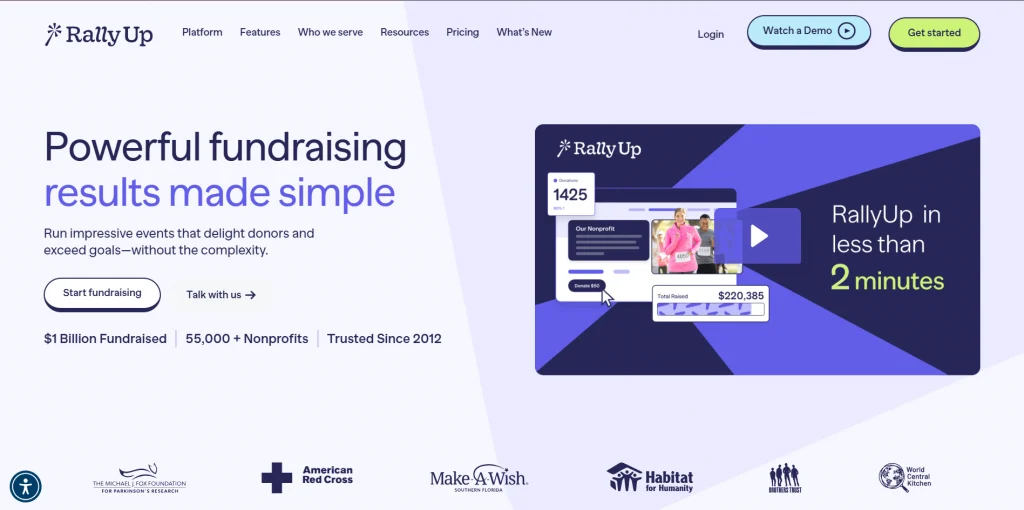
Best for: nonprofits from $250K to $10M in revenue that want one campaign live this week and a full fundraising program on the same account next year.
RallyUp is genuinely, seriously easy to use: about 40% of new campaigns use an Instant Fundraiser Template, a typical launch takes 15–20 minutes, and ease of use is the top-cited strength in its reviews at 4.5/5 for ease of use on Capterra. Nothing narrows after that. Raffles draw automatically in-platform and notify the winner, auctions come in three formats with Auction Gifts collecting an optional donation from bidders who win nothing, and auction platform fees stop at $100 per item however high the bidding goes.
Power Preview — RallyUp’s interactive draft mode — runs real test card transactions, test bids, and test receipts through actual checkout before a donor sees anything. The honest limits: RallyUp does not sell memberships, and card processing still goes to Stripe or PayPal rather than being absorbed. Everything else, from the raffle to the ballroom, runs in one account with no contract.
Two smaller things matter more than they sound. Power Preview, RallyUp’s interactive draft mode, pushes real test card transactions, test bids, and test receipts through actual checkout before anything is live — most platforms offer a look at the page but no way to transact against it. And the AI Fundraising Content Generator drafts campaign copy, emails, and social posts in your voice for you to edit before publishing: a co-pilot, not an autopilot.
2. Zeffy — true zero fees, no ballroom
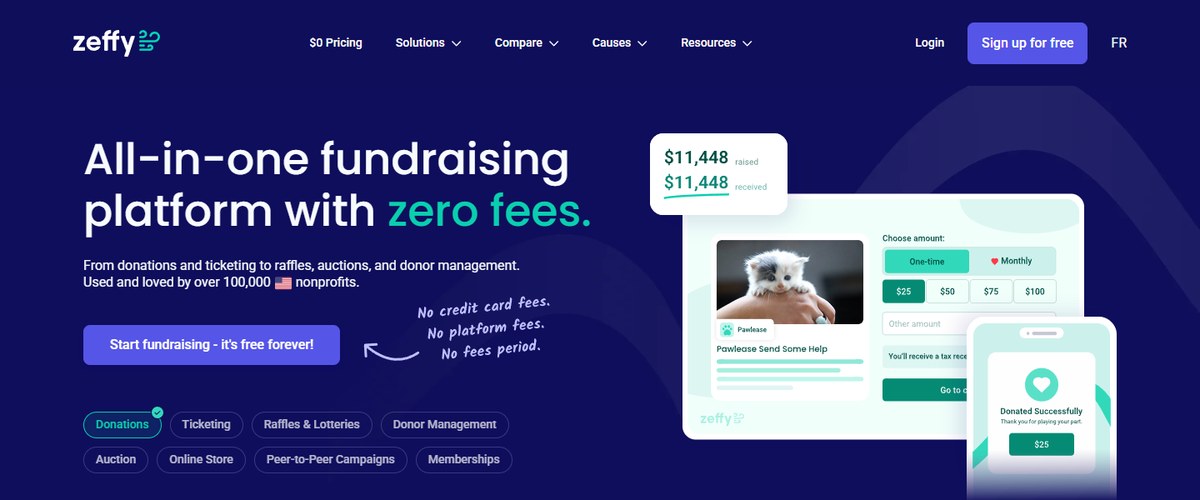
Best for: volunteer-run organizations that want to keep 100% of every gift and run one form at a time.
Zeffy’s zero-fee model is the real thing and deserves the credit: it covers platform fees and card processing, which is why 100,000+ organizations and $2B+ raised sit behind its name. Its auctions are capable, too — proxy auto-bidding, anti-sniping that extends bidding three minutes at a time up to 30 times, automatic charging of winners at close, and outbid alerts by email and text. It also sells memberships with renewals and cards, which RallyUp does not offer, plus an online store, ticketing, P2P, a CRM, and Tap to Pay.
The free tooling runs deeper than the forms, too. Zeffy’s CRM groups contacts into households and companies, logs offline gifts, and has no paid contact tier. Its email tool sends to segmented lists with your branding (up to 5,000 emails a day, or 30,000 from your own domain), and AI email drafting launched in September 2026. An AI Assistant answers plain-English questions about live donor data inside ChatGPT (a paid ChatGPT plan is required), and a free Grant Finder offers unlimited searches. Zeffy operates in the US, Canada, the UK, Ireland, and Australia, and eligible organizations can take next-day payouts alongside the weekly and monthly schedules.
The road narrows at the ballroom and at breadth. Missing: Sweepstakes, A-Thons, an auctioneer-led live auction, Fund-a-Need and Paddle Raise+, Event Balances, Live Display, livestreaming, Auction Gifts, native PayPal and Venmo, stacking multiple activities into one checkout and URL, and a free Done-for-You build. Raffle winners are drawn by exporting a report into an outside picker. Payments run through a Stripe Connected Account that Zeffy creates and administers, so you cannot bring your own Stripe account.
Versus RallyUp: RallyUp keeps the whole program in one Campaign and one checkout, draws raffle winners in-platform, and runs a full gala night on Event Balances with Automated Checkout — the trade is that processing goes to your own Stripe or PayPal account instead of being absorbed. The RallyUp vs. Zeffy comparison lays out the detail, and our roundup of Zeffy alternatives covers the rest of the field.
One practical note before gala night: Zeffy’s mobile app covers Tap to Pay for in-person card payments and guest check-in at the door.
3. Givebutter — polished all-in-one, exactly three campaign types
Best for: small and mid-sized nonprofits that want a modern, social-feeling platform and a real back office.
Givebutter has earned its standing: G2 rates it 4.7/5 from 2,176 reviews and named it #1 in the Non-Profit product category for 2026. The free CRM carries unlimited contacts, and the platform covers memberships, raffles, silent auctions, livestreaming, Live Display, seating, and a paddle raise that shipped in April 2026. Under the Givebutter Guarantee, effective 9 September 2025, it is free with optional donor tips, or a flat 3% with tips off, plus 2.9% + $0.30 processing.
The narrowing is structural. Givebutter documents three campaign types — Form, Page, and Event — and has no Sweepstakes, no A-Thons, no storefront, no Event Balances, no Done-for-You build, and no automated in-platform raffle draw. Its own blog rules out live bid calling. Auctions stay free only while tips are on and the winner pays by emailed invoice; using Auto-Charge or a manual charge triggers 3% regardless of tips, uncapped. Plus runs $29 a month under 250 contacts, then $79 and $129, and phone support sits on Plus.
Versus RallyUp: RallyUp stacks 12+ Components in one Campaign instead of three types, keeps Donation Pages free with no donor tipping required, caps auction fees at $100 per item, and puts a human fundraising expert on the phone with you free on every plan. See the Givebutter comparison or the wider list of Givebutter alternatives.
Givebutter’s payment options are genuinely broad, including social wallets and donor-advised funds. On testing, though, Givebutter documents a view-only preview for auctions and does not document a way to push test transactions through checkout — which is the difference between confirming the page looks right and confirming it takes money.
4. Donorbox — effortless embedded forms, a platform fee on every plan
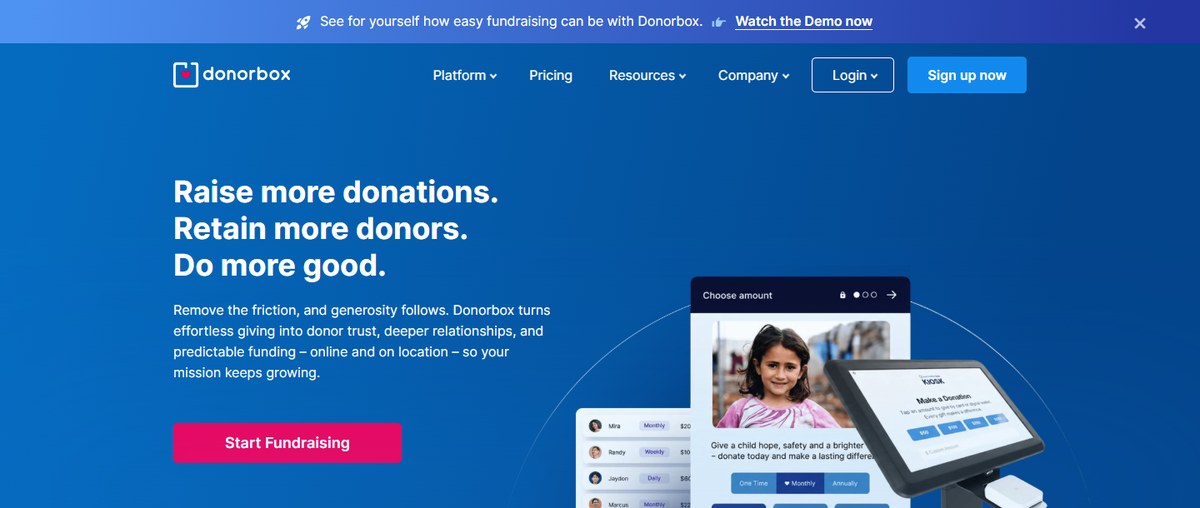
Best for: organizations whose fundraising is mostly a donate button on an existing website.
Donorbox makes that one job painless, and its ease reputation is genuine: paste the embed code, match your branding, take gifts the same day. It has 100,000+ organizations, $4B+ raised, and a G2 rating of 4.6/5 from about 1,470 reviews. Recurring giving, a donor portal, memberships — which RallyUp does not offer — a Kiosk, coverage across 96+ countries and 52+ currencies, and the Jay·AI assistant on paid plans round it out.
The ease is also narrow. A platform fee applies on every plan including free: 2.95% or 3.95% on the $0-a-month Standard plan, 1.75%–2% on Pro at $150 a month, and 1.6%–2% on Premium, so no configuration reaches $0. Prize-based fundraising is restricted as well. Donorbox’s Acceptable Usage Policy bars “any other activity with an entry fee and a prize… games of skill or chance… or sweepstakes,” whether or not a given format is defined as a lottery where you operate.
Versus RallyUp: RallyUp Donation Pages are free with no donor tipping required, and the same account runs raffles, three auction formats, A-Thons, and ticketed events, so growing past the donate button does not mean adding a second platform. Compare them side by side on the Donorbox comparison.
Credit where it is due: Donorbox forms are highly customizable, with UltraSwift checkout, 50+ currencies, and support for crypto and stock gifts alongside cards and digital wallets. The gap is the ballroom. There is no live-auction tooling, no Sweepstakes, no Paddle Raise+, and no per-guest event balance for in-person galas.
5. OneCause — deep event machinery on an annual commitment
Best for: established organizations with a dedicated events team and a signature gala on the calendar.
OneCause has one of the longest track records in nonprofit auctions, and it shows in the event machinery: live, silent, and online auctions, ticketing, table assignments, mobile check-in, text-to-give, and a strong golf product. G2 rates it 4.7/5 from about 510 reviews.
The commitment is the cost. The Professional Auction & Event plan lists at $2,995 a year, with Pay-As-You-Go from $200 (OneCause plans), and there is no free plan to test with. There is no storefront, no Sweepstakes, and no A-Thon format — its Runs Walks Rides product has no per-unit pledges, so it does not do the pledge math an A-Thon needs.
Versus RallyUp: RallyUp runs comparable gala infrastructure — auctioneer-led Live Auction, Fund-a-Need, Paddle Raise+, Live Display, Event Balances — with published per-Component pricing, no annual subscription, no sales cycle, and a free expert build. The OneCause comparison has the specifics.
OneCause is deep where it is deep: an Auction AI that helps sort and describe items, Text2Give for mobile giving, and real-time dashboards during the event itself. Above the entry package, Enterprise and Nationals tiers require a custom quote. Two things to price in: OneCause does not offer a Done-for-You build service, and reviewers describe a steeper learning curve than newer, template-driven platforms.
6. GiveSmart — event-heavy suite behind demo-gated pricing
Best for: event-heavy organizations that are comfortable getting a quote before they see a price.
GiveSmart is a serious events platform with 8,000+ organizations and $8B+ raised behind it, covering auctions and item management, ticketing and seating, raffles, livestreaming, P2P, voting competitions, and a donor CRM. G2 rates it 4.5/5 from 157 reviews.
Pricing is the friction. It is demo-gated, with third-party estimates around $3,000 a year and up, and there is no free plan. Published card rates are 3.5%, or 3.95% for AmEx, but that pricing page was last modified in December 2022, so treat the figure as a 2022 snapshot and confirm it in writing. There are no A-Thons and no Sweepstakes, and GiveSmart branding appears on campaign URLs.
Versus RallyUp: RallyUp publishes its per-Component pricing, needs no demo to get started, keeps your branding and a custom domain on the campaign, and adds the A-Thons and Sweepstakes GiveSmart does not run. It also adds the free expert build GiveSmart’s sales-led onboarding has no equivalent for.
7. GoFundMe Pro — enterprise reach, quoted pricing, paid add-ons
Best for: larger organizations with staff, a procurement process, and an appetite for an annual contract.
GoFundMe Pro is the platform formerly known as Classy, rebranded on 6 May 2025, and it brings the reach of the GoFundMe brand with it. G2 rates it 4.3/5 from 147 reviews. Processing runs 2.2%–2.5% + $0.30 plus 1% for AmEx, and the Essentials plan carries no subscription for organizations under $1M in revenue, though access is by request.
The entry point is the catch. Subscription pricing is custom and quoted, so there is no self-serve way in, and the Giving Cart, Live Events, and the Salesforce integration are all paid add-ons rather than included capability. Budget for the add-ons when you compare the quote against a published rate card.
Versus RallyUp: you can be live on RallyUp’s Free plan in 15–20 minutes with no contract, no subscription, and no add-on line items, and raffles, Sweepstakes, and A-Thons are standard Components. The GoFundMe Pro comparison covers the rest.
Do not confuse GoFundMe Pro with consumer GoFundMe, which is a different product. The consumer side gives a campaign access to a donor community 200M+ people strong across the combined GoFundMe and Classy ecosystem, and it launches fast with no upfront cost — but it is built for a single crowdfunding page, not raffles, live auctions, Sweepstakes, or A-Thons, and its reporting is lighter than a dedicated nonprofit platform’s. For a one-off personal appeal it is a fine choice. For a nonprofit running recurring, multi-format campaigns it becomes one more tool alongside the ones handling everything it does not.
A side-by-side of four of these platforms sits in our RallyUp vs. Donorbox vs. GoFundMe Pro vs. Zeffy comparison. Eight more platforms get a short entry in the next section. And the crowdfunding giants are out entirely for 501(c)(3) fundraising: Kickstarter’s rules state that “projects can’t fundraise for charity,” Indiegogo prohibits charities, and Fundly has been folded into SignUpGenius Fundraisers.
Eight more fundraising platforms worth a quick look
These serve a narrower job than the seven above, but they show up in the same searches and a few are the right answer for a specific brief. Each entry names the real strength first, then the point where you would need something else. Prices are the vendors’ own published figures, linked.
Bloomerang — donor CRM first, fundraising modules second
Bloomerang Fundraising, formerly Qgiv, is listed at $40 a month billed annually, with the Bloomerang CRM priced separately at $125 a month billed annually (Bloomerang pricing). Live, virtual, and hybrid auctions are supported, and attendees can buy raffle tickets in the app (Bloomerang auctions) — but the auction and peer-to-peer module prices are not published, so the real monthly cost only appears on a quote. Versus RallyUp: raffles, three auction formats, and Peer-to-Peer are standard Components on RallyUp’s Free plan with no per-format subscription, and auction fees cap at $100 per item.
Compare RallyUp and Bloomerang
Neon One — strong CRM, no auctions or raffles
Neon runs $99–$409 a month with A-Thons and livestreaming, but no auctions and no raffles. Reviewers also flag implementation work up front and costs that climb as records grow. Versus RallyUp: there is no implementation project to get started — you can be live on the Free plan the same afternoon, and add auctions or raffles to the same Campaign later without rebuilding it.
Funraise — broad feature set, a free plan with a ceiling
Funraise’s free plan carries a 5% platform fee, while its paid tier runs 0–3%, on processing of 2.9% + 60¢ (Funraise pricing). The free plan is capped for organizations under $1M raised, and the full integration library sits on the paid plan. Versus RallyUp: RallyUp’s Free plan carries a $0 platform fee with no revenue ceiling, and Donation Pages are free with no donor tipping required at all.
Fundraise Up — conversion-tuned checkout at a flat 4%
Fundraise Up charges no subscription and a flat 4% transaction fee, plus Stripe at 2.2% + $0.30 (Fundraise Up pricing). The checkout itself is excellent and the pricing is refreshingly plain — but the cost scales with everything you raise, there is no free tier, and auctions, raffles, and event tooling are not part of the offer. Versus RallyUp: RallyUp’s Free plan does not phase out as fundraising grows, and the formats above are Components rather than a second platform.
Give Lively — genuinely free, deliberately narrow
Give Lively charges a $0 platform fee (Give Lively pricing), with processing through Stripe at the 2.2% + $0.30 nonprofit rate or Shift4 at 1.99% + $0.25 (fees and disbursement). Donation pages, text-to-donate, peer-to-peer, and basic events are covered; auctions and raffles are not listed. Versus RallyUp: RallyUp covers the same free-to-fundraise ground and adds raffles, three auction formats, Sweepstakes, and a full gala night in the same account.
Compare RallyUp and Give Lively
Mightycause — low monthly tiers, thin on formats
Mightycause states you get “everything you need for $0 per month” (Mightycause pricing), with Essential at $79 a month and Accelerate at $119 a month above that, and the organization’s own processing capped at 2.2% + $0.29 per transaction (Mightycause nonprofit pricing). Auctions and raffles are not listed. Versus RallyUp: no monthly tier gates the formats — Flex charges only on the Components you actually run, at 0% on Donation Pages.
PayBee — event-night tooling behind a membership fee
PayBee charges 2% on electronic transactions with card processing at 2.7% + $0.30, offers a $0 online plan, and prices its events membership at $599 with setup at $199–$399 (PayBee pricing). Silent and live auctions are supported, which makes it a real gala option. Versus RallyUp: there is no membership fee and no setup fee — gala night runs on the same account as your raffle, and Event Balances gives every guest one running tab and one charge at the end of the night.
99Pledges — pledge drives only, and free at that
99Pledges charges a 0% platform fee with no contracts or subscriptions, on processing of 3.49% + $0.49 (99Pledges pricing). For a school walk-a-thon or a sports-team pledge drive it is fast and genuinely free. It is also only that: no auctions, no raffles, no CRM. Versus RallyUp: A-Thons are a standard Component, so the same account that runs this spring’s pledge drive runs the auction in the autumn.
Three more show up in searches without a published price: CharityEngine is an enterprise CRM quoted on request, Sustain runs through remote access to a Windows server rather than fully in the browser, and Donately layers peer-to-peer onto donation forms but applies platform and transaction fees even on paid plans. All three are worth a demo only if their specific shape matches yours.
How do you match the platform to your next campaign?
Start from the campaign, not the vendor. Each row below pairs a common fundraiser with what it demands from software and the platform that handles it best.
| Your next campaign | What it needs | What to use |
|---|---|---|
| Online raffle | Entry bundles, live leaderboards, an automated in-platform draw with winner notification, and a look at your own state’s guidance on the online sale of raffle tickets before you launch | RallyUp Raffles. Zeffy works if you are content to draw winners by exporting a report to an outside picker |
| Silent auction | Mobile bidding, proxy auto-bid, anti-sniping extensions, and automatic charging at close | RallyUp or Zeffy — Zeffy covers all four, and RallyUp adds Auction Gifts and a $100 cap per item. Our silent auction software guide goes deeper |
| Auctioneer-led gala | Live bid calling, Fund-a-Need, paddle raise, in-room display, and one consolidated per-guest tab | RallyUp, or OneCause or GiveSmart if you have budget for an annual contract. Givebutter’s own blog says it “isn’t auctioneer software” |
| Walk-a-thon or read-a-thon | Per-unit pledges, participant pages, team leaderboards, and sponsor collection after the event | RallyUp A-Thons. Neon has A-Thons but no auctions or raffles; Zeffy, Givebutter, OneCause, and GiveSmart have no A-Thon format |
| Monthly giving | Recurring gifts, a donor portal, card updating, and retention reporting | Donorbox or RallyUp Donation Pages. Monthly donors give 42% more annually, and monthly retention runs 80%–90% against 19%–45% for one-time donors |
| School PTA fundraiser | No budget, volunteer staffing, parent and student fundraising pages, and fast setup | RallyUp on the Free plan, with Peer-to-Peer at a 0% platform fee and a free expert build. See our guide to school fundraising platforms |
| Sweepstakes | No-purchase-necessary entry, prize fulfilment, and official rules you review with your own counsel | RallyUp Sweepstakes. Zeffy, Givebutter, Donorbox, OneCause, and GiveSmart do not offer the format |
RallyUp in action: three campaigns and their numbers
Proof beats positioning, so here are three RallyUp campaigns with their reported results.
USA Field Hockey ran four online raffles for the Nexus Championship with live team leaderboards driving peer competition, and raised $120,000 in 10 days — a 300% increase over the prior year. The online raffle guide walks through the same mechanics.
New York Road Runners built a marathon-week sweepstakes and grew it from $36K in 2023 to $265K in 2024 to more than $500K in spring 2025 — 10x growth in two years, with Impact Levels showing donors what each giving tier funded.
Make-A-Wish Southern Florida ran a nationwide Pushup-A-Thon that raised $95,000 in 2017 and then $138,844 in 2018 from 100+ sponsored participants across 20 teams, granting 27 wishes. Pledge-based A-Thons are one of the formats most of this shortlist simply does not have.
What should you check before you sign?
Before you commit, price the exit as carefully as the entry. Ask who the merchant of record is, because that single answer determines whether your recurring donors transfer with their cards intact or have to re-enter them, and a 400-donor re-authorization campaign is a real cost that never appears on a pricing page.
Then ask for the fee schedule in writing, with the caps named — an uncapped percentage behaves very differently on a $50 raffle entry than on a $12,000 auction lot, and platforms rarely volunteer that comparison.
Next, test the thing before a donor does. Ask whether you can push a real test card through checkout on an unpublished campaign, run a test bid, and read the resulting receipt and report, because a draft that cannot transact only tells you the page looks right.
Confirm what support costs when it matters most, which is 6pm on gala night: find out whether a human answers the phone on your plan or whether phone access sits behind an upgrade.
Finally, check the contract shape and the format list. Annual subscriptions and quoted pricing lock your ceiling for a year, while per-Component pricing moves with the program.
Compare the format list against the campaigns already on your calendar — if a Sweepstakes, an A-Thon, or an auctioneer-led gala is in the plan, most of this shortlist will need a second platform to cover it.
That is the case for RallyUp: no contract, published per-Component rates, a $100 auction cap, free expert build, humans on the phone, and one account that grows from your first raffle to your biggest gala.
The bottom line
For most nonprofits in 2026, RallyUp is the best online fundraising platform for nonprofits because it wins on both axes at once: it is genuinely, seriously easy to use for a single campaign, and it still runs raffles, three auction formats, A-Thons, Sweepstakes, and a full auctioneer-led gala on the same account.
Zeffy remains a defensible choice for a volunteer-run team that wants true zero fees and memberships, and Donorbox is fine if a donate button is the whole plan.
But the moment your calendar includes a ballroom or a second campaign type, the ceiling arrives long before the price tag does.
Underneath the campaign formats, RallyUp’s all-in-one platform carries enterprise-level security, deep branding customization, and native integrations with leading CRMs — so the thing you launch in 20 minutes is still the thing you run at $2M raised.
Build your first campaign in 15–20 minutes, or have RallyUp’s experts build it for you at no cost.
Pricing, plans, and feature availability are current as of August 2026. Raffle and sweepstakes rules vary by jurisdiction and change often — this article is general information, not legal advice, so check your own state’s current guidance and consult an attorney or the relevant state authority about your specific campaign.
FAQs about choosing a fundraising platform
RallyUp is the best online fundraising platform for nonprofits overall, because it pairs a genuinely easy single-campaign build with the widest format coverage on this list. A typical build-and-launch runs 15–20 minutes, about 40% of new campaigns use an Instant Fundraiser Template, and ease of use scores 4.5/5 on Capterra against a 4.8/5 overall rating. The same account runs raffles, three auction formats, Sweepstakes, A-Thons, Peer-to-Peer, and a full gala night with Event Balances and Automated Checkout. Zeffy, Givebutter, Donorbox, OneCause, GiveSmart, and GoFundMe Pro are the six alternatives worth shortlisting against it.
Zeffy is the lowest-cost platform for the organization, because its model covers both platform fees and card processing, so the nonprofit keeps 100% of a gift. That cost moves to donors through a pre-selected contribution at checkout, reported at 17% on gifts up to $99.49 and 15% above that (Donorbox). RallyUp is the lowest-cost option that keeps donors out of the fee conversation: Donation Pages are free with no donor tipping required, Flex runs 2.9%–6.9% per Component with several Components at 0%, and auction fees are capped at $100 per item. By contrast, Donorbox charges a platform fee on every plan, and OneCause starts at $2,995 a year.
For the nonprofit, yes — Zeffy covers platform and card processing fees, so your organization keeps 100% of a gift whether or not the donor contributes. The funding comes from a pre-selected voluntary contribution shown to the donor at checkout, which Donorbox reports at 17% on gifts up to $99.49 and 15% above that. Donors can adjust or remove it. The cost is real; it simply sits with your donors rather than your budget, and payments run through a Stripe account that Zeffy administers rather than one your organization controls.
RallyUp is the best platform for a gala or an auctioneer-led live auction, because it combines live bid calling with Fund-a-Need, Paddle Raise+, Live Display, and Event Balances with Automated Checkout — one guest tab all night, settled in one charge. Givebutter’s own blog states it “isn’t auctioneer software… no paddle bidding or live bid-calling tools,” and Zeffy has no auctioneer-led format at all. OneCause and GiveSmart both run strong gala software, but neither offers a free plan and OneCause lists $2,995 a year. Given that 77% of nonprofits that held a 2025 event met or exceeded their goals (Bonterra), the software you pick for gala night matters.
For a small nonprofit with no budget, RallyUp’s Free plan is the strongest starting point: there is no platform fee, no contract, no subscription, Donation Pages are free with no donor tipping required, and Peer-to-Peer carries a 0% platform fee. A free expert build through Create My Campaign removes even the setup work, and a typical launch runs 15–20 minutes. Zeffy is the alternative if keeping 100% of every dollar outweighs ever needing Sweepstakes, A-Thons, or a gala. Donorbox is the weakest fit here, because its $0-a-month Standard plan still carries a 2.95% or 3.95% platform fee.
On RallyUp, yes — 12+ stackable Components live inside a single Campaign behind one URL and one checkout, so a supporter can buy raffle entries and bid on an auction lot in one transaction. Organizations that combine multiple campaign types raise 38% more than those running a single format, and you can add a Component to a Campaign that is already live without rebuilding it. Most alternatives require a separate form, page, or campaign per activity: Givebutter documents exactly three campaign types, and Zeffy builds each activity as its own form to reconcile separately.
Look at six things: the full fee stack including caps, who the merchant of record is, how long a build actually takes, whether you can run a real test transaction before publishing, what support costs on your plan, and whether the format list covers the campaigns already on your calendar. Caps matter more than rates on big-ticket items — an uncapped 3% on a $10,000 auction lot costs $300 where RallyUp’s cap costs $100. Support access is the other common surprise: Givebutter reserves phone support for its Plus tier, which starts at $29 a month. RallyUp answers both with published per-Component pricing and free human fundraising experts on every plan.
Yes, and mid-year is usually the best time, because December alone accounts for 26% of annual charitable giving and the final three days account for 11% — you do not want to migrate in November. Export donor records, transaction history, and recurring gift details first, then rebuild and brand your pages, import and map the data, and test with real transactions before switching your links. Recurring donors are the one manual step: if your current platform is the merchant of record, they generally have to re-enter payment details, so give them a clear ask and a deadline. On RallyUp, Power Preview lets you run test card transactions and test bids through checkout before anyone sees the campaign.
There is no single best fundraising software for every nonprofit, because the answer follows the campaign formats you actually run. For most organizations RallyUp is the strongest all-round option: it is genuinely easy to launch a single campaign and it grows into raffles, three auction formats, Sweepstakes, A-Thons, and Peer-to-Peer without switching tools, with ease of use scoring 4.5/5 on Capterra. If a donate button is the whole plan, Donorbox or Give Lively will do. If you want a true zero-fee model for simple online fundraising, Zeffy is the one to look at. Where most shortlists break is the ballroom — an auctioneer-led gala needs software that runs the room, not just the form.
RallyUp is built around fast setup: about 40% of new campaigns launch from an Instant Fundraiser Template in 15–20 minutes, and averaged across all new organizations, first login to a live campaign runs roughly three hours. Ease of use is the single most-cited strength in RallyUp reviews, at 4.5/5 for ease of use on Capterra. If you would rather not build it at all, Create My Campaign hands the setup to RallyUp’s team at no cost on any plan, including the Free one. Most other platforms on this list either do not offer that or bundle it into paid onboarding.
Yes. RallyUp’s Create My Campaign and full Done-for-You service let RallyUp’s team plan, build, and launch a campaign on your behalf at no extra cost, on any plan including the Free one, with a typical turnaround of about one business day. Most other platforms either do not offer a build service or price it as paid onboarding or an implementation project. OneCause, for example, does not offer a Done-for-You build, and reviewers describe a steeper learning curve than newer template-driven platforms.
RallyUp’s Instant Fundraiser Templates are complete, launchable campaigns — page design, Components, and email flow already assembled — not just a colour scheme. About 40% of new RallyUp campaigns start from one, with a typical build-and-launch time of 15–20 minutes. This is worth checking carefully when you compare platforms, because several vendors describe a cosmetic theme as a template. Ask to see one applied end to end, then push a test card through checkout before you publish.
Yes — RallyUp supports both as dedicated Components alongside raffles, three auction formats, Peer-to-Peer, and Donation Pages in the same account, and A-Thons run at 4.9% on the Flex plan. Most platforms on this shortlist cover neither: Neon has A-Thons but no auctions or raffles, and 99Pledges handles pledge drives only. Sweepstakes are a fundraising option worth considering, but whether one is permitted for your organization depends on several factors beyond just your state, so check current guidance for your situation and consult an attorney or the relevant state authority before launching one. Last reviewed: August 2026.
Now that you’ve seen it in action, are you ready to start fundraising?
Get Started