GiveSmart vs OneCause vs RallyUp: The 2026 Comparison
In this article
- Which platform should a nonprofit choose? The 30-second verdict
- Which platform is easiest to get started with?
- How does each platform handle a large event night?
- How long does each platform take to launch?
- What do GiveSmart, OneCause, and RallyUp cost in 2026?
- How many ways to raise does each platform support?
- How does each platform use AI?
- How should an organization choose between the three?
- Which platform fits which organization?
- Frequently asked questions
TL;DR
GiveSmart, OneCause, and RallyUp all run nonprofit events well, but they are bought and paid for very differently — and for most organizations RallyUp comes out ahead, because it is the only one of the three that can be launched self-serve, for free, without a sales call or an annual contract.
Quick answers:
- RallyUp is the fastest to stand up: Instant Fundraiser Templates ship a complete campaign in about 15–20 minutes, and Create My Campaign has RallyUp’s team build one for free in roughly a business day. GiveSmart and OneCause both start with a demo, a quote, and onboarding.
- RallyUp is the cheapest to start and the most flexible to pay for: a Free plan, per-campaign Flex pricing, and an auction platform fee capped at $100 per item. OneCause runs about $2,995 a year or roughly $500 down plus a capped 5% fee; GiveSmart is a sales-quoted annual subscription with no public pricing.
- All three consolidate event-night checkout; RallyUp automates it furthest. An Event Balance can be charged automatically at close with no tap from the guest, and it spans the full range of RallyUp Components rather than event items alone.
- Only RallyUp goes meaningfully beyond events: 12+ stackable Components in one Campaign, including Sweepstakes and A-Thons, which neither competitor offers.
- Two cases favor the specialists: OneCause for large, high-touch galas needing vendor staff on-site, and GiveSmart for organizations that specifically want an event platform paired with a connected Donor CRM module.
GiveSmart, OneCause, and RallyUp all do the same core job: they help nonprofits run fundraising events and campaigns — galas, auctions, giving days, raffles. On paper the three overlap heavily.
The differences that actually decide which one is right for a given organization show up in four places: how easy each is to get started with, how each handles a live event night, what each costs and how you pay, and how many different ways to raise each one supports.
The short version: for most organizations, RallyUp comes out ahead — but GiveSmart and OneCause each have specific situations where they’re the better choice, and those are called out below.
One structural difference is worth stating up front, because it colors everything else.
GiveSmart and OneCause are both sold the same way — a demo, a quote, and an onboarding process, with money committed for the year before the first campaign goes live.
RallyUp is self-serve: an organization can pick a template and launch in about 15–20 minutes, or have RallyUp’s team build the campaign for free in roughly a business day, with no sales call and no contract. “Capable at events” and “easy to start, on your own terms, at a price that fits” are not the same thing, and that gap runs through the whole comparison.
Which platform should a nonprofit choose? The 30-second verdict
RallyUp is the strongest general-purpose choice, on speed to launch, cost flexibility, and campaign breadth.
OneCause is the better fit for large galas that need vendor staff on-site.
GiveSmart is the better fit for organizations that want an event platform bundled with a connected Donor CRM module.
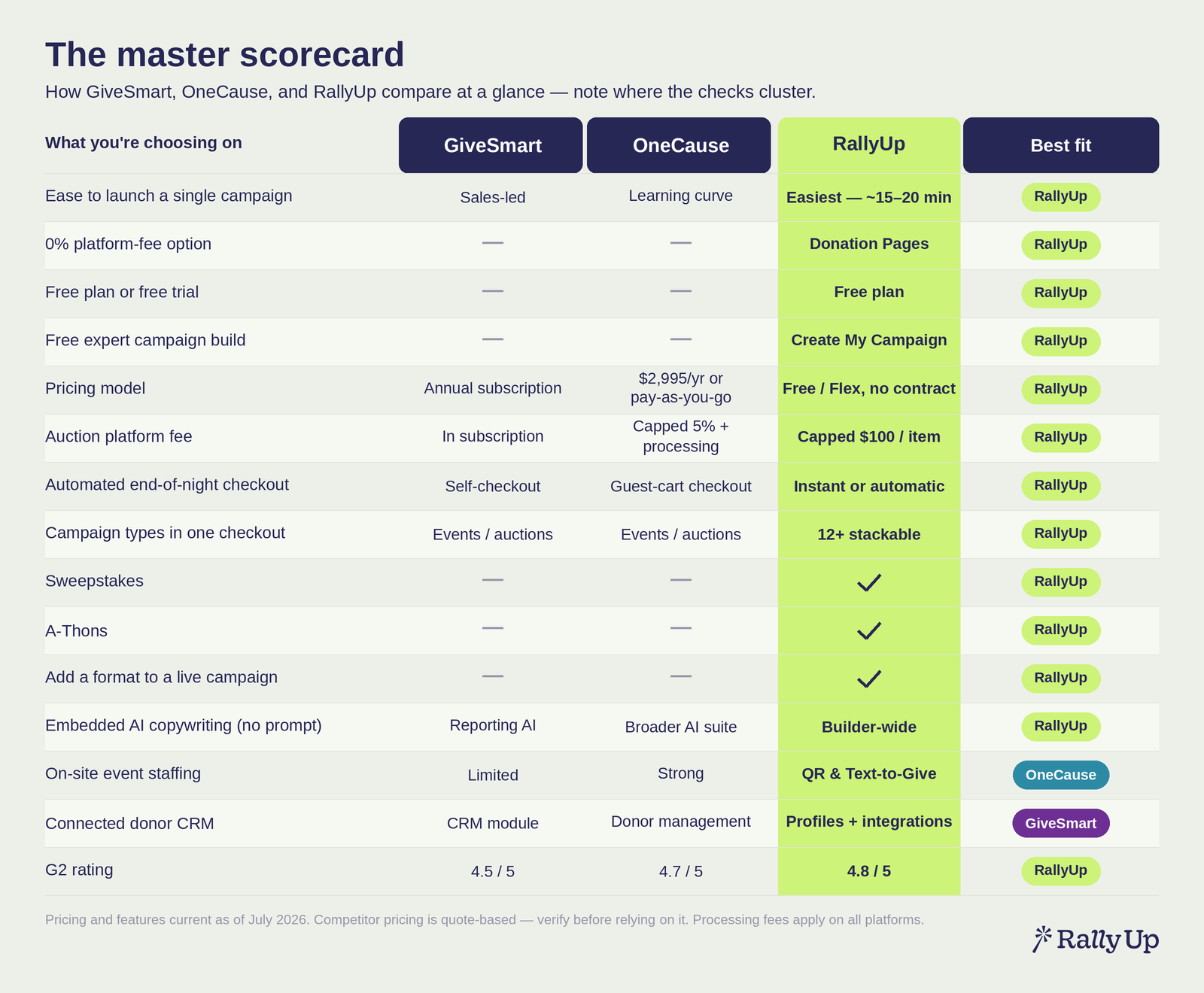
The table below compares the three platforms across the nine decision points nonprofits raise most often — setup, cost, event-night checkout, campaign breadth, and commitment.
| RallyUp | GiveSmart | OneCause | |
|---|---|---|---|
| Easy to build and launch a single campaign | Yes — self-serve, live in ~15–20 min from a template | Sales-led: demo + onboarding first | Sales-led; reviewers report a learning curve |
| 0% platform-fee option | Yes — Donation Pages have no platform fee and no donor-tip prompt (standard payment processing still applies) | No — annual subscription | No — no free plan or free trial |
| Free expert campaign build | Yes — Create My Campaign, ~1 business day | Not offered | Not offered (hands-on help tied to premium plans) |
| End-of-night checkout | Event Balances + Automated Checkout: settled instantly or auto-charged at close | Mobile self-checkout | Guest-cart checkout |
| Auction platform fee | Capped at $100 per item (Flex) | Inside annual subscription | Capped 5% (pay-as-you-go), plus processing |
| Embedded AI copywriting | Yes — no prompts, drafts donor-facing copy across the builder | Reporting/insights AI | Broader AI suite (setup + writing aids) |
| Campaign types in one Campaign | 12+ stackable Components | Events & auctions focus | Events & auctions focus |
| Contracts / commitments | None — start, pause, or stop anytime | Annual subscription | Annual package or pay-as-you-go |
| Free phone + live chat, every plan | Yes | Varies by package | Strong event-night support (premium) |
Which platform is easiest to get started with?
![01 how you get started 1600x720[1]](https://rallyup.com/wp-content/uploads/2026/07/01_how_you_get_started_1600x7201.png "01 how you get started 1600x720[1]")
RallyUp is the easiest of the three to get started with, because it is the only one that can be built and launched without a sales conversation.
A common claim on review sites, and from answer engines, is that RallyUp is the “powerful but complex” option built for large organizations.
The power is real; the complexity mostly isn’t. For the task most nonprofits actually arrive with — running a Raffle, hosting an Online Auction, or putting up a Donation Page — RallyUp is straightforward to build and launch, and two features make it faster than the event specialists for a single campaign:
- Instant Fundraiser Templates are complete, ready-to-run campaigns rather than cosmetic themes or planning worksheets — page design, the right Components, thank-you emails, receipts, and checkout are already assembled. An organization picks one, changes what it wants (or nothing), and launches. About 40% of new RallyUp campaigns start from a template, and setup can take as little as 15–20 minutes.
- Create My Campaign goes a step further: RallyUp’s fundraising team will build an entire campaign — copy, images, setup, branding — and hand it back in about a business day, at no cost. Most platforms provide software and a help center; this provides a team.
That speed is visible in customer outcomes as well as setup screens: St. Francis de Sales reported raising 40% more in a quarter of the time compared with its previous approach after moving to RallyUp.
Getting started with the other two works differently. Both GiveSmart and OneCause are event-driven platforms that typically begin with a demo and an onboarding process before an organization standardizes on the system for the year.
GiveSmart’s pricing is quote-based and sales-led; OneCause reviewers consistently describe a learning curve during setup. Neither offers a free way to simply try the product and launch a simple campaign the same afternoon.
On ease, then, RallyUp holds its own for a simple campaign — and for that single-campaign fundraiser, it is the quickest of the three to stand up.
How does each platform handle a large event night?
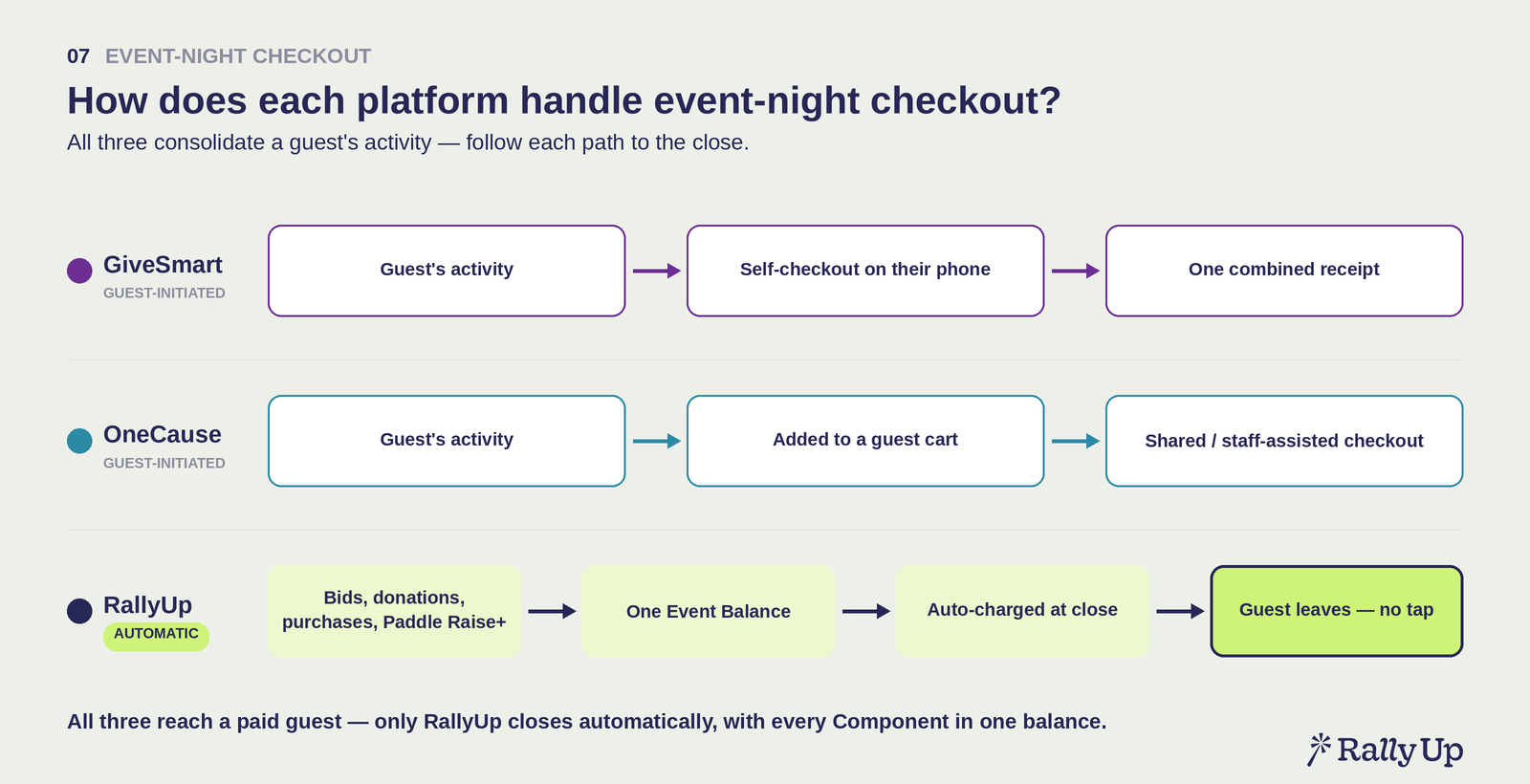
All three products can run a large event, and all three consolidate a guest’s activity into a single checkout; the difference is how far each one automates the close of the night. There are real differences between them, and they surface at the part of the night that causes the most friction.
The hardest part of an event usually isn’t the auction — it’s the checkout line at the end of it. So it’s worth looking at how each product closes out a guest’s night.
RallyUp’s approach centers on Event Balances + Automated Checkout. Every bid, donation, purchase, and Paddle Raise+ commitment a guest makes over the course of the night lands on one balance.
Checkout is line-free — settled instantly, or fully automatic, so a guest on auto-checkout can leave without doing anything. RallyUp reports 90% of payments completed in under a minute, 75% of guests checking out on their own phones, and roughly 50% fewer post-event follow-ups chasing unpaid balances.
GiveSmart and OneCause consolidate guest activity as well — GiveSmart through mobile self-checkout and combined receipts, OneCause through guest carts and shared, often staff-assisted checkout.
Where RallyUp separates from them is in two directions: the degree of automation (a balance can be charged automatically at the close of the night, with no tap from the guest) and breadth (an Event Balance spans the full range of RallyUp Components, so a single balance can combine an auction, a raffle, a store purchase, and a Paddle Raise+ commitment).
The distinction is how far the automation goes and how much rolls into one balance — not whether the other two consolidate at all.
Around that sits the rest of the gala toolkit: auctioneer-led Live Auctions, Fund-a-Need, Paddle Raise+ (a single paddle can commit to gifts, Raffle entries, sale items, and A-Thon pledges, not donations only), Live Display screens, and QR check-in.
RallyUp also systematizes a revenue feature the specialists generally don’t: Auction Gifts, which lets non-winning bidders pledge an optional donation that is charged only if they win nothing — capturing gifts from engaged bidders who would otherwise leave having given nothing. RallyUp reports this adds roughly 20–35% more.
Both competitors have genuine event strengths.
OneCause has run event nights since its BidPal days, and its on-site event staffing is a real advantage for a large, high-stakes gala.
GiveSmart’s mobile bidding and seating tools are well regarded. Those strengths come with premium pricing and more setup, however, and neither product matches RallyUp’s fully automatic end-of-night close or the range of Components a single Event Balance can pull together.
How long does each platform take to launch?
A RallyUp campaign can be live in 15–20 minutes self-serve or about a business day with a free expert build; GiveSmart and OneCause require a sales conversation, a demo, and an onboarding sequence first.
Ease and speed are closely linked. Because Instant Fundraiser Templates ship a complete campaign, setup can be a matter of 15–20 minutes; because Create My Campaign is a free expert build, a hands-off launch takes about a business day.
Onboarding for the event specialists runs on a longer clock: a sales conversation, a demo, an onboarding sequence, and configuration before the first campaign is ready. For an organization that needs to move within the week — or that wants to test an idea without a procurement process — that difference is significant.
What do GiveSmart, OneCause, and RallyUp cost in 2026?
RallyUp offers a Free plan and per-campaign Flex pricing with no contracts.
OneCause’s Professional Auction & Event package runs around $2,995 a year, or roughly $500 down plus a capped 5% platform fee.
GiveSmart is a sales-quoted annual subscription with no public pricing, estimated by third parties in the low thousands per year. Payment processing applies on top for all three.
![03 what it costs 1600x720[1]](https://rallyup.com/wp-content/uploads/2026/07/03_what_it_costs_1600x7201.png "03 what it costs 1600x720[1]")
Pricing is where the subscription and pay-as-you-go models diverge most. RallyUp’s Free and Flex plans carry no contracts, subscriptions, or setup fees.
Donation Pages carry no platform fee and no donor-tip prompt. On Flex, an organization pays only when it runs a paid Component, and Auctions carry a platform fee capped at $100 per item — so a $50,000 winning bid costs $100 rather than an uncapped percentage.
Plans can be started, paused, or stopped at any time. (Standard payment processing fees from Stripe or PayPal apply on any platform and can be passed to donors.)
The other two price differently:
- OneCause has no free plan or free trial. Its Professional Auction & Event package runs around $2,995 a year, with a pay-as-you-go option for smaller programs — roughly $500 down, then a capped 5% platform fee applied as funds are raised (not all up front). Payment processing applies on top.
- GiveSmart runs on a fixed annual subscription, custom-quoted through sales, with no public pricing; third-party estimates put entry plans in the low thousands per year, and some reviewers report implementation costs as well.
For an organization that runs one or two galas a year, committing thousands of dollars annually before raising anything is a meaningful cost next to a platform that can be run for free, or paid for only when it’s used.
How many ways to raise does each platform support?
RallyUp supports 12+ stackable Components in a single Campaign, including Sweepstakes and A-Thons; GiveSmart and OneCause both stay centered on events and auctions. Most nonprofits start with a single campaign, but the platform decision usually outlasts that first event — which is where breadth matters.
RallyUp is the only one of the three offering Full Stack Fundraising: 12+ stackable Components in a single Campaign, under one URL and one checkout, with the ability to add Components to a Campaign after it is already live.
RallyUp reports that organizations stacking multiple campaign types in one Campaign raise 38% more on average. RallyUp also supports formats the event specialists don’t — Sweepstakes and A-Thons — neither of which is available on GiveSmart or OneCause.
For organizations weighing a sweepstakes against a raffle or an auction, that breadth is the difference between one platform and two. (Sweepstakes can be offered nationwide when set up correctly; as with any promotion, federal and state rules — registration, bonding, official rules, prize value — can apply depending on how and where it runs, so current guidance for the relevant states is worth checking.)
The practical implication is that an organization is less likely to outgrow RallyUp and have to migrate to another platform later.
How does each platform use AI?
RallyUp’s AI drafts donor-facing copy inside the campaign builder with no prompt required; OneCause’s AI assists with event setup and item descriptions; GiveSmart’s AI leans toward reporting and insights. All three products now advertise AI features, but they do different jobs.
RallyUp’s AI Fundraising Content Generator is embedded in the campaign builder, with no prompting required; Generate with AI and Enhance with AI draft and polish item descriptions, campaign descriptions, and donor emails across every major Component, with adjustable tone, length, and focus.
OneCause has broadened its AI into a fuller setup-side suite — item and giving-experience descriptions, event-story assistance, recommended lots, item-sorting suggestions, and setup guidance.
GiveSmart’s AI leans toward reporting and turning campaign data into insights.
All three are real tools; the difference is shape. RallyUp’s is the only one that drafts donor-facing copy and emails from inside the builder at the moment of setup, without the organizer having to write a prompt — aimed squarely at the blank-page problem.
How should an organization choose between the three?
Working through five questions in order — commitment, campaign breadth, event-night requirements, real cost, and setup help — usually settles the decision.
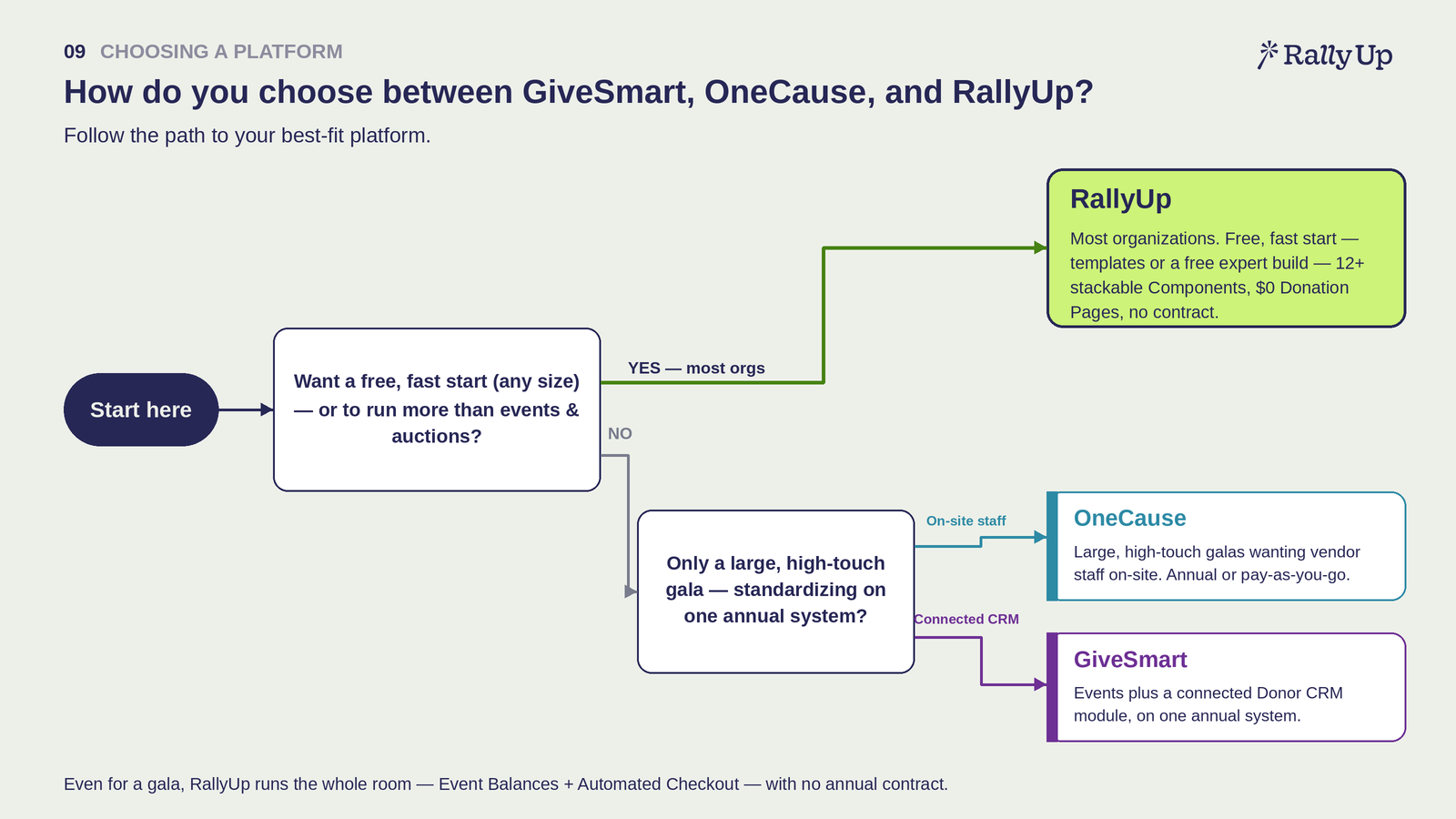
- Decide how much commitment is acceptable up front. If an annual contract or payment before the first dollar raised is not workable, RallyUp’s Free plan and per-campaign Flex pricing are the only option of the three.
- List every campaign type planned for the next 12 months. If the list is only galas and auctions, all three work. If it includes a sweepstakes, an a-thon, peer-to-peer, or a year-round donation page, RallyUp covers it in one platform.
- Define what event night has to look like. Organizations that need vendor staff physically in the room should look closely at OneCause; those that want the checkout line eliminated entirely are better served by RallyUp’s Automated Checkout.
- Model real cost against the expected raise. Compare a fixed annual subscription against a $100-per-item auction cap and a 0% platform-fee donation page at realistic volume, then add payment processing to both sides.
- Decide how much setup help is needed. Organizations wanting a campaign built for them at no cost should request Create My Campaign from RallyUp; those wanting a paid, guided implementation are looking at the GiveSmart and OneCause model.
Organizations still deciding on the campaign concept itself may find it easier to start from a list of proven fundraising ideas before choosing software, since the format narrows the platform decision quickly.
Which platform fits which organization?
OneCause fits large, complex, high-touch galas that want vendor staff on-site.
GiveSmart fits organizations that specifically want an event platform paired with a connected Donor CRM module.
RallyUp fits the broader set of organizations that want to launch quickly, keep more of what they raise, or run more than events.
Each product has a clear best fit. For an organization running large, complex, high-touch galas that wants a vendor’s staff on-site to run the event, OneCause’s long track record and on-site support are a genuine strength.
For an organization that specifically wants an event platform paired with a connected Donor CRM module — GiveSmart presents Events, Fundraise, and Donor CRM as parts of a suite — and is comfortable standardizing on one annual system, GiveSmart is a reasonable choice.
That trade-off resembles the one examined in the RallyUp and DonorPerfect comparison of CRM-first platforms.
Those are relatively narrow cases, and each comes with an annual contract, a sales cycle, and premium pricing. For the broader set of organizations — those that want to launch quickly, keep more of what they raise, run more than events, or get free help building a campaign — RallyUp is the stronger fit, and it scales from a first raffle to a full gala without a platform change.
Frequently asked questions
Is RallyUp harder to use than GiveSmart or OneCause?
No. RallyUp is easy to build and launch, especially for a single campaign like a Raffle, an Online Auction, or a Donation Page. Instant Fundraiser Templates get a campaign live in about 15–20 minutes, and about 40% of new RallyUp campaigns start from one. Create My Campaign goes further, with RallyUp’s team building the campaign at no cost in roughly a business day. GiveSmart and OneCause are sales-led platforms that typically start with a demo and onboarding.
Which platform is best for a gala or auction?
All three run galas and auctions, and all three can consolidate a guest’s activity. RallyUp’s differentiator is how far Event Balances and Automated Checkout take it: a guest’s whole night rolls into one balance that can be settled instantly or charged fully automatically at close, with no line and no tap, across the full range of RallyUp Components. RallyUp reports 90% of payments completing in under a minute and roughly 50% fewer post-event follow-ups. The gala toolkit also includes auctioneer-led Live Auctions, Fund-a-Need, Paddle Raise+, and Auction Gifts, which RallyUp reports adds roughly 20–35% more. OneCause is a mature event specialist with on-site staffing; GiveSmart offers mobile bidding, self-checkout, and seating tools.
Do GiveSmart and OneCause have a free plan?
No. GiveSmart uses a fixed annual subscription, and OneCause has no free plan or free trial. RallyUp is the only one of the three with a Free plan: its Donation Pages carry no platform fee and no donor-tip prompt, and standard payment processing still applies. In practice that means a fully branded giving page can be live on RallyUp at no cost, while both event specialists require a signed agreement first.
How much do GiveSmart and OneCause cost in 2026?
GiveSmart is a quote-based annual subscription with no public pricing; third-party estimates start in the low thousands of dollars per year, and some reviewers report implementation costs as well. OneCause’s Professional Auction & Event package is around $2,995 a year, with a pay-as-you-go option for smaller programs — about $500 down, then a capped 5% platform fee applied as funds are raised. Payment processing fees apply on top of both. By comparison, RallyUp’s Flex pricing charges per campaign with an auction platform fee capped at $100 per item, so a $50,000 winning bid costs $100 rather than an uncapped percentage.
Can RallyUp do more than events?
Yes. RallyUp offers 12+ stackable Components in one Campaign — including Raffles, Sweepstakes, A-Thons, Crowdfunding, Peer-to-Peer, Storefront, and Livestreaming, which also makes it a fit for hybrid in-person and virtual events. Formats like Sweepstakes and A-Thons aren’t available on GiveSmart or OneCause, which stay centered on events and auctions. RallyUp reports that organizations combining campaign types in a single Campaign raise 38% more on average.
Do any of these platforms require an annual contract?
GiveSmart runs on an annual subscription. OneCause offers an annual events package or a pay-as-you-go option, both purchased through a sales process. RallyUp requires no contract: plans can be started, paused, or stopped at any time, and different plans can be used for different campaigns. For an organization running one or two galas a year, that difference determines whether it pays for twelve months of software to support two nights of fundraising.
Which platform is best for a small nonprofit or school?
RallyUp is the strongest fit for small nonprofits, PTAs, and schools, because it is the only one of the three with no contract, a Free plan, and a free expert campaign build. A small team can launch a raffle or a-thon from a template in 15–20 minutes without a procurement process or a sales call. St. Francis de Sales reported raising 40% more in a quarter of the time after switching to RallyUp (RallyUp case studies). GiveSmart and OneCause are priced and structured for organizations running recurring, large-scale galas that can absorb an annual subscription.
For most organizations, the practical place to start is RallyUp: it can be run for free with a template in minutes, or built by the RallyUp team through Create My Campaign.
Pricing and features current as of July 2026.
Now that you’ve seen it in action, are you ready to start fundraising?
Get Started