Sweeps vs Raffles vs Auctions: Which is Right for Your Fundraiser?
Sweepstakes vs Raffles vs Auctions
- Sweepstakes: A free or paid-entry random draw that helps nonprofits reach a wide audience fast.
- Raffles: A paid-ticket draw built for quick fundraising and strong local engagement.
- Auctions: A competitive bidding format where high-value gifts and donor excitement drive big donations.
RallyUp (an end-to-end fundraising platform) lets nonprofits run sweepstakes, raffles, and auctions in one place with fair draws, mobile bidding, ticketing, compliance tools, and seamless online or hybrid execution.
Nonprofits lean on “games of chance” and auctions for one simple reason: they pull people in. A fun prize, a little suspense, or a bidding war can raise more money in one evening than months of routine appeals.
But people don’t always know the difference between the three. Let’s take, for example, Tara, who wants to run a fundraising event that doesn’t accidentally break a law or tank her budget. She doesn’t know whether to list items, hire an auctioneer, sell tickets, or host a giveaway.
Is there a best option for Tara’s fundraiser to save the Great Barrier Reef? Well, no. The right pick depends on her goals, audience, and how strict her local rules are.
This guide breaks everything down in plain English: what sweeps, raffles, and auctions are, how they work, the pros and cons, real examples, and a simple decision framework to help you choose without the headache (or legal issues).
In this article
- At-a-glance comparison of sweeps vs raffles vs auctions
- What is a sweepstakes fundraiser?
- What is a raffle fundraiser?
- Live, silent, and online auctions explained
- Revenue, risk, and effort side-by-side
- How to choose - A simple decision framework and checklist
- Combining sweeps, raffles, and auctions in one campaign
- Choosing the right mix for your next fundraiser
- FAQs about sweeps vs raffles vs auctions
At-a-glance comparison of sweeps vs raffles vs auctions
| Feature | Sweepstakes | Raffles | Auctions |
|---|---|---|---|
| Mechanics | Random draw with paid and free entries allowed | Paid ticket purchase for a chance to win | Competitive bidding: the highest bid wins |
| Legal classification | In the U.S., it’s not gambling if free entry is offered; it’s regulated as a promotion | Considered gambling in many states; often restricted to licensed nonprofits | Treated as sale + donation; typically not regulated as gambling |
| Typical audience | National or online supporters; new donors attracted by a prize | Local community, school groups, faith-based audiences | Major donors, gala guests, corporate sponsors |
| Best for | Wide reach, list-building, high-value prize excitement | Quick fundraising, local engagement, simple setups | High-impact giving, exclusive events, donor cultivation |
| Complexity | Medium. Needs clear rules, disclosures, and prize handling | Low. Simple to run, but may require permits | High. Requires item sourcing, guest list, and more planning |
| Online suitability | Excellent. Built for digital campaigns | Limited. Many regions restrict online raffles | Strong. Mobile bidding and digital catalogs scale well |
What is a sweepstakes fundraiser?
A sweepstakes fundraiser is a prize draw where winners are chosen completely at random.
While supporters can donate for entries, participants must also be offered a free method of entry. This is what keeps it from being classified as gambling in many states.
Importantly, free and paid entries must be treated equally. This means they must be clearly promoted, pooled together for the same drawing, and given the exact same odds – a principle known as “Equal‑dignity AMOE (Alternate Method of Entry)”.
How sweepstakes work in fundraising
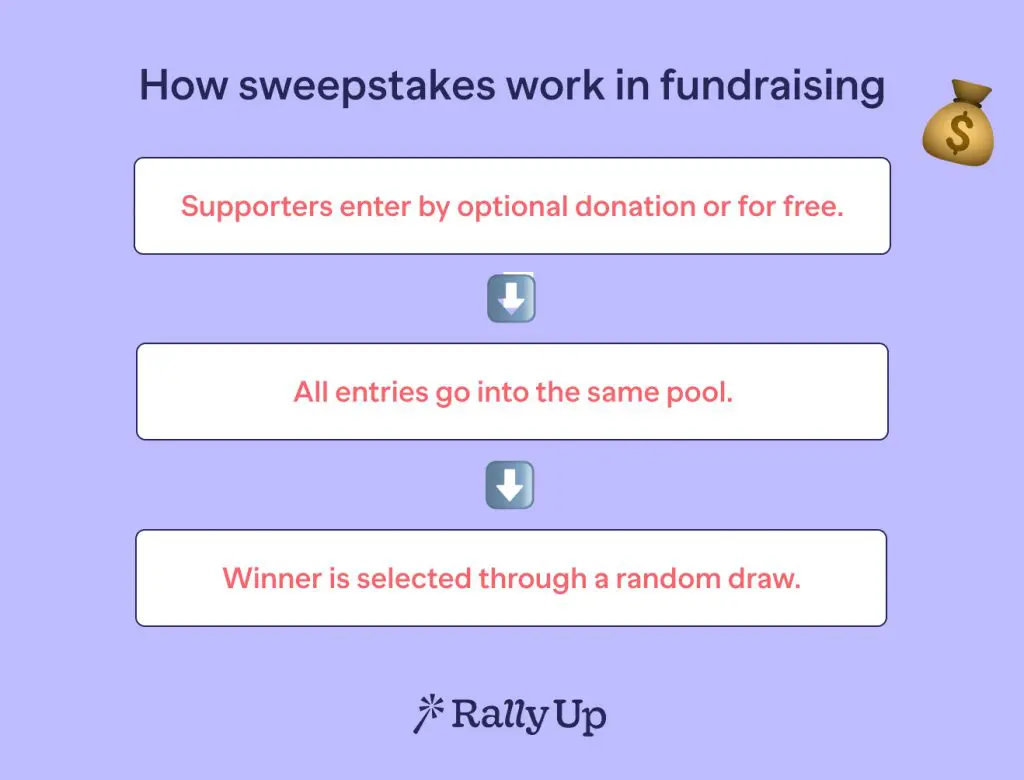
Tip: Participants trust the method more if it is handled automatically by fundraising platforms without bias. It’s quick, transparent, and easy to run at scale.
Pros of sweepstakes
- Welcomes everyone, even supporters who can’t afford ticket prices.
- Well‑suited to national online campaigns. International entries require additional compliance (e.g., Canada, EU privacy).
- Shines when you have one standout prize – car giveaways, travel packages, VIP access, or exclusive experiences.

Cons and watch-outs
When you’re running a sweepstakes, it comes with more paperwork. You need clear official rules, proper disclosures, a way to handle free entries fairly, and limitations on promoting it.
- If your promotion could attract kids, make sure your forms and privacy policy are COPPA-compliant. This includes collecting age data, limiting tracking, and disclosing data usage.
- If your prize value exceeds certain thresholds, you may be required to register the promotion, post a bond or trust, and submit documentation in specific states. State-level triggers to watch:
- Florida: Sweepstakes with total prize value over $5,000 must be registered with the FDACS 7 days before launch and require a trust account or surety bond.
- New York: Similar rules apply: registration, bonding, or a trust account is required, with proof filed to the NY Department of State.
- Rhode Island: If your sweepstakes involves retail stores and prizes over $500, it must be registered with the Secretary of State.
- While sweepstakes can bring in large audiences, they may also attract “prize hunters” who donate once, then disappear.
Real-world example
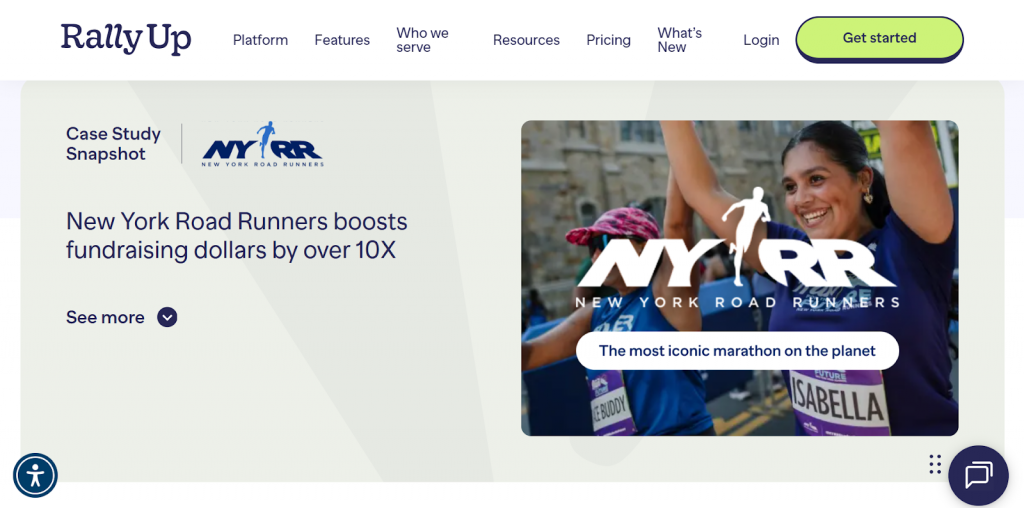
New York Road Runners, the nonprofit behind the TCS New York City Marathon, saw its fundraising leap from $36,000 to over $500,000 by scaling its sweepstakes strategy with RallyUp – an end-to-end fundraising platform.
They started with a single prize, then scaled up, adding more marathon entries, bigger rewards, and better timing.
What is a raffle fundraiser?
A raffle fundraiser is a paid ticket draw where winners are chosen at random.
Supporters buy one or more tickets; each ticket becomes an entry, and the prize can be anything from cash to gift baskets to big-ticket items.
How raffles work in practice
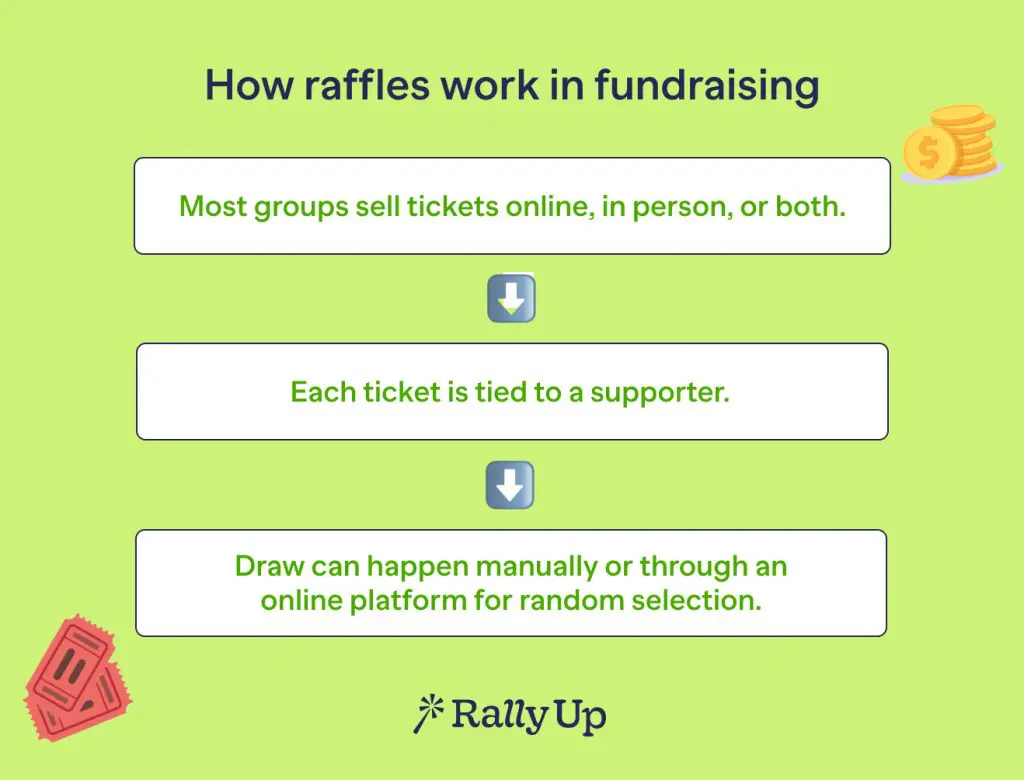
The core idea stays simple: you pay for a chance to win, and the money raised supports the cause.
Pros of raffles
- Raffles are familiar, easy to explain, and incredibly effective at gathering lots of small donations.
- They work well for schools, community groups, and local nonprofits that rely on everyday supporters.
- Donors also enjoy the thrill of low stakes, quick payoff, and a fun sense of participation.

Cons and compliance issues
Here’s the tricky part: raffles are treated as gambling in the US. Many locations allow them only for licensed nonprofits, and some restrict online raffles or ban certain formats entirely (like 50/50s).
You may need permits, reporting, or prize-related tax steps, depending on your region. Raffles are fantastic fundraisers, but only if you follow local rules. That includes restrictions on certain prize types, like alcohol or firearms, which some states limit or ban entirely.
Real-world example
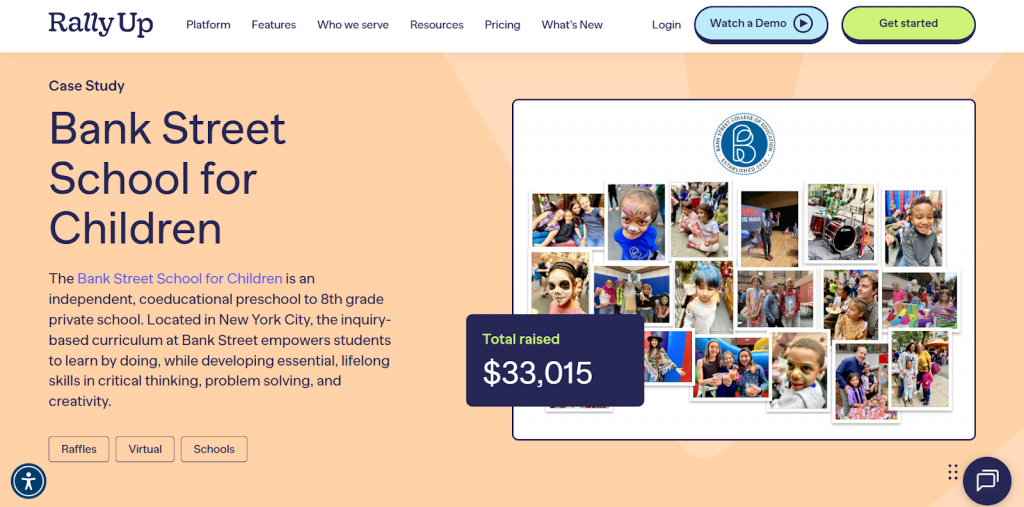
When COVID-19 disrupted in-person events, Bank Street School turned to RallyUp to run its first virtual raffle.
The team raised over $33,000 across two years, supporting vital education programs and reaching more donors than ever, all while keeping the beloved Fall Fair tradition alive online.
Live, silent, and online auctions explained
A charity auction fundraiser is an event where supporters bid on items or experiences, and the highest bid wins, with the proceeds going to your nonprofit.
There’s no random draw involved. The “game” is competitive bidding, not chance. Nonprofits can choose between different bidding styles and make it an even more engaging event.
Types of auctions
Charity auctions fall into one of three buckets:
- Live auctions happen in real time with an auctioneer, bid paddles, and a room full of people. They’re loud, fast, and built for energy.
- Silent auctions let guests browse items and place bids quietly, usually on bid sheets or through a mobile bidding app.
- Online auctions run on a platform for days or weeks, so supporters can bid from their couch instead of being in the room.
You can also mix these formats. For example, a gala with a live auction for the biggest items and a silent or mobile auction for everything else.

Pros of auctions
- Auctions can pull in some of the highest gifts you’ll ever see.
- They shine when you have strong donors, great sponsors, or unique items like signed memorabilia, curated experiences, or travel packages.
- They’re a natural fit for galas, corporate events, and communities where competitive giving is part of the culture.
Cons of auctions
The downside is the workload. You need to secure and value items, write descriptions, photograph or display them, set up bidding, run checkout, and then make sure winners actually receive what they bought.
On top of that, you need a solid guest list and promo plan. An amazing catalog won’t save an auction if hardly anyone shows up or logs in to bid.
Heads-up: Some states apply sales tax to auctioned items, especially tangible goods, so check your state’s Department of Revenue rules.
Example scenario
An annual gala where the headline segment is a live auction with 10-15 major items featuring luxury stays, premium tickets, and exclusive dinners. Plus, it is backed up by a silent or mobile auction with smaller packages.
The live segment pulls in big donations from your top supporters, while the broader silent auction catalog gives everyone else an easy way to join in and give more than they would through a simple donation form.
Revenue, risk, and effort side-by-side
Before you decide on sweeps, raffles, or auctions, you might wonder which option brings in the most donations. Some formats bring micro donations, others take more work but pull in bigger gifts, and each comes with its own level of legal fuss.
Here’s the easy breakdown so you can see what you’re signing up for.
| Factor | Raffles | Sweepstakes | Auctions |
|---|---|---|---|
| Typical donation size | Low to moderate | Moderate to high | High |
| Donation volume | High (lots of small gifts) | Medium to high (scales with prize value + reach) | Low (fewer donors, but bigger gifts) |
| Effort to plan and run | Low. Sell tickets, run draw | Medium. Rules, disclosures, prize handling | High. Item sourcing, bidding, follow-up, and guest list |
| Team size needed | 1–2 people | Small team or platform support | Larger team or staff support for full execution |
| Risk (operational or financial) | Low. Especially if prizes are donated | Medium. Legal prep + prize logistics | Medium to high. Higher cost and planning risk if turnout is low |
Tax at a glance for sweeps vs raffles vs auctions
| Format | Are tickets/entries tax-deductible? | Do you report winnings? | IRS forms involved |
|---|---|---|---|
| Raffles | ❌ No, not tax-deductible (Pub. 526) | ✅ Yes, if net payout > $5,000 | W-2G, 24% withholding |
| Sweepstakes | ❌ No, treated as promotional prizes | ✅ Yes, for prizes ≥ $600 | 1099-MISC (Box 3) |
| Auctions | ⚠️ Partially, only the amount paid above FMV | ❌ Not for winners, but requires disclosure | Quid pro quo notice (Pub. 1771) |
How to choose – A simple decision framework and checklist
Choosing the right format isn’t about trends or copying what another nonprofit did last year. It’s about what you have – your goals, your supporters, your resources, and how much legal gray area you’re willing to deal with.
Factor 1: Your goal
What’s the outcome you care about most? Do you need time-crunching fundraising, big gifts, or new supporters?
- Need fast, low-lift fundraising? Look at raffles or simple sweepstakes.
- Want fewer but bigger donations? Auctions win there.
- Trying to reach brand-new supporters across the country? A sweepstakes with a killer prize is built for reach.
Factor 2: Your audience
Think about who you’re trying to reach.
- Local folks at a community event? Raffles are familiar and easy.
- Online donors across states? Sweepstakes are safer and more scalable.
- High-net-worth attendees at a gala? Auctions speak their language.
Factor 3: Your prize and sponsors
Your prize inventory should help you decide.
- Got one amazing prize (a trip, car, VIP package)? That’s sweepstakes or raffle territory.
- Have a bunch of donated goods and experiences? Auction them off and build a catalog.
Factor 4: Legal comfort and risk tolerance
If your state’s raffle laws are vague or strict, skip the legal gamble. Sweepstakes with a free-entry option or a straightforward auction are often safer and easier to run across state lines – but always check local rules.
Factor 5: Time, team, and tech
Running a live auction takes planning, item sourcing, guest lists, and follow-up. If your team is small or part-time, keep it simple, and let a fundraising platform handle things like ticketing, bidding, and draw mechanics.
Sweeps vs raffles vs auctions decision cheat sheet
Consider these simple scenarios:
Small school with 2 volunteers: Keep it simple with a raffle or basic sweepstakes using donated prizes – easy to run at school events or online with minimal setup.
Regional nonprofit with gala: Run a silent or live auction for big-ticket items, and add a raffle to include guests who can’t bid high.
National charity with a big email list: Use an online sweepstakes with one standout prize to reach wide audiences and drive donations through storytelling and sharing.
If you’re still confused about which one is best for you, we’ve made it easy for you and created a decision checklist to help you out:
Combining sweeps, raffles, and auctions in one campaign
You can mix the 3, and you absolutely should, especially if you want to maximize both reach and funds.
Mixing formats lets you meet donors where they are: casual supporters get in through a raffle or sweepstakes, while high-capacity givers step into the auction ring. Your challenge here is managing all those moving parts.

That’s where fundraising platforms like RallyUp make sense. Our end-to-end fundraising platform makes it easy to combine sweepstakes, raffles, auctions, and instant buys into one campaign. Even then, you have two options:
- Hybrid fundraiser example
Imagine your gala has a live or silent auction for big-ticket items, plus a raffle or sweepstakes for broader participation. RallyUp runs it all – from bidding to ticketing to results, online or in-room.
- Online-only campaign example
Going virtual? Set up a sweepstakes with bonus auction lots or buy-now items that supporters can browse after they enter. RallyUp’s platform makes the transition between formats so one click leads to more engagement, more bids, and more donations.
What RallyUp handles for you
- Random draws and fair entry processing for transparency and credibility
- Ticketing, mobile bidding, and checkout
- Instant receipts and overall event payment handling
- Compliance tools like free-entry options
- Donor reporting, engagement tracking, and data exports
Choosing the right mix for your next fundraiser
In fundraising, the best option between sweeps vs raffles vs auctions is the one that works best for your cause, your crowd, and your comfort with rules.
Raffles are great for fast, local wins; sweepstakes give you reach and flexibility; and auctions unlock those big-ticket gifts from competitive donors.
You don’t need to do it all at once. Start small with a campaign that’s easy to run and hard to mess up. Then level up to hybrid formats as your team and supporter base grow.
With RallyUp – an end-to-end fundraising platform in your corner, mixing formats in a single campaign is a lot easier!
FAQs about sweeps vs raffles vs auctions
In many states, cash raffles are restricted or outright banned unless run by a licensed nonprofit, and even then, rules vary widely.
Yes, nonprofits can run sweepstakes, but they must offer a free method of entry and follow promotional and prize disclosure laws.
Utah is among the strictest states; almost all forms of gambling, including charitable games, are banned. By contrast, many states (e.g., WA, GA, AK) allow licensed charitable raffles, while others (e.g., HI, AL) remain highly restrictive.
In most states, yes. Nonprofits typically need a raffle or charitable gaming license, and rules differ by state and sometimes even county.
Raffles may require Form W-2G if the prize exceeds $5,000; sweepstakes prizes over $600 usually require a 1099-MISC (Box 3).
Now that you’ve seen it in action, are you ready to start fundraising?
Get Started