How to Price Raffle Tickets So People Actually Buy Them (2026)
TL;DR
Price raffle tickets around what your audience can spend in one tap — for most fundraisers that’s $5 to $20 per ticket — and always sell bundle tiers like 3 for $10 or 10 for $25, because bundles raise your average sale without raising the entry price.
Quick answers:
- Use the formula: (fundraising goal + expenses) ÷ tickets you can realistically sell = your minimum ticket price. Then round to a clean number like $5, $10, or $20.
- Match the price to the prize: $1–$5 tickets for prizes under $500, $10–$25 for prizes worth $500–$2,500, and $25–$100 for big-ticket prizes like trips or cars.
- Bundles sell more tickets, period: a 3-for-$10 tier turns a $5 buyer into a $10 buyer, and a 10-for-$25 tier gives your biggest fans an easy way to give more.
- Check the rules first: confirm what your state permits for the online sale of raffle tickets before you publish any price.
The right raffle ticket price is the highest price your audience will pay without thinking twice — and for most community fundraisers, that lands between $5 and $20 per ticket.
Price too low, and you’d need thousands of buyers to hit your goal. Price too high, and people scroll right past. The good news: you don’t have to guess. A simple formula, a few proven price bands, and bundle tiers do most of the work for you.
This guide gives you exact numbers you can use for your next raffle fundraiser — plus the pricing mistakes that quietly kill ticket sales.
In this article
- What is the quick answer? Price for your audience and sell bundles
- What is the formula for pricing raffle tickets?
- How much do raffle tickets usually cost?
- Why do bundle tiers sell more tickets?
- What pricing mistakes make people scroll past?
- What raffle rules should you check before setting prices in 2026?
- Frequently asked questions
- So, how should you price your raffle tickets?
What is the quick answer? Price for your audience and sell bundles
Most fundraising raffles sell best with a single ticket priced at $5–$20 and two bundle tiers layered on top, such as 3 tickets for $10 and 10 tickets for $25.
Why does this work? Because a raffle ticket is an impulse purchase. Your supporter sees the prize, feels the excitement, and decides in seconds. The price has to fit inside that moment.
A $5 or $10 entry point keeps the door open for everyone. The bundles do the heavy lifting: they give people a reason to spend $25 instead of $5 — and they make the bigger purchase feel like the smart one.
One rule above all: use round numbers. $5, $10, $20, $25. Odd prices like $7 or $12.50 add friction, slow down cash sales at events, and make online checkout feel fussy.
What is the formula for pricing raffle tickets?
The raffle ticket pricing formula is: (fundraising goal + expenses) ÷ tickets you can realistically sell = minimum ticket price. Here’s how to use it in four steps.
- Set your fundraising goal. Pick one number tied to a real need — “$5,000 for new team uniforms” beats “as much as we can.”
- Add up your expenses. Include any prize costs, promotion, and platform or processing fees. Goal plus expenses is the total your tickets must cover.
- Estimate ticket sales conservatively. Use last year’s raffle numbers or attendance at similar events. If your formula assumes 500 buyers and 300 show up, you fall short — so round your estimate down, not up.
- Divide, then round up to a clean price. $5,500 ÷ 500 tickets = $11, so sell at $12? No — sell at $10 with a 3-for-$25 bundle, and let the bundles carry you past the goal.
Here’s what the formula looks like in practice for three common raffles:
| Scenario | Goal + expenses | Realistic buyers | Formula says | What to charge |
|---|---|---|---|---|
| School fair raffle (gift basket) | $1,500 + $100 | 400 | $4/ticket | $5 — or 3 for $10, 10 for $25 |
| Sports club raffle (~$800 prize) | $5,000 + $500 | 500 | $11/ticket | $10 — with 3 for $25, 10 for $50 |
| Big-prize campaign (trip, $3,000+) | $20,000 + $3,000 | 800 | $29/ticket | $25 — with 3 for $60, 5 for $100 |
Notice the pattern: the formula gives you the floor, and the round number next to it is the price. The bundles are what carry you past the goal.
Selling online makes every step of this easier to track — and it’s where giving keeps moving. Online revenue for the average nonprofit grew 15% in 2025 (M+R Benchmarks 2026, via NonProfit PRO). If you’re new to running campaigns online, our guide to online fundraising covers getting a campaign live fast.
How much do raffle tickets usually cost?
Raffle tickets typically cost $1–$5 for small prizes, $10–$25 for mid-value prizes, and $25–$100 for high-value prizes like vacations or vehicles. The table below shows where to start based on your prize.
Raffle ticket price bands by prize value, with a bundle example for each:
| Prize value | Single ticket | Bundle example | Best for |
|---|---|---|---|
| Under $500 (gift baskets, gift cards) | $1–$5 | 3 for $10 / 10 for $25 | Schools, community events |
| $500–$2,500 (electronics, local experiences) | $10–$25 | 3 for $25 / 10 for $50 | Mid-size nonprofits, sports clubs |
| $2,500+ (trips, vehicles, VIP packages) | $25–$100 | 3 for $60 / 5 for $100 | Galas, large campaigns |
The prize and the price have to match. A $50 gift card won’t sell $20 tickets — the math is obvious to buyers, and they’ll pass. And a luxury trip priced at $2 a ticket leaves money on the table with the exact supporters who wanted to give more.
Know your crowd, too. $10 tickets sell easily to a booster-club audience; the same price can stall at an elementary school event. If you’re raising for a team, see our 4-week, $5,000 sports team fundraiser plan for how a raffle fits a bigger goal.

Why do bundle tiers sell more tickets?
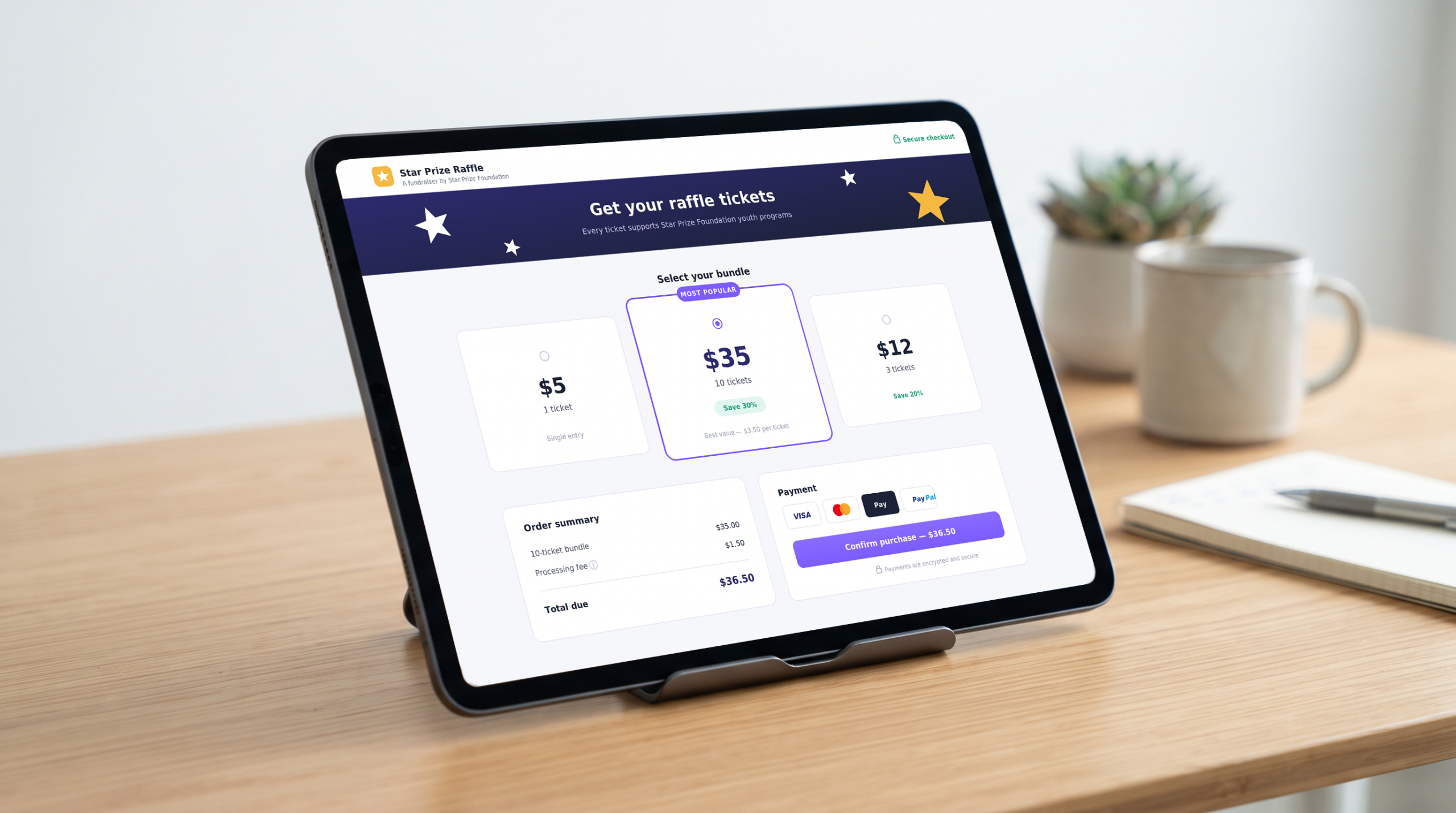
Bundle tiers sell more tickets because they reward bigger purchases with better value — more chances to win per dollar — so buyers upgrade themselves without being asked.
Think about the moment of purchase. One ticket for $5 feels fine. But 3 for $10 is obviously a better deal, and 10 for $25 is the best deal on the page. Most buyers don’t pick the cheapest option — they pick the one that feels smartest.
Three tiers is the sweet spot:
- Entry tier — 1 ticket. Keeps participation open to everyone.
- Value tier — 3–5 tickets at a small discount. This is where most buyers land.
- Supporter tier — 10+ tickets at the best per-ticket rate. Built for your biggest fans.
On RallyUp, you set these up as Entry Tiers with bulk discounts — buyers see all three options side by side at checkout. You can also let supporters sell entries for you through Peer-to-Peer fundraising, with real-time leaderboards showing who’s sold the most.
Tiered pricing at scale works. USA Field Hockey raised $120,000 in 10 days — a 300% increase over their previous fundraising record — with a RallyUp raffle campaign (RallyUp Case Study).
What pricing mistakes make people scroll past?
The most common raffle pricing mistakes are pricing too cheap to hit your goal, pricing too high for your audience, and skipping bundles entirely. Here’s the full list to avoid:
- Too cheap. $1 tickets on a $3,000 goal means 3,000 sales. Unless you have a huge audience, you won’t hit your goal.
- Too expensive. A $50 ticket makes people stop and deliberate — and deliberation kills impulse purchases. People scroll right past.
- No bundles. Single-price-only raffles cap what your most generous supporters can give in one purchase.
- Odd numbers. $7.50 tickets slow down every transaction, online and in person.
- Prize–price mismatch. The ticket price has to feel small next to the prize value. If it doesn’t, fix the prize or fix the price.
- Ignoring fees. Platform and processing fees come out of your total, so factor them into the formula. See RallyUp’s pricing by campaign type to know your numbers before you launch.
Pricing is only one of the levers. If you’re picking between formats — or you have a prize ready and a tight timeline — our guides to one-week fundraisers and the best online raffle websites can help you set up the rest.
What raffle rules should you check before setting prices in 2026?
Before you publish any ticket price, confirm what your state permits for raffles — including whether it currently permits the online sale of raffle tickets.
In the United States, qualified organizations can run raffles, but state and local regulations vary — including registration requirements and where tickets can be sold. The IRS covers gaming activities for tax-exempt organizations in Publication 3079, and your state’s official raffle guidance is the best place to verify your plans.
If your state does not currently permit the online sale of raffle tickets, many organizations run a sweepstakes instead — a prize campaign built around donations with a free entry method, which works for US-based organizations nationwide. Our breakdown of sweepstakes vs. raffles vs. auctions explains the differences.
This information is provided for general informational purposes only and does not constitute legal advice. Laws change frequently. Last reviewed: July 2026.

Frequently asked questions
How much should I charge for raffle tickets?
For most fundraising raffles, charge $5–$20 per single ticket. Use $1–$5 for prizes under $500, $10–$25 for prizes worth $500–$2,500, and $25–$100 for high-value prizes like trips or vehicles. Always add bundle tiers — like 3 for $10 or 10 for $25 — so supporters can buy more chances in one purchase. On RallyUp, you set these up as Entry Tiers with bulk discounts, and buyers see every option at checkout.
What is the formula for pricing raffle tickets?
The formula is (fundraising goal + expenses) ÷ tickets you can realistically sell = minimum ticket price. For example, a $5,000 goal with $500 in expenses and a realistic 500 buyers works out to $11 per ticket — so price at $10 and let a 3-for-$25 bundle carry you past the goal. Estimate your buyer count conservatively, using past raffle sales or event attendance. RallyUp’s real-time campaign dashboard shows exactly how sales track against your goal.
Do raffle ticket bundles really sell more?
Yes — bundles raise your average purchase because buyers upgrade themselves to the better per-ticket deal. A 3-for-$10 tier turns a $5 buyer into a $10 buyer, and a 10-for-$25 tier gives your most committed supporters an easy way to give more. Tiered pricing works at scale, too: USA Field Hockey raised $120,000 in 10 days — a 300% increase over their previous record — with a RallyUp raffle campaign (RallyUp Case Study).
Is $1 too cheap for a raffle ticket?
Usually, yes — unless your audience is very large or your prize is small. At $1 per ticket, a $3,000 goal requires 3,000 individual sales, which most organizations can’t reach. $1 tickets make sense for small prizes at high-traffic events like school fairs, where volume is realistic. For online raffles, a $5 entry with bundle tiers almost always raises more per buyer, and RallyUp’s Sharing Rewards can add free bonus entries for supporters who share your campaign.
Can I change ticket prices after the raffle starts?
Avoid changing the base price mid-raffle — it feels unfair to early buyers and can conflict with your state’s raffle rules. Instead, plan flexibility into your tiers from day one, then add urgency with promotion: milestone announcements, countdowns, and limited-time bonus-entry pushes. Campaigns that combine multiple fundraising activities raise 38% more on average (rallyup.com), so adding a donation option alongside your raffle is a safer lever than changing prices.
What if my state doesn’t permit the online sale of raffle tickets?
Check your state’s official raffle guidance first — and if online ticket sales aren’t permitted, many organizations run a sweepstakes instead. A sweepstakes is a donation-based prize campaign with a free entry method, available to US-based organizations nationwide. It can grow dramatically: New York Road Runners grew from $36,000 to over $500,000 raised through RallyUp sweepstakes over two years. This is general information, not legal advice — review your state’s rules before launching.
So, how should you price your raffle tickets?
Run the formula, round to a clean number your audience can say yes to instantly, and let bundle tiers do the raising.
Start with (goal + expenses) ÷ realistic sales. Check the price against your prize and your crowd. Then build three tiers — one entry price, one value bundle, one supporter bundle — and promote the middle one hard.
RallyUp makes the setup part easy: Entry Tiers with bulk discounts, automatic randomized drawings inside the platform, and winner notifications handled for you. Set your prices once, launch, and focus on the fun part — telling people about the prize.
Ready to put the right price on your next raffle?
Now that you’ve seen it in action, are you ready to start fundraising?
Get Started