Raffle Laws by State in 2026: What Every Nonprofit 501 (c) Must Know
A raffle is regulated as gambling in nearly every state because it contains all three elements that legally define gambling: consideration (you pay for a ticket), chance (a random drawing), and prize (the winner gets something of value). When all three are present, the activity is a lottery, and states generally ban private lotteries unless they carve out a specific exception for charities.
In this article
- What makes a raffle legal in the US
- Which states restrict charitable raffles?
- Can nonprofits 501 (c) sell raffle tickets online in 2026?
- What are the raffle laws in the 10 biggest states?
- Raffle laws for 501 (c) nonprofits in all 50 states at a glance
- What is changing in raffle law in 2024 to 2026?
- Is there a federal raffle law? Taxes and reporting
- How do you run a compliant raffle from one place?
- Before you launch a raffle for 501 (c) nonprofit
- FAQs on raffle laws by state
What makes a raffle legal in the US
That charitable exception is what makes nonprofit raffles legal in most states. It is also why the rules are so inconsistent: each state writes its own exception, with its own eligibility list, license process, prize caps, and reporting duties.
There is no single federal charitable-raffle licensing regime, so “raffle laws by state” is the primary way to think about compliance. (There is, however, a federal tax layer — IRS reporting, withholding, and tax-exempt-status rules — covered later in this guide.)
Remove any one of the three gambling elements and the legal picture changes.
This is why a sweepstakes is treated differently from a raffle. A sweepstakes (a prize-based campaign that offers a free method of entry, so no purchase is required) removes the “consideration” element, which is why sweepstakes can generally be run nationwide while paid raffles cannot. Important caveat: sweepstakes are not a regulation-free zone.
They carry their own state-law requirements — around registration, bonding or trust accounts, disclosures, winner lists, and advertising. For example, New York requires certain prize promotions over $5,000 to file with the Secretary of State and maintain a trust account or bond (NY Gen. Bus. Law Section 369-e), and Florida’s game-promotion statute imposes filing and trust-or-bond requirements for covered promotions over $5,000 (Fla. Stat. Section 849.094).
If your state restricts raffles, a properly structured nonprofit sweepstakes is often the compliant alternative — just plan for those rules.
For a deeper breakdown of the legal differences, see RallyUp’s guide to sweepstakes vs. raffles vs. auctions.
Disclaimer
This information is provided for general informational purposes only and does not constitute legal advice. Laws change frequently.
Which states restrict charitable raffles?
Three states are the clearest no-go states for paid charitable raffles in 2026: Alabama, Hawaii, and Utah do not provide a workable charitable exception for paid-ticket raffles. In these states, selling raffle tickets is treated as running an illegal lottery, even for a good cause.
It is worth being precise about language here. Most states authorize some form of charitable raffle, drawing, or charitable gaming, but not every state allows the same paid-ticket format.
A separate example is Florida, which authorizes charitable drawings but bars any required payment to enter — so it is not a no-go state, but it is not a conventional paid-ticket raffle state either (see the Florida breakdown below).
- Alabama: Alabama’s constitution and gambling statutes treat raffles as lotteries, and the state has no general charitable-raffle exemption at the state level. Some activity occurs under local constitutional amendments in specific counties, but there is no statewide nonprofit raffle license. (Source: Ala. Const. Art. IV, Section 65; Alabama Code Title 13A, Chapter 12, Alabama Attorney General.)
- Hawaii: Hawaii is one of only two states with essentially no legalized gambling. Raffles fall under the state’s gambling prohibition in Hawaii Revised Statutes Chapter 712, and there is no charitable carve-out for paid raffles. (Source: Hawaii Revised Statutes Chapter 712.)
- Utah: Utah Code Section 76-9-1401 law defines a lottery to include a raffle or gift enterprise, and the state prohibits gambling without a charitable exception. Paid-ticket raffles are not authorized. (Source: Utah Code Section 76-9-1401.)
The compliant move in these states is usually a no-purchase-necessary sweepstakes, which removes the “consideration” element and sidesteps the gambling definition — though, as noted above, sweepstakes carry their own state registration and disclosure rules.
Can nonprofits 501 (c) sell raffle tickets online in 2026?
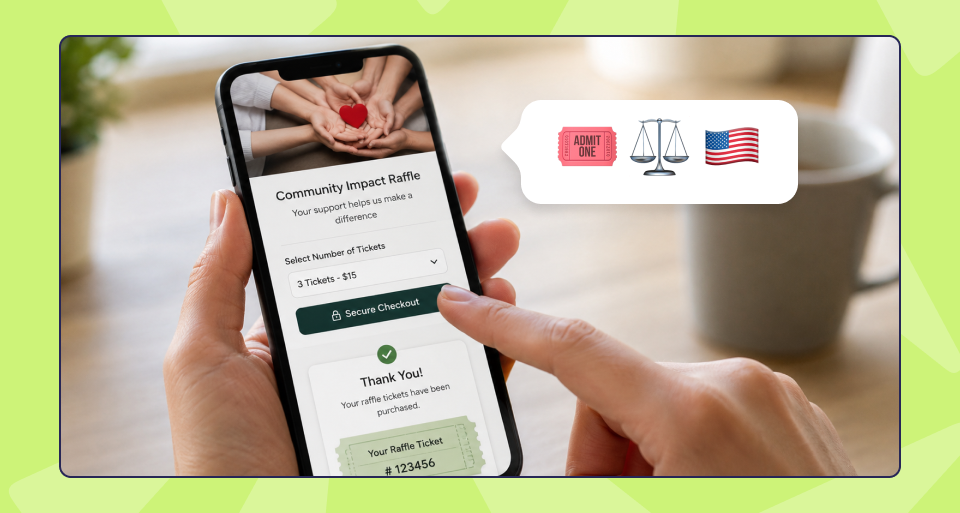
Whether a nonprofit can sell raffle tickets online depends entirely on the state, and it is the single most misunderstood question in raffle compliance. Some states expressly allow it, some expressly ban it, and many simply never addressed it, which leaves nonprofits guessing.
This table summarizes how state laws treat online raffle ticket sales in 2026:
| Online-sales status | What it means | Example states |
|---|---|---|
| Expressly allowed, with restrictions | Online/mobile sales permitted, but only under geographic, eligibility, age-verification, or timing conditions | New York (geo + 180-day limits), North Dakota, Maine, West Virginia |
| Allowed for nonprofits, constrained | Nonprofits may sell out of state only if not prohibited where the buyer resides; restrictions must be disclosed | Montana |
| Expressly prohibited | Internet sales of raffle tickets are banned | California |
| Limited to order forms / non-sale handling | Some electronic handling allowed; a downloaded order form is not itself a sale | Washington, Wisconsin |
| Not expressly authorized (silent statute) | Statute does not mention online sales; a physical drawing is often assumed, so confirm with the regulator | Texas, Ohio, North Carolina, Pennsylvania, New Mexico |
| Paid online sales not viable | A required paid ticket is itself unlawful, so paid online ticket sales are not an option (not merely “unaddressed”) | Florida |
A few specifics worth knowing:
- New York permits online and mobile raffle ticket purchases by credit or debit card, but only within its games-of-chance framework: age verification, privacy/security rules, the geographic and local-law limits in subdivision 13, and a rule that sales may not start more than 180 days before the raffle (NY Gen. Mun. Law Section 189; Section 190-a). This is not the same as nationwide online ticket sales.
- Montana allows nonprofit online sales, but with constraints: a nonprofit may sell raffle tickets outside Montana only if the purchase is not prohibited where the buyer resides, and any internet announcement or advertisement must disclose that sale restriction along with the organization’s name and the raffle terms (Montana Code 23-5-413).
- California prohibits operating or conducting a raffle over the internet; tickets cannot be sold, traded, or redeemed online, though you may advertise online (California DOJ Raffles).
- Florida is different in kind: because a required paid ticket is itself unlawful, paid online ticket sales are not simply “unaddressed” — they are not a viable option at all (Florida Statutes Section 849.0935).
- Washington’s enhanced raffles allow sales by mail, fax, phone, and in person, and let you post order forms online, but a downloaded form is not itself a sale (Washington RCW Chapter 9.46).
- Many states, including Texas, Ohio, North Carolina, and Pennsylvania, have statutes that predate online fundraising and simply do not mention electronic sales. When the law is silent, the conservative reading is that fully online ticket sales may not be permitted, and you should confirm with your regulator.
This is exactly the kind of rule changing right now.
Ohio’s House Bill 476, which passed the Ohio House in November 2025, would explicitly authorize fully online charitable raffles, including digital ticket sales and remote winner selection. As of spring 2026 it was still pending in the Ohio Senate (Ohio House Bill 476).
RallyUp Tip
Because online-sales rules vary so much, build your raffle on a platform that lets you control where and how tickets are sold and that keeps clean records for reporting. RallyUp’s online raffles run in states that allow online sales and support in-person and hybrid formats for states that require a physical component, so your compliance posture drives the setup, not the other way around. If you are still comparing tools, see RallyUp’s roundup of the best online raffle websites.
What are the raffle laws in the 10 biggest states?
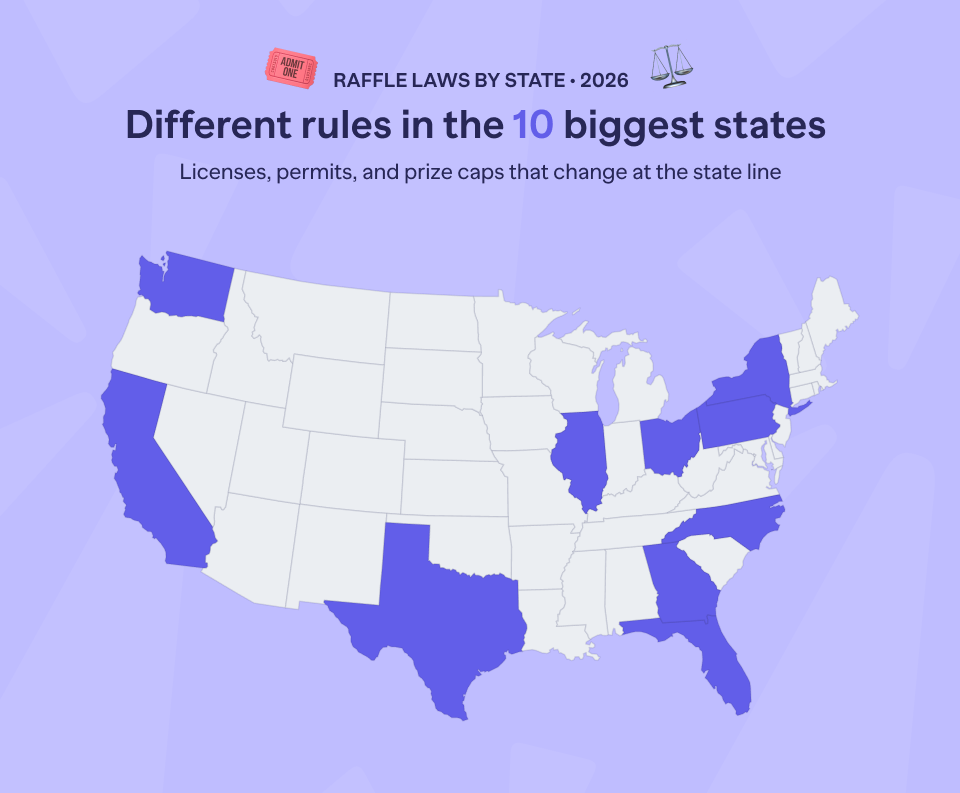
The 10 most populous states each regulate raffles differently, ranging from no license at all (Texas, Florida, North Carolina) to strict state registration (California) and local sheriff permits (Georgia).
Below are detailed breakdowns, current as of 2026. (For ideas beyond raffles, RallyUp’s list of fundraising ideas for nonprofits is a useful companion.)
Always verify the live rules before launching, because legislatures amend these laws frequently.
What are the raffle rules in California in 2026?
California allows charitable raffles only as a narrow exception to its anti-lottery rule, and it is one of the strictest states. Eligible nonprofits must have been qualified to do business in California for at least one year and must register annually with the Attorney General’s Registry of Charities and Fundraisers using Form CT-NRP-1, and receive written confirmation, before selling any tickets.
- Who can run one: Tax-exempt nonprofits in eligible Revenue and Taxation Code categories. Religious organizations, educational institutions, and hospitals are exempt from registration and reporting, but they must still comply with all of the substantive raffle rules (90% requirement, supervision, no internet sales, and so on).
- License: Yes. Annual registration with a $30 fee and written confirmation before any ticket is sold, plus an annual raffle report (CT-NRP-2) due February 1.
- Key limits: At least 90% of gross ticket receipts must go to charitable purposes in California; a person 18 or older must supervise; standard 50/50 raffles are generally illegal for ordinary charities.
- Online sales: Prohibited. You may advertise online but cannot sell, trade, or redeem tickets over the internet.
- Citation: Cal. Penal Code Section 320.5 (California DOJ Raffles).
What are the raffle rules in Texas in 2026?
Texas is famously permissive: the Charitable Raffle Enabling Act lets qualified organizations run raffles without a state license. The trade-off is a tight set of conditions, including a hard cap on how often you can run a raffle.
- Who can run one: Qualified nonprofits (generally in existence three years with 501(c) status), qualified religious societies (10 years in Texas), volunteer fire departments, and volunteer EMS organizations.
- License: None required by the state.
- Key limits: No cash prizes; most prizes capped at $75,000 ($750,000 for a residential dwelling); an organization is not authorized to conduct a raffle once it has awarded prizes in four other raffles during the same calendar year — i.e., a cap of four raffles per calendar year; tickets must list the organization, price, prize, and drawing date.
- Online sales: Not authorized. Statewide promotion and paid mass-media advertising are barred; you may promote to existing supporters by email, website, and social media.
- Citation: Tex. Occ. Code Chapter 2002, Sections 2002.052 and 2002.056 (Tex. Occ. Code Sections 2002.052 and 2002.056).
What are the raffle rules in New York in 2026?
New York is the rare large state that expressly permits online raffle ticket sales, making it a useful model for where the country may be heading. Raffles are regulated as “games of chance” by the New York State Gaming Commission, with a layer of municipal licensing on top.
- Who can run one: Religious, charitable, educational, fraternal, service, and veterans organizations that have served their lawful purpose for at least one year.
- License: No state registration if expected net proceeds are under $5,000 per raffle and under $30,000 per year. Above that, you need a Games of Chance Identification Number plus municipal authorization.
- Key limits: Single prize cap of $300,000; series cap of $500,000; no organization may award more than $3,000,000 in raffle prizes per license period; under-18s may not play or operate.
- Online sales: Expressly allowed, but with conditions. Tickets may be bought online or by mobile app with a debit or credit card only within New York’s games-of-chance framework, including age verification, privacy and security rules, and the geographic/local-law limits in subdivision 13. Ticket sales may not begin more than 180 days before the raffle. This is not the same as unrestricted nationwide online sales.
- Citation: N.Y. General Municipal Law Article 9-A, Sections 189 and 190-a (NY Gen. Mun. Law Section 189; Section 190-a).
What are the raffle rules in Florida in 2026?
Florida is an important exception to the paid-ticket raffle model. Florida Statutes Section 849.0935 authorizes charitable “drawings by chance” (often called raffles), but it expressly makes it unlawful to require an entry fee, donation, or proof of purchase as a condition of entering or winning. In other words, a Florida charitable drawing must be free to enter, so it does not fit the paid-ticket raffle format used in most other states.
- Who can run one: Organizations exempt under 26 U.S.C. 501(c)(3), (4), (7), (8), (10), or (19) with a current IRS determination letter. No minimum time in existence.
- License: None required.
- Key limits: You may not require an entry fee, donation, payment, proof of purchase, or contribution as a condition of entering or winning; every ticket and ad must disclose the rules, the organization’s name and address, the source of all prizes, the drawing date, time, and place, and that no purchase or contribution is necessary.
- Online (paid) ticket sales: Effectively not available in the paid sense. Because Florida bars any required payment to enter, selling paid raffle tickets online is the core problem, not a gap the statute simply left unaddressed.
- Citation: Fla. Stat. Section 849.0935 (Florida Statutes Section 849.0935).
What are the raffle rules in Pennsylvania in 2026?
Pennsylvania regulates raffles under its Small Games of Chance Act, and it is unusually local. Eligible organizations get licensed through the county or municipality, and small games of chance are only legal in municipalities that approved them by voter referendum.
- Who can run one: Charitable, religious, fraternal, veterans, and civic nonprofits, generally in existence at least one year, that hold a Small Games of Chance license.
- License: Yes, from the county or municipal licensing authority. Special raffle permits are available for prizes above the standard limit, up to $150,000.
- Key limits: Prize and annual gross-receipts caps apply; 50/50 drawings are treated as raffles within the Act’s limits; rules are partly set at the local level.
- Online sales: Not clearly authorized; treat fully online sales as not approved without specific written guidance.
- Citation: 10 P.S. Sections 311 et seq. (Pennsylvania Department of Revenue Small Games of Chance).
What are the raffle rules in Ohio in 2026?
Ohio lets many nonprofits run raffles without a bingo license, which makes it one of the easier large states for an occasional raffle. The big story in Ohio is legislative: a 2025 bill would legalize fully online raffles.
- Who can run one: 501(c)(3) charities and certain (c)(4), (c)(6), (c)(7), (c)(8), (c)(10), and (c)(19) organizations, plus listed schools. The “charitable organization” definition requires two years of continuous Ohio existence.
- License: A qualifying not-for-profit raffle does not require a bingo license; the Attorney General oversees charitable gaming.
- Key limits: 501(c)(3) groups may keep 100% of net proceeds; other eligible categories must direct at least 50% of net profit to a charitable purpose.
- Online sales: Not currently authorized; Ohio has historically required a physical drawing. House Bill 476 would change this and passed the Ohio House in November 2025.
- Citation: Ohio Rev. Code Section 2915.092 (Ohio Rev. Code 2915.092).
What are the raffle rules in Illinois in 2026?
Illinois authorizes raffles under the Raffles and Poker Runs Act, but it delegates most of the work to local governments. Your county or municipality issues the license and sets many of the specific limits, so two Illinois towns can have very different ceilings.
- Who can run one: Qualified charitable, religious, educational, fraternal, veterans, and labor organizations; many local ordinances require five years of continuous existence.
- License: Yes, issued by the local government (municipality or county) under the state Act. Some areas auto-grant certain license classes; others require an application and a fidelity bond.
- Key limits: Local ordinances set prize ceilings, maximum ticket price, the number of raffle events per year, and the sales period.
- Online sales: Not clearly authorized statewide; confirm with the local licensing authority.
- Citation: 230 ILCS 15 (Raffles and Poker Runs Act) (Illinois General Assembly 230 ILCS 15).
What are the raffle rules in Georgia in 2026?
Georgia is the state where the sheriff is in charge. Under O.C.G.A. Section 16-12-22.1, only nonprofit, tax-exempt organizations licensed by their local sheriff may operate raffles, and unlicensed raffles are treated as commercial gambling.
- Who can run one: Nonprofit, tax-exempt churches, schools, civic organizations and support groups, and 501(c) organizations, in existence for at least 24 months.
- License: Yes, from the county sheriff, with an annual fee of up to $100. An organization operating in multiple counties only needs a license from its headquarters county.
- Key limits: For-profit partners cannot manage or operate the raffle, even as consultants; raffles must be run on premises the organization owns or leases; an annual receipts-and-expenditures report is due by April 15.
- Online sales: Not addressed in the statute; confirm with your sheriff’s office.
- Citation: O.C.G.A. Section 16-12-22.1 (Georgia Code 16-12-22.1).
What are the raffle rules in North Carolina in 2026?
North Carolina makes raffles straightforward: no state license or registration is required, but the statute sets clear caps and an annual limit on raffles. The rules live in G.S. 14-309.15.
- Who can run one: Nonprofit organizations, plus candidates, political committees, and government entities. A regional or county chapter may run raffles independently of its parent.
- License: None required by the state.
- Key limits: A nonprofit may hold no more than five raffles per year; maximum cash prize of $125,000 per raffle and $250,000 in cash prizes per year; real-property prizes capped at $2,250,000 per year; at least 90% of net proceeds must go to the charitable purpose; raffles may not be run alongside bingo.
- Online sales: Unaddressed in the statute.
- Citation: N.C. Gen. Stat. Section 14-309.15 (NC G.S. 14-309.15).
What are the raffle rules in Washington in 2026?
Washington runs a tiered system through the State Gambling Commission. Small member-only raffles need no license, while larger raffles, and the high-value “enhanced raffles,” require licensing and auditing.
- Who can run one: Bona fide charitable or nonprofit organizations organized primarily for purposes other than raffles, in continuous operation for at least 12 months.
- License: None required if annual gross raffle revenue is $5,000 or less and tickets are sold only to members; above that, a Gambling Commission license is required. Enhanced raffles always require a license.
- Key limits: Standard raffle tickets capped at $100 each; enhanced raffles (high-value, state-licensed raffles with grand prizes that can reach into the millions) allow tickets up to $250 and grand prizes up to $10,000,000, with independent audits required; records must be kept for one year.
- Online sales: Standard raffles are not expressly authorized online; enhanced raffles allow sales by mail, fax, phone, and in person, with online order forms permitted but not online sales themselves.
- Citation: RCW Chapter 9.46 (Washington RCW Chapter 9.46).
Raffle laws for 501 (c) nonprofits in all 50 states at a glance
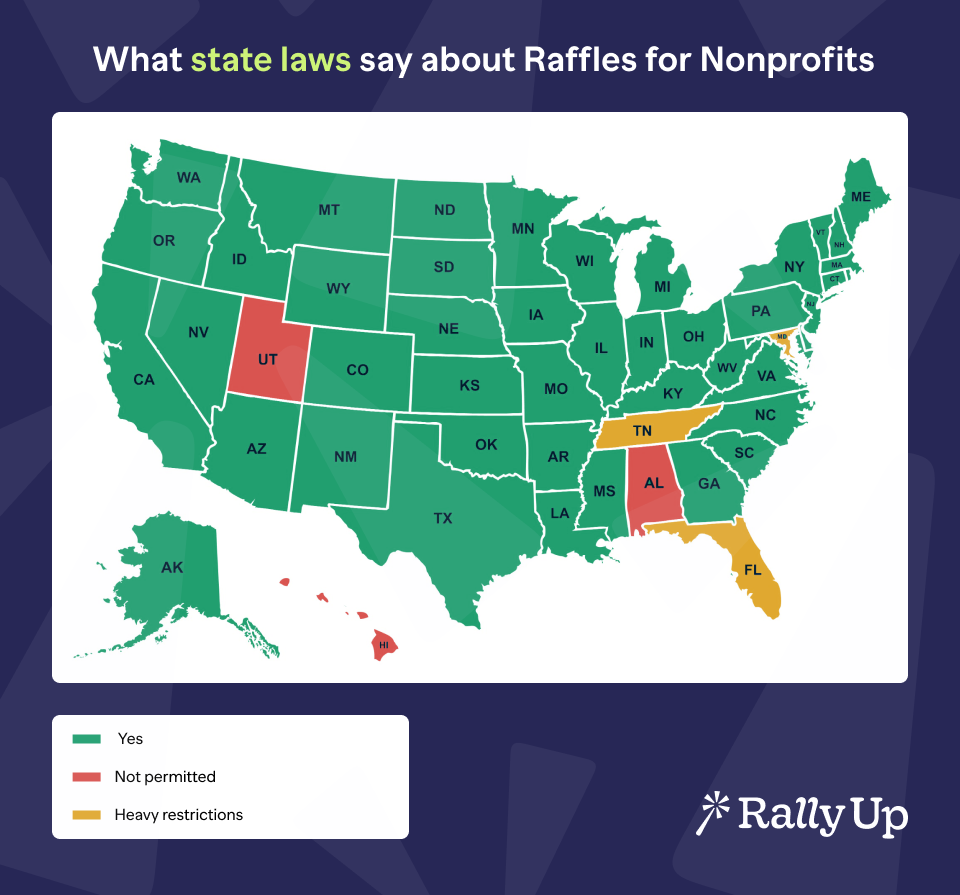
This table is a fast orientation to charitable raffle rules in every state; verify the live rules with the linked regulator before you launch. “License” reflects the most common requirement; many states add local permits on top.
| State | State Law Says | License/registration | Online sales | Primary law |
|---|---|---|---|---|
| Alabama | Restricted (no state exemption) | None statewide | Not permitted | Ala. Const. Art. IV, Sec. 65; Ala. Code Tit. 13A |
| Alaska | Yes | Permit via charitable gaming | Not expressly authorized | AS Tit. 5, Ch. 15 |
| Arizona | Yes | No general license | Unaddressed | A.R.S. 13-3302 |
| Arkansas | Yes | Annual bingo/raffle permit (DFA) | Unaddressed | Ark. Code 23-114-101 |
| California | Yes | Annual AG registration ($30) | Prohibited | Cal. Penal Code 320.5 |
| Colorado | Yes | License (Dept. of Revenue) | Not expressly authorized | C.R.S. Tit. 44, Art. 30 |
| Connecticut | Yes | Permit (Dept. of Consumer Protection) | Not expressly authorized | Conn. Gen. Stat. Ch. 98 |
| Delaware | Yes | Permit (Board of Charitable Gaming) | Unaddressed | Del. Code Tit. 28, Ch. 15 |
| Florida | Drawing only (no required payment) | None | Paid sales not viable | Fla. Stat. 849.0935 |
| Georgia | Yes | Sheriff license (up to $100/yr) | Unaddressed | O.C.G.A. 16-12-22.1 |
| Hawaii | Restricted (gambling prohibited) | None | Not permitted | HRS Ch. 712 |
| Idaho | Yes | License (charitable gaming) | Not expressly authorized | Idaho Code Tit. 67, Ch. 77 |
| Illinois | Yes | Local license under state Act | Confirm locally | 230 ILCS 15 |
| Indiana | Yes | Charitable gaming license | Not expressly authorized | Ind. Code Art. 4-32.3 |
| Iowa | Yes | License/certification (DIA) | Not expressly authorized | Iowa Code Ch. 99B |
| Kansas | Yes | None under $25,000/yr; license above | Electronic devices barred | K.S.A. 75-5171 et seq. |
| Kentucky | Yes | License (charitable gaming) | Not expressly authorized | KRS Ch. 238 |
| Louisiana | Yes | License (Office of Charitable Gaming) | Not expressly authorized | La. R.S. Tit. 4 |
| Maine | Yes | License; internet-raffle category exists | Allowed; internet-raffle license | 17 M.R.S. 1837-A, 1837-B |
| Maryland | Yes (limited contexts) | Often county/local permit | Unaddressed | Md. Bus. Reg. Tit. 6 |
| Massachusetts | Yes | Local permit + AG filing | Not expressly authorized | M.G.L. Ch. 271, 7A |
| Michigan | Yes | Raffle license (Lottery Charitable Gaming) | Not expressly authorized | Traxler-McCauley-Law-Bowman Act |
| Minnesota | Yes | Board license (some exclusions) | Not openly authorized | Minn. Stat. 349.173 |
| Mississippi | Yes (charitable gaming) | Charitable bingo/raffle oversight (Gaming Commission) | Not expressly authorized | Miss. Code Tit. 97, Ch. 33 |
| Missouri | Yes | License (Gaming Commission) | Unaddressed | Mo. Rev. Stat. Ch. 313 |
| Montana | Yes | DOJ Gambling Control oversight | Allowed for nonprofits, constrained | Mont. Code 23-5-413 |
| Nebraska | Yes | Permit (lottery/gift enterprise) | Unaddressed | Neb. Rev. Stat. 9-402 |
| Nevada | Yes | Register with Gaming Control Board Chair | Allowed with approval | NRS Ch. 462 |
| New Hampshire | Yes | Lottery Commission registration | Not expressly authorized | N.H. RSA Ch. 287-A |
| New Jersey | Yes | License (Legalized Games of Chance) | Not expressly authorized | N.J.S.A. 5:8-50 et seq. |
| New Mexico | Yes | Operator’s license (Gaming Control Board) | Not authorized | NMSA Ch. 60, Bingo & Raffle Act |
| New York | Yes | ID number + municipal license over thresholds | Allowed with geo/age/180-day limits | N.Y. Gen. Mun. Law Art. 9-A |
| North Carolina | Yes | None | Not expressly authorized | N.C.G.S. 14-309.15 |
| North Dakota | Yes | Annual AG license | Allowed with conditions | N.D.C.C. Ch. 53-06.1 |
| Ohio | Yes | No bingo license for qualifying raffles | Pending (HB 476) | Ohio R.C. 2915.092 |
| Oklahoma | Yes (qualified orgs) | No state license; voluntary-contribution exception | Allowed via platform (AG Op. 2024-7) | 21 O.S. Section 1051 |
| Oregon | Yes | License (DOJ Charitable Gaming) | Unaddressed | ORS 167.117-167.118 |
| Pennsylvania | Yes | Local Small Games of Chance license | Not clearly authorized | 10 P.S. 311 et seq. |
| Rhode Island | Yes | State charitable gaming license | Not expressly authorized | R.I.G.L. Tit. 11, Ch. 19 |
| South Carolina | Yes | Annual raffle registration (SOS) | Unaddressed | S.C. Code 33-57-100 |
| South Dakota | Yes | Lottery/raffle authority; local + state rules | Not expressly authorized | S.D. Const. Art. III, Section 25; SDCL 22-25A |
| Tennessee | Limited (501(c)(3)/(c)(19), annual approval) | Legislative approval process | Unaddressed | Tenn. Code 39-17-501 |
| Texas | Yes | None | Not authorized | Tex. Occ. Code Ch. 2002 |
| Utah | Restricted (prohibited) | None | Not permitted | Utah Code 76-9-1401 |
| Vermont | Yes | Nonprofit gaming authority (limits + reporting) | Not expressly authorized | 13 V.S.A. Section 2143 |
| Virginia | Yes | Permit (Office of Charitable Gaming) | Not expressly authorized | Va. Code 18.2-340.16 |
| Washington | Yes | None under $5,000/yr; license above | Limited (enhanced raffles) | RCW Ch. 9.46 |
| West Virginia | Yes | License (narrow no-license exception) | Allowed; online license $500/yr | W. Va. Code Ch. 47, Arts. 21, 21A |
| Wisconsin | Yes | License (Dept. of Administration) | Limited, not fully online | Wis. Stat. Ch. 563 |
| Wyoming | Yes | No statewide raffle license found | Unaddressed | W.S. 6-7-101(a)(iii)(H) |
Note:
Tennessee permits raffles only for 501(c)(3) and 501(c)(19) organizations and requires an annual approval process through the legislature, making it one of the more restrictive “legal” states.
Oklahoma authorizes qualified organizations to raise funds through numbered tickets and voluntary contributions, with the drawing supervised by an organization official and conducted by members without compensation (21 O.S. Section 1051).
Vermont authorizes nonprofit lotteries, raffles, and games of chance under 13 V.S.A. Section 2143. As always, confirm the current rules with the state before launching.
RallyUp in Action: USA Field Hockey case study
USA Field Hockey ran online raffles using live team leaderboards to drive peer competition. The result: $120,000 raised in 10 days, a 300% increase over the prior year, funding scholarships and athlete development. It is a clear example of how much a well-run raffle program can do when the format fits the rules and the audience. Source: RallyUp Case Studies — USA Field Hockey.
What is changing in raffle law in 2024 to 2026?
Raffle law is not static, and 2024 to 2026 brought meaningful movement, especially around online sales and licensing. These are the changes nonprofits should watch.
- Ohio HB 476 (online raffles): This bill would explicitly authorize fully online charitable raffles, including online ticket sales, digital ticket delivery, and remote winner selection. It passed the Ohio House on November 19, 2025, and was pending in the Senate as of spring 2026 (Ohio HB 476).
- Delaware annual raffle license (HB 389 / HS 1, 2024): Delaware enacted a new annual raffle license framework allowing up to 20 raffle events per year, with a $300 annual fee, 7-day advance notice, and 60-day post-event reporting. Signed September 2024, effective six months later (Delaware General Assembly).
- Ongoing online-sales modernization: New York’s express authorization of online and mobile raffle purchases continues to be the template other states are studying as digital fundraising becomes the norm.
The takeaway: even if you ran a compliant raffle two years ago, re-check your state’s rules before your next one. Caps, fees, and online-sales rules are exactly the provisions legislatures keep revisiting.
Is there a federal raffle law? Taxes and reporting
There is no federal statute that licenses charitable raffles — eligibility, licensing, and prize caps are all set at the state level. But “no federal raffle license” does not mean “no federal rules.”
The IRS treats raffles as a form of gaming, and a tax-exempt organization that runs them takes on federal reporting, withholding, and tax-status obligations that apply on top of whatever the state requires.
- Reporting winnings (Form W-2G): A tax-exempt organization that conducts gaming may have to report a participant’s winnings to the IRS on Form W-2G. For a raffle (treated like a sweepstakes, wagering pool, or lottery), reporting is generally required when winnings (reduced by the wager) are $2,000 or more in calendar year 2026 and at least 300 times the wager, with the threshold adjusted for inflation after 2025 (IRS Instructions for Forms W-2G and 5754).
- Withholding (the 24% rule): Regular gambling withholding of 24% applies when proceeds (winnings minus the wager) from a sweepstakes, wagering pool, or lottery exceed $5,000. If a noncash prize over that threshold is awarded and the winner does not pay the withholding, the organization may have to cover it, and “backup withholding” can apply when a winner does not furnish a correct taxpayer identification number (IRS Instructions for Forms W-2G and 5754).
- Remitting what you withhold (Form 945): Income tax withheld from raffle and other gaming winnings is reported and paid to the IRS using Form 945, Annual Return of Withheld Federal Income Tax (IRS Publication 3079, Tax-Exempt Organizations and Gaming).
- Effect on tax-exempt status and UBI: IRS Publication 3079 explains that gaming — which expressly includes raffles — is generally not a tax-exempt purpose. Gaming revenue can be treated as unrelated business income (UBI) and, if gaming becomes a substantial part of an organization’s activities, it can jeopardize tax-exempt status. The publication walks through when gaming income is taxable and what records to keep (IRS Publication 3079).
The practical takeaway: even in the most permissive states, build your raffle so you can capture winner information, calculate proceeds against the wager, withhold when required, and file Forms W-2G and 945 on time. Clean records are not just a state-compliance nicety — they are how you meet these federal obligations and protect your exempt status.
How do you run a compliant raffle from one place?
To run a compliant raffle, confirm three things in your state first: whether your organization is eligible, whether you need a state or local license (or both), and whether you can sell tickets online or must hold a physical drawing.
Those three answers shape everything else, from how you price tickets to how you advertise and where supporters can buy in.
If your state allows online sales, an online raffle is usually the highest-yield option, because it removes friction and lets supporters share the campaign with their own networks. If your state requires a physical drawing or restricts online sales, you can still run a strong in-person or hybrid raffle, selling tickets at events and drawing live while keeping the digital pieces (promotion, records, receipts) clean.
And if you are in Alabama, Hawaii, or Utah, a no-purchase-necessary sweepstakes is the compliant way to capture the same excitement.
Whatever format your state allows, the operational burden is the same: clear ticketing, accurate records, automatic receipts, and reporting you can hand to a regulator. This is where running everything from one platform matters.
RallyUp is an end-to-end fundraising platform built for nonprofits. It supports single-prize, multi-prize, and 50/50 raffles (where half the pot goes to one winner and the other half to your nonprofit), online and in-person formats, peer-to-peer ticket selling, and the recordkeeping you need for state reports. Because raffles can be combined with auctions, crowdfunding, and sweepstakes in a single campaign, you can match the format to your state’s rules without juggling separate tools.
Before you launch a raffle for 501 (c) nonprofit
Raffles remain one of the most effective and beloved fundraisers in the nonprofit playbook, but “legal in most states” is not the same as “legal everywhere, every way.” The rules differ on who can run a raffle, what you can give away, whether you need a license, and whether you can sell a ticket online.
The nonprofits that win with raffles are the ones that check the rules first, build the campaign to fit, and keep clean records.
Confirm your state’s current requirements with your attorney general or gaming commission, then build the compliant version. When you are ready, start building your raffle with RallyUp’s raffle platform, or review RallyUp’s full-stack fundraising to see how online, in-person, and hybrid raffles work in one place.
FAQs on raffle laws by state
Are raffles legal in all 50 states?
Not in the same way — most states authorize some form of charitable raffle, drawing, or charitable gaming, but not every state allows the same paid-ticket format. Alabama, Hawaii, and Utah are the clearest no-go states for paid charitable raffles, treating them as unlawful lotteries or gambling. Florida and several others require additional qualification — for example, Florida authorizes charitable drawings but bars any required payment to enter, so it does not fit the paid-ticket model used elsewhere. Even among states that allow paid raffles, licensing, prize caps, and online-sales rules differ significantly. In restricted states, a no-purchase-necessary sweepstakes is usually the compliant alternative — though sweepstakes carry their own state registration and disclosure rules.
Do nonprofits need a license to run a raffle?
It depends on the state — some require none, some require state registration, and some require a local or sheriff permit. Some states require no license at all (including Texas, Florida, and North Carolina), some require state registration (such as California’s annual Attorney General filing with a $30 fee), and others require a local permit from a county, municipality, or even the sheriff (as in Georgia and Pennsylvania). A handful of states, such as Washington and Kansas, only require a license once you exceed a revenue threshold, often around $5,000 to $25,000 per year. Always confirm with your state’s charitable-gaming regulator before selling tickets.
Can nonprofits sell raffle tickets online?
Sometimes — New York, North Dakota, Maine, West Virginia, and Montana allow it (under conditions), California bans it, and many states never addressed it. This is the most state-specific question in raffle compliance. Those states permit online or electronic raffle ticket sales for licensed nonprofits, but with geographic, eligibility, licensing, age, or timing conditions, while California expressly prohibits selling tickets over the internet. Many states, including Texas and Ohio, simply never addressed online sales in their statutes, which often implies a physical drawing is expected; Florida is a special case because its drawings must be free to enter, so paid online sales are not viable there at all. Ohio’s pending House Bill 476 would explicitly legalize fully online raffles, a sign that more states may follow.
What is a 50/50 raffle and is it legal?
A 50/50 raffle splits the pot between one winner and the nonprofit; its legality varies by state and some ban cash-prize raffles entirely. In a 50/50, half the pot goes to one winner and the other half to your nonprofit. Many states treat it as an ordinary cash-prize raffle subject to standard rules, but some restrict or prohibit cash-prize raffles entirely — California, for example, generally bars standard 50/50 raffles for ordinary charities and only allows them under a separate program for major-league sports teams. Confirm your state’s treatment of cash prizes before planning a 50/50.
What is the difference between a raffle and a sweepstakes?
A raffle requires payment to enter (making it gambling), while a sweepstakes offers a free method of entry — so a properly run sweepstakes can generally be offered nationwide where a paid raffle cannot. Because a sweepstakes removes the “consideration” element, it sidesteps the gambling definition that makes paid raffles unlawful in restricted states. Sweepstakes are not regulation-free, though: they carry their own state requirements for registration, bonding or trust accounts, disclosures, winner lists, and advertising (for example, New York requires certain promotions over $5,000 to file with the Secretary of State and post a bond or trust account under Gen. Bus. Law Section 369-e). For nonprofits in Alabama, Hawaii, or Utah — or any organization that wants to take online entries without raffle restrictions — a properly structured sweepstakes is often the better legal fit.
What happens if a nonprofit runs an illegal raffle?
Penalties range from voided proceeds to misdemeanor charges, plus damage to donor trust and your standing with regulators. In North Carolina, for instance, a violation is a Class 2 misdemeanor and can bar the organization from conducting a raffle for one year. Beyond legal penalties, an improper raffle can damage donor trust and your nonprofit’s standing with regulators, which is why confirming the rules first is always worth the time.
How much of the proceeds must go to charity?
Many states require a minimum share — commonly 90% — of proceeds to go to your charitable purpose. California and North Carolina both require at least 90% to benefit the charitable purpose, while Ohio requires 501(c)(3) groups to keep proceeds for charity and requires certain other nonprofit categories to direct at least 50% of net profit to a charitable use. Check your state’s specific percentage and whether it applies to gross or net receipts, because the difference is significant.
How often can a nonprofit hold a raffle?
Limits vary widely — Texas caps a qualified organization at four raffles per calendar year, North Carolina allows up to five per year, and Delaware permits up to 20 events under an annual license. Texas bars an organization from conducting a raffle once it has awarded prizes in four other raffles during the same calendar year, and North Carolina caps a nonprofit at five raffles per year under G.S. 14-309.15. Some states set no explicit event cap and instead limit the number of license periods or the total annual prize value. Verify both the event-count limit and any annual prize or revenue cap in your state before scheduling multiple raffles.
Where can I find my state’s official raffle rules?
Check your state’s attorney general charities division, gaming/gambling commission, or secretary of state — the agencies that write and enforce raffle rules. For example, California publishes raffle guidance through the Attorney General’s Registry of Charities and Fundraisers, New York through its Gaming Commission, and Georgia through your county sheriff’s office. This article links the primary statute or regulator for each state, but rules change frequently, so always confirm the current requirements directly with the agency before you launch.
Can a fundraising platform like RallyUp handle raffle compliance for me?
No platform can give legal advice or waive a state’s rules, but RallyUp makes running the compliant version easier once you know what your state allows. RallyUp does not write or enforce raffle law. What an end-to-end platform does is make the compliant version easier to run: it supports online, in-person, and hybrid raffles, single-prize, multi-prize, and 50/50 formats, and keeps the clean ticketing and reporting records most state regulators expect. For example, USA Field Hockey used RallyUp online raffles to raise $120,000 in 10 days, a 300% increase over its prior record (RallyUp case study). Confirm eligibility, licensing, and online-sales rules with your regulator first, then use the platform to execute.
Now that you’ve seen it in action, are you ready to start fundraising?
Get Started