12 Leading Crowdfunding Sites & Platforms For Nonprofits In 2026
The easiest fundraising platform for most nonprofits
- RallyUp is genuinely, seriously easy to use. Most organizations build and launch a crowdfunding campaign in 15–20 minutes from an Instant Fundraiser Template, and the average time to a first campaign launch is about three hours.
- And it does dramatically more. Crowdfunding is one of 12+ stackable Components — you can add a raffle, an auction, or a Donation Page to the same campaign without starting over.
- Donation Pages are free with no donor tipping required, and there are no contracts, subscriptions, or setup fees.
- Real people answer the phone. An AI-powered chatbot handles quick questions; free human fundraising experts are available by chat and by phone on every plan.
- The platforms below are the alternatives worth knowing, and where each one runs out of road.
A flooded basement, a shelter that’s out of medical funds, a youth center that needs a new roof — the fastest path from “we need help” to “we have the money” is usually a crowdfunding campaign. Roughly half of Americans say they’ve donated to charity in the past year, and most of that giving now happens online, in response to a single shareable link.
The platform you pick decides how much of that generosity actually reaches your crowdfunding campaign versus how much gets eaten by fees, tipping prompts, and setup friction. Below, we’ve compared the best crowdfunding sites for nonprofits — what each one does well, and the point at which you’d need something more.
In this article
- The short answer: start with RallyUp
- What do you mean by crowdfunding?
- What changes when you're ready to grow
- 11 other crowdfunding sites for nonprofits worth knowing
- Must-have features in a crowdfunding platform
- How to choose the right crowdfunding site for your nonprofit
- Ready to launch your crowdfunding campaign?
- FAQs on crowdfunding for nonprofits
The short answer: start with RallyUp
RallyUp is genuinely, seriously easy to use. If you’re running one campaign — a crowdfunding push, a donation drive, a raffle — you can build it and launch it the same afternoon. About 40% of new RallyUp campaigns start from an Instant Fundraiser Template, which drops a complete, pre-built campaign in front of you instead of a blank form; a typical build-and-launch takes 15–20 minutes, and the average across all new organizations is roughly three hours from first login to a live campaign. Ease is the single most-cited strength in RallyUp reviews, with a 4.5/5 ease-of-use score on G2 and a 4.8/5 overall rating. If you’d rather not build at all, Create My Campaign hands the setup to RallyUp’s team for free.
And it does dramatically more than a single-purpose crowdfunding tool. On RallyUp, crowdfunding is one of 12+ stackable Components that live inside a single Campaign, behind one URL and one checkout. A donor can give to your crowdfunding goal, buy a raffle entry, and bid on an auction item in one transaction instead of three — and you can add a new Component to a campaign that’s already live, with no rebuild.
Three things separate it from the alternatives below. Easier: templates and a free expert build mean the campaign exists before you’ve finished your coffee. Faster: Power Preview lets you run real test card transactions all the way through checkout before you publish, so you’re not debugging a live campaign in front of your donors. Cheaper: Donation Pages are free with no donor tipping required, the Free plan carries a $0 platform fee, and there are no contracts, subscriptions, or setup fees to sign before you find out whether the thing works.
| What matters most | RallyUp | Typical alternative |
|---|---|---|
| Launching one campaign | Build and launch in 15–20 minutes from an Instant Fundraiser Template; 40% of new campaigns start that way | Blank forms, cosmetic themes, or a planning worksheet |
| Free expert build | Create My Campaign builds it for you at no cost, in about one business day | Not offered, or bundled into paid onboarding |
| Testing before you publish | Power Preview runs real test card transactions through checkout | Non-transacting previews or campaign-level test receipts, if offered at all |
| Fundraise free | Free plan with a $0 platform fee; Donation Pages free with no donor tipping required | Free only while donor tipping is on, or a flat platform fee once it’s off |
| Getting help | AI-powered chatbot plus free human fundraising experts by chat and phone on every plan | Chat and email free; phone support often behind a paid tier |
| Raffles, sweepstakes, and events | Built in as stackable Components, alongside crowdfunding | Usually a separate tool or not offered at all |
| When you’re ready to grow | 12+ stackable Components in one Campaign — one URL, one checkout — and you can add Components to a live Campaign without rebuilding | A separate campaign or form for every new activity |
What do you mean by crowdfunding?
Crowdfunding means raising money from a large number of people, usually online, through a shared campaign page rather than one-on-one asks. For a nonprofit, that typically means a single, shareable page with a goal, a story, and a donate button that anyone can reach in one click.
Types of crowdfunding campaigns you can run
- Donation-based: Supporters give with nothing expected in return — the most common model for nonprofit crowdfunding.
- Reward-based: Donors receive a perk, product, or experience in exchange for giving at certain levels.
- Membership or subscription-based: Supporters commit to recurring giving in exchange for ongoing access or updates.
Note: Raffles and sweepstakes have different legal requirements depending on your location. Check with legal counsel or your local regulations before running these types of campaigns.
What changes when you’re ready to grow
Most nonprofits start with one campaign type, and about nine out of ten RallyUp campaigns stay that way. But crowdfunding rewards organizations that combine formats, and that’s where the platform choice starts to compound.
RallyUp calls this Full Stack Fundraising: 12+ stackable Components that live inside a single Campaign, behind one URL and one checkout. Organizations that combine multiple campaign types raise 38% more than those running a single format — a raffle add-on to a crowdfunding goal, or a Donation Page next to an auction, instead of three separate links to manage. You can also add a Component to a Campaign that’s already live — no rebuild, no second URL, no asking your donors to bookmark something new.
A few things that make the growing part less painful:
- Power Preview. RallyUp’s interactive pre-publish preview lets you test drive a campaign end to end — real test card transactions through the actual checkout, test bids, test receipts, test reports — before a single donor sees it.
- The AI Fundraising Content Generator. It drafts your campaign description, prize and item copy, and donor emails from inside the builder — no prompt writing. Treat it as a co-pilot: you’re still editor-in-chief.
- Done-for-You. If you’d rather hand the whole build over, RallyUp’s Done-for-You team builds the campaign for you at no cost — more than 1,000 campaigns built so far.
- Support that answers. An AI-powered chatbot handles the quick questions instantly. Behind it are real human fundraising experts, reachable by chat and by phone, free on every plan — including the free one.
- Pricing you can predict. The Free plan has a $0 platform fee and optional donor tipping on Core Components; Donation Pages are free with no donor tipping required. The Flex plan charges a percentage only on the Components you actually use — 4.9% for crowdfunding and auctions, 2.9% for ticketing and storefront, 6.9% for raffles and sweepstakes, and 0% for livestreaming, Donation Pages, and Done-for-You services. Payment processing goes to Stripe or PayPal at 1.9–2.9% + $0.30. No contracts, no subscription, no setup fee.
Across 55,000+ organizations, RallyUp has helped raise more than $1 billion, at a 4.8/5 average rating.
11 other crowdfunding sites for nonprofits worth knowing
Every platform here does something genuinely well. The useful question isn’t whether a platform is good — it’s where it stops. Each entry below names the real strength first, then the point at which you’d need something else.
1. Mightycause — solid for peer-to-peer and team crowdfunding, thin past that
Best for: Nonprofits running Peer-to-Peer (P2P) or team-based crowdfunding pushes on a modest budget.
Mightycause charges no monthly subscription on its entry tier and asks donors to cover 7.9% + $0.30 per transaction (6.9% for subscribers); Mightycause’s own pages state the nonprofit-side rate two different ways, so confirm current terms before budgeting. That pay-as-you-go model is genuinely friendly for a small team just getting started with peer-to-peer or team crowdfunding.
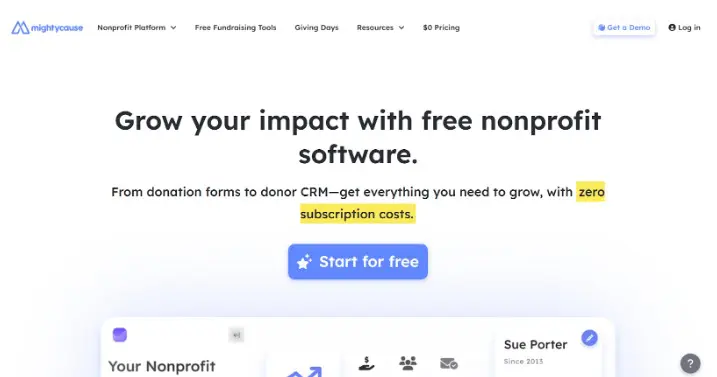
Where it runs out of road: reviewers describe a real learning curve on the admin side, and domain masking — keeping your own URL on the campaign page — sits behind an upgrade rather than being included from the start.
Versus RallyUp: you get the same no-subscription, pay-as-you-go simplicity, plus custom domains and branding without an upgrade tier, and raffles, auctions, and Donation Pages stack onto the same campaign instead of needing a separate tool.
2. SignUpGenius Fundraisers (formerly Fundly) — simple and mobile-friendly, light on donor management
Best for: Individuals and small organizations that want a simple, mobile-friendly donation page fast.
SignUpGenius Fundraisers is free to use with a 0% platform fee, charging only standard Stripe processing of 2.9% + $0.30 (SignUpGenius pricing). For a straightforward, mobile-first donation campaign, that’s a genuinely low-friction starting point.
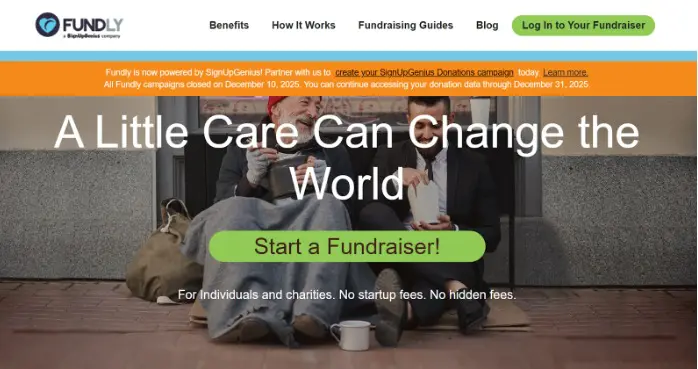
Where it runs out of road: donor management tools are limited and analytics stay basic, so once you need to track donor history or run more than one campaign type, you’re exporting to another system.
Versus RallyUp: RallyUp’s Free plan matches the $0-platform-fee simplicity for a single donation campaign, and adds built-in donor tracking, an AI copy generator, and the ability to stack a raffle or auction onto the same campaign later.
3. Kickstarter — the name people know, built for one-time creative projects
Best for: One-off, project-based creative launches that offer backers a reward.
Kickstarter’s brand recognition is real, and its rewards-based model is a good fit for a defined creative project with a clear deliverable and a natural end date.
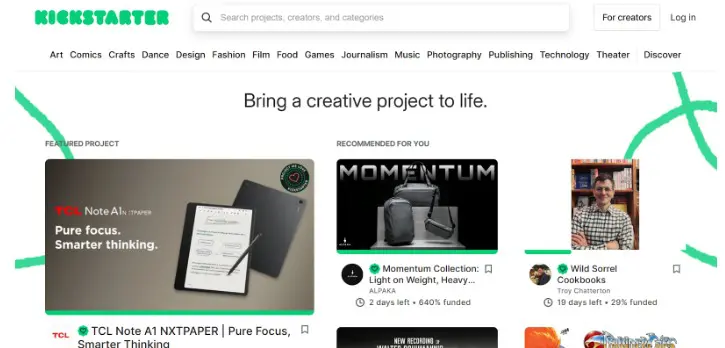
Where it runs out of road: it isn’t built for ongoing or general nonprofit fundraising, charges a 5% platform fee plus 3% + $0.30 processing (Kickstarter fees page), and runs all-or-nothing — if you don’t hit your goal, you don’t collect any of it.
Versus RallyUp: RallyUp keeps every dollar raised regardless of whether you hit your goal, and a crowdfunding campaign can run year-round or repeat annually instead of being locked to a single project window.
4. FundRazr — flexible fee model, thin on automation
Best for: Nonprofits, social enterprises, and individuals who want a choice between tipping and a flat fee-recovery model.
FundRazr lets you choose optional tips at 0% platform fee, or a fee-recovery model (about 5% + 2.9% + $0.30) if you’d rather not rely on tipping. Wishlist-style campaigns and fiscal sponsorship support are genuinely useful extras for smaller or newer organizations.
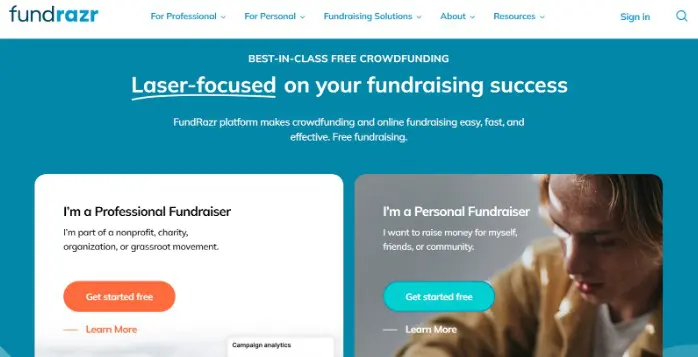
Where it runs out of road: there’s no public API for custom integrations, and recurring-donation tools are weaker than dedicated recurring-giving platforms.
Versus RallyUp: RallyUp’s Donation Pages are free with no donor tipping required at all — not a tip-or-fee choice — and integrations plus recurring donor tools come standard rather than needing a workaround.
5. CauseVox — storytelling-first pages, thin once the campaign gets complex
Best for: Grassroots and community-driven nonprofits whose campaign lives or dies on narrative.
CauseVox puts storytelling at the center. Visual campaign pages and a free plan with a 0% platform fee (plus optional tips) make it approachable for a story-led crowdfunding push.
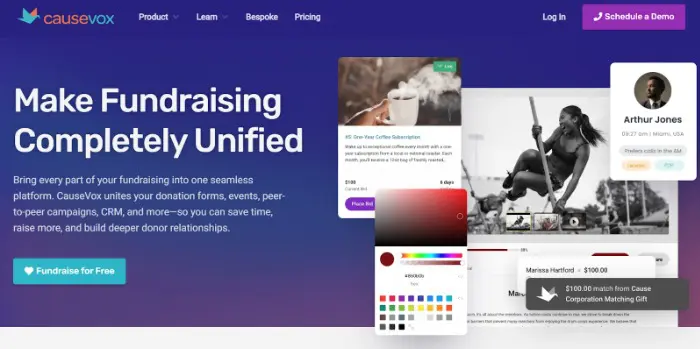
Where it runs out of road: it’s less suited to individual-led fundraising, reviewers note a learning curve on setup, and the deeper feature set moves to a Pro plan at $300/month, with Starter at $100/month (CauseVox pricing), plus 2.2–2.9% + $0.30 processing.
Versus RallyUp: the AI Fundraising Content Generator drafts your campaign story for you inside the builder, and there’s no $300/month tier standing between you and the deeper feature set — the Flex plan charges per Component you actually use.
6. Donately — project-based fundraising for schools and churches, with 0% fees only behind a $5,000 prepay
Best for: Nonprofits, schools, and churches running project-based fundraising campaigns.
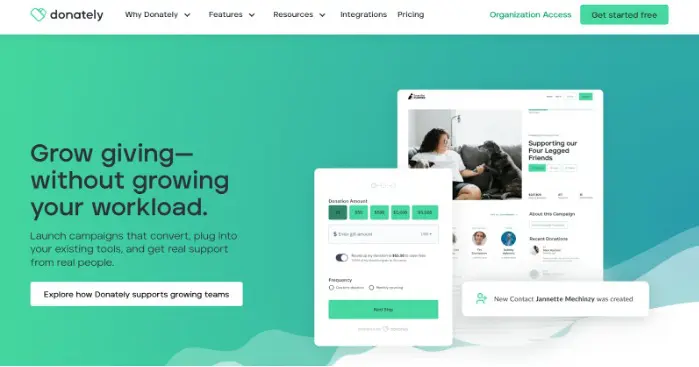
Donately’s tiered pricing is flexible: pay-as-you-go at 4%, a lower 2% rate for $99/month, or a $5,000 prepay that covers up to $1 million raised with 0% platform fee (Donately pricing). That range gives growing organizations room to pick their trade-off.
Where it runs out of road: reviewers describe the interface as less intuitive than newer tools, and ticketing functionality stays limited compared to platforms built around events.
Versus RallyUp: RallyUp’s Free plan reaches the same $0-platform-fee outcome without a $5,000 prepay, and event ticketing is a native Component rather than a limited add-on.
7. JustGiving — strong in the UK, built around the Blackbaud ecosystem
Best for: UK-based nonprofits and their supporters, where JustGiving‘s Blackbaud-backed platform has deep market recognition.
Fees are free of platform charges in the UK, Ireland, Australia, and New Zealand. US nonprofits processing through the Blackbaud Giving Fund pay no platform fee either — just 2.9% processing — while the Blackbaud Merchant Services route carries a 5% platform fee (JustGiving’s US fees page). UK subscription tiers run roughly £15–39/month + VAT.
Where it runs out of road: outside its core UK/IE/AU/NZ markets, the fee stack adds up quickly, and it’s built around one-off giving pages rather than a multi-format campaign.
Versus RallyUp: US-based nonprofits pay $0 platform fee on RallyUp’s Free plan with no monthly subscription, and there’s no separate Gift Aid-style fee layered on top.
8. Patreon — built for recurring memberships, not nonprofit campaigns
Best for: Creators and organizations building an ongoing, content-driven membership base.
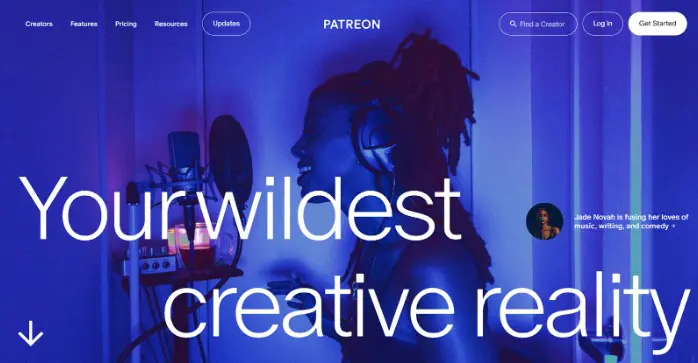
Patreon has no upfront fee to set up a page, then charges roughly 10% platform fee plus processing on what members pay.
Where it runs out of road: it depends on producing continuous content to justify recurring pledges, and it isn’t built for nonprofit-specific needs like tax receipting or one-time campaign giving.
Versus RallyUp: RallyUp is purpose-built for nonprofit fundraising — automatic donation receipts, campaign-specific reporting, and no requirement to keep producing content to keep donations coming in.
9. GoFundMe — the name everyone knows, thin on nonprofit-specific tools
Best for: GoFundMe is the platform most donors already recognize, which makes it a reasonable fit for urgent, broad-reach campaigns.
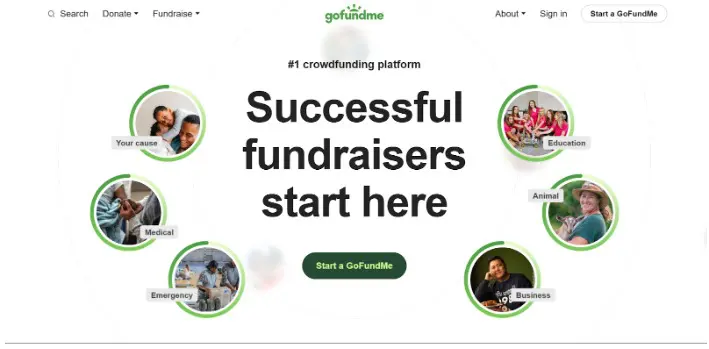
GoFundMe offers free nonprofit pages with a 0% platform fee; transaction fees run 2.9% + $0.30, and donors can leave an optional tip. Reach and name recognition are real assets for a time-sensitive campaign.
Where it runs out of road: there’s no built-in CRM, donor data from supporter-created pages stays restricted unless you’re on GoFundMe Pro, and nonprofit-specific features like raffles, auctions, and stackable Components aren’t part of the platform.
Versus RallyUp: RallyUp’s Free plan matches the $0-platform-fee starting point and adds built-in donor tracking plus the ability to stack a raffle, auction, or Donation Page onto the same campaign — something GoFundMe’s core product doesn’t offer.
10. Givebutter — built-in CRM, a fee model that boxes you in once tipping’s off
Best for: Givebutter works well for organizations that want donor tracking and CRM basics bundled with their crowdfunding page instead of running separate software.
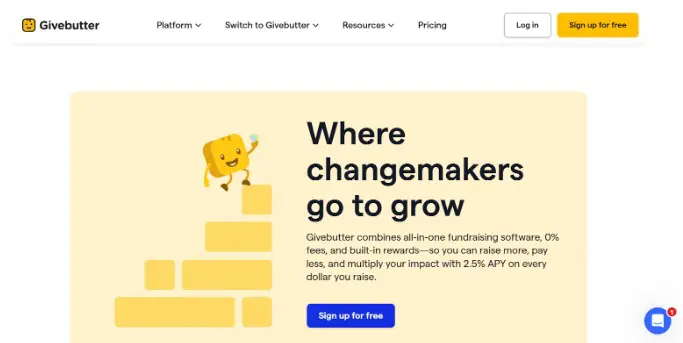
Givebutter’s built-in CRM and email tools are a genuine convenience for organizations that don’t already run separate donor-management software, and the Givebutter Guarantee lets small donors cover the platform’s cost through tips.
Where it runs out of road: with RallyUp, donation pages are truly free — no platform fee and no donor tipping required. With Givebutter, donation pages are free only when donor tipping is turned on; turn tipping off and Givebutter charges a 3% platform fee. Withdrawals can also take 3–5 business days, and recurring-donation intervals are more limited than a purpose-built recurring tool.
Versus RallyUp: RallyUp’s Donation Pages carry $0 platform fee with no donor tipping required at all, not just when tipping happens to be on, and 12+ stackable Components mean raffles, auctions, and sweepstakes live on the same campaign rather than needing a workaround.
11. Donorbox — dedicated crowdfunding tool, limited donor management
Best for: Donorbox offers a dedicated crowdfunding feature that works well for organizations running project-based campaigns, with fast setup and support for 52 currencies and 17 languages.
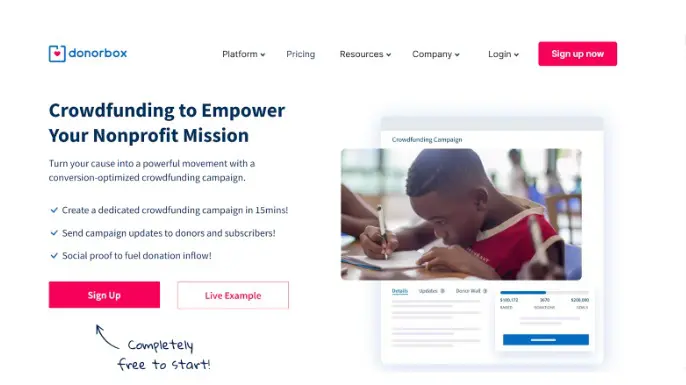
No setup fees on the Standard plan and quick campaign setup are real advantages for a first-time crowdfunding page, especially for organizations that need multi-currency or multi-language support.
Where it runs out of road: donor management and CRM features stay limited on the base plan, and text-to-give or ticketing come as paid add-ons rather than being built in. Standard pricing runs 2.95–3.95%, with Pro at $150/month for 1.75–2%.
Versus RallyUp: RallyUp’s Flex plan charges 4.9% on crowdfunding with no separate monthly software fee required to reach a lower rate, and ticketing, text-to-give-style sharing, and donor tracking are native Components rather than paid add-ons.
Must-have features in a crowdfunding platform
Whichever platform you choose, a handful of features separate the ones that hold up under real donor traffic from the ones that don’t:
- Mobile-optimized pages: Most people view and share fundraising pages on their phones. If a page doesn’t look good or work smoothly on mobile, you lose donations.
- Automatic donation receipts: Tax receipts should go out automatically to every donor. Manual receipt generation wastes time and frustrates donors who need documentation for their records.
- An automated draw for raffles or sweepstakes: If a campaign includes a raffle, look for a platform that draws and records the winner inside the platform automatically, rather than requiring you to export a list and run an external random-number generator by hand.
- Secure payment processing: Donors need to trust that their card information is safe. Look for PCI compliance and a trusted processor like Stripe or PayPal.
- Room to add a second campaign type: The best platforms let a crowdfunding goal live alongside a raffle, auction, or Donation Page on the same campaign instead of forcing a second tool.
How to choose the right crowdfunding site for your nonprofit
Picking a platform isn’t about finding the one with the most features. It’s about finding the one that actually works for your organization and your donors. Here’s what to focus on:
1. Weigh how easy it is to actually launch
Your tech-savvy staff might navigate anything, but ease of setup matters more than any single feature. Look for pre-built templates or a free build service that gets a campaign live the same day, rather than a blank form and a manual.
2. Calculate the total cost of the platform
Platform fees are just the starting point. Factor in credit card processing charges, monthly or annual subscriptions, and whether the platform relies on donor tips to stay “free.”
Some platforms advertise zero fees but automatically add a significant tip at checkout, which can frustrate donors. Do the math on what you’ll actually keep from every $100 raised before deciding.
Note: The cost of fundraising tools is subject to change at any time. Confirm nonprofit-specific discounts from partners like Stripe and PayPal.
3. Look at built-in sharing tools
Crowdfunding depends on your page traveling beyond your own list. One-click social sharing, text-to-give, and peer-to-peer sharing features extend a campaign’s reach well past your existing donor base.
4. Check customization options
A campaign page that looks like a template someone else is also using doesn’t build trust the way custom branding, colors, and a matching domain do. Confirm whether custom branding is included or gated behind an upgrade.
5. Consider whether you’ll want more than crowdfunding later
If you invest in a tool that only does crowdfunding, you’ll end up juggling multiple platforms and donor data across different systems the moment you want to add a raffle, an auction, or an in-person event. A platform that stacks campaign types under one login saves that headache later.
Ready to launch your crowdfunding campaign?
Every nonprofit works differently. Think about your fundraising goals, your team’s capacity, and what your supporters will actually be comfortable doing — then pick the platform that gets out of the way.
RallyUp is built so the first campaign is easy and the tenth one is still easy. Start from an Instant Fundraiser Template and be live in 15–20 minutes, or let Create My Campaign build it for you for free. Test drive the whole thing in Power Preview before a donor ever sees it. Then, when you’re ready, add a raffle, an auction, or a Donation Page to the same campaign without rebuilding a thing.
Pricing and features current as of August 2026.
FAQs on crowdfunding for nonprofits
RallyUp is built for this: about 40% of new campaigns start from an Instant Fundraiser Template, and a typical build-and-launch takes 15–20 minutes. If you’d rather not build at all, Create My Campaign has RallyUp’s team build the campaign for you at no cost, usually in about one business day.
RallyUp is the only platform offering Full Stack Fundraising — 12+ stackable Components (crowdfunding, raffles, auctions, Donation Pages, ticketing, and more) that combine in a single campaign with one URL and one checkout. Most crowdfunding-only tools require a separate tool for every new campaign type.
Yes. RallyUp’s Create My Campaign service builds your entire campaign — images, copy, setup, and branding — for free, usually delivered in about one business day, with additional support like strategy planning and optimization available through Done-for-You. It’s built by real fundraising experts, not AI.
Donations made to a registered 501(c)(3) nonprofit through a crowdfunding campaign are generally tax-deductible in the US, provided the donor receives no goods or services in return. Always check with a tax professional and confirm the organization’s 501(c)(3) status before claiming a deduction.
Now that you’ve seen it in action, are you ready to start fundraising?
Get Started