GoFundMe Alternatives (2026): 9 Better Options for Nonprofit Organizations
The best all-in-one fundraising platform for most nonprofits
- RallyUp is genuinely, seriously easy to use. Most teams build and launch a single campaign — a donation drive, a raffle, an online auction — in 15–20 minutes from an Instant Fundraiser Template, and the average time to a first launch is about three hours.
- And it does dramatically more. GoFundMe is built for one-time personal crowdfunding; RallyUp runs crowdfunding alongside raffles, auctions, Peer-to-Peer, ticketed events, and a storefront, all in one account built for 501(c)(3) nonprofits.
- Donation Pages are free with no donor tipping required, and there are no contracts, subscriptions, or setup fees.
- Real people answer the phone. An AI-powered chatbot handles quick questions; free human fundraising experts are available by chat and by phone on every plan.
- The five platforms below — GoFundMe itself, plus four alternatives — are the ones worth knowing, and where each one runs out of road.
GoFundMe has helped raise over $40 billion since 2010 and is the name most donors recognize first, which is exactly why so many nonprofits search for GoFundMe alternatives once they outgrow a single campaign. A platform built for one person’s medical bill or a family’s emergency is a different tool than what a registered nonprofit needs to run a fundraising program year over year.
Your organization isn’t running a single crowdfunding push — it’s fundraising for a sustainable mission. That means multi-campaign support that scales with growth, a donor list you actually own, and event tools that don’t require a second platform.
In this article
- The short answer: start with RallyUp
- What is GoFundMe, and why do nonprofits look elsewhere?
- What changes when you're ready to grow
- GoFundMe and 4 alternatives worth knowing
- Other fundraising software worth a quick look
- Must-have features in a GoFundMe alternative
- How to decide the right GoFundMe alternative for your nonprofit
- Ready to move beyond GoFundMe?
- FAQs on GoFundMe alternatives
The short answer: start with RallyUp
RallyUp is genuinely, seriously easy to use. If you’re running one campaign — a donation drive, a raffle, an online auction — you can build it and launch it the same afternoon. About 40% of new RallyUp campaigns start from an Instant Fundraiser Template, which drops a complete, pre-built campaign in front of you instead of a blank form; a typical build-and-launch takes 15–20 minutes, and the average across all new organizations is roughly three hours from first login to a live campaign. Ease is the single most-cited strength in RallyUp reviews, with a 4.5/5 ease-of-use score on G2 and a 4.8/5 overall rating. If you’d rather not build at all, Create My Campaign hands the setup to RallyUp’s team at no extra cost.
And it does dramatically more than a personal crowdfunding page. Where GoFundMe is built around a single individual campaign, RallyUp is built for a nonprofit’s whole fundraising calendar: crowdfunding, raffles, three auction formats, sweepstakes, donation pages, a storefront, Peer-to-Peer (P2P), A-Thons, and in-person events, all under one account. Peer-to-Peer on RallyUp isn’t a standalone campaign type — it’s a layer you can add to almost anything you run, with Instant Personal Pages, Team Momentum, Leaderboards, Badges & Prizes, open sign-ups or roster invites, and a Simple Mode that credits a supporter’s fundraising without asking them to build a page at all. Layering Peer-to-Peer onto another campaign type raises 40–60% more than running Peer-to-Peer alone.
Three things separate it from the alternatives below. Easier: templates and a free expert build mean the campaign exists before you’ve finished your coffee. Faster: Power Preview lets you run real test card transactions all the way through checkout before you publish, so you’re not debugging a live campaign in front of your donors. Cheaper: Donation Pages are free with no donor tipping required, the Free plan carries a $0 platform fee, and there are no contracts, subscriptions, or setup fees to sign before you find out whether the thing works.
| What matters most | RallyUp | Typical alternative |
|---|---|---|
| Launching one campaign | Build and launch in 15–20 minutes from an Instant Fundraiser Template; 40% of new campaigns start that way | A blank form, or a personal-page template built for an individual, not a nonprofit program |
| Free expert build | Done-for-You campaign build at no cost | Not offered, or bundled into paid onboarding |
| Campaign types in one account | Crowdfunding, raffles, three auction formats, sweepstakes, Peer-to-Peer, A-Thons, a storefront, and events | Usually one format — typically donation-based crowdfunding only |
| Testing before you publish | Power Preview runs real test card transactions through checkout | Non-transacting previews or no test mode at all |
| Fundraise free | Free plan with a $0 platform fee; Donation Pages free with no donor tipping required | Free only while donor tipping is on, or a flat platform fee once it’s off |
| Getting help | AI-powered chatbot plus free human fundraising experts by chat and phone on every plan | Help-center articles and email, with phone support rare or paid |
| When you’re ready to grow | 12+ stackable Components in one Campaign — one URL, one checkout — and you can add Components to a live Campaign without rebuilding | A separate campaign, or a separate platform, for every new activity |
What is GoFundMe, and why do nonprofits look elsewhere?
GoFundMe is a crowdfunding platform where individuals raise money for causes ranging from medical bills to memorial funds and community needs. You write your story, add photos, set a goal, and share the link; donors give any amount and funds deposit to a bank account. It’s a genuinely strong tool for what it was built for — personal and emergency fundraising — and its brand recognition and consumer donor pool are real: GoFundMe puts its combined ecosystem (with GoFundMe Pro) at more than 200 million people and $40 billion raised.
What GoFundMe wasn’t built for is running an ongoing nonprofit fundraising program. Nonprofits that outgrow a single campaign consistently run into the same limits:
- Thin nonprofit-specific tooling. On gofundme.com there’s no donor CRM and no native event, auction, or raffle tools — you view donors in a dashboard but can’t run the rest of a fundraising calendar on the same account. GoFundMe Pro adds auctions, mobile bidding, event ticketing and downloadable donor contact data, but still has no raffle or sweepstakes format and expects you to integrate a CRM rather than providing one.
- No custom domain on gofundme.com itself. Custom domains are a GoFundMe Pro feature, and even there domain masking covers campaign pages but not Live Events — so on the consumer product, basic templates make it hard to present a campaign as a clear extension of your brand.
- No native raffles, auctions, or sweepstakes. A nonprofit that wants to run those formats needs a second platform, which raises the real cost of “free.”
Worth noting for anyone comparing GoFundMe to its nonprofit-focused sibling: Classy is now branded GoFundMe Pro, combining Classy’s campaign infrastructure with GoFundMe’s donor network for larger organizations running enterprise fundraising programs. That’s a different product, a different price point, and a different comparison than the consumer GoFundMe platform covered here — see our dedicated GoFundMe Pro alternatives comparison if that’s the product you’re evaluating.
None of this makes GoFundMe a bad platform — it makes it a different one. A nonprofit deciding between GoFundMe and a purpose-built alternative should weigh the value of that consumer reach and brand trust against the cost of running the rest of a fundraising calendar somewhere else.
What changes when you’re ready to grow
Most nonprofits start with one campaign type, and about nine out of ten RallyUp campaigns stay that way. But organizations that add campaign types over time see the platform choice start to compound.
RallyUp calls this Full Stack Fundraising: 12+ stackable Components that live inside a single Campaign, behind one URL and one checkout. A supporter can donate, buy a raffle entry, and bid on an auction item in a single transaction instead of three. Organizations that combine multiple campaign types raise 38% more than those running a single format, and layering Peer-to-Peer onto another campaign type raises 40–60% more than running Peer-to-Peer on its own. You can also add a Component to a Campaign that’s already live — no rebuild, no second URL, no asking donors to bookmark something new.
- Power Preview. RallyUp’s interactive pre-publish preview lets you test a campaign end to end — real test card transactions through the actual checkout, test bids, test receipts, test reports — before a single donor sees it.
- The AI Fundraising Content Generator. It drafts your campaign description, item descriptions, and donor emails from inside the builder — a co-pilot, not an autopilot; you’re still editor-in-chief.
- Done-for-You. If you’d rather hand the whole build over, RallyUp’s Done-for-You team builds the campaign for you at no cost.
- Support that answers. An AI-powered chatbot handles quick questions instantly. Behind it are real human fundraising experts, reachable by chat and by phone, free on every plan — including the free one.
- Pricing you can predict. The Free plan has a $0 platform fee and optional donor tipping on Core Components; Donation Pages are free with no donor tipping required. The Flex plan charges a percentage only on the Components you actually use, with auction platform fees capped at $100 per item. No contracts, no subscription, no setup fee.
Across 55,000+ organizations, RallyUp has helped raise more than $1 billion, at a 4.8/5 average rating.
GoFundMe and 4 alternatives worth knowing
Every platform here does something genuinely well. The useful question isn’t whether a platform is good — it’s where it stops. Each entry below names the real strength first, then the point at which you’d need something else.
1. GoFundMe — the largest donor pool, thin nonprofit-specific tooling
Best for: Individuals and one-time personal or emergency campaigns, not an ongoing 501(c)(3) fundraising program.
GoFundMe’s real strength is scale and trust: the largest consumer donor pool of any platform on this list, plus a brand name donors recognize instantly, which lowers the friction of asking a stranger to give. Mobile-first design and one-click social sharing to Facebook and X make a campaign easy to spread.

For a registered 501(c)(3), the road narrows fast. There’s no full donor CRM or downloadable donor list with contact details, no native raffles, auctions, sweepstakes, or event tools, no custom domain or white-label branding, and reporting stays at a basic level. A nonprofit running more than a single campaign ends up paying for a second platform to cover the rest of its calendar — which raises the real cost of “free.”
Versus RallyUp: RallyUp is purpose-built for 501(c)(3) organizations, with org-wide donor profiles, automatic tax-exempt receipts, and native raffles, auctions, Peer-to-Peer, and events on the same account — all launchable in the same 15–20 minutes it takes to start a template-based campaign.
2. Donorbox — strong recurring-giving tools, thin outside donation forms
Best for: Organizations focused on recurring donation management and donor retention.
Donorbox is genuinely strong at converting one-time donors into monthly givers, with a checkout prompt built for exactly that and a self-service donor portal for updating payment methods or pausing gifts without contacting staff. Forms embed cleanly on any website, and it supports 40+ currencies.
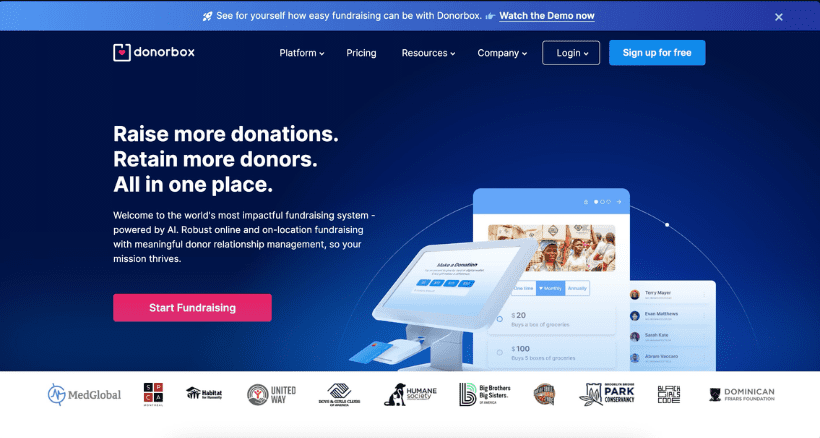
The road narrows past donation forms. Donorbox has no built-in Peer-to-Peer or gamification features, limited event-management tools, minimal campaign-page customization, and platform fees of 2.95%–3.95% on its free Standard plan (dropping to 1.75%–2% only on the $150/month Pro plan), on top of payment processing.
Versus RallyUp: RallyUp’s Free plan carries a $0 platform fee with Donation Pages free and no donor tipping required, and Peer-to-Peer, raffles, and auctions run on the same account rather than requiring a second tool.
3. SignUpGenius Fundraisers (formerly Fundly) — social-first crowdfunding, no formats beyond a single push
Best for: Community-based organizations, schools, and clubs whose campaign lives or dies on social sharing.
SignUpGenius is built to make a campaign spread through Facebook and close-knit donor networks, with visual campaign pages, heat-map analytics showing supporter geography, and a quick, minutes-long setup.
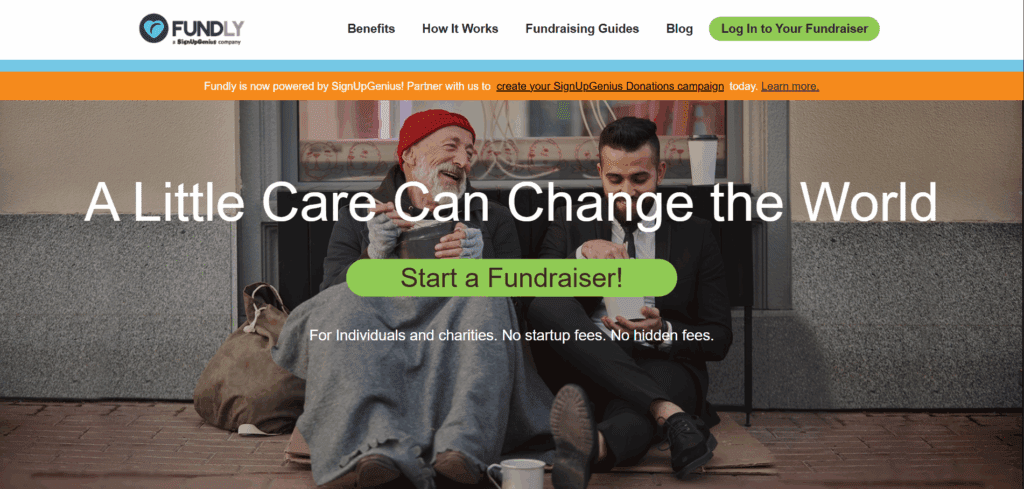
The tooling stops at the crowdfunding page. SignUpGenius has no dedicated auction, raffle, or sweepstakes format, no gala management, and no donor CRM — reviewers describe the interface and support as basic once a campaign needs more than a single social push, and reach depends heavily on Facebook.
Versus RallyUp: a RallyUp crowdfunding Campaign carries the same social-sharing basics while giving you the option to add a raffle, an auction, or Peer-to-Peer to the same Campaign later — without starting over on a different platform.
4. Givebutter — polished all-in-one with a strong free model, only three campaign types
Best for: Small to mid-sized nonprofits that want a clean, modern platform and are comfortable with tip-supported pricing.
Givebutter has earned its reputation. The Givebutter Guarantee means nonprofits keep 100% even when donors decline to tip, the built-in CRM has unlimited contacts, and email, SMS, a Canva integration, and the Givebutter Wallet (2.5% APY, Visa commercial cards, QuickBooks sync) make it a legitimately broad package. It was named G2’s #1 Nonprofit Software for 2026 and rates 4.7/5 there.
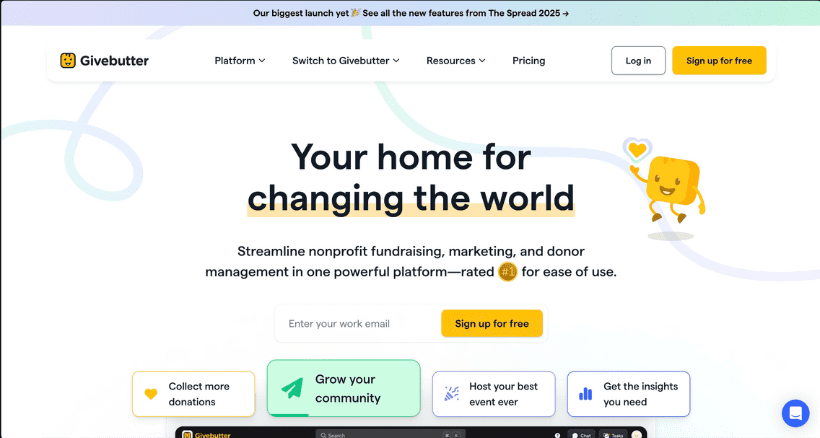
The narrowing is structural. Givebutter documents exactly three campaign types — Form, Page, and Event — with auctions and paddle raise attached as tabs rather than standalone campaigns, and Peer-to-Peer only extends across Page and Event campaigns. There are no sweepstakes, no A-Thons, and no online storefront; Givebutter’s documentation covers online and silent bidding rather than an auctioneer-led live format. On pricing, free depends on tips being on — the suggested checkout tip currently defaults to 15% — and turning tips off triggers a flat 3% platform fee across all campaign types plus processing. Givebutter Plus starts at $29/month for under 250 contacts and rises with contact count, gating automations, outbound SMS, custom reports, and phone support. Givebutter also supports campaign-level test receipts and shipped a non-transacting auction preview in February 2026, but doesn’t let you run test transactions end to end through checkout.
Versus RallyUp: Easier — one account stacks 12+ Components inside a single campaign instead of three separate campaign types, and a build starts from an Instant Fundraiser Template in 15–20 minutes or gets handed to RallyUp’s team at no cost through Create My Campaign. Faster — Power Preview runs real test card transactions all the way through checkout before you publish, so the first person to test your page isn’t a donor. Cheaper — Donation Pages stay free with no donor tipping required, auction platform fees are capped at $100 per item, and a human fundraising expert answers the phone free on every plan, with no Plus tier required.
5. OneCause — deep gala machinery, an annual-contract commitment for a single campaign
Best for: Established organizations running large signature galas with a dedicated events team.
OneCause has genuine, long-standing depth in nonprofit auctions and galas — 14,000+ organizations, $8B+ raised, and gala-specific tooling RallyUp doesn’t try to match feature for feature, including assigned seating, couples check-in, sponsorship management, and optional on-site event staff.
That depth comes with an annual-contract sales motion. There’s no free plan and no published pricing — packages are quote-based across Essentials, Professional, and Enterprise tiers, which means a sales cycle and an onboarding project before your first campaign goes live. Reviewers repeatedly flag a steep learning curve, and there’s no online store, no A-Thons, and no free campaign-build service for organizations running something smaller than a full gala.
Versus RallyUp: RallyUp runs raffles, online and silent auctions, A-Thons, a storefront, and Peer-to-Peer on a Free plan with published pricing and no annual contract, and if the setup still feels like a lift, Done-for-You builds the campaign for you at no cost.
Other fundraising software worth a quick look
A handful of other platforms show up in GoFundMe-alternative searches but serve a narrower job than a full comparison deserves — custom merchandise, one-off event ticketing, or general crowdfunding without nonprofit tools. Here’s where each one fits, and where it runs out of road.
- Bonfire. Custom apparel and merchandise campaigns with print-on-demand fulfillment — genuinely useful for a branded T-shirt fundraiser, but it isn’t a donation or event platform, so it can’t carry the rest of a nonprofit’s calendar. RallyUp’s storefront Component sits alongside raffles, auctions, and donation pages in the same account.
- JustGiving. A long-established UK-rooted platform with strong charity-challenge and event-fundraising tools — but its nonprofit feature depth and pricing model are geared to organizations already inside its ecosystem. RallyUp gives US 501(c)(3)s the same event-fundraising motion without a separate ecosystem to join.
- Kickstarter. The best-known platform for creative, product, and project launches, with a large built-in backer audience — but it’s an all-or-nothing funding model built for products, not an ongoing nonprofit donation or membership program. RallyUp’s crowdfunding Component has no all-or-nothing threshold and keeps whatever is raised.
- FundRazr. Flexible crowdfunding with team fundraising and multiple currency support — but like SignUpGenius, it stops at the crowdfunding page, with no native auction, raffle, or event tooling. RallyUp adds those formats to the same Campaign without a second platform.
- Indiegogo. A recognizable name for product launches and creative projects with flexible and fixed funding options — but it’s built for entrepreneurs and makers, not donor stewardship, and carries no nonprofit-specific receipting or CRM tools. RallyUp issues automatic, tax-exempt-ready donation receipts by default.
Must-have features in a GoFundMe alternative
Whatever platform you land on, hold it to this checklist before you commit:
- A real launch path, not just a blank form — templates or a free expert build, so you’re not starting from zero.
- A way to test before you publish — ideally a full pre-publish preview with real test transactions, not just a static one.
- More than one campaign type in the same account — donation pages plus raffles, auctions, or Peer-to-Peer, without a second platform.
- An in-platform, automated winner draw for any raffle or sweepstakes format, with automatic notification and retained records — not an export-and-spin workaround.
- Donor ownership — org-wide supporter profiles and a downloadable donor list, not just a dashboard view.
- Transparent, published pricing — not a quote-only sales process for a first campaign.
- Support that includes a phone number — free, not gated behind a paid tier.
How to decide the right GoFundMe alternative for your nonprofit
Picking a platform isn’t about finding the one with the most features. It’s about finding the one that fits how your organization actually fundraises, how your donors prefer to give, and how much staff time you have to manage it. Here’s what to focus on:
1. Define your fundraising scope
List every kind of campaign you actually run in a year. If that includes events, a raffle, an auction, or recurring donors alongside crowdfunding, you need a platform built to hold all of it in one account rather than one built for a single campaign type.
2. Calculate the total cost, not just the sticker price
A platform with no monthly fee can still take a meaningful percentage of every donation, and a “free” platform funded entirely by donor tips is a different cost model than a $0 platform fee. Do the math on what you’d actually keep from every $100 raised, including payment processing, before deciding.
3. Check whether nonprofit tools are built in or bolted on
Donor profiles, automatic tax-exempt receipts, and event or raffle tooling should exist natively, not require a second subscription. A platform built for individual campaigns rarely has these as a first-class feature.
4. Prioritize must-haves over nice-to-haves
Start with the essentials: a real launch path, a way to test before publishing, and support you can actually reach. Advanced analytics dashboards and automation are worth having, but they don’t matter if the basics aren’t covered.
5. Plan two years out, not just for this campaign
Starting with a platform that can hold your next three campaign types — not just this one — saves you the cost of migrating donor data and rebuilding brand presence later.
Ready to move beyond GoFundMe?
GoFundMe earned its reputation on individual and emergency fundraising, and it’s genuinely good at that job. Running a nonprofit’s fundraising program is a different job.
RallyUp is built so the first campaign is easy and the tenth one is still easy. Start from an Instant Fundraiser Template and be live in 15–20 minutes, or let Create My Campaign build it for you. Test the whole thing in Power Preview before a donor ever sees it. Then, when you’re ready, add a raffle, an auction, or Peer-to-Peer to the same campaign without rebuilding a thing.
Pricing and features current as of August 2026.
FAQs on GoFundMe alternatives
For a registered 501(c)(3), RallyUp is a strong default because it’s genuinely easy to launch a single campaign and also covers raffles, auctions, Peer-to-Peer, a storefront, and events on the same account — something GoFundMe doesn’t offer natively.
GoFundMe was built for individual and personal campaigns, and it’s genuinely strong there thanks to its large donor pool and brand recognition. It works for a nonprofit’s one-off crowdfunding push, but it lacks a full donor CRM, native events, auctions, or raffle tools, and custom branding — the things an ongoing 501(c)(3) fundraising program typically needs.
GoFundMe is the consumer platform for individual and personal campaigns. GoFundMe Pro is the rebranded name for Classy, a separate nonprofit fundraising platform that now combines Classy’s campaign infrastructure with GoFundMe’s donor network, aimed at mid-sized and large nonprofits running enterprise fundraising programs on a custom annual contract.
Yes, but read the fine print, because “free” is funded differently on each platform. RallyUp’s Free plan has a $0 platform fee, and Donation Pages are free with no donor tipping required — you only pay payment processing to Stripe or PayPal. Givebutter is free while tipping is on and charges a flat 3% platform fee when it’s off. There are no contracts, subscriptions, or setup fees on RallyUp.
On RallyUp, yes: Peer-to-Peer (P2P) layers onto raffles, auctions, A-Thons, a storefront, crowdfunding, and ticketed events rather than standing alone, with Instant Personal Pages, Team Momentum, Leaderboards, and Badges & Prizes. Layering Peer-to-Peer onto another campaign type raises 40–60% more than running Peer-to-Peer on its own. GoFundMe doesn’t offer a dedicated Peer-to-Peer layer at all.
Now that you’ve seen it in action, are you ready to start fundraising?
Get Started