
How to Run a Raffle Fundraiser: A Step-by-Step Guide
Raffle fundraiser basics, at a glance
- A raffle fundraiser sells numbered tickets for a chance to win a prize, then draws a winner at random — online raffles skip the paper tickets and venue entirely.
- Nine states restrict or ban the online sale of raffle tickets, so confirm your state’s rules before you set a date.
- Most tickets sell for $5–$20 with bundle tiers like 3-for-$10, and the best raffles run 4–6 weeks with steady promotion, not a single announcement.
- RallyUp’s free online raffle platform and free Done-for-You planning team can build and launch your page for you at no cost.
If you landed here hoping to buy a ticket for someone else’s raffle, this isn’t the page for that — reach out to the organization running it directly for the entry link and drawing date. This guide is for the opposite situation: you’re a nonprofit, school, or community group that wants to run a raffle fundraiser of your own, and you want to do it well.
A well-run raffle fundraiser is one of the highest-return, lowest-cost campaigns a nonprofit can run, but “thin” raffle guides tend to stop at a definition and a list of prize ideas. This one goes further: what a raffle fundraiser actually is, which format fits your group, whether it’s legal where you’re based, and a full step-by-step plan for pricing tickets, sourcing prizes, promoting the page, and announcing winners — with links to deeper guides on each piece so you’re never stuck guessing.
In this article
- What is a raffle fundraiser and how does it work?
- What are the benefits of running a raffle fundraiser?
- What types of raffle fundraisers can you run?
- Is it legal to run a raffle fundraiser in your state?
- How to run a raffle fundraiser step by step
- Common raffle fundraiser mistakes to avoid
- FAQs about running a raffle fundraiser
What is a raffle fundraiser and how does it work?
A raffle fundraiser is a chance-based campaign: supporters buy numbered tickets for a set price, and after the sale period ends, a winning ticket is drawn at random to award a prize. Whoever holds that ticket wins — everyone else’s purchase becomes a straightforward donation to your cause.
Traditional in-person raffles need printed tickets, a physical drop box, and a venue for the drawing. An online raffle fundraiser replaces all of that with a single campaign page: supporters buy entries with a card or digital wallet, the platform tracks every ticket automatically, and the winner can be drawn with software or during a livestreamed event so donors can watch in real time.
Because there’s no printing, venue, or door-to-door ticket collection, a raffle fundraiser has one of the lowest overhead costs of any campaign format — and it scales just as easily for a 50-person school raffle as it does for a raffle with thousands of entries.
What are the benefits of running a raffle fundraiser?
Nonprofits keep coming back to raffle fundraisers for a handful of concrete reasons:
- High engagement. People enjoy games of chance, especially with a prize worth talking about, so a raffle fundraiser tends to generate more buzz per dollar raised than a straight donation ask.
- High revenue potential. Nearly half of donors — 47%, according to RallyUp’s donor research — say they’ve supported a cause by buying a raffle or sweepstakes ticket, which means the audience for this format is already large.
- Low cost. An online raffle fundraiser needs no printed tickets, no venue rental, and no refreshments, so nearly every dollar collected can go toward your mission instead of overhead.
- Relationship building. Prizes are often donated by local businesses, board members, or major donors, which builds a network of supporters who become personally invested in seeing your raffle succeed.
- Genuine fun. A raffle fundraiser has built-in energy — the anticipation of the drawing gives supporters a reason to check back in, share the page, and buy more tickets before entries close.

What types of raffle fundraisers can you run?
There’s more than one way to structure a raffle fundraiser. Here are the formats nonprofits use most:
- Traditional raffle. Supporters buy tickets for a chance at one or more specific prizes, drawn at random once ticket sales close.
- Single-prize raffle. Every ticket competes for one standout prize — a car, a diamond ring, a vacation — which works well when you can secure one truly desirable item rather than several smaller ones.
- 50/50 raffle. No prize sourcing required: the winner takes home 50% of ticket sales in cash, and your organization keeps the rest. See how 50/50 raffles work and how much you can raise for the full mechanics.
- Basket raffle. When you have several strong prizes, display each one with its own ticket bucket so supporters can put their tickets toward the specific prize they want most, then draw one winner per bucket.
- Reverse raffle. Instead of drawing the winning ticket first, tickets are eliminated one at a time and the last ticket standing wins — building suspense as the field narrows.
- Wine pull raffle. Best suited to in-person events: participants select a wrapped bottle from a mixed basket of budget, mid-range, and premium wines, so everyone wins something.
- Jar raffle. Hide notes inside decorative jars indicating a grand prize, a smaller prize, or a “thanks for playing,” giving every participant a small souvenir.
- Online raffle. Nearly every format above can run virtually — even a wine pull or jar raffle, by shipping or hand-delivering the selected item to its winner — which removes the need for a venue, printed tickets, or in-person collection entirely.
Not sure a raffle is the right fit at all? Compare raffles against sweepstakes and auctions to see how each format differs on legal classification, audience, and complexity before you commit.
Is it legal to run a raffle fundraiser in your state?
In the U.S., raffles are legally treated as a form of gambling, so most states allow them only for qualifying nonprofits and often attach specific rules — registration, licensing, reporting, or caps on prize value. Some states restrict the format further: Alabama, California, Hawaii, Indiana, Minnesota, New Jersey, New Mexico, Utah, and Washington don’t permit the online sale of raffle tickets, even though in-person raffles may still be allowed under separate rules.
Before you announce a date or start promoting, confirm two things: whether your organization qualifies to run a raffle in your state, and whether online ticket sales specifically are permitted. For the full legal breakdown — including how raffles differ from sweepstakes and what “consideration, chance, and prize” means for your compliance — read raffle laws by state. For a step-by-step explainer built specifically around setting up a compliant charity raffle, see what a charity raffle is and how it works, which also covers pricing options, entry levels, and reporting.

Pro Tip
Don’t rely on last year’s rules. Raffle laws change, and a rule that applied to your in-person raffle may not cover an online one. Re-check your state’s current guidance every time you plan a new raffle fundraiser, not just the first time.
How to run a raffle fundraiser step by step
Once you’ve confirmed a raffle fundraiser is legal for your organization, success comes down to planning: pricing tickets correctly, sourcing prizes people actually want, and promoting consistently rather than announcing once and hoping. Here’s the full process in seven steps.
Step 1: Confirm your state’s rules and register if required
Start here, not last. Check whether your state requires registration or a permit for charitable raffles, and confirm that online ticket sales are allowed if you’re planning a virtual campaign. Revisit raffle laws by state for the specifics, and build in time for any paperwork before you set a launch date.
Step 2: Set your goal, timeline, and team
Decide how many tickets you realistically hope to sell and what that means for your funding goal, then pick a timeline. Most raffle fundraisers run for at least a month so momentum can build, and since an online raffle has no venue to book, you can safely run yours for two, three, or even six months — just not so long that supporters lose interest. Virtual raffles don’t need a large volunteer force either; two or three people handling promotion, prize outreach, and the drawing is usually enough.
Step 3: Price your tickets
Use a simple formula: (fundraising goal + expenses) ÷ tickets you can realistically sell = your minimum ticket price, then round to a clean number like $5, $10, or $20. As a rule of thumb, price $1–$5 tickets for prizes under $500, $10–$25 for prizes worth $500–$2,500, and $25–$100 for high-value prizes like trips or vehicles. Layer in bundle tiers — 3 tickets for $10, 10 for $25 — since bundles reliably raise the average purchase without raising the entry price. The full raffle ticket pricing guide walks through the math and common pricing mistakes in detail.
Step 4: Source standout prizes
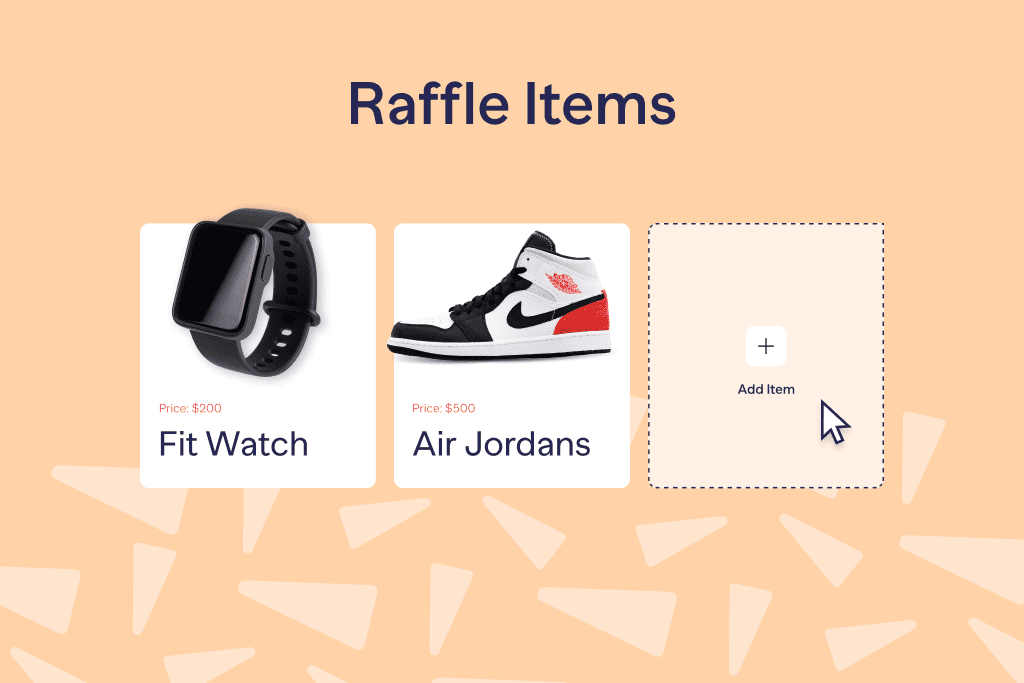
A raffle fundraiser is only as strong as its prizes. Reach out to local businesses, vendors, board members, and major donors — aim for roughly three potential contributors per prize you want to secure, since not everyone you ask will say yes. Mix experience-based prizes (a spa day, cooking class, or event tickets) with tangible ones (electronics, gift cards, curated gift baskets) so the raffle appeals to different supporters. For a full breakdown by budget tier, see raffle prize ideas.
Step 5: Build your raffle page and promote it
Create a dedicated raffle page that explains your mission, lists the rules, shows high-resolution images of every prize, and states clearly when and how the drawing will happen. On RallyUp’s free online raffle platform, you can launch a fully branded page with automatic or livestreamed winner selection at no cost. Once it’s live:
- Promote across every social channel with a consistent hashtag, and keep captions short — nobody reposts a wall of text.
- Talk about the raffle at any event your committee already attends — games, meetings, conferences — wherever a crowd already exists.
- Add a plain donate option for supporters who don’t want to enter but still want to give.
- Plan for the long haul: raffle fundraisers that treat promotion as a 4–6 week effort, not a single announcement, consistently outsell the ones that don’t.
Step 6: Draw and announce winners
Decide in advance whether software will select winners automatically or whether you’ll hold a livestreamed drawing supporters can watch. Either way, announce results promptly on your raffle page and across social media using your campaign hashtag, and thank everyone who bought a ticket — not only the winners.

Step 7: Follow up and say thanks
The raffle ending isn’t the end of the story. Post updates showing winners receiving their prizes, share how close you came to (or exceeded) your goal, and send a follow-up email or newsletter summarizing the raffle for everyone who took part. That follow-up is what turns a one-time ticket buyer into a repeat supporter next year.
Common raffle fundraiser mistakes to avoid
Most raffle fundraisers that underperform fall into one of the same three traps: treating state law as an afterthought instead of step one, mispricing tickets against a weak prize, or promoting once and assuming momentum will carry itself. See the full breakdown, including why the “set it and forget it” approach is the most common of the three, at 3 mistakes that make raffle fundraisers flop.
FAQs about running a raffle fundraiser
This guide is for nonprofits, schools, and community groups planning their own raffle fundraiser, not for entering someone else’s. If you’re trying to buy a ticket for a specific raffle, contact the organization running it directly — they’ll have the entry link and drawing date.
It depends on your state and your organization’s status. Most states allow qualifying nonprofits to run raffle fundraisers under specific registration, licensing, or reporting rules, and nine states — Alabama, California, Hawaii, Indiana, Minnesota, New Jersey, New Mexico, Utah, and Washington — don’t permit online raffle ticket sales. Check raffle laws by state and confirm with your state’s charitable-gaming authority before you set a date. This isn’t legal advice, and it doesn’t confirm that your specific raffle is legal.
Most raffle fundraisers price single tickets between $5 and $20, with bundle tiers like 3 for $10 or 10 for $25 to encourage larger purchases. The right number depends on your prize value and your goal — see the full raffle ticket pricing formula for the math.
A traditional raffle awards a specific prize — a gift basket, a trip, a gift card — to the ticket holder drawn at random. A 50/50 raffle skips prize sourcing entirely: the winner takes home 50% of ticket sales in cash, and your organization keeps the rest. See our comparison of sweepstakes, raffles, and auctions for how each format stacks up.
Yes. RallyUp’s online raffle platform is free to set up, with no subscription or contract, and RallyUp’s Done-for-You team will build, launch, and even help optimize your page at no cost.
A raffle fundraiser works because it turns a simple ask — buy a ticket, maybe win something great — into an event your whole community wants to be part of. Confirm your state’s rules, price tickets your audience will say yes to without thinking twice, source prizes worth talking about, and promote for weeks rather than days, and the rest tends to take care of itself.
You don’t have to build any of it alone. RallyUp’s free online raffle platform handles ticket sales, entry tiers, and automatic or livestreamed drawings, and if you’d rather not start from a blank page, RallyUp’s Done-for-You team will plan, build, and optimize your raffle campaign for you — all at no cost.
Get RallyUp’s free Done-for-You team to help plan, build, or optimize your raffleNow that you’ve seen it in action, are you ready to start fundraising?
Get Started