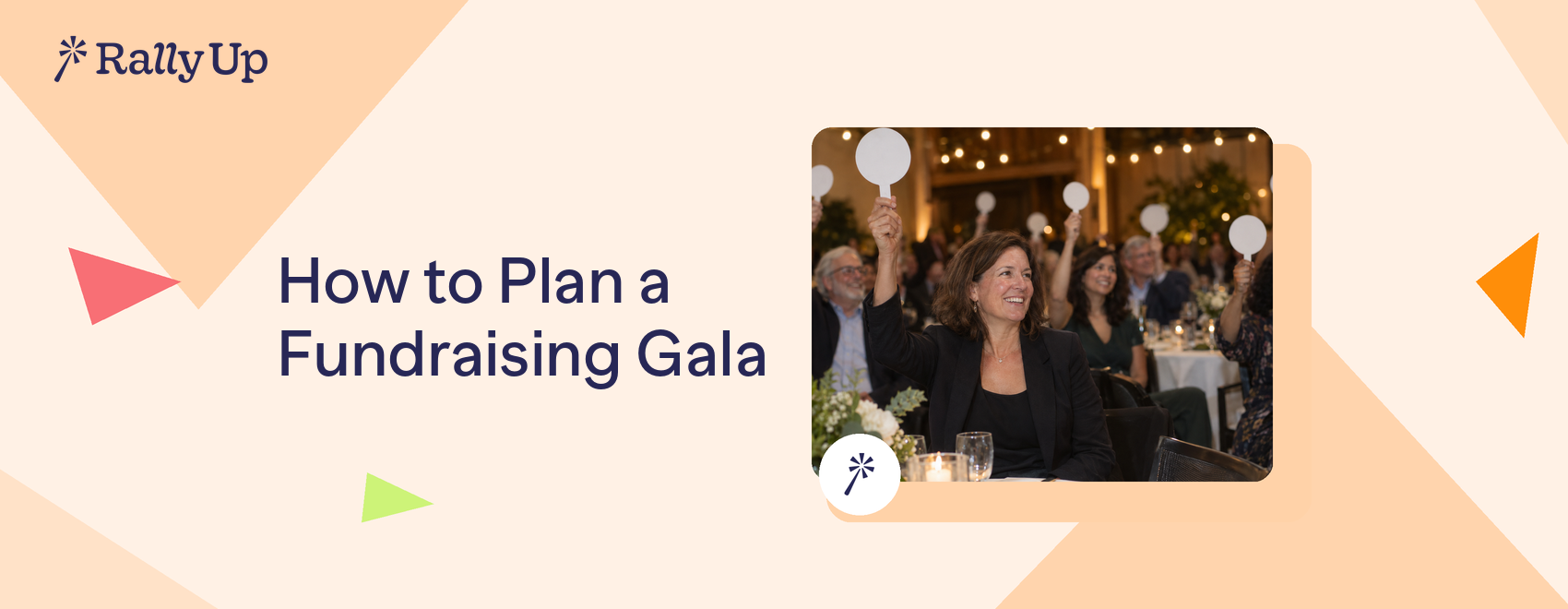
How to Plan a Fundraising Gala: Timeline and Checklist
How to plan a fundraising gala, in short
To plan a fundraising gala, start 6–12 months ahead and work through seven stages, from setting the goal to thanking guests the week after.
- Start 6–12 months out with a goal, a budget, a date, a venue, and a small team.
- Line up sponsors, auction items, ticket prices, and your emcee and auctioneer 4–6 months out. Open ticket sales 2–3 months out.
- Aim to spend no more than 50 cents for every dollar you raise. Less is better.
- The paddle raise is usually the biggest money of the night, so plan it like the main event.
- Fast checkout protects the last impression. With one tab per guest, no one waits in line at the end of the night.
A fundraising gala is a ticketed evening, usually with dinner, a short program, and one or more ways to give, such as an auction or a paddle raise. It raises money and brings your supporters closer to the cause. To plan a fundraising gala without a last-minute scramble, start 6 to 12 months ahead. The bigger the event, the closer to 12.
If you’ve just been asked to run your organization’s gala, take a breath. This guide tells you what to do and when, with a printable checklist at the end.
Still choosing a theme? Start with our 15 fundraising gala ideas, then come back here for the plan. Planning a different kind of event? Our charity event timeline covers the general version.
In this article
The fundraising gala timeline
Dates, venues, and sponsors need the longest lead time, so they come first. The details come later.
6–12 months out: goal, budget, date, venue, team
Set a net goal. Decide what you need to have left after costs, not just what you hope to bring in. Then work backward: your net goal plus your expected costs is what the night has to gross.
Draft the budget. Rough numbers are fine for now. See the budget section below.
Pick a date. Check holidays, school breaks, big local events, and other nonprofits’ galas in your area. Spring and fall are popular gala seasons, so venues and auctioneers book up early.
Book the venue. Ask about capacity, catering rules (in-house only, or can you bring your own caterer?), AV equipment, setup time, accessibility, and parking. Also check cell signal and Wi-Fi in the room. Guests will be bidding and giving on their phones.
Build your team. A gala committee can be two people. Split the work like this:
- One person owns the money coming in: sponsors, auction items, and tickets.
- The other owns the room: venue, vendors, volunteers, and the program.
For a larger event, you can add a chair, a board liaison, and small sub-teams for sponsors, items, and logistics. That’s optional. Two people with clear jobs can run a great gala.
4–6 months out: sponsors, auction items, ticket prices, emcee and auctioneer
Ask sponsors. Companies often set budgets months ahead, so this is the moment to ask. The sponsorship section below has simple tiers.
Start collecting auction items. Make a wish list first: experiences, trips, restaurant packages, and local services usually do better than gift baskets. Track every item in one sheet with the donor, the value, any restrictions, and how the winner collects it.
Set ticket prices. At minimum, the ticket price should cover each guest’s food and drink. Offer individual tickets and table packages, and consider an early-bird price. RallyUp Ticketing lets you sell single tickets and Event Packages, such as a full table, from one event page.
Book your emcee and auctioneer. The emcee keeps the program on time. A professional benefit auctioneer runs the live auction and the paddle raise, which are often the biggest money moments of the night. Good auctioneers book early, so don’t wait.
Send a save-the-date. A short email or postcard is enough.
2–3 months out: open ticket sales, send invitations, collect auction items
Test before you launch. Build your Campaign and run through it before tickets go on sale. RallyUp’s Power Preview lets you place test bids and run test card transactions through checkout while the Campaign is still a draft. When the Campaign goes live, test data is cleared automatically.
Open ticket sales with pre-registration. When guests save a card at registration, check-in is faster and checkout at the end of the night can happen automatically. This one setting makes gala night easier.
Send invitations. Email works for most guests. For major donors, add a personal note or call from a board member or your executive director.
Collect and describe auction items. Get the items, certificates, and photos in hand. Write short descriptions that sell the experience. If you’re writing a lot of them, the AI Fundraising Content Generator in RallyUp drafts item descriptions with one click, and you edit from there.
Open online bidding early (optional). Putting auction items online a week or two before the gala builds interest and lets people who can’t attend still bid.
4–6 weeks out: seating, volunteers, run of show, test everything
Plan seating. Assign tables from your RSVP list. Seat sponsors and major donors where they can see the stage. A spreadsheet or your venue’s floor plan works well for this.
Recruit and brief volunteers. You need people for check-in, auction spotting (recording bids and paddle numbers), item pickup, and a help desk. A smaller gala can run on a handful of volunteers if each one has one clear job. Hold a short walkthrough so everyone knows where to stand and who to ask.
Write the run of show. This is a minute-by-minute script for the night: who speaks, for how long, when screens change, and when the music cuts. A typical order looks like this:
- Doors open: reception, check-in, silent auction open
- Dinner and welcome
- Mission moment: a short story or video about the people you serve
- Live auction
- Paddle raise
- Silent auction closes
- Thank-yous and close
Test everything. Walk through the whole guest flow with your volunteers on the phones and Wi-Fi you’ll use that night: check a guest in, find an auction item, make a gift, and pull up a guest’s tab. People learn the flow faster by doing it once. Confirm the screens, microphones, and card readers work at the venue too.
Pro Tip
Put the paddle raise right after your mission moment. Guests give most when the story is still in the room.
Gala week: final counts, print materials, rehearsal
Send final counts. Give your caterer the final headcount and any dietary needs by their deadline.
Print what you need. Table numbers, signage, a simple program, paddles with guest numbers, and display cards for each auction item with a QR code so guests can bid from their phones.
Rehearse. Walk the room with your emcee and auctioneer. Check the microphones, the screens, and the slides. Run the paddle raise script out loud, including the giving levels. Make sure every device is charged and connected.
Gala night: check-in, program, the big giving moment, checkout
Check-in. Pre-registered guests scan a QR code and walk in. Keep one table with a printed list or tablet for walk-ins and anyone who can’t find their code.
Program. Follow the run of show and keep speeches short.
The big giving moment. This is the paddle raise. More on that below.
Checkout. This is the last thing guests remember, so make it fast. More on that below too.
The week after: thank everyone, share results
Thank people quickly. Email every guest, sponsor, item donor, and volunteer within a couple of days. Major donors and sponsors deserve a call or a handwritten note.
Share results. Tell supporters what you raised and what it will fund. A specific outcome, like “40 scholarships,” lands better than a total.
Close the books. Collect any unpaid balances, deliver auction items, and send sponsors their recognition recap.
Hold a debrief. While it’s fresh, write down what worked, what didn’t, and what it cost to raise each dollar. Next year’s planner, who may be you, will thank you.
How to budget for a fundraising gala
Most gala costs fall into a few buckets:
- Venue: room rental, setup and teardown, security, and any required insurance.
- Food and drink: usually the biggest single line. Get per-person pricing in writing.
- Entertainment and AV: emcee, auctioneer, music, microphones, screens, and projectors.
- Printing and signage: invitations, programs, table numbers, item cards, and paddles.
- Decor: centerpieces, lighting, and linens, if the venue doesn’t include them.
- Card processing: payment processors charge per transaction. On RallyUp, processing runs 1.9% to 2.9% plus $0.30 per transaction and is paid to Stripe or PayPal, not to RallyUp. On the Flex plan, platform fees run 2.9%–6.9% per Component, with several Components at 0%, and you can ask donors to cover fees at checkout. See RallyUp pricing for current rates.
- A cushion: set aside 5% to 10% for surprises.
The rule of thumb: spend no more than 50 cents to raise a dollar. The Nonprofit Research Collaborative found that the average special event costs about 50 cents for every dollar raised, according to Pride Philanthropy. Treat that as a ceiling, not a target. RallyUp’s guide to cost per dollar raised puts special events at roughly $0.30 to $0.50.
The math is simple: total costs divided by total raised. A gala that grosses $100,000 should cost no more than $50,000, and ideally closer to $30,000 to $40,000. The fastest way to bring that number down is to have sponsors cover big costs, like dinner or the bar, before the night begins.
Sponsorship tiers for your gala
Keep it to three or four tiers so sponsors can choose quickly. Dollar amounts depend on your community, but these benefits work at almost any size:
- Presenting sponsor (one only): name on the event (“The Spring Gala presented by…”), a reserved table, a speaking moment or thanks from the stage, and top logo placement on invitations, signage, and screens.
- Gold sponsor: a reserved table, logo on signage and screens, and recognition from the stage.
- Silver sponsor: two to four tickets, logo on screens and in the program.
- Community or in-kind sponsor: name in the program and on screens. This tier is a good fit for local businesses donating food, drinks, printing, or auction items.
Sell the presenting sponsorship first. Once you have one, it’s easier to sell the rest. RallyUp’s Live Display can show sponsor callouts on screens during the event, which gives sponsors something they can see. For help with the ask, see our sponsorship letter guide.
The giving moment: how a paddle raise works
A paddle raise, also called a fund-a-need, is a live appeal for straight donations. Nobody wins anything. Guests give because they care about what the money will do.
Here’s how it works:
- Your emcee or auctioneer tells a short story about the need and names what each gift will do, such as “$250 buys school supplies for a classroom.”
- They call out giving levels from the top down, for example $5,000, $2,500, $1,000, $500, $250, and $100.
- Guests raise their numbered paddles at the level they choose. Spotters record each paddle number.
- A screen shows the total climbing as gifts come in.
Why it’s usually the biggest money of the night. It’s public, so when one paddle goes up, others follow. It’s fast, so energy stays high. And it includes everyone, from the $100 guest to the $5,000 guest. RallyUp’s Paddle Raise+ page notes the format consistently outperforms auctions, raffles, and ticket sales in total dollars raised per minute.
Three ways to make it stronger:
- Line up a lead gift. Ask a board member or major donor to commit to the top level ahead of time so the first paddle goes up right away.
- Time it right. Run it right after your mission moment, while the story is still in the room.
- Keep it short. A few focused minutes beats a long appeal.
Paddle Raise+ goes beyond donations. Guests can also buy sale items or make A-Thon pledges by raising a paddle. Every gift lands on the guest’s Event Balance, so there’s nothing to collect at the table. Paddle Raise+ is part of RallyUp’s Galas & Events tools on the Flex plan. For more on running one, see our paddle raise planning guide.
Getting guests out the door: checkout
Long checkout lines are one of the most common gala complaints. After a great night, guests stand in a queue to pay, and the last thing they remember is waiting. It costs you money too: guests who leave without paying become follow-up calls next week.
Event Balances fix this. Every guest runs one tab all night. Bids, donations, paddle raise gifts, and purchases all land on the same balance, and the guest pays once. You choose how checkout happens:
- Automated Checkout: balances are charged at a time you choose, using the card the guest saved at registration.
- Self-Checkout: guests pay from an email or mobile link.
- Manual: your team settles a balance with a guest in person.
The results from events using Event Balances:
- 90% of payments are processed in under a minute.
- 75% of guests check out on their phones.
- 50% fewer follow-ups after the event.
- 0 minutes in line for guests on Automated Checkout. They simply leave.
Event Balances and Automated Checkout are part of RallyUp’s Galas & Events tools on the Flex plan.
Your printable fundraising gala checklist
Print this section or copy it into your planning doc. Check off each item as you go.
6–12 months out
- Set a net fundraising goal
- Draft a budget with a 5–10% cushion
- Choose a date and check for conflicts
- Book the venue
- Name your team and split the jobs
4–6 months out
- Send sponsor asks, presenting sponsor first
- Start the auction item wish list and tracking sheet
- Set ticket and table prices
- Book the emcee and auctioneer
- Send a save-the-date
2–3 months out
- Test your Campaign in Power Preview before it goes live
- Open ticket sales with pre-registration
- Send invitations, with personal notes for major donors
- Collect auction items, photos, and descriptions
- Open online bidding (optional)
4–6 weeks out
- Assign seating
- Recruit and brief volunteers
- Write the run of show
- Walk volunteers through check-in, bidding, giving, and checkout
Gala week
- Send the final headcount to the caterer
- Print table numbers, signage, programs, item cards, and paddles
- Rehearse with the emcee and auctioneer
- Charge devices and confirm Wi-Fi
Gala night
- Staff check-in and the help desk
- Keep the program on time
- Run the paddle raise after the mission moment
- Close the silent auction and run checkout
The week after
- Thank guests, sponsors, item donors, and volunteers
- Share the results and what they’ll fund
- Collect open balances and deliver items
- Debrief and record your cost per dollar raised
Now that you’ve seen it in action, are you ready to start fundraising?
Get Started