Giving Tuesday – The Complete Strategy Guide for Nonprofits
In this article
- What is Giving Tuesday?
- Why is Giving Tuesday important?
- When is Giving Tuesday?
- When is Giving Tuesday?
- Why do nonprofits participate in this global day of giving?
- Is Giving Tuesday only for nonprofits?
- Why choose Giving Tuesday for your fundraising campaign?
- What are the best ways to raise money on Giving Tuesday?
- Giving Tuesday Campaign ideas for nonprofits
- How to run a successful Giving Tuesday campaign
- How do I participate in Giving Tuesday?
- How to plan and run a successful Giving Tuesday campaign
- How to come up with your own Giving Tuesday fundraiser ideas
- Who’s matching donations on Giving Tuesday?
- Why you need a marketing plan for Giving Tuesday
- Marketing Tips for a successful Giving Tuesday campaign
- Giving Tuesday best practices
- How to create a Giving Tuesday fundraiser with RallyUp
- Frequently Asked Questions
- What is Giving Tuesday?
- Why is Giving Tuesday important?
- When is Giving Tuesday?
- When is Giving Tuesday?
- Why do nonprofits participate in this global day of giving?
- Is Giving Tuesday only for nonprofits?
- Why choose Giving Tuesday for your fundraising campaign?
- What are the best ways to raise money on Giving Tuesday?
- Giving Tuesday Campaign ideas for nonprofits
- How to run a successful Giving Tuesday campaign
- How do I participate in Giving Tuesday?
- How to plan and run a successful Giving Tuesday campaign
- How to come up with your own Giving Tuesday fundraiser ideas
- Who’s matching donations on Giving Tuesday?
- Why you need a marketing plan for Giving Tuesday
- Marketing Tips for a successful Giving Tuesday campaign
- Giving Tuesday best practices
- How to create a Giving Tuesday fundraiser with RallyUp
- Frequently Asked Questions
TL;DR
This guide covers the most effective Giving Tuesday campaign ideas and strategies for nonprofits aiming to maximize donations on December 1, 2026.
In this guide:
- What Giving Tuesday is and when the next one falls (December 1, 2026)
- 9 proven campaign ideas — peer-to-peer, a-thons, crowdfunding, auctions, sweepstakes, and more
- How to use past campaign data to double down on what works
- Donor, storytelling, and promotion tactics that drive last-mile gifts
What is Giving Tuesday?
It’s the Tuesday after Thanksgiving—and it’s not about leftovers. It’s a global day to give back. Think: donations, volunteering, kindness bombs.
Started in 2012 by NYC’s 92nd Street Y and the UN Foundation, it’s now a worldwide generosity party powered by hashtags, heart, and hustle.
Fun Fact: In 2023, folks in the U.S. gave $3.1 billion in one day. Yup, billion. Across 80+ countries, people showed up and gave big.
Online giving? It explodes on platforms like PayPal, GoFundMe, and nonprofit sites. Giving Tuesday is kind of a big deal.

Let’s make generosity loud. You in?
Here’s what you need to know about Giving Tuesday:
No signup needed: Just jump in! Use the logo, the hashtags—no paperwork or secret handshakes.
Everyone’s invited: Nonprofits, businesses, solo do-gooders, friend groups—anyone can join. You don’t need to be a 501(c). Just bring the good vibes.
Do it your way: Big budget or tiny pocket change? Doesn’t matter. $5, a tweet, or a whole campaign—all of it counts.
It’s global: Happening in 80+ countries! Support local needs or plug into global causes like education, climate action, or health.
Why is Giving Tuesday important?
Fueling a culture of generosity
Giving Tuesday flips the script on the shopping frenzy. Instead of grabbing deals, people give. Time. Money. Kindness. All of it counts.
It’s a moment to pause and ask: What do I care about? Then act on it. Small acts add up and together, we spark something big.
A big day for nonprofits
For nonprofits, this day is a game-changer. It’s one of the biggest fundraising boosts of the year. A lot of them count on it to keep programs running, especially with so many donations landing in December.
It’s not just about dollars. It’s about building real connections. Finding new supporters. Re-engaging old ones. Laying the foundation for long-term impact.
Spotlight on the causes that matter
Giving Tuesday doesn’t whisper, it broadcasts. With hashtags flying and stories flooding social feeds, it puts everything from local food drives to global climate action front and center.
As people share why they give, others get inspired. That spark travels fast. And wide.
The power of all of us
This isn’t a solo act. It’s a full-on, all-hands effort. In 2023, over 34 million adults in the U.S. showed up and raised $3.1 billion. That’s serious people power.
It brings folks together—nonprofits, businesses, neighbors, even governments. Think matching gifts. Team fundraisers. Community campaigns. When we move together, we move the needle.
Generosity isn’t just nice. It’s powerful.
Is Giving Tuesday only about raising money?
While most Giving Tuesday campaigns are based on monetary donations, many others focus on volunteering or sharing valuable resources. Some legal organizations, for example, donate pro bono services to those who do not have the means to fund their own legal representation. Some communities run local food drives. In short, there are infinite ways to give, and Giving Tuesday celebrates them all.
Is Giving Tuesday the biggest fundraising day of the year?
Is Giving Tuesday the biggest fundraising day? Not quite but it’s close.
Let’s clear this up: Giving Tuesday is a huge day for fundraising, especially online. But for most nonprofits, it’s not the #1 day for total donations.
That title usually goes to December 31. Why? Simple: tax deadlines. Donors race to get those year-end gifts in, and the final days of December, especially the 31st, see major spikes in giving.
Here’s how it stacks up:
Year-End giving packs a punch
- December 31 is typically the biggest giving day of the year.
- December 30 and 29 also see high traffic as donors wrap up their year.
- Roughly 30% of all annual giving happens in December alone (yep, you read that right).
Crisis campaigns can beat it too
- Urgent causes (natural disasters or emergencies) can spark massive giving days.
- Example: #GivingTuesdayNow in 2020 global support rallied during the early days of COVID-19 and topped regular Giving Tuesday numbers for many groups.
So why does Giving Tuesday still matter?
Because it’s a spark plug.
Giving Tuesday brings unmatched visibility, momentum, and energy to the year-end giving season. It rallies people around generosity. It helps nonprofits reach new donors, boost smaller campaigns, and start conversations that keep going into December.
It’s one of the most important fundraising days, especially for online donations, grassroots giving, and public engagement, even if it doesn’t always take the top revenue spot.
So no, it’s not always the biggest. But it sure is one of the boldest.
When is Giving Tuesday?
Think of it as the global generosity party—and you’re invited. Giving Tuesday happens every year on the first Tuesday after Thanksgiving (yep, right after Black Friday and Cyber Monday). It flips the script from buy, buy, buy to give, give, give.
Here are the upcoming dates, so you’re always ready to roll:
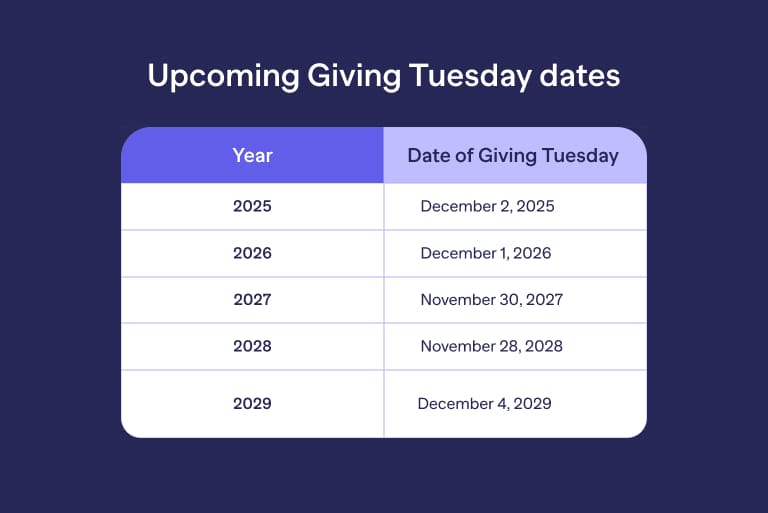
Upcoming Giving Tuesday dates
| Year | Date |
|---|---|
| 2025 | December 2 |
| 2026 | December 1 |
| 2027 | November 30 |
| 2028 | November 28 |
When is Giving Tuesday?
Giving Tuesday always lands on the Tuesday after Thanksgiving in the U.S. That means it falls somewhere between November 27 and December 3, depending on the year. It’s five days after Thanksgiving so mark your calendar!
Want to plan ahead? Here’s a quick look at the upcoming dates based on the Thanksgiving schedule.

Upcoming Giving Tuesday dates
| Year | Date of Giving Tuesday |
| 2025 | December 2, 2025 |
| 2026 | December 1, 2026 |
| 2027 | November 30, 2027 |
| 2028 | November 28, 2028 |
| 2029 | December 4, 2029 |
For confirmation of future dates beyond 2026, you can check resources like www.GivingTuesday.org, as dates may vary slightly based on calendar adjustments.
How long does Giving Tuesday last?
One day. All day. Midnight to 11:59 PM local time.
That’s the official window. Just 24 hours of full-on giving, kindness, and community action. It’s a single-day global event that moves fast but makes a big impact.
But here’s the twist
Because of global time zones, Giving Tuesday actually rolls out over 48 hours worldwide. While one country is winding down, another is just getting started. It’s like a relay race for generosity.
Also worth noting:
Some nonprofits stretch the moment. You’ll see “Giving Tuesday Week” campaigns or early-bird match offers popping up before and after the big day. These help build momentum but the heart of the movement is still that one powerful Tuesday.
Why do nonprofits participate in this global day of giving?
Let’s talk impact.
In 2023, Giving Tuesday raised $3.1 billion in the U.S. alone. That’s up slightly from 2022, even with economic headwinds.
Globally? Huge lifts in places like Canada, Brazil, India, and the UK. Platforms like PayPal and GoFundMe processed millions in donations. The day moves money and fast.
Launchpad for year-end giving
Giving Tuesday isn’t just a big day. It’s the starting line for the biggest giving stretch of the year. December is when donors dig deep, and this day sets the tone.
Nonprofits know it, too. That’s why many launch matching gift campaigns or limited-time appeals, turning one donation into two or three. Momentum builds here.
Fresh, creative, global fundraising
This movement isn’t stuck in the past.
Organizations get creative – think crowdfunding, virtual events, peer-to-peer campaigns. It’s all about making giving easy, personal, and global.
A megaphone for causes
Giving Tuesday doesn’t just raise money. It raises voices.
- Social reach: In 2023, the hashtag #GivingTuesday lit up social media with 2 billion+ impressions. From food security to gender equality, causes got airtime—and attention.
- Real stories: Nonprofits tell it like it is. One post. One video. One story about how $50 feeds a family, and people get it.
- Global vibes: 80+ countries join in, each putting their local spin on the day. From #GivingTuesdayIndia to #UnDiaParaDar in Latin America, campaigns speak the local language and meet real needs.
Everyone’s in
Giving Tuesday isn’t a niche event. It’s everyone’s day to give.
- Individuals: Gen Z, Millennials; younger donors are showing up strong. In 2023, 60% of U.S. donors under 40 gave on Giving Tuesday.
- Businesses: From tech giants like Microsoft and Google to small local shops, companies step up with matches, volunteer hours, and donated goods.
- Communities: Schools, churches, libraries; folks organize food drives, fundraisers, and more. Giving gets local and powerful.
Ready for anything
The world throws curveballs. Giving Tuesday swings back.
In 2020, #GivingTuesdayNow popped up in May to support COVID-19 relief, raising serious funds fast. This movement is nimble and built for the moment.
It also tackles the long game: inequality, climate change, systemic challenges. By spotlighting organizations doing that work, Giving Tuesday keeps people engaged long after the day ends.
It’s not just about one day. It’s about what that day kicks off. Giving Tuesday is loud, generous, flexible and growing.
How can my nonprofit organization participate in Giving Tuesday?
- Start Planning Early (September–October)
- Secure matching gift partners (e.g., local businesses or donors) to double donations
- Focus on a clear message (e.g., “$25 feeds a family for a week”) with emotional visuals or stories.
- Use a user-friendly donation platform
Tip: Start with a basic crowdfunding page if new to Giving Tuesday
- Announce your campaign 4–6 weeks out via email and social media
- Encourage board members, volunteers, or donors to share your campaign or start peer-to-peer fundraisers.
- Promote matches on December 2 (e.g., “Your $50 gift becomes $100 today!”)
- Go live at midnight with posts, emails, or live updates
- Thank donors within 48 hours via email or social media, sharing impact
- Use Giving Tuesday to launch year-end giving, as 30% of donations occur in December
How do I register my organization to take part in Giving Tuesday?

No red tape. No gatekeeping. Just give.
You don’t need to register to be part of Giving Tuesday.
No forms. No fees. No approvals.
This is an open-source movement—wide open to everyone. Whether you’re a registered nonprofit, a community group, or just a few neighbors with a cause—you’re in.
Here’s how to jump in:
- Plan your campaign your way.
- Use the #GivingTuesday hashtag and logo to show you are part of the global crew.
- Want to go a step further? Customize the logo to match your mission. Yep, it’s allowed.
Need tools? Ideas? Free stuff?
Sign up for the GivingTuesday Nonprofit Newsletter at www.GivingTuesday.org. You’ll get toolkits, templates, and tips straight to your inbox. It’s the closest thing to “registering”—and super helpful.
Is Giving Tuesday only for nonprofits?
Who can be part of Giving Tuesday?
Short answer: everyone.
✅ Nonprofits
The usual power players. Think 501(c)s raising funds, recruiting volunteers, and sharing their mission with the world. Giving Tuesday is made for this.
✅ Community & Grassroots Groups
No nonprofit status? No problem.
Neighborhood groups, clubs, mutual aid collectives. Organize a fundraiser, plan a cleanup, or just get the word out.
✅ Businesses
Yes, companies jump in too.
From Microsoft to your local coffee shop, businesses match gifts, donate products, or let their teams volunteer. Doing good = good business.
✅ Schools
PTAs, kindergartens, college campuses, schools bring energy! Expect bake sales, student-led service projects, and creative campaigns to support classroom causes.
✅ Faith-Based Organizations
Churches, synagogues, mosques, temples – faith communities give big. They organize donation drives, service projects, and outreach aligned with their values.
✅ Individuals
You don’t need a group to make an impact.
Donate. Volunteer. Share a cause. Help a neighbor. Kindness counts. Even a single social post with #GivingTuesday can spark something.
✅ Civic + Government Groups
City councils, libraries, public agencies – they get involved, too. Hosting food drives, promoting local campaigns, or rallying residents to give back.
No matter who you are or what you’ve got to give—Giving Tuesday is yours.
It’s one day, for everyone, to show up and do good!
Why choose Giving Tuesday for your fundraising campaign?
This isn’t just another Tuesday. Giving Tuesday is the day to fire up your fundraising, rally your people, and grow your impact. It’s like a booster shot for generosity—and your mission can ride that wave. So what exactly makes Giving Tuesday such as great time for fundraising?
Sky-high fundraising & unstoppable engagement
Millions of people across the globe jump in—giving, sharing, volunteering. The energy? Wild. The reach? Massive. Here’s what you can do:
- Drive donations: People are ready to give. And give big.
- Spark connections: Use stories, videos, and fun challenges to light up your community.
- Go viral (in a good way): Peer-to-Peer fundraising lets your supporters take the lead—and expand your reach like wildfire.
Real talk: In 2024, Giving Tuesday pulled in $3.6 billion in donations in the U.S. alone. That’s the kind of impact we’re talking about.
People are primed to give
Giving Tuesday has its own rhythm—kind of like Black Friday, but for hearts instead of carts. People expect to give, and that’s your cue to shine.
- Donors are in the mood: This is your moment to inspire action.
- Free media buzz: News outlets love Giving Tuesday. Your campaign gets bonus eyeballs.
- Built-in community support: Local schools, businesses, and groups often join in. Team up and grow your reach.
Giving Tuesday gives you the stage, the spotlight, and a crowd ready to cheer you on. You just have to show up and make it count.
A golden chance to find new donors
Ready to grow your crowd? Giving Tuesday is the perfect time to bring in fresh faces—especially people who’ve never donated to you before.
- It’s for everyone: This movement speaks to all kinds of people. Young, old, local, global—generosity connects us all.
- Social media does the heavy lifting: One great post can ripple out fast. Supporters share, their friends see it, and suddenly, someone who’s never heard of you is ready to give.
- It kicks off year-end giving: Giving Tuesday isn’t just a one-day push. It opens the door to December—when nearly a third of yearly donations come through. Bring in new donors now, and you could keep them around for the long haul.
Want to make it easy for newcomers? Offer small donation options or simple ways to get involved. That first gift might just be the start of something long-term.
Double the impact
If you’ve got a matching gift lined up, Giving Tuesday is your moment to shine. It’s one of the smartest ways to boost results.
- People give faster: When donors hear their gift can go twice as far, they act. Fast. Nobody wants to miss the match window.
- They give more: A match is a powerful motivator. A $50 gift suddenly feels like $100. That’s the impact they can feel.
- It builds big-league relationships: Match sponsors—whether they’re companies, foundations, or major donors—often turn into long-term partners.
Want results? Promote early. Be clear. Spell it out: “Every dollar matched up to $50,000!”
And here’s proof it works: In 2024, nonprofits with matching campaigns on Giving Tuesday raised up to 50% more than those without.
What are the best ways to raise money on Giving Tuesday?
Here are 10 of the best ways to raise more money on Giving Tuesday:
1. Peer-to-peer Fundraising
Have you ever noticed that people are much more likely to give generously to people they already know and love? For example, a father would sooner contribute $50 to his daughter’s favorite charity to support her than to a stranger in the street asking for donations for the exact same cause.
Peer-to-peer fundraising harnesses the innate trust we place in our friends, family, and loved ones. Your supporters can reach out to their social networks to drum up new donors and contributions. This is welcome news for last-minute planning because it means that your supporters basically do all the advertising and fundraising for you!
Learn more about Peer-to-peer.
3 Steps to a Giving Tuesday Peer-to-Peer Campaign
Peer-to-peer fundraising doesn’t have to be complicated. Just follow these 3 steps to get started.
- Recruit Supporters. Find a core group of supporters who will raise funds on your behalf. A good place to look is within your organization’s past donors and supporters, of course. But don’t be shy about reaching out to family, neighbors, and friends—people get really excited about a good cause!
- Support Your Supporters. While your supporters will promote and fundraise on your behalf, you can make the most of their efforts by providing a helpful schedule. Include things like: when they should post on social media accounts, talking points about your organization’s cause and values, and email and social media templates for effective communication with donors. (Download some campaign-ready resources here!).
- Check In. Encourage supporters to post and share regular updates about the status of their campaigns. Not only does it keep morale high, but it inspires other donors to lend a hand.
- Say thank you. Don’t ever be perfunctory with gratitude. Supporters take a ton of time and initiative to go to bat for you, so show them how much you appreciate it. Whether it’s social media shoutouts, personal emails sent directly to their inbox, or even a phone call. (Yes, hearing a warm human voice is a beautiful thing!).
2. Giving Tuesday A-thons
From marathons to walk-a-thons to read-a-thons to dance-a-thons, the same peer-to-peer principle applies: supporters rely on their own networks to drive awareness and ask for donations as they walk, run, read, or dance the night away on behalf of your cause!
The best part about a-thons is how creative and diverse they are. For organizations that are running late for Giving Tuesday, a virtual a-thon is easy and quick to set up. For example, supporters can log their own miles as they walk in support of your Giving Tuesday campaign no matter where they are in the world as you cheer them on through social media shoutouts.
Learn more about A-thons.
3. Crowdfunding
If you really want to keep it easy this Giving Tuesday, launch a crowdfunding campaign and invite your biggest supporters to be ambassadors for your cause. Not only does crowdfunding tap into a global audience, but it lets people donate without leaving their couch. A digital-first movement like Giving Tuesday aligns perfectly with the storytelling power of crowdfunding campaigns.
The key strategy is to share a compelling, interesting narrative about all the good your nonprofit does in the world and highlight exactly how donations will be used. Donors want to know that their contribution matters, so don’t be afraid to get really detailed here. For example, $100 builds a well. Don’t forget to be creative with crisp, relevant images to really inspire giving!
Learn more about Crowdfunding.
4. Giving Tuesday Auctions
There’s nothing like a little friendly competition to inspire donors! Auctions are fun, lighthearted, and bring people together to bid on thrilling prizes on behalf of your nonprofit.
If you opt for an in-person auction this Giving Tuesday, give attendees an easy way to bid on fun items and keep track of their bidding status with smart mobile bidding software that’s optimized for mobile phones and devices. For efficiency and broader reach, why not hold an online auction? It lets supporters quickly scroll through crisp images of what’s on offer on branded, customized donation pages. They’ll have a blast bidding against one another as they’re alerted to their bid status by email or text in real time!
The best part of an online auction—aside from eliminating worries about finding a venue and booking entertainment and refreshments—is that it gives donors plenty of time to bid on prizes. Instead of a one-night affair, a virtual auction can last weeks!
You could start your online auction in early November, making Giving Tuesday the last day to bid.
Learn more about Auctions.
5. Giving Tuesday Events and Ticketing
The pandemic showed the world that people can connect and support one another wonderfully online, but they also crave in-person events. With a super simple event management platform that bypasses the hassle of paper tickets and sign-up sheets, it’s a piece of cake to plan, promote, and hold a Giving Tuesday event online or in-person.
From intimate, curated experiences for your top donors (a virtual wine and cheese party, anyone?) to in-person galas and events, you can save a lot of time and resources with online ticketing, registration, and seamless communication.
Learn more about Events and Ticketing.
6. Giving Tuesday Sweepstakes
Entice donors with exciting giveaways by organizing a Giving Tuesday Sweepstakes on an easy-to-use landing page. Your nonprofit can give away fun and maybe valuable gifts to supporters while creating a sense of community and suspense.
Since Giving Tuesday is all about boosting global awareness through social media, supporters will love giveaways that make it easier to connect with one another. Think slick earbuds and headphones for smaller gifts and an impressive digital gadget as your main showstopper!
Learn more about Sweepstakes.
7. Giving Tuesday Sale
On a day like Giving Tuesday, mindless consumption takes a backseat as donors support their favorite causes by making meaningful purchases that help improve the world.
Whether your nonprofit is selling lovingly made DIY items or kindly donated gifts, make it easy for your supporters to get one. Give them a hassle-free, intuitive browsing and purchasing experience with our sales software. With beautifully designed product listings that reflect your unique brand, donors will be delighted to explore what you’re offering!
Learn more about Sales.
9. Giving Tuesday Livestream
If you don’t livestream it, did it even happen? In all seriousness, for nonprofits that are running late with their Giving Tuesday campaign, livestreaming is a brilliant solution that lets you connect with supporters anywhere in the world.
While you can certainly livestream an impressive event—a gala party or a concert, for instance—it’s perfectly acceptable to livestream something much more ordinary while giving your supporters a peek behind the scenes. For example, a livestreamed sit-down with the board of directors or a coffee break with your volunteers.
You can take donations, run spotlight auctions, raffles, and much more since they’re built right into our easy-to-use livestreaming.
Learn more about Livestreaming.
10. Giving Tuesday Donation Pages
To tap into the sharable, digital, go-viral-or-go-home nature of Giving Tuesday, a donation page is an absolute must. Not only does it share your cause with millions of supporters all over the world with engaging images and powerful storytelling, but it makes donating so easy. Best of all, it encourages one-time contributors to become recurring donors with an automatic invitation to become a monthly supporter. On Giving Tuesday, that offer is hard to resist!
Learn more about Donation Pages.
Giving Tuesday Campaign ideas for nonprofits
Whether you keep it sweet and simple or really step it up for maximum impact, here are a few Giving Tuesday fundraiser ideas to help you get the ball rolling.
Giving Tuesday Fundraising Idea #1: Host a Holiday Party
Since Giving Tuesday falls right between the major autumn and winter holidays, it’s easy to keep the momentum going by organizing a midwinter shindig. Get in touch with local event venues to donate their space, sell tickets through a fundraising platform, and just enjoy a night out. Keep it adults-only, with champagne and hors d’oeuvres, or plan a family-friendly affair, complete with Santa Claus as the guest of honor.
Giving Tuesday Fundraising Idea #2: Run a Clothing Drive
Since Giving Tuesday is all about, well, giving, now is the time to round up all those extra coats, hats, gloves, and warm socks. Sub-zero temps are no joke for the vulnerable folks in your region, and they’ll be grateful for the extra layers. Organizing a drive is straightforward: begin by posting a call to action on your social media site, then set up bins in schools, community centers, churches, or the lobbies of apartment buildings.
Giving Tuesday Fundraising Idea #3: Set up a Themed Online Store
One of the easiest Giving Tuesday fundraising ideas on the planet is to sell DIY apparel through a fundraising platform. Recruit volunteers from your organization to bust out those mad crafting skills and make winter wreaths, bouquets, or wool scarves. You can even invest in a basic sticker machine and draw holiday-themed stickers (kids, especially, LOVE stickers).
Giving Tuesday Fundraising Idea #4: Plan a Dog-Walk-A-Thon
When it’s freezing outside, nobody wants to get out in the snow — except our furry pals! Since Fluffy needs her walk even when it’s cold, why not at least walk for a good cause? This Giving Tuesday, invite the dog owners in your area to bring their (leashed) pups for a fun afternoon making laps around the local park. Sponsors can donate per mile, per hour, or per paw!
How to run a successful Giving Tuesday campaign
A successful Giving Tuesday campaign is critical for many non-profits and fundraisers, here’s some important steps and key considerations to make during the planning and execution of your campaign.
Look back before you launch forward
If you’ve run Giving Tuesday campaigns before, guess what? You’ve got gold. All that data? It’s your roadmap for making this year even better.
Dig into the data
Pull together the numbers from last time—and look at the full picture. Don’t just ask what happened. Ask why.
Here’s what to track:
- Total Raised: Did you hit your goal? Surpass it? Or fall short?
- Donor Count: Who gave? Were they new or returning?
- Average Gift Size: How much did people give? Any surprising spikes?
- When They Gave: Morning rush? Evening wave? Right after that email went out?
- Campaign Costs: What did it cost to run—and was the return worth it?
Action step: Drop it all in a simple spreadsheet or build a dashboard. Compare year-over-year to find what’s growing—and what’s not.
Follow the money (by channel)
Every channel doesn’t perform the same. Some pull in big gifts. Others drive volume. Look at which ones actually brought in dollars—not just likes or clicks.
Here’s how to break it down:
- Website: Use your analytics to see where traffic came from. Email? Social? Direct? Which path led to the most donations?
- Email: Which messages converted? Look at open rates, click-throughs, and—most important—donation completions.
- Social media: Track what posts or ads drove action. Focus on what moved people to donate, not just what got hearts and shares.
- Text-to-Give, Events, Peer-to-Peer: If you used other tools or tactics, measure their return. Was it worth the time and money?
Pro tip: Use tracked links, tags, or UTM codes next time to get even clearer data.
Your past campaign is a playbook. Use it. Look for patterns. Double down on what worked. Ditch what didn’t. And walk into this year’s GivingTuesday campaign smarter, sharper, and more prepared to win.
Spot what’s working. Shake up what’s not.
Want to crush your next Giving Tuesday? Start with what your own data is already telling you. It’s all there—just waiting to guide your next big move.
Chase the channels that pay off
Let the numbers lead.
Insight: If 60% of your donations came through email but only 10% through social? Double down on email. Then try new tricks on social media—maybe some paid ads or teaming up with a mission-aligned influencer.
Action: Put more time, budget, and love into the channels that actually bring in money. For the underperformers? Mix things up. Try shorter mobile-friendly forms if your website was a bottleneck. Think quick wins, not guesswork.
Size up your social media impact
Social is the megaphone for Giving Tuesday. But shouting into the void? Not the move. You want reach and real engagement. Here’s what to dig into:
- Reach vs. Impressions: How many unique people saw your stuff? And how many total views did it get?
- Engagement: Clicks, shares, comments—these are your clues that people cared.
- Hashtag Traction: Did #GivingTuesday or your custom tag take off?
- Top Content: Which posts actually delivered—emotionally and financially?
Example Insight: If a heartfelt beneficiary video got 10x more shares than a basic donation post, guess what you should lead with next year?
Action: Go big on what worked—more videos, more storytelling, more real faces. Try new formats, like Reels or TikTok, if your audience is there. And post when your data says your people are most active.
Dial in your email game
Email isn’t just alive—it’s thriving. Especially on Giving Tuesday. But only if you send the right message, at the right time, to the right people.
Here’s what to measure:
- Open Rates: How many actually opened? A solid average is 20–25%.
- Click-Through Rates (CTR): Did your links get clicks? Over 2–3% is great for nonprofits.
- Conversions: Did clicks turn into donations? If not, your donation page might need a tune-up.
- Segmentation: Were targeted emails (like past donors vs. new folks) more effective than one-size-fits-all blasts?
- Timing: What time of day led to the most gifts?
Insight: If your early morning email pulled a 30% open rate and your evening blast flopped at 10%—you’ve found your sweet spot.
Action:Keep the tactics that worked—clear subject lines, emotional storytelling, mobile-optimized donation links. And test the ones that didn’t. Even small shifts (like send time or CTA placement) can make a big difference.
The wrap-up: Your last campaign has all the clues. All you have to do is follow them.

Then show up this Giving Tuesday smarter, louder, and more effective than ever.
Double down. Fix what flopped. Try something new (but not everything).
Scale what worked
If something crushed it—run it back, but bigger.
Example: Your matching gift campaign doubled donations? Lock in a larger match for 2025 and start hyping it early.
A social media challenge went viral? Bring it back with a twist—think dance challenge instead of just photos. Proven wins deserve more attention, budget, and energy.
Fix what fell flat
Not every tactic hits. That’s okay—as long as you learn from it.
Here’s how to troubleshoot:
- Social media got crickets? Test paid ads. Team up with an influencer. Use punchier visuals or video.
- Emails didn’t convert? Simplify your donate page. Tighten your CTA. Make it easy and fast to give.
- Struggled to reach new donors? Try peer-to-peer fundraising or connect with local orgs to boost visibility.
Reminder: Don’t write off the channel—fix the execution.
Try one or two smart experiments
Fresh ideas keep your campaign exciting. But don’t toss out everything that worked.
Example: If mobile giving was weak last year, test a text-to-give option this time. Or try a livestream mini-event if you’ve never gone live.
Key rule: One or two tests. Not ten. You want insights—not chaos.
Expand the hits. Tweak the misses. Test one new thing. That’s your formula for a sharper, stronger, smarter Giving Tuesday campaign.
How do I participate in Giving Tuesday?
Whether you’re flying solo, repping a nonprofit, running a business, or leading a school or faith group, there’s a way for you to make a difference.
1. For Individuals
Ready to give? Here’s how to go big (or small, it all counts):
Give money
- Pick a cause that hits home. Local shelter? Climate nonprofit? Global relief?
- Donate on December 2, through their site or use fundraising platforms.
- Tip: Watch for matching gifts where your donation gets doubled (yep, double impact).
Give time
- Volunteer at a food bank, shelter, or local event. Check www.GivingTuesday.org for listings.
- More of a couch giver? Help virtually! Write thank-you notes, manage a nonprofit’s social posts, or host an online fundraiser.
2. For Nonprofits
Giving Tuesday is your moment. Let’s get you campaign-ready:
Plan your campaign
- Set a goal: $5,000? 50 volunteers? Pick something clear.
- Grab the free toolkit at www.GivingTuesday.org. It’s loaded with templates and social media assets.
- Craft a powerful message, something real: “Just $25 gives a child school supplies for a year.”
- Real talk: Fenix Youth Project raised $7,000 with a Facebook fundraiser and a Twitter chat.
Start early
- Mid-October is go time. Start teasing your campaign via email, socials, and your site.
- Use #GivingTuesday + your own hashtag (like #SaveTheStraysGivingTuesday) to build buzz.
Make giving easy
- Test your donation page, especially on mobile. Tools like RallyUp help.
- Link up with a business for matching gifts or promo support.
3. For Businesses
Want to build goodwill and give back? Here’s your playbook:
Give back
- Donate a slice of your sales. Match employee gifts. Or give products/services to a nonprofit partner.
Example: A retailer donates $1 for every sale that day – simple and effective.
Get your team involved
- Offer paid volunteer time or match what your staff gives.
- Shout it out! Share your efforts on socials using #GivingTuesday. Tag your nonprofit partners and show your values in action.
Customer engagement ideas
- Let customers round up at checkout or add a small donation to their order.
- Host a fun event – think charity auction, food drive, or pop-up fundraiser.
- Look at PayPal: They process millions in Giving Tuesday donations, helping nonprofits crush their goals.
4. For schools, faith groups & community orgs
Your group has heart; Giving Tuesday is your time to show it.
Run a fundraiser
- Crowdfunding, bake sales, clothing drives, it all works.
- Not a formal nonprofit? No problem. Use tools like GoFundMe to keep it simple.
Example: Schools often do “Kindness Days” where students lead donations or service projects. Big impact, big smiles.
Raise awareness
- Share your Giving Tuesday story using #GivingTuesday and your city’s tag (like #GivingTuesdayNYC).
- Make your own campaign hashtag to rally your crew.
- Use events or social media to teach your community why your cause matters.
Whatever your role, whatever your size, you’re invited
Rally the team—because going solo is a no-go

You can’t (and shouldn’t) do this alone
Running a Giving Tuesday campaign solo? Hard pass. That’s how you end up overwhelmed, missing things, and playing catch-up.
Teamwork spreads the work, sparks smarter ideas, and keeps the whole campaign on track—from first brainstorm to final thank-you note.
And let’s be real: group brainpower > one-person hustle.
Action: Kick things off early—like summer-early. Host a planning meeting to set your goals, assign roles, and sketch out a rough timeline. Use tools like Zoom or Google Docs to make it easy for everyone to contribute—even if they’re remote.
More Voices = Better Ideas
Every team member sees your mission through a different lens—and that’s gold.
Your program staff knows what moves hearts.
Volunteers hear what donors love (and what they don’t).
Board members? They bring strategy—and sometimes, connections.
That variety can lead to creative gold.
Case: Someone pitches a “Day in the Life” fundraiser.
Each donation funds a real part of your program—like $50 for a kid’s art therapy session—while telling the story of the impact.
Simple. Tangible. Powerful.
Action Step: Hold a structured brainstorm with fun, focused prompts. Try:
- “What’s a wild way to show our impact?”
- “How can we make giving fun?”
And make space for all voices—especially the ones that don’t usually get the mic.
Let marketing do their thing
Your marketing team? They’re your megaphone.
They know how to grab attention, tell a story, and get your message seen by the right people—on the right platforms—at the right time.
What they bring:
- Killer social media skills
- Scroll-stopping graphics
- Email know-how
- Data to back it all up
From campaign videos to hashtag-ready posts, they help your campaign break through the noise—and get seen, shared, and funded.
Your marketing team are your storytelling powerhouse. They don’t just post—they plan, track, and adapt on the fly. Marketing owns your message and knows how to make it pop across every channel.
What They Bring: Big-picture thinking + tactical magic. Social posts, email blasts, website updates—all dialed in and on-brand.
Specific Role: Build a multi-channel plan, Create a content calendar, Track what’s working (and what’s not) in real time.
Example: They launch a viral photo challenge with your hashtag. It spreads fast on Instagram and X—boosting reach and engagement big time.
Action Step: Loop them in early. Have them dig into past wins (like top-performing posts) and shape a plan that ties directly to your mission.
Finance: your budget watchdogs
They’re the ones making sure your campaign makes sense—and makes cents.
What They Bring: Budgeting savvy, cost-checking, donation tracking, and financial compliance.
Specific Role: Set your budget, Price out tools and ads, Keep spending smart, Track incoming gifts and flag anything off-track.
Example: Marketing wants a slick promo video. Finance suggests a powerful, volunteer-made one instead—saving money without losing impact.
Action Step: Have finance review the whole campaign plan. Ask them to suggest thrifty tweaks and set up a live donation tracker so you’re crystal clear on results.
Board of directors: your connector crew
They’ve got reach. And they’ve got clout. Your board opens doors, rallies big names, and lends major credibility.
What They Bring: Strong networks, strategic thinking, fundraising chops.
Specific Role: Bring in corporate matches, Introduce new partners, Host small donor events (think: virtual briefings or online mixers), Share your campaign far and wide.
Example: One board member lands a $10,000 match from a local company. Boom—every gift now goes twice as far.
Action Step: Present your Giving Tuesday goals early. Ask for specific support—like locking in one match sponsor or sharing your fundraiser with 10 new contacts.
Volunteers: your mission in motion
They’re on the ground, living the mission—and they’ve got insights that paid ads can’t buy.
What They Bring: Frontline know-how, true passion, and direct community ties.
Specific Role:
- Test your donation forms.
- Share campaign ideas.
- Lead peer-to-peer fundraising.
- Spread the word to their personal circles.
Case: A longtime volunteer suggests a “Thank You Wall” where every donor’s name gets featured. It’s based on what they’ve seen get real love from your community.
Action Step: Get their input early—via brainstorms or a quick survey. Shout them out in your campaign. Share their stories. They’ll show up even stronger.
Giving Tuesday isn’t a solo sprint—it’s a team sport. Every department brings something essential to the table. Get aligned early. Play to each team’s strengths.
And use collaborative tools: platforms like Trello, Slack, or Asana can streamline communication and task management, especially for large or remote teams.
Team-powered Giving Tuesday in action
Organization: A community health clinic
Campaign: Heal a Heart Challenge
Here’s how the team made it shine:
- Marketing: Dropped a moving video with real patient stories. Launched a heart-filled challenge—supporters posted hearts with #HealAHeart to show they gave.
- Finance: Locked in a $5,000 match. Made sure the donation platform was mobile-friendly and easy on the budget.
- Board: Called in a favor. Landed a sponsorship from a local hospital and spread the word through their networks.
- Volunteers: Brought the spark. Came up with the “Health Hero” idea—donors could honor a nurse or doc. Also hosted a live Q&A on Giving Tuesday.
The Result:
- They raised $20,000.
- Welcomed a wave of new donors.
- Built stronger ties across the whole community.
Analyze your competitors

Want to stand out this Giving Tuesday? Start by scoping the field.
If you want to shine, you’ve got to know what everyone else is doing. Checking out other organizations in your space isn’t spying—it’s strategy. It helps you dodge donor fatigue, stay original, and borrow smart ideas without blending into the crowd.
Do some friendly snooping
Look at nonprofits that are like you—same mission, region, or donor base—and see what they pulled off last Giving Tuesday.
Here’s how:
- Poke around online: Head to their websites and scroll their social feeds. Sign up for their emails. Take notes on what they said, how they said it, and what made it pop.
- Dig through fundraising platforms: Fundraising platforms like RallyUp often feature Giving Tuesday campaigns. Hunt down their past pages to check out goals, graphics, and incentives.
- Hit up GivingTuesday.org: Their campaign roundups and leaderboards show off what’s worked across sectors. Use them as a goldmine of ideas.
- Look local: If your competitors are nearby, scan for press releases, event listings, or local Giving Tuesday happenings—like matching drives or virtual meetups.
Example: Running a food bank? See how other hunger-fighting orgs framed their 2024 pitch. Did they highlight meals served, share volunteer stories, or team up with a local grocer?
Action: Make a quick spreadsheet. Track things like campaign themes, calls-to-action, tone, visuals, and (if you can find it) how successful it looked—based on social buzz or public fundraising numbers.
Don’t just copy—cut through the noise
Here’s the deal: If five nonprofits in your town all launch “Double Your Impact!” campaigns with the same hashtag… donors are gonna tune out.
You’ve got to zag when others zig.
- Why it matters: Donors juggling multiple asks may skip the ones that sound the same. Familiar = forgettable.
- How to stand out: Look at what’s being overused. Then flip the script. If everyone’s doing email pushes, maybe you lead with a text-to-give campaign. If matching gifts are everywhere, tell a long-game story about building something lasting.
Example: If last year’s crowd all shouted, “Double Your Impact,” go a new route. Try something like “Fuel the Future”—where gifts help launch a new program or fund year-round support.
Action: Before you lock in your campaign, do a final cross-check. If your plan’s looking too similar to a competitor’s, tweak it. Swap your hashtag. Pick a different hero story. Shift your tone. Keep it fresh.
Awareness is power. Do the research. And deliver a campaign that cuts through the Giving Tuesday noise.
Go Bigger. Go Bolder. Go Yours.
You’re not here to play it safe—you’re here to make waves. And the best way to do that? Watch what’s working out there, then turn it up in a way only you can.
But remember—this isn’t about spending more. It’s about being sharper, smarter, and more unforgettable.
- Spot what’s hot: Track the big wins—viral posts, big fundraising pushes, crazy engagement. Scroll their social feeds, check campaign pages, and clock those like counts and donation totals.
- Crank it up: Take what worked for them and scale it creatively. If they did a photo challenge, bring the energy with a video contest. Add storytelling. Add meaning. Add a reason to share it.
Example: A local nonprofit crushed a “Sponsor a Child” campaign and hit $10K. Cool. You could level that up with a “Sponsor a Future” twist—where donors fund mentorship, school supplies, or tutoring. Add a live thank-you event to make them feel like heroes.
Action: Find one or two standout campaigns. Then huddle with your team to brainstorm how you’d do it—louder, stronger, and more on-brand. Add a match, a challenge, or a twist that makes it pop.
Remix what’s working—so it feels 100% you
Let’s be real: nobody wants a copycat campaign. But a remix? Now that’s a smart strategy.
The trick? Take what worked somewhere else and shape it to fit your voice, your values, and your goals. This way, your campaign feels fresh and familiar—and your donors feel right at home.
- Tweak the theme: Keep the bones but change the outfit. Their “Run for a Cause”? Yours becomes a “Walk for Wellness”—perfect if your mission is mental health.
- Keep it goal-driven: Want more recurring donors? More first-time gifts? Whatever your GivingTuesday goal is, make sure the idea supports it.
- Stay true to you: Match your tone, visuals, and message. That’s how you keep trust high and engagement higher.
Example: Saw a “Meal Match” campaign that funded meals for families? If you’re in literacy, flip it into a “Book Match” campaign. One gift = one book for a child. Partner with a sponsor to match donations, and boom—impact, doubled.
Action: Pick one winning idea from a competitor. Workshop it with your team. Make it yours. Then soft-launch it with a small donor group or on social to see how it lands. If it hits? Roll it out big.
Watch what’s out there. Learn from the best. Then go make it even better—with your own spin, your own voice.
Talk to your donors—they know what works
Want a Giving Tuesday campaign that actually hits home? Start by asking the people who know you best: your donors.
They’re not just supporters—they’re a goldmine of insights. Tap in, and they’ll tell you exactly what lights them up (and what makes them hit “unsubscribe”).
Run a quick donor survey
Surveys are your low-lift, high-reward tool. Fast to make. Easy to share. Full of clarity.
How to do it: Use tools like Google Forms, SurveyMonkey, or your email service (Mailchimp, Constant Contact, etc.). Keep it short—3 to 5 punchy questions. Send it via email, post on socials, and share at events.
What to ask:
- What inspires you to give?
- Which programs or stories stick with you most?
- What kind of Giving Tuesday campaign would you actually get excited about (matching gifts, challenges, events)?
- What turns you off (too many emails, clunky donation forms, vague appeals)?
When to do it:
Now. Like, this month (May 2025). Give yourself time to listen, learn, and adjust.
Real-world example: Let’s say survey results show donors love real, personal stories—but hate cookie-cutter messaging. That’s your green light for a “Faces of Impact” campaign, where each donation brings a human story to life.
Action step: Draft your survey this week. Aim for 50–100 responses. Want more? Offer a raffle or a small thank-you gift to sweeten the deal.
Listen in—the casual way
Not every insight needs a spreadsheet. Sometimes the gold is in real talk.
Try this:
- One-on-one convos: Call a few long-time donors. Ask what they’ve loved (or not loved) about past campaigns.
- Ask your volunteers: They hear things on the ground. Let them share what donors are saying.
- Run a social media poll: “Which GivingTuesday campaign sounds more fun—A or B?” Boom. Instant feedback.
What to look for: Patterns. If multiple people say your donation form is a mess on mobile, fix it. If everyone lights up over matching gifts, prioritize that.
Example insight: A donor tells you your last appeal felt too vague. You adjust this year’s ask to be razor-sharp: “$50 funds one hour of trauma counseling for a child.” That’s clarity. That’s impact.
Action step: Host a 30-minute virtual coffee chat with your top donors. Or drop a poll on Instagram Stories. Gather the chatter. Then match it with your survey data for the full picture.
What makes donors give?
Want to spark action on Giving Tuesday? Get inside your donors’ heads. They give when they feel something—connection, confidence, or even a little urgency. Use their feedback to find what lights that spark.
Most donors give for one (or more) of these reasons:
- They care deeply about your cause.
- They trust your team to use funds wisely.
- They can see their gift making a real impact.
- They’re nudged by matching gifts, shout-outs, or exclusive content.
Want to know what drives your donors? Just ask.
Ask these questions (they work):
- “What made you give last Giving Tuesday?”
- “Was there a story, post, or program that really stuck with you?”
- “What would motivate you to give again this year?”
- “Do things like matching gifts or recognition make a difference?”
Keep it simple. Keep it honest. Then watch the insights roll in.
Turn insights into action
Once you’ve got the data, apply it.
If they love impact: Be specific. Say things like “$25 gives a child one week of tutoring.”
If they want to feel seen: Give shout-outs. Build a thank-you wall. Celebrate them.
If they love transparency: Use live trackers or post updates during the day.
Real-life example: If donors say they give because they trust your transparency, run a “See it in Action” campaign—with a real-time impact counter and live updates on where donations go.
Action Step: Comb through survey and convo feedback. Find your top 2–3 donor motivators. Build your Giving Tuesday story around them. Make it emotional, clear, and totally your vibe.
Example campaign: “Mentor a Moment”
Organization: A youth mentoring nonprofit
Challenge: Competitors ran “Sponsor a Child” campaigns—but donors found them too impersonal.
What Donors Said: They wanted real stories and to feel part of the journey.
The Pivot: The team launched a “Mentor a Moment” campaign.
- Donors funded specific experiences, like a $50 career workshop or $100 college visit.
- Supporters shared their own mentorship memories on social media using a custom hashtag.
- The campaign mixed personal storytelling with purpose—and it worked.
How to plan and run a successful Giving Tuesday campaign
Prepping for your Giving Tuesday campaign isn’t one of those things that you just slap together real quick. It takes time and a solid plan for the best success. Here’s how to take full advantage of all Giving Tuesday has to offer:
Step 1: Plan, Plan, Plan
Giving Tuesday is no different from any other fundraiser in terms of creating a plan of action. Now is time to set up a brainstorming meeting with your team to map it all out.
Questions your team should answer include:
- Are you trying to reach a specific demographic? This will help determine what mediums you’ll use and the type of messaging.
- What’s your campaign’s message? This is where brainstorming is really helpful as you can work to come up with something that will inspire your audience to give.
- What are your resources? Giving Tuesday is an all day event that largely hinges on getting the word out. It’s important to have a list of staff and/or volunteers that can help take video, pictures, and engage on social media throughout the day.
- How do you plan to reach your audience? Remember, Giving Tuesday is powered by social media. So it’s important you pick the platform(s) that have the best chance of resonating with your specific audience. For example, if your donors are primarily 45-64, you’d be smart to choose Facebook as your primary platform for your fundraising, with Instagram or Twitter in support.
- Do you have corporate partners? Compile a list of sponsors and partners from past events and reach out to see if they will either help to spread the word or match donations. They could match all donations received or for a specific time period.
When should you start planning for Giving Tuesday?
Planning cheat sheet: by role
1. Individuals
- Start: Mid-October to early November (Oct 14–Nov 4)
- Why: You’ve got less prep, but still check for matches, pick your cause, maybe plan a mini fundraiser.
2. Nonprofits
- Start:
- Big campaign: Early to mid-September (Sep 9–Oct 7)
- Simple push: Early October
- Why: You’ll need time to lock in goals, line up matching gifts, design your messaging, and test donation pages.
3. Businesses
- Start:
- Larger campaigns: 8–12 weeks out (Sep 9–Oct 7)
- Smaller efforts: Around October 14
- Why: You might want to partner with a nonprofit, build a matching program, or launch a promo (like donating $1 per sale).
4. Schools, faith groups, and community orgs
- Start:
- Standard events: October 7–14
- Big drives or service projects: Back it up to September
- Why: You’ll need time to rally volunteers, plan events, and spread the word.
How to come up with your own Giving Tuesday fundraiser ideas
The best Giving Tuesday ideas are the ones no one else could run—because they’re so unique to you. So root it in your mission, make it interactive, tell a powerful story, and meet your audience where they are.
1. Start with your mission
Ask: What’s the heart of what we do?
Your campaign should feel like an extension of your work, not a side project.
Case: If you help kids heal through art, your fundraiser should feel like art in motion. Creativity, color, and expression—that’s your vibe.
2. Know your people
Who’s your crowd? What do they care about? Where do they hang out online?
Build your idea around how they want to engage, not just how you want to fundraise.
Example Audience: Families, educators, and millennials who love social media and shareable moments.
3. Find your fundraiser hook
Now, the fun part. Combine what you do with what your audience loves to create an idea that pops.
Real example: “Paint a Brighter Future”
- Every $25 gives a child an art therapy session.
- Each donor adds a “brushstroke” to a growing digital mural.
- The mural lives on your site and grows with every gift—literally showing your impact.
- Donors can share their piece with friends using a campaign hashtag.
It’s mission-forward, interactive, and designed for sharing.
4. Make it interactive (even a little game-like)
People love to do something, not just click “donate.” Build in a way for them to see, shape, or track progress.
Ideas to steal (and make your own):
- Gamify it: A wildlife group could create a digital map where each gift “moves” an animal toward safety.
- Challenge them: A literacy group could start a “Read It Forward” challenge where donors pledge to read to a child and donate to share books with others.
- Unlock moments: Hit mini goals that reveal new content or stories. For example, $10K unlocks a home repair video or testimonial.
5. Use storytelling that sticks
Numbers are good. But stories? They’re unforgettable. Pair your campaign with a real voice—a person who’s been impacted by your work. Add a video. Show results. Make it real.
6. Promote where your people are
TikTok. Instagram. Email. Local news. Choose the channels your audience already uses—and tailor the content to fit each one.
Pro tip: Track the campaign visually—let people see the impact building in real-time.
And don’t forget: A matching gift from a local business can double donations and double the hype.
Need help shaping your own custom idea? Throw our fundraising experts your mission, audience, and goals—we’ll help you brainstorm a winner.
Who’s matching donations on Giving Tuesday?

1. Big-hearted individuals (a.k.a. major donors & philanthropists)
These are the generous folks with deep pockets and big passions.
What They Do: They say, “Hey, I’ll match every dollar you give—up to $10,000!”
How It Works: They partner with a nonprofit, set a goal, and usually double donations during the 24-hour Giving Tuesday window (midnight to 11:59 PM on December 2, 2025).
Real Talk: Back in the day, a donor helped YearUp snag a $50,000 challenge grant—just by matching gifts from 500 donors.
2. Companies – big brands & local favorites
From Microsoft to your neighborhood coffee shop, businesses love to give back too.
Employee Matching: A company matches what their staff donates. Usually done through platforms.
Customer Campaigns: Like “We’ll donate $1 for every purchase” or “Round up your total at checkout.”
Direct Matches: Sometimes companies pledge big sums to specific causes. PayPal, for example, has powered huge matching drives on its platform.
Need Proof? A local business in Central New York matched gifts during their community’s Giving Day. Result? Local nonprofits got a serious boost.
3. Foundations (private & community ones)
These are the big organizers behind the scenes – quiet, but mighty.
How They Help: Foundations like the Bill & Melinda Gates Foundation step in to match gifts to specific programs, think education, disaster relief, or health.
Challenge Grants: Sometimes, it’s “If 300 people give, we’ll unlock $25K.”
Past Example: The Gates Foundation has matched donations to global health nonprofits – taking your $10 and making it $20 for a big cause.
4. Online platforms (sometimes, not always)
Online platforms might chip in but it’s not a sure thing.
The Deal: These platforms sometimes announce time-limited matches (like “First $1M matched on Giving Tuesday”).
Heads-Up: Matching funds can disappear fast. It’s usually “first come, first matched.”
2023 Highlight: PayPal’s giving platform backed matching campaigns that helped groups like the Canadian Cancer Society stretch their impact past Tuesday.
5. Nonprofits themselves (they hustle for matches!)
Yep, many nonprofits work their connections to line up matching gifts before the big day.
How It Works: They’ll say something like “Double your donation – matched up to $5K thanks to [Awesome Donor].”
The Fine Print: These matches aren’t from the nonprofit’s own budget. They’re pulled in from partners – individuals, businesses, or foundations.
Success Story: Fenix Youth Project crushed their goal by using matching gifts to raise over $7,000 – more than double what they aimed for.
6. But not the government
Just so we’re clear…
Nope: Government agencies don’t match Giving Tuesday donations.
They Might Promote It: They’ll support community events or awareness but not with matching dollars.
Rare Exception: If there’s a public-private partnership around a crisis, maybe. But it’s not the norm.
Why you need a marketing plan for Giving Tuesday

Winging it on Giving Tuesday? That’s a hard no. With thousands of nonprofits in the mix, a solid plan is your edge. Here’s why it matters:
You’ll actually get noticed
Giving Tuesday is loud. A plan makes sure your campaign cuts through the noise. It gets your message on the right channels, at the right time, to the right people.
You’ll spark more action
Strategic messaging = results. A smart plan helps you inspire giving, encourage sharing, and turn supporters into champions for your cause.
You’ll use your time (and budget) smarter
No more last-minute flailing. A plan helps you prioritize what works, ditch what doesn’t, and get the most from your budget, team, and tools.
You’ll build serious buzz
Marketing isn’t just about the big day. A coordinated plan builds momentum before Giving Tuesday and keeps it going straight into year-end giving.
You’ll stay on brand, every step of the way
Without a plan, messages can feel scattered. A clear roadmap keeps your team aligned so your voice, visuals, and vibe are always on point.
No plan? You risk getting drowned out, missing your audience, and losing steam.
Marketing Tips for a successful Giving Tuesday campaign
Email Marketing Tips
In an increasingly online world, people are checking their email several times a day. That’s why email marketing is one of the most fruitful ways to connect, engage, and get the word out about your Giving Tuesday campaign. Here’s how to make it work for you:
Attention-Grabbing Headline
With only a few seconds to capture a potential donor’s attention, an email headline has to be interesting enough to click on. Our Giving Tuesday campaign toolkit shares fresh ideas for email headlines, but here are a few headline Do’s and Don’ts to help you get started:
- DO: Be upbeat and inspiring. Making donors feel good goes a long way to boosting engagement.
- DO: Show impact. Even in a brief headline, it’s possible to state exactly how donations will be used. This works because donors want to know how they’re helping to make a difference!
- DON’T: Be wordy. Emails with long headlines get deleted!
- DON’T: Be boring. Find a way to remind donors that Giving Tuesday is coming up without sounding generic or recycling material from last year.
Click-Worthy Email Headline Ideas
Use the following attention-grabbing email subject headings:
- What do you stand for? Make your mark this Giving Tuesday.
- This year, we have just one word for you: Generosity.
- Ready to shake things up this Giving Tuesday?
- Join the global #GivingTuesday movement!
- This Giving Tuesday, be a part of something BIG.
- With just $5, YOU can save the Blue-Legged Frog this Giving Tuesday!
Powerful Narrative and Imagery
Stories connect people across cultures, languages, and generations. On Giving Tuesday, when the entire world comes together to support philanthropic organizations, storytelling is more important than ever. An email that includes a powerful, moving story is more likely to inspire donations than an ordinary letter that simply makes a request for contributions, or one that bombards readers with facts.
People like stories with clear heroes or relatable characters—can you imagine a good movie without a main character to root for? We can’t. That’s why it’s helpful to focus on how your organization benefits individuals or families.
For example, instead of stating that a literacy program benefited more than 1,000 children, focus on just one child and describe how the program changed their life. Instead of explaining that your nonprofit helps protect the environment, focus on one specific region, community, or even plant and animal species that you’re helping.
Use plenty of crisp, interesting, and emotionally compelling imagery to support your narrative and help donors connect with your main characters!
Say Their Name
Like most people, donors want to know that they’re valued contributors to your cause and that their support matters to you. Never send messages that begin with a generic opener like “Dear Friend or “Dear Donor.” The only message that sends is that you don’t know who they are and didn’t bother to take the time to find out.
Make your opening personal and authentic: “Dear Susan” or “Hi, Mark!” work wonders, and this is especially true for social media
Prioritize mobile
Nearly half of all emails are opened on a mobile device. If your meticulously written email looks awkward on a small screen, either because there’s too much text or the images are too big, supporters will skip reading it!
Get to the point
Emails aren’t novels, and this is especially true for donors who are reading your messages on the go. Whether you’re inviting supporters to join your campaign or blasting out updates, always remember that less is more.
Center the Call to Action
Your CTA, whether it’s a big Donate Now button or a link that encourages supporters to learn more about your nonprofit, should be prominently displayed in your email. Don’t make people scroll to the very bottom of the page to see it—many of your busy supporters may never get that far into the email in the first place!
Social Media Marketing Tips
Since Giving Tuesday got its major boost from social media, nonprofits will see the most engagement by improving their social media efforts. Here are some solid tips to help you get the ball rolling.
Start As Soon as Possible
Don’t wait until the day before to start advertising your Giving Tuesday campaign. The more times supporters hear your message, the more it sticks! So start posting as early and as often as you can, nudging supporters as you get closer to the day.
Count it Down
A clever way of drumming up support as Giving Tuesday draws near is to post a daily countdown.
For example: Just 30 days until Giving Tuesday! How will YOU drive change this year? The next day, you’d post: Giving Tuesday is 29 days away! And so on. A countdown builds anticipation and gives you a great theme to schedule your posts around.
Get Emotional
Social media sets the perfect stage for stories, especially image-based platforms like Instagram, so don’t be afraid to tug at heartstrings with moving images, powerful stats, and surprising facts. Really connect with your followers in an authentic way that makes them feel something they won’t soon forget!
Blast Out Video Content
Studies show that videos get a lot more engagement on social media than regular posts, so take the time to create fun, informative, and quick videos that pitch your Giving Tuesday campaign to as many followers as possible.
Remember: shareability is key. Would YOU send the video you create to your friend, parent, coworker? If the answer is no, then make another video that’s more fun to watch. The more engaging the video, the more likely it is to get shared with a wide audience.
Leverage Hashtags
Do you know what helped make Giving Tuesday the massive movement it is? Hashtags! The iconic #GivingTuesday hashtag made all the difference in getting the word out back in 2012 and by 2020, it was receiving more than 20 billion impressions.
It sounds simple, but it’s critical to be strategic about hashtags when you’re posting to Facebook, Instagram, Twitter, and LinkedIn: it’s how potential donors find and share your campaign. Our Giving Tuesday toolkit includes unique hashtags to help catapult your nonprofit to the biggest audience yet!
10 Catchy Hashtag Ideas
Use these hashtags to promote your posts:
- #GivingTuesday25
- #GivingTuesday2025
- #GT25
- #GiveMore
- #SharetheLove
- #KindnessIsKing
- #GivingOnGivingTuesday
- #MakeADifference
- #NonprofitFTW
- #EveryDollarCounts
Include Donation Instructions
Even if you’re posting often (and you should be!) in the days leading up to Giving Tuesday, it’s imperative to include donation instructions every single time. You never know how far your posts will be shared or whether a potential supporter is encountering your nonprofit for the first time. Make it easy by including a clear Call to Action and donation link on every post.
Talk Back
Engagement boosts engagement, so take the time to communicate with your supporters. If someone comments on your posts, reply! Even a few words are guaranteed to make a good impression. If someone retweets your post, thank them.
The more valued and heard people feel, the more likely they are to go the distance to root for your Giving Tuesday campaign and share it with their own followers.
Send Social Media Shoutouts
If you hit your Giving Tuesday goal, thank your supporters on your social media accounts by calling out specific donors. They don’t have to be your biggest donors, and might even be a special group of volunteers that you’re grateful for.
If you post warm praise of a supporter, they’ll be delighted—who doesn’t like to hear how awesome they are? The likelihood that they’ll repost or retweet is almost 100%, which gives your Giving Tuesday campaign that much more exposure.
Don’t Forget to Follow Up!
When it’s over, it’s not over. One of the biggest marketing mistakes nonprofits make is neglecting to follow up with supporters after a campaign winds down.
No matter how stellar your Giving Tuesday and marketing campaigns are, a nonprofit sinks or swims with its donor retention strategy. Turn those once-in-awhile supporters into loyal donors by checking in and following up with these tips.
Send an Email
The easiest and quickest way to thank donors is to send them an email. Remember: the purpose of a thank you email is to express gratitude, not to ask for more money. Thank them for their generosity by name and keep it brief. They’ll appreciate your gratitude and feeling valued means that they’re much more likely to donate again next time!
Make a Phone Call
Nobody makes phone calls anymore, which is why they’re increasingly valued as instances of authentic connection. So pick up that phone and start dialing! There’s no reason to make it complicated, either. Whether you’re leaving a voice message or speaking with a donor directly, just follow this sample script:
Good morning, Jean-Luc, this is Annie from the Save the Gorillas Fund.
I promise I won’t take up too much of your time. I’m just calling to say thank you for your kind Giving Tuesday donation. That $100 will go toward building a new enclosure for Gorilla George.
I’m happy to answer any questions that you may have about our organization
And that’s it! No need to ask for anything else at this stage. If the donor gets curious about the campaign or has questions, they’ll ask, you’ll answer, and a lovely conversation will follow
For Extra Brownie Points, Hand-Write a Note
Talk about a lost art! It turns out that people absolutely love to receive handwritten notes in the mail precisely because it’s such a rare occurrence. This is especially true for older generations, which many major donors happen to be.
Simply print up a stack of cards with your organization’s name and write a few sentences thanking your biggest donors for their generous contribution. Sign your name. Voila, you’ve made a human connection with a supporter. If you’re lucky, the donor will tack up your note on their office bulletin board or home fridge, which means more exposure for your nonprofit!
Giving Tuesday best practices
Set goals that get you moving!
Don’t just aim to “raise money.” Be sharp. Be specific. Think:
- “Raise $20,000.”
- “Bring in 100 new donors.”
- “Grow social media reach by 25%.”
Tie those numbers to your mission. Look at what worked last year, then stretch just enough. Your goals should excite your team and give you something solid to track.
Planning and preparation
Build a campaign that hits home.
Tell a story that sticks.
Your theme should grab hearts and tie straight to your mission. Think “Light the Way” for education or “Feed Hope” for hunger relief. Spotlight a real person. Show the impact:
“$25 = a year of books for one child.”
Speak to your people.
One-size-fits-all won’t cut it.
Use different versions of your message:
- Emotional for loyal donors
- Urgent for newcomers
- Clear and direct for everyone
Use feedback from your donor surveys to hit what matters: outcomes, honesty, connection.
Add the must-haves.
Don’t forget the core ingredients:
- A strong call-to-action (“Give now. Change a life.”)
- A sense of urgency (“Only 24 hours left!”)
- A big dose of gratitude (“You make this possible. Thank you.”)
And if there’s a match? Shout it from the rooftops.
Format for the feed.
Tailor content to the channel. Keep it punchy, visual, and on-brand.
Email: “Meet Sarah. Your gift changed her life. Help more kids—donate before midnight.”
Social Post: “Join #GivingTuesday! Just $10 feeds a family. Give here: [link] #FeedHope”
Text Message: “Double your gift today. Text GIVE to 12345. It’s Giving Tuesday!”
Show it. Don’t just say it.
Pair your message with bold, branded visuals—photos, videos, infographics. Keep the look consistent and unmistakably you.
Map out the momentum.
Big campaigns need strong timelines. Here’s how to keep things moving (and stress low):
- Now (May–June): Set your goals. Dig into last year’s data. Stalk the competition. Survey your donors.
- July–August: Time to brainstorm. Lock in your theme. Pick your platforms.
- September–October: Write your messages. Create your visuals. Nail down partners and matching gifts.
- November: Start teasing. Test your tech. Crank up the buzz.
- Giving Tuesday (Dec 2): Game on. Monitor in real time. Push until the last second.
- Afterwards: Say thanks. Share results. Invite donors into your year-end campaign.
And don’t skip this stuff:
- Test Everything. Run checks on links, emails, and posts before launch day. No surprises.
- Spend Smart. Use your budget wisely. Organic social is your best friend if funds are tight (finance would be proud).
- Get Your Volunteers In. Ask them to post, host, and hype your campaign. They’re your secret weapon.
Set metrics for success

If you don’t track it, you can’t grow it. Set clear metrics to see what worked, what didn’t, and what to do better next time. The big 5 to watch:
1. Fundraising:
- Total dollars raised
- Number of donors
- Average gift size
2. Engagement:
- Social media reach
- Likes, shares, comments
- Hashtag use (track your campaign tag!)
3. Email performance:
- Open rate
- Click-through rate (CTR)
- Conversion rate (donations from emails)
4. Website:
- Visits to your Donation Page
- Conversion rate (visits → gifts)
- Bounce rate (who leaves without action)
5. Donor retention:
- How many new donors come back to give again
- Especially watch 30-day and 90-day windows
Messaging
Pick your power channels.
Want your message to land with impact? Show up where your audience already is. Here’s how to mix and match your megaphones:
1. Email Marketing
Why it rocks: Direct, personal, and a fundraising workhorse—nonprofits see up to $40 raised for every $1 spent.
How to use it: Send targeted emails with real stories and bold calls-to-action.
Map out a Giving Tuesday schedule:
- Morning kickoff
- Midday update
- Final push after dinner
Pro tip: Use Mailchimp or Constant Contact to see who’s opening and clicking. Adjust fast.
2. Social media (Organic + Paid)
Why it rocks: Massive reach. Built-in energy. Great for visuals and hashtags.
How to use it: Post donor shoutouts, quick videos, or “why I give” stories on Instagram, Facebook, TikTok, and X. Run a few paid ads to boost visibility—especially to folks in your area or aligned with your cause. Create your own hashtag (think: #HealWithUs or #BooksForBrightFutures). Make it easy to share.
Smart tip: Check when your audience is most active—and post then. (Yes, that might be 8:37 p.m.)
3. Website + Donation Page
Why it rocks: It’s your campaign home base. Everything leads here.
How to use it: Make your donation page clean, fast, and mobile-friendly. Add a bold GivingTuesday banner. Use a live progress bar. Keep the form short and sweet. Show impact right on the homepage—what $25 does, who it helps, why it matters.
Insider tip: Fire up Google Analytics to track what’s working (and what’s not). Adjust for conversion.
4. Text-to-Give
Why it rocks: Fast. Easy. Perfect for folks on the move.
How to use it: Promote your short code everywhere: “Text GIVE to 12345 to double your impact today.” Use it in emails, social posts, and events. Keep the message short and packed with urgency.
Bonus tip: Try platforms like RallyUp to set it up in minutes.
5. Live or virtual events
Why it rocks: Real-time connection. Energy. Buzz.
How to use it: Host a livestream: a Q&A with someone your donors have helped, a peek behind the scenes, or a rapid-fire donor shoutout session. Or go in-person with a coffee meetup, open house, or small celebration.
Smart tip: Promote it across every channel. Get RSVPs. Drop reminders. Build FOMO.
6. Partnerships + Influencers
Why it rocks: Bigger reach. Trusted voices. New audiences.
How to use it: Team up with local businesses or media outlets. Ask influencers to share your story or go live. Have a board member connect you with their network. Tap those community ties.
Insider tip: Co-create content with partners so they want to share it. Make it easy, branded, and plug-and-play.
Now pick your mix, fire up the strategy, and meet your donors where they are—scrolling, clicking, texting, and ready to give.
Engagement
Bring them back.
Giving Tuesday is the perfect moment to reconnect with folks who’ve drifted away or only pop in now and then.
How to do it: Split your list—lapsed donors (no gifts in 12+ months), occasional givers, monthly champs. Send personal, to-the-point messages. “Hey Sarah, we miss you. Want to help kids thrive this Giving Tuesday?” Invite them to a livestream or share a bite-sized impact report showing what their gift has already done.
Make it real: Use the feedback you gathered earlier—show transparency, give clear updates, and reflect what donors said they care about.
Bring in new faces.
Want to grow? Reach new hearts.
How to do it: Run social media ads that speak straight to mission-minded folks. Target by city, interest, or cause.
Example: “Hey animal lovers in Austin—$10 can save a pet this Giving Tuesday.”
Team up with influencers, board members, and local businesses to spread the word.
Launch Peer-to-Peer fundraising—let your supporters fundraise for you, using their stories and networks.
Stand out
Skip the tired “match gift” headline. Say what the gift does. “$10 feeds a shelter dog” wins over “Donate now.”
Quick Action: Start a low-budget social ad campaign in late November. Make the ask small. Make the impact huge.
Shine a light on donors.
Real stories spark real giving.
How to do it: Feature one or two donor stories in your emails or social posts (with their OK).
“John gave $50 last year to fund a child’s education. He’s still giving. Still changing lives.”
Or spotlight the power of the crowd: “200 donors. 1,000 meals. All in one day.”
Action: Reach out now to a couple of donors who’d be willing to share their ‘why.’ Turn their story into a 30-second video or bold graphic. Post it on Giving Tuesday.
Say thanks—loud and fast
Thanking donors isn’t a postscript. It’s part of the campaign.
How to do it: Send an instant “thank you” email or text—use names, real numbers, and genuine voice. “Emma, your gift helped us hit $10,000. You did that. Thank you.”
Post a visual donor wall on social. Shout them out. Host a virtual thank-you hangout. Keep it light. Keep it joyful.
Go Live. Get Real.
Livestreaming = energy, authenticity, and urgency.
How to do it: Host a short livestream (30–60 min) on IG Live, YouTube, or Facebook.
Feature a beneficiary story. Show campaign progress. Drop updates in real-time.
Prompt giving throughout: “We’re unlocking a $1,000 match right now—who’s in?”
Engagement tips: Talk to the chat. Answer questions. Show what every dollar does.
Put a live donation counter on screen to boost momentum.
Action: Schedule your livestream for GivingTuesday evening. Pick a fun host. Promote it hard in November.
Make giving simple
If it’s not easy, they won’t finish. Period.
How to do it:
- Use a clean, mobile-first donation form—no more than 3–5 fields.
- Make sure it loads fast. Accept multiple payment options (credit card, Apple Pay, PayPal).
- Put a “safe and secure” message front and center.
Why it matters: More than half of Giving Tuesday donations come from mobile. One glitch and you lose them.
Bonus tip: Test the full donation flow on your phone before November. No snags. No friction. Just give-and-go.
Want your Giving Tuesday to pop? Reconnect. Invite. Spotlight. Thank. Go live. And make giving easy.
After the campaign
After the buzz: keep the fire burning.
Giving Tuesday isn’t the end. It’s the spark. What do you do next? That’s where the magic happens.
1. Say thank you—loud and clear
Gratitude = loyalty. If people gave, they need to feel it.
Here’s how:
- Send a thank-you email within 48 hours. Make it specific.
- “Thanks to you, we raised $15,000 for 300 therapy sessions!”
- Drop a quick video on social media—a heartfelt thanks from your team, a beneficiary, or even a cute blooper reel from the big day.
- Host a short virtual thank-you hangout for a human touch.
- Major donor? Go old school: handwritten note or a personal call.
Make it personal: Use names and gift amounts. “David, your $100 gift lit up lives. Thank you!”
Action: Prep your thank-you email and video before Giving Tuesday. Set them to send on Dec 3–4. Done and done.
2. Keep the momentum going
Giving Tuesday kicks off the giving season. You’ve got people’s attention—don’t let it fade.
Here’s how: Share results like a celebration. “We hit our $20,000 goal!”
Invite folks to stay in it: “Keep giving. We’re just getting started.” Promote recurring gifts or year-end appeals.
Host a follow-up event—a Zoom peek into your 2026 plans or a Q&A with the team.
Work smart: Use your Giving Tuesday data. Who clicked? Who gave? Who shared? Target them with tailored asks and updates.
Sample momentum plan: literacy nonprofit edition
November game plan:
- Social media: Daily posts with #ReadItForward. Share student wins. Launch a “Book a Future” selfie challenge.
- Lapsed Donors: Email with “You helped Maria read—ready to do it again?”
- New Donors: Run X (Twitter) ads for book lovers. Entry gift? Just $10.
- Stories: Spotlight a donor who gave 50 books in 2024—via a 30-sec video.
- Thank-Yous: Auto-email thank-you notes. Drop a digital donor wall on Instagram.
- Livestream: Host a 7 PM Giving Tuesday read-along with authors or staff.
- Donation Flow: Mobile-friendly RallyUp page, tested in advance by real people (aka volunteers).
Post-Giving Tuesday (Dec 3 and beyond):
- Thank Donors: Email with results: “You helped fund 2,000 books!”
- Drive Year-End Giving: Start a December email series. Keep them engaged. Keep them giving.
- Build Relationships:
- Add new donors to a welcome journey.
- Invite them to volunteer in 2026.
- Make them feel like they belong—because they do.
Don’t go quiet after Giving Tuesday.
Keep showing up. Keep saying thank you.
Keep inviting them into the story.
Because giving isn’t a day.
Example Snapshot: Animal Rescue Nonprofit
Goal: Raise $15,000 for emergency vet care, Bring in 50 brand-new donors.
Channels:
- Email: 3 blasts on Giving Tuesday
- Social media: Daily posts on Instagram and X with #PawsForGiving
- Text-to-Give: Short code promoted across channels
- Livestream: “Rescue Tour” on Dec 2—show the behind-the-scenes magic
Messaging:
- Theme: Save a Paw
- Core Pitch: “$50 funds a pet’s surgery. Double your impact today!”
- Visuals: Real rescue stories. Before-and-after photos of animals saved.
Timeline:
- Draft messaging: Done by September
- Teasers launch: November 1
- Livestream: December 2
What you’ll measure:
- Total raised
- Number of new donors
- Email click-to-donate rate
- Social media shares and hashtag traction
- Livestream engagement (views, comments, live donations)
How to create a Giving Tuesday fundraiser with RallyUp

Step 1: Pick your fundraising style
RallyUp makes it easy to go your way. Choose one that fits your vibe:
Crowdfunding: The classic. Simple donation page, big Giving Tuesday energy.
Peer-to-Peer: Let your supporters shine. They each get their own page and tap into their networks.
Raffle or Sweepstakes: Prizes + donations = fun. Just make sure Sweepstakes offer a free entry option (RallyUp handles the legal stuff).
Event: Hosting a virtual gala or in-person bash? Sell tickets right on RallyUp.
Step 2: Create your message
Tell a story that people feel. Why does your cause matter? What will donations do?
Need inspo? Hit up www.GivingTuesday.org for free toolkits, ideas, and ready-to-roll content.
Step 3: Create your RallyUp account (it’s fast + free)
Head to www.RallyUp.com and sign up – no fees, no strings.
Connect a Stripe or PayPal account so donations land safely.
No Stripe or PayPal for your nonprofit? RallyUp supports DAF options via Pledge or Giving Stream (just note: higher fees and longer payouts – 15 to 90 days).
Raising funds on behalf of a 501(c)? RallyUp can route funds directly and securely to the organization(s) of your choice.
Step 4: Build your campaign
From your dashboard, hit “Create a Fundraiser.” Use a ready-made template or build your own.
Name + Look: Title your campaign (ex: “Giving Tuesday 2025 for [Your Cause]”), upload a logo, and customize your colors.
Set the details: Pick your goal, set the timeline (think 24 hours for Giving Tuesday), and choose your currency.
Tell your story: Add a heartfelt description. Drop in photos or videos; images = more clicks + donations.
Fine-tune settings: Crowdfunding: Enable one-time or monthly gifts. Offer thank-you Perks for higher donations.
Peer-to-Peer: Let supporters create their own Fundraising Pages.
Preview everything: Test before launch. Use RallyUp’s preview button and even run a trial donation.
Note for Raffles or Sweepstakes: RallyUp includes built-in legal rules, but you should always double-check local laws before running a giveaway.
Step 5: Promote
RallyUp gives you tools to spread the word fast:
Text-to-Give: Set up a keyword (like “GIVE”) folks can text to 33100. Boom! They get your campaign link.
Sharing rewards: Activate this for Raffles or Sweepstakes. Donors get bonus entries for spreading your campaign.
One Link. Easy Access. All your fundraising happens under one sleek RallyUp URL.
Frequently Asked Questions
Absolutely! RallyUp is made for nonprofits. Whether you’re running a Crowdfunding campaign, Peer-to-Peer push, Raffle, or Event, you’re in.
You bet. Schools, PTAs, and universities can run their own RallyUp campaigns—think fundraising for school programs, scholarships, or partner charities. Use tools like Crowdfunding, Raffles, or ticketed Events to bring students, families, and alumni together on Giving Tuesday.
Oh yes. Small businesses that want to support charitable causes can shine on RallyUp. Launch a campaign or host a Giving Tuesday Event. RallyUp’s custom pages help you showcase your brand while supporting a cause.
For sure. Big teams, big goals, RallyUp’s got the tools. From enterprise campaigns to corporate matching and multi-activity setups, large nonprofits and corporations can go big on Giving Tuesday with powerful, ready-to-launch templates.
Great news: RallyUp is free if donors leave a tip at checkout (most do!). Prefer to control costs up front? Go with Flex Pricing. There’s no subscription. No sign-up fee. Just start when you’re ready.
There’s no single list, since each campaign is created by its organizer. On December 2, check out #GivingTuesday on social media or visit www.GivingTuesday.org for more.
Nope! Any charitable group or organization can fundraise on RallyUp.
Maybe, but it’s up to you to lock it in! RallyUp doesn’t offer matching funds itself (yet!) but if you line up a matching donor or business partner, RallyUp makes it easy to promote and track those gifts. Want your donations doubled? Secure a match by October to be ready for December 2.
You’re covered. RallyUp has live support (chat or email), expert campaign reviews, and tons of tutorials at learn.rallyup.com. Would you like extra help with a complex setup? The RallyUp Create My Campaign service is ready. Or try Instant Fundraiser Templates to speed up a process. Don’t forget to grab the Giving Tuesday Guide.
Easy! You’ve got options:
On December 2, follow #GivingTuesday on X, Instagram, or Facebook—many campaigns share their links there.
Visit GivingTuesday.org or check local hashtags (like
Nonprofits, schools, families, businesses, big-name orgs—you name it. If you’re raising funds for a charitable group or organization, you can use RallyUp.
And if you’re worried you don’t have time to write email, make graphics, and build social media posts, we’ve got your back. Just use these customizable templates in Canva. We give you campaign-ready Canva Graphics, Social Posts, and Emails to help make your campaign a success.
If you enjoyed this article, you might also like:
TL;DR
This guide covers the most effective Giving Tuesday campaign ideas and strategies for nonprofits aiming to maximize donations on December 1, 2026.
In this guide:
- What Giving Tuesday is and when the next one falls (December 1, 2026)
- 9 proven campaign ideas — peer-to-peer, a-thons, crowdfunding, auctions, sweepstakes, and more
- How to use past campaign data to double down on what works
- Donor, storytelling, and promotion tactics that drive last-mile gifts
What is Giving Tuesday?
It’s the Tuesday after Thanksgiving—and it’s not about leftovers. It’s a global day to give back. Think: donations, volunteering, kindness bombs.
Started in 2012 by NYC’s 92nd Street Y and the UN Foundation, it’s now a worldwide generosity party powered by hashtags, heart, and hustle.
Fun Fact: In 2023, folks in the U.S. gave $3.1 billion in one day. Yup, billion. Across 80+ countries, people showed up and gave big.
Online giving? It explodes on platforms like PayPal, GoFundMe, and nonprofit sites. Giving Tuesday is kind of a big deal.
Let’s make generosity loud. You in?
Here’s what you need to know about Giving Tuesday:
No signup needed: Just jump in! Use the logo, the hashtags—no paperwork or secret handshakes.
Everyone’s invited: Nonprofits, businesses, solo do-gooders, friend groups—anyone can join. You don’t need to be a 501(c). Just bring the good vibes.
Do it your way: Big budget or tiny pocket change? Doesn’t matter. $5, a tweet, or a whole campaign—all of it counts.
It’s global: Happening in 80+ countries! Support local needs or plug into global causes like education, climate action, or health.
Why is Giving Tuesday important?
Fueling a culture of generosity
Giving Tuesday flips the script on the shopping frenzy. Instead of grabbing deals, people give. Time. Money. Kindness. All of it counts.
It’s a moment to pause and ask: What do I care about? Then act on it. Small acts add up and together, we spark something big.
A big day for nonprofits
For nonprofits, this day is a game-changer. It’s one of the biggest fundraising boosts of the year. A lot of them count on it to keep programs running, especially with so many donations landing in December.
It’s not just about dollars. It’s about building real connections. Finding new supporters. Re-engaging old ones. Laying the foundation for long-term impact.
Spotlight on the causes that matter
Giving Tuesday doesn’t whisper, it broadcasts. With hashtags flying and stories flooding social feeds, it puts everything from local food drives to global climate action front and center.
As people share why they give, others get inspired. That spark travels fast. And wide.
The power of all of us
This isn’t a solo act. It’s a full-on, all-hands effort. In 2023, over 34 million adults in the U.S. showed up and raised $3.1 billion. That’s serious people power.
It brings folks together—nonprofits, businesses, neighbors, even governments. Think matching gifts. Team fundraisers. Community campaigns. When we move together, we move the needle.
Generosity isn’t just nice. It’s powerful.
Is Giving Tuesday only about raising money?
While most Giving Tuesday campaigns are based on monetary donations, many others focus on volunteering or sharing valuable resources. Some legal organizations, for example, donate pro bono services to those who do not have the means to fund their own legal representation. Some communities run local food drives. In short, there are infinite ways to give, and Giving Tuesday celebrates them all.
Is Giving Tuesday the biggest fundraising day of the year?
Is Giving Tuesday the biggest fundraising day? Not quite but it’s close.
Let’s clear this up: Giving Tuesday is a huge day for fundraising, especially online. But for most nonprofits, it’s not the #1 day for total donations.
That title usually goes to December 31. Why? Simple: tax deadlines. Donors race to get those year-end gifts in, and the final days of December, especially the 31st, see major spikes in giving.
Here’s how it stacks up:
Year-End giving packs a punch
- December 31 is typically the biggest giving day of the year.
- December 30 and 29 also see high traffic as donors wrap up their year.
- Roughly 30% of all annual giving happens in December alone (yep, you read that right).
Crisis campaigns can beat it too
- Urgent causes (natural disasters or emergencies) can spark massive giving days.
- Example: #GivingTuesdayNow in 2020 global support rallied during the early days of COVID-19 and topped regular Giving Tuesday numbers for many groups.
So why does Giving Tuesday still matter?
Because it’s a spark plug.
Giving Tuesday brings unmatched visibility, momentum, and energy to the year-end giving season. It rallies people around generosity. It helps nonprofits reach new donors, boost smaller campaigns, and start conversations that keep going into December.
It’s one of the most important fundraising days, especially for online donations, grassroots giving, and public engagement, even if it doesn’t always take the top revenue spot.
So no, it’s not always the biggest. But it sure is one of the boldest.
When is Giving Tuesday?
Think of it as the global generosity party—and you’re invited. Giving Tuesday happens every year on the first Tuesday after Thanksgiving (yep, right after Black Friday and Cyber Monday). It flips the script from buy, buy, buy to give, give, give.
Here are the upcoming dates, so you’re always ready to roll:
Upcoming Giving Tuesday dates
| Year | Date |
|---|---|
| 2025 | December 2 |
| 2026 | December 1 |
| 2027 | November 30 |
| 2028 | November 28 |
When is Giving Tuesday?
Giving Tuesday always lands on the Tuesday after Thanksgiving in the U.S. That means it falls somewhere between November 27 and December 3, depending on the year. It’s five days after Thanksgiving so mark your calendar!
Want to plan ahead? Here’s a quick look at the upcoming dates based on the Thanksgiving schedule.
Upcoming Giving Tuesday dates
| Year | Date of Giving Tuesday |
| 2025 | December 2, 2025 |
| 2026 | December 1, 2026 |
| 2027 | November 30, 2027 |
| 2028 | November 28, 2028 |
| 2029 | December 4, 2029 |
For confirmation of future dates beyond 2026, you can check resources like www.GivingTuesday.org, as dates may vary slightly based on calendar adjustments.
How long does Giving Tuesday last?
One day. All day. Midnight to 11:59 PM local time.
That’s the official window. Just 24 hours of full-on giving, kindness, and community action. It’s a single-day global event that moves fast but makes a big impact.
But here’s the twist
Because of global time zones, Giving Tuesday actually rolls out over 48 hours worldwide. While one country is winding down, another is just getting started. It’s like a relay race for generosity.
Also worth noting:
Some nonprofits stretch the moment. You’ll see “Giving Tuesday Week” campaigns or early-bird match offers popping up before and after the big day. These help build momentum but the heart of the movement is still that one powerful Tuesday.
Why do nonprofits participate in this global day of giving?
Let’s talk impact.
In 2023, Giving Tuesday raised $3.1 billion in the U.S. alone. That’s up slightly from 2022, even with economic headwinds.
Globally? Huge lifts in places like Canada, Brazil, India, and the UK. Platforms like PayPal and GoFundMe processed millions in donations. The day moves money and fast.
Launchpad for year-end giving
Giving Tuesday isn’t just a big day. It’s the starting line for the biggest giving stretch of the year. December is when donors dig deep, and this day sets the tone.
Nonprofits know it, too. That’s why many launch matching gift campaigns or limited-time appeals, turning one donation into two or three. Momentum builds here.
Fresh, creative, global fundraising
This movement isn’t stuck in the past.
Organizations get creative – think crowdfunding, virtual events, peer-to-peer campaigns. It’s all about making giving easy, personal, and global.
A megaphone for causes
Giving Tuesday doesn’t just raise money. It raises voices.
- Social reach: In 2023, the hashtag #GivingTuesday lit up social media with 2 billion+ impressions. From food security to gender equality, causes got airtime—and attention.
- Real stories: Nonprofits tell it like it is. One post. One video. One story about how $50 feeds a family, and people get it.
- Global vibes: 80+ countries join in, each putting their local spin on the day. From #GivingTuesdayIndia to #UnDiaParaDar in Latin America, campaigns speak the local language and meet real needs.
Everyone’s in
Giving Tuesday isn’t a niche event. It’s everyone’s day to give.
- Individuals: Gen Z, Millennials; younger donors are showing up strong. In 2023, 60% of U.S. donors under 40 gave on Giving Tuesday.
- Businesses: From tech giants like Microsoft and Google to small local shops, companies step up with matches, volunteer hours, and donated goods.
- Communities: Schools, churches, libraries; folks organize food drives, fundraisers, and more. Giving gets local and powerful.
Ready for anything
The world throws curveballs. Giving Tuesday swings back.
In 2020, #GivingTuesdayNow popped up in May to support COVID-19 relief, raising serious funds fast. This movement is nimble and built for the moment.
It also tackles the long game: inequality, climate change, systemic challenges. By spotlighting organizations doing that work, Giving Tuesday keeps people engaged long after the day ends.
It’s not just about one day. It’s about what that day kicks off. Giving Tuesday is loud, generous, flexible and growing.
How can my nonprofit organization participate in Giving Tuesday?
- Start Planning Early (September–October)
- Secure matching gift partners (e.g., local businesses or donors) to double donations
- Focus on a clear message (e.g., “$25 feeds a family for a week”) with emotional visuals or stories.
- Use a user-friendly donation platform
Tip: Start with a basic crowdfunding page if new to Giving Tuesday
- Announce your campaign 4–6 weeks out via email and social media
- Encourage board members, volunteers, or donors to share your campaign or start peer-to-peer fundraisers.
- Promote matches on December 2 (e.g., “Your $50 gift becomes $100 today!”)
- Go live at midnight with posts, emails, or live updates
- Thank donors within 48 hours via email or social media, sharing impact
- Use Giving Tuesday to launch year-end giving, as 30% of donations occur in December
How do I register my organization to take part in Giving Tuesday?
No red tape. No gatekeeping. Just give.
You don’t need to register to be part of Giving Tuesday.
No forms. No fees. No approvals.
This is an open-source movement—wide open to everyone. Whether you’re a registered nonprofit, a community group, or just a few neighbors with a cause—you’re in.
Here’s how to jump in:
- Plan your campaign your way.
- Use the #GivingTuesday hashtag and logo to show you are part of the global crew.
- Want to go a step further? Customize the logo to match your mission. Yep, it’s allowed.
Need tools? Ideas? Free stuff?
Sign up for the GivingTuesday Nonprofit Newsletter at www.GivingTuesday.org. You’ll get toolkits, templates, and tips straight to your inbox. It’s the closest thing to “registering”—and super helpful.
Is Giving Tuesday only for nonprofits?
Who can be part of Giving Tuesday?
Short answer: everyone.
✅ Nonprofits
The usual power players. Think 501(c)s raising funds, recruiting volunteers, and sharing their mission with the world. Giving Tuesday is made for this.
✅ Community & Grassroots Groups
No nonprofit status? No problem.
Neighborhood groups, clubs, mutual aid collectives. Organize a fundraiser, plan a cleanup, or just get the word out.
✅ Businesses
Yes, companies jump in too.
From Microsoft to your local coffee shop, businesses match gifts, donate products, or let their teams volunteer. Doing good = good business.
✅ Schools
PTAs, kindergartens, college campuses, schools bring energy! Expect bake sales, student-led service projects, and creative campaigns to support classroom causes.
✅ Faith-Based Organizations
Churches, synagogues, mosques, temples – faith communities give big. They organize donation drives, service projects, and outreach aligned with their values.
✅ Individuals
You don’t need a group to make an impact.
Donate. Volunteer. Share a cause. Help a neighbor. Kindness counts. Even a single social post with #GivingTuesday can spark something.
✅ Civic + Government Groups
City councils, libraries, public agencies – they get involved, too. Hosting food drives, promoting local campaigns, or rallying residents to give back.
No matter who you are or what you’ve got to give—Giving Tuesday is yours.
It’s one day, for everyone, to show up and do good!
Why choose Giving Tuesday for your fundraising campaign?
This isn’t just another Tuesday. Giving Tuesday is the day to fire up your fundraising, rally your people, and grow your impact. It’s like a booster shot for generosity—and your mission can ride that wave. So what exactly makes Giving Tuesday such as great time for fundraising?
Sky-high fundraising & unstoppable engagement
Millions of people across the globe jump in—giving, sharing, volunteering. The energy? Wild. The reach? Massive. Here’s what you can do:
- Drive donations: People are ready to give. And give big.
- Spark connections: Use stories, videos, and fun challenges to light up your community.
- Go viral (in a good way): Peer-to-Peer fundraising lets your supporters take the lead—and expand your reach like wildfire.
Real talk: In 2024, Giving Tuesday pulled in $3.6 billion in donations in the U.S. alone. That’s the kind of impact we’re talking about.
People are primed to give
Giving Tuesday has its own rhythm—kind of like Black Friday, but for hearts instead of carts. People expect to give, and that’s your cue to shine.
- Donors are in the mood: This is your moment to inspire action.
- Free media buzz: News outlets love Giving Tuesday. Your campaign gets bonus eyeballs.
- Built-in community support: Local schools, businesses, and groups often join in. Team up and grow your reach.
Giving Tuesday gives you the stage, the spotlight, and a crowd ready to cheer you on. You just have to show up and make it count.
A golden chance to find new donors
Ready to grow your crowd? Giving Tuesday is the perfect time to bring in fresh faces—especially people who’ve never donated to you before.
- It’s for everyone: This movement speaks to all kinds of people. Young, old, local, global—generosity connects us all.
- Social media does the heavy lifting: One great post can ripple out fast. Supporters share, their friends see it, and suddenly, someone who’s never heard of you is ready to give.
- It kicks off year-end giving: Giving Tuesday isn’t just a one-day push. It opens the door to December—when nearly a third of yearly donations come through. Bring in new donors now, and you could keep them around for the long haul.
Want to make it easy for newcomers? Offer small donation options or simple ways to get involved. That first gift might just be the start of something long-term.
Double the impact
If you’ve got a matching gift lined up, Giving Tuesday is your moment to shine. It’s one of the smartest ways to boost results.
- People give faster: When donors hear their gift can go twice as far, they act. Fast. Nobody wants to miss the match window.
- They give more: A match is a powerful motivator. A $50 gift suddenly feels like $100. That’s the impact they can feel.
- It builds big-league relationships: Match sponsors—whether they’re companies, foundations, or major donors—often turn into long-term partners.
Want results? Promote early. Be clear. Spell it out: “Every dollar matched up to $50,000!”
And here’s proof it works: In 2024, nonprofits with matching campaigns on Giving Tuesday raised up to 50% more than those without.
What are the best ways to raise money on Giving Tuesday?
Here are 10 of the best ways to raise more money on Giving Tuesday:
1. Peer-to-peer Fundraising
Have you ever noticed that people are much more likely to give generously to people they already know and love? For example, a father would sooner contribute $50 to his daughter’s favorite charity to support her than to a stranger in the street asking for donations for the exact same cause.
Peer-to-peer fundraising harnesses the innate trust we place in our friends, family, and loved ones. Your supporters can reach out to their social networks to drum up new donors and contributions. This is welcome news for last-minute planning because it means that your supporters basically do all the advertising and fundraising for you!
Learn more about Peer-to-peer.
3 Steps to a Giving Tuesday Peer-to-Peer Campaign
Peer-to-peer fundraising doesn’t have to be complicated. Just follow these 3 steps to get started.
- Recruit Supporters. Find a core group of supporters who will raise funds on your behalf. A good place to look is within your organization’s past donors and supporters, of course. But don’t be shy about reaching out to family, neighbors, and friends—people get really excited about a good cause!
- Support Your Supporters. While your supporters will promote and fundraise on your behalf, you can make the most of their efforts by providing a helpful schedule. Include things like: when they should post on social media accounts, talking points about your organization’s cause and values, and email and social media templates for effective communication with donors. (Download some campaign-ready resources here!).
- Check In. Encourage supporters to post and share regular updates about the status of their campaigns. Not only does it keep morale high, but it inspires other donors to lend a hand.
- Say thank you. Don’t ever be perfunctory with gratitude. Supporters take a ton of time and initiative to go to bat for you, so show them how much you appreciate it. Whether it’s social media shoutouts, personal emails sent directly to their inbox, or even a phone call. (Yes, hearing a warm human voice is a beautiful thing!).
2. Giving Tuesday A-thons
From marathons to walk-a-thons to read-a-thons to dance-a-thons, the same peer-to-peer principle applies: supporters rely on their own networks to drive awareness and ask for donations as they walk, run, read, or dance the night away on behalf of your cause!
The best part about a-thons is how creative and diverse they are. For organizations that are running late for Giving Tuesday, a virtual a-thon is easy and quick to set up. For example, supporters can log their own miles as they walk in support of your Giving Tuesday campaign no matter where they are in the world as you cheer them on through social media shoutouts.
Learn more about A-thons.
3. Crowdfunding
If you really want to keep it easy this Giving Tuesday, launch a crowdfunding campaign and invite your biggest supporters to be ambassadors for your cause. Not only does crowdfunding tap into a global audience, but it lets people donate without leaving their couch. A digital-first movement like Giving Tuesday aligns perfectly with the storytelling power of crowdfunding campaigns.
The key strategy is to share a compelling, interesting narrative about all the good your nonprofit does in the world and highlight exactly how donations will be used. Donors want to know that their contribution matters, so don’t be afraid to get really detailed here. For example, $100 builds a well. Don’t forget to be creative with crisp, relevant images to really inspire giving!
Learn more about Crowdfunding.
4. Giving Tuesday Auctions
There’s nothing like a little friendly competition to inspire donors! Auctions are fun, lighthearted, and bring people together to bid on thrilling prizes on behalf of your nonprofit.
If you opt for an in-person auction this Giving Tuesday, give attendees an easy way to bid on fun items and keep track of their bidding status with smart mobile bidding software that’s optimized for mobile phones and devices. For efficiency and broader reach, why not hold an online auction? It lets supporters quickly scroll through crisp images of what’s on offer on branded, customized donation pages. They’ll have a blast bidding against one another as they’re alerted to their bid status by email or text in real time!
The best part of an online auction—aside from eliminating worries about finding a venue and booking entertainment and refreshments—is that it gives donors plenty of time to bid on prizes. Instead of a one-night affair, a virtual auction can last weeks!
You could start your online auction in early November, making Giving Tuesday the last day to bid.
Learn more about Auctions.
5. Giving Tuesday Events and Ticketing
The pandemic showed the world that people can connect and support one another wonderfully online, but they also crave in-person events. With a super simple event management platform that bypasses the hassle of paper tickets and sign-up sheets, it’s a piece of cake to plan, promote, and hold a Giving Tuesday event online or in-person.
From intimate, curated experiences for your top donors (a virtual wine and cheese party, anyone?) to in-person galas and events, you can save a lot of time and resources with online ticketing, registration, and seamless communication.
Learn more about Events and Ticketing.
6. Giving Tuesday Sweepstakes
Entice donors with exciting giveaways by organizing a Giving Tuesday Sweepstakes on an easy-to-use landing page. Your nonprofit can give away fun and maybe valuable gifts to supporters while creating a sense of community and suspense.
Since Giving Tuesday is all about boosting global awareness through social media, supporters will love giveaways that make it easier to connect with one another. Think slick earbuds and headphones for smaller gifts and an impressive digital gadget as your main showstopper!
Learn more about Sweepstakes.
7. Giving Tuesday Sale
On a day like Giving Tuesday, mindless consumption takes a backseat as donors support their favorite causes by making meaningful purchases that help improve the world.
Whether your nonprofit is selling lovingly made DIY items or kindly donated gifts, make it easy for your supporters to get one. Give them a hassle-free, intuitive browsing and purchasing experience with our sales software. With beautifully designed product listings that reflect your unique brand, donors will be delighted to explore what you’re offering!
Learn more about Sales.
9. Giving Tuesday Livestream
If you don’t livestream it, did it even happen? In all seriousness, for nonprofits that are running late with their Giving Tuesday campaign, livestreaming is a brilliant solution that lets you connect with supporters anywhere in the world.
While you can certainly livestream an impressive event—a gala party or a concert, for instance—it’s perfectly acceptable to livestream something much more ordinary while giving your supporters a peek behind the scenes. For example, a livestreamed sit-down with the board of directors or a coffee break with your volunteers.
You can take donations, run spotlight auctions, raffles, and much more since they’re built right into our easy-to-use livestreaming.
Learn more about Livestreaming.
10. Giving Tuesday Donation Pages
To tap into the sharable, digital, go-viral-or-go-home nature of Giving Tuesday, a donation page is an absolute must. Not only does it share your cause with millions of supporters all over the world with engaging images and powerful storytelling, but it makes donating so easy. Best of all, it encourages one-time contributors to become recurring donors with an automatic invitation to become a monthly supporter. On Giving Tuesday, that offer is hard to resist!
Learn more about Donation Pages.
Giving Tuesday Campaign ideas for nonprofits
Whether you keep it sweet and simple or really step it up for maximum impact, here are a few Giving Tuesday fundraiser ideas to help you get the ball rolling.
Giving Tuesday Fundraising Idea #1: Host a Holiday Party
Since Giving Tuesday falls right between the major autumn and winter holidays, it’s easy to keep the momentum going by organizing a midwinter shindig. Get in touch with local event venues to donate their space, sell tickets through a fundraising platform, and just enjoy a night out. Keep it adults-only, with champagne and hors d’oeuvres, or plan a family-friendly affair, complete with Santa Claus as the guest of honor.
Giving Tuesday Fundraising Idea #2: Run a Clothing Drive
Since Giving Tuesday is all about, well, giving, now is the time to round up all those extra coats, hats, gloves, and warm socks. Sub-zero temps are no joke for the vulnerable folks in your region, and they’ll be grateful for the extra layers. Organizing a drive is straightforward: begin by posting a call to action on your social media site, then set up bins in schools, community centers, churches, or the lobbies of apartment buildings.
Giving Tuesday Fundraising Idea #3: Set up a Themed Online Store
One of the easiest Giving Tuesday fundraising ideas on the planet is to sell DIY apparel through a fundraising platform. Recruit volunteers from your organization to bust out those mad crafting skills and make winter wreaths, bouquets, or wool scarves. You can even invest in a basic sticker machine and draw holiday-themed stickers (kids, especially, LOVE stickers).
Giving Tuesday Fundraising Idea #4: Plan a Dog-Walk-A-Thon
When it’s freezing outside, nobody wants to get out in the snow — except our furry pals! Since Fluffy needs her walk even when it’s cold, why not at least walk for a good cause? This Giving Tuesday, invite the dog owners in your area to bring their (leashed) pups for a fun afternoon making laps around the local park. Sponsors can donate per mile, per hour, or per paw!
How to run a successful Giving Tuesday campaign
A successful Giving Tuesday campaign is critical for many non-profits and fundraisers, here’s some important steps and key considerations to make during the planning and execution of your campaign.
Look back before you launch forward
If you’ve run Giving Tuesday campaigns before, guess what? You’ve got gold. All that data? It’s your roadmap for making this year even better.
Dig into the data
Pull together the numbers from last time—and look at the full picture. Don’t just ask what happened. Ask why.
Here’s what to track:
- Total Raised: Did you hit your goal? Surpass it? Or fall short?
- Donor Count: Who gave? Were they new or returning?
- Average Gift Size: How much did people give? Any surprising spikes?
- When They Gave: Morning rush? Evening wave? Right after that email went out?
- Campaign Costs: What did it cost to run—and was the return worth it?
Action step: Drop it all in a simple spreadsheet or build a dashboard. Compare year-over-year to find what’s growing—and what’s not.
Follow the money (by channel)
Every channel doesn’t perform the same. Some pull in big gifts. Others drive volume. Look at which ones actually brought in dollars—not just likes or clicks.
Here’s how to break it down:
- Website: Use your analytics to see where traffic came from. Email? Social? Direct? Which path led to the most donations?
- Email: Which messages converted? Look at open rates, click-throughs, and—most important—donation completions.
- Social media: Track what posts or ads drove action. Focus on what moved people to donate, not just what got hearts and shares.
- Text-to-Give, Events, Peer-to-Peer: If you used other tools or tactics, measure their return. Was it worth the time and money?
Pro tip: Use tracked links, tags, or UTM codes next time to get even clearer data.
Your past campaign is a playbook. Use it. Look for patterns. Double down on what worked. Ditch what didn’t. And walk into this year’s GivingTuesday campaign smarter, sharper, and more prepared to win.
Spot what’s working. Shake up what’s not.
Want to crush your next Giving Tuesday? Start with what your own data is already telling you. It’s all there—just waiting to guide your next big move.
Chase the channels that pay off
Let the numbers lead.
Insight: If 60% of your donations came through email but only 10% through social? Double down on email. Then try new tricks on social media—maybe some paid ads or teaming up with a mission-aligned influencer.
Action: Put more time, budget, and love into the channels that actually bring in money. For the underperformers? Mix things up. Try shorter mobile-friendly forms if your website was a bottleneck. Think quick wins, not guesswork.
Size up your social media impact
Social is the megaphone for Giving Tuesday. But shouting into the void? Not the move. You want reach and real engagement. Here’s what to dig into:
- Reach vs. Impressions: How many unique people saw your stuff? And how many total views did it get?
- Engagement: Clicks, shares, comments—these are your clues that people cared.
- Hashtag Traction: Did #GivingTuesday or your custom tag take off?
- Top Content: Which posts actually delivered—emotionally and financially?
Example Insight: If a heartfelt beneficiary video got 10x more shares than a basic donation post, guess what you should lead with next year?
Action: Go big on what worked—more videos, more storytelling, more real faces. Try new formats, like Reels or TikTok, if your audience is there. And post when your data says your people are most active.
Dial in your email game
Email isn’t just alive—it’s thriving. Especially on Giving Tuesday. But only if you send the right message, at the right time, to the right people.
Here’s what to measure:
- Open Rates: How many actually opened? A solid average is 20–25%.
- Click-Through Rates (CTR): Did your links get clicks? Over 2–3% is great for nonprofits.
- Conversions: Did clicks turn into donations? If not, your donation page might need a tune-up.
- Segmentation: Were targeted emails (like past donors vs. new folks) more effective than one-size-fits-all blasts?
- Timing: What time of day led to the most gifts?
Insight: If your early morning email pulled a 30% open rate and your evening blast flopped at 10%—you’ve found your sweet spot.
Action:Keep the tactics that worked—clear subject lines, emotional storytelling, mobile-optimized donation links. And test the ones that didn’t. Even small shifts (like send time or CTA placement) can make a big difference.
The wrap-up: Your last campaign has all the clues. All you have to do is follow them.
Then show up this Giving Tuesday smarter, louder, and more effective than ever.
Double down. Fix what flopped. Try something new (but not everything).
Scale what worked
If something crushed it—run it back, but bigger.
Example: Your matching gift campaign doubled donations? Lock in a larger match for 2025 and start hyping it early.
A social media challenge went viral? Bring it back with a twist—think dance challenge instead of just photos. Proven wins deserve more attention, budget, and energy.
Fix what fell flat
Not every tactic hits. That’s okay—as long as you learn from it.
Here’s how to troubleshoot:
- Social media got crickets? Test paid ads. Team up with an influencer. Use punchier visuals or video.
- Emails didn’t convert? Simplify your donate page. Tighten your CTA. Make it easy and fast to give.
- Struggled to reach new donors? Try peer-to-peer fundraising or connect with local orgs to boost visibility.
Reminder: Don’t write off the channel—fix the execution.
Try one or two smart experiments
Fresh ideas keep your campaign exciting. But don’t toss out everything that worked.
Example: If mobile giving was weak last year, test a text-to-give option this time. Or try a livestream mini-event if you’ve never gone live.
Key rule: One or two tests. Not ten. You want insights—not chaos.
Expand the hits. Tweak the misses. Test one new thing. That’s your formula for a sharper, stronger, smarter Giving Tuesday campaign.
How do I participate in Giving Tuesday?
Whether you’re flying solo, repping a nonprofit, running a business, or leading a school or faith group, there’s a way for you to make a difference.
1. For Individuals
Ready to give? Here’s how to go big (or small, it all counts):
Give money
- Pick a cause that hits home. Local shelter? Climate nonprofit? Global relief?
- Donate on December 2, through their site or use fundraising platforms.
- Tip: Watch for matching gifts where your donation gets doubled (yep, double impact).
Give time
- Volunteer at a food bank, shelter, or local event. Check www.GivingTuesday.org for listings.
- More of a couch giver? Help virtually! Write thank-you notes, manage a nonprofit’s social posts, or host an online fundraiser.
2. For Nonprofits
Giving Tuesday is your moment. Let’s get you campaign-ready:
Plan your campaign
- Set a goal: $5,000? 50 volunteers? Pick something clear.
- Grab the free toolkit at www.GivingTuesday.org. It’s loaded with templates and social media assets.
- Craft a powerful message, something real: “Just $25 gives a child school supplies for a year.”
- Real talk: Fenix Youth Project raised $7,000 with a Facebook fundraiser and a Twitter chat.
Start early
- Mid-October is go time. Start teasing your campaign via email, socials, and your site.
- Use #GivingTuesday + your own hashtag (like #SaveTheStraysGivingTuesday) to build buzz.
Make giving easy
- Test your donation page, especially on mobile. Tools like RallyUp help.
- Link up with a business for matching gifts or promo support.
3. For Businesses
Want to build goodwill and give back? Here’s your playbook:
Give back
- Donate a slice of your sales. Match employee gifts. Or give products/services to a nonprofit partner.
Example: A retailer donates $1 for every sale that day – simple and effective.
Get your team involved
- Offer paid volunteer time or match what your staff gives.
- Shout it out! Share your efforts on socials using #GivingTuesday. Tag your nonprofit partners and show your values in action.
Customer engagement ideas
- Let customers round up at checkout or add a small donation to their order.
- Host a fun event – think charity auction, food drive, or pop-up fundraiser.
- Look at PayPal: They process millions in Giving Tuesday donations, helping nonprofits crush their goals.
4. For schools, faith groups & community orgs
Your group has heart; Giving Tuesday is your time to show it.
Run a fundraiser
- Crowdfunding, bake sales, clothing drives, it all works.
- Not a formal nonprofit? No problem. Use tools like GoFundMe to keep it simple.
Example: Schools often do “Kindness Days” where students lead donations or service projects. Big impact, big smiles.
Raise awareness
- Share your Giving Tuesday story using #GivingTuesday and your city’s tag (like #GivingTuesdayNYC).
- Make your own campaign hashtag to rally your crew.
- Use events or social media to teach your community why your cause matters.
Whatever your role, whatever your size, you’re invited
Rally the team—because going solo is a no-go
You can’t (and shouldn’t) do this alone
Running a Giving Tuesday campaign solo? Hard pass. That’s how you end up overwhelmed, missing things, and playing catch-up.
Teamwork spreads the work, sparks smarter ideas, and keeps the whole campaign on track—from first brainstorm to final thank-you note.
And let’s be real: group brainpower > one-person hustle.
Action: Kick things off early—like summer-early. Host a planning meeting to set your goals, assign roles, and sketch out a rough timeline. Use tools like Zoom or Google Docs to make it easy for everyone to contribute—even if they’re remote.
More Voices = Better Ideas
Every team member sees your mission through a different lens—and that’s gold.
Your program staff knows what moves hearts.
Volunteers hear what donors love (and what they don’t).
Board members? They bring strategy—and sometimes, connections.
That variety can lead to creative gold.
Case: Someone pitches a “Day in the Life” fundraiser.
Each donation funds a real part of your program—like $50 for a kid’s art therapy session—while telling the story of the impact.
Simple. Tangible. Powerful.
Action Step: Hold a structured brainstorm with fun, focused prompts. Try:
- “What’s a wild way to show our impact?”
- “How can we make giving fun?”
And make space for all voices—especially the ones that don’t usually get the mic.
Let marketing do their thing
Your marketing team? They’re your megaphone.
They know how to grab attention, tell a story, and get your message seen by the right people—on the right platforms—at the right time.
What they bring:
- Killer social media skills
- Scroll-stopping graphics
- Email know-how
- Data to back it all up
From campaign videos to hashtag-ready posts, they help your campaign break through the noise—and get seen, shared, and funded.
Your marketing team are your storytelling powerhouse. They don’t just post—they plan, track, and adapt on the fly. Marketing owns your message and knows how to make it pop across every channel.
What They Bring: Big-picture thinking + tactical magic. Social posts, email blasts, website updates—all dialed in and on-brand.
Specific Role: Build a multi-channel plan, Create a content calendar, Track what’s working (and what’s not) in real time.
Example: They launch a viral photo challenge with your hashtag. It spreads fast on Instagram and X—boosting reach and engagement big time.
Action Step: Loop them in early. Have them dig into past wins (like top-performing posts) and shape a plan that ties directly to your mission.
Finance: your budget watchdogs
They’re the ones making sure your campaign makes sense—and makes cents.
What They Bring: Budgeting savvy, cost-checking, donation tracking, and financial compliance.
Specific Role: Set your budget, Price out tools and ads, Keep spending smart, Track incoming gifts and flag anything off-track.
Example: Marketing wants a slick promo video. Finance suggests a powerful, volunteer-made one instead—saving money without losing impact.
Action Step: Have finance review the whole campaign plan. Ask them to suggest thrifty tweaks and set up a live donation tracker so you’re crystal clear on results.
Board of directors: your connector crew
They’ve got reach. And they’ve got clout. Your board opens doors, rallies big names, and lends major credibility.
What They Bring: Strong networks, strategic thinking, fundraising chops.
Specific Role: Bring in corporate matches, Introduce new partners, Host small donor events (think: virtual briefings or online mixers), Share your campaign far and wide.
Example: One board member lands a $10,000 match from a local company. Boom—every gift now goes twice as far.
Action Step: Present your Giving Tuesday goals early. Ask for specific support—like locking in one match sponsor or sharing your fundraiser with 10 new contacts.
Volunteers: your mission in motion
They’re on the ground, living the mission—and they’ve got insights that paid ads can’t buy.
What They Bring: Frontline know-how, true passion, and direct community ties.
Specific Role:
- Test your donation forms.
- Share campaign ideas.
- Lead peer-to-peer fundraising.
- Spread the word to their personal circles.
Case: A longtime volunteer suggests a “Thank You Wall” where every donor’s name gets featured. It’s based on what they’ve seen get real love from your community.
Action Step: Get their input early—via brainstorms or a quick survey. Shout them out in your campaign. Share their stories. They’ll show up even stronger.
Giving Tuesday isn’t a solo sprint—it’s a team sport. Every department brings something essential to the table. Get aligned early. Play to each team’s strengths.
And use collaborative tools: platforms like Trello, Slack, or Asana can streamline communication and task management, especially for large or remote teams.
Team-powered Giving Tuesday in action
Organization: A community health clinic
Campaign: Heal a Heart Challenge
Here’s how the team made it shine:
- Marketing: Dropped a moving video with real patient stories. Launched a heart-filled challenge—supporters posted hearts with #HealAHeart to show they gave.
- Finance: Locked in a $5,000 match. Made sure the donation platform was mobile-friendly and easy on the budget.
- Board: Called in a favor. Landed a sponsorship from a local hospital and spread the word through their networks.
- Volunteers: Brought the spark. Came up with the “Health Hero” idea—donors could honor a nurse or doc. Also hosted a live Q&A on Giving Tuesday.
The Result:
- They raised $20,000.
- Welcomed a wave of new donors.
- Built stronger ties across the whole community.
Analyze your competitors
Want to stand out this Giving Tuesday? Start by scoping the field.
If you want to shine, you’ve got to know what everyone else is doing. Checking out other organizations in your space isn’t spying—it’s strategy. It helps you dodge donor fatigue, stay original, and borrow smart ideas without blending into the crowd.
Do some friendly snooping
Look at nonprofits that are like you—same mission, region, or donor base—and see what they pulled off last Giving Tuesday.
Here’s how:
- Poke around online: Head to their websites and scroll their social feeds. Sign up for their emails. Take notes on what they said, how they said it, and what made it pop.
- Dig through fundraising platforms: Fundraising platforms like RallyUp often feature Giving Tuesday campaigns. Hunt down their past pages to check out goals, graphics, and incentives.
- Hit up GivingTuesday.org: Their campaign roundups and leaderboards show off what’s worked across sectors. Use them as a goldmine of ideas.
- Look local: If your competitors are nearby, scan for press releases, event listings, or local Giving Tuesday happenings—like matching drives or virtual meetups.
Example: Running a food bank? See how other hunger-fighting orgs framed their 2024 pitch. Did they highlight meals served, share volunteer stories, or team up with a local grocer?
Action: Make a quick spreadsheet. Track things like campaign themes, calls-to-action, tone, visuals, and (if you can find it) how successful it looked—based on social buzz or public fundraising numbers.
Don’t just copy—cut through the noise
Here’s the deal: If five nonprofits in your town all launch “Double Your Impact!” campaigns with the same hashtag… donors are gonna tune out.
You’ve got to zag when others zig.
- Why it matters: Donors juggling multiple asks may skip the ones that sound the same. Familiar = forgettable.
- How to stand out: Look at what’s being overused. Then flip the script. If everyone’s doing email pushes, maybe you lead with a text-to-give campaign. If matching gifts are everywhere, tell a long-game story about building something lasting.
Example: If last year’s crowd all shouted, “Double Your Impact,” go a new route. Try something like “Fuel the Future”—where gifts help launch a new program or fund year-round support.
Action: Before you lock in your campaign, do a final cross-check. If your plan’s looking too similar to a competitor’s, tweak it. Swap your hashtag. Pick a different hero story. Shift your tone. Keep it fresh.
Awareness is power. Do the research. And deliver a campaign that cuts through the Giving Tuesday noise.
Go Bigger. Go Bolder. Go Yours.
You’re not here to play it safe—you’re here to make waves. And the best way to do that? Watch what’s working out there, then turn it up in a way only you can.
But remember—this isn’t about spending more. It’s about being sharper, smarter, and more unforgettable.
- Spot what’s hot: Track the big wins—viral posts, big fundraising pushes, crazy engagement. Scroll their social feeds, check campaign pages, and clock those like counts and donation totals.
- Crank it up: Take what worked for them and scale it creatively. If they did a photo challenge, bring the energy with a video contest. Add storytelling. Add meaning. Add a reason to share it.
Example: A local nonprofit crushed a “Sponsor a Child” campaign and hit $10K. Cool. You could level that up with a “Sponsor a Future” twist—where donors fund mentorship, school supplies, or tutoring. Add a live thank-you event to make them feel like heroes.
Action: Find one or two standout campaigns. Then huddle with your team to brainstorm how you’d do it—louder, stronger, and more on-brand. Add a match, a challenge, or a twist that makes it pop.
Remix what’s working—so it feels 100% you
Let’s be real: nobody wants a copycat campaign. But a remix? Now that’s a smart strategy.
The trick? Take what worked somewhere else and shape it to fit your voice, your values, and your goals. This way, your campaign feels fresh and familiar—and your donors feel right at home.
- Tweak the theme: Keep the bones but change the outfit. Their “Run for a Cause”? Yours becomes a “Walk for Wellness”—perfect if your mission is mental health.
- Keep it goal-driven: Want more recurring donors? More first-time gifts? Whatever your GivingTuesday goal is, make sure the idea supports it.
- Stay true to you: Match your tone, visuals, and message. That’s how you keep trust high and engagement higher.
Example: Saw a “Meal Match” campaign that funded meals for families? If you’re in literacy, flip it into a “Book Match” campaign. One gift = one book for a child. Partner with a sponsor to match donations, and boom—impact, doubled.
Action: Pick one winning idea from a competitor. Workshop it with your team. Make it yours. Then soft-launch it with a small donor group or on social to see how it lands. If it hits? Roll it out big.
Watch what’s out there. Learn from the best. Then go make it even better—with your own spin, your own voice.
Talk to your donors—they know what works
Want a Giving Tuesday campaign that actually hits home? Start by asking the people who know you best: your donors.
They’re not just supporters—they’re a goldmine of insights. Tap in, and they’ll tell you exactly what lights them up (and what makes them hit “unsubscribe”).
Run a quick donor survey
Surveys are your low-lift, high-reward tool. Fast to make. Easy to share. Full of clarity.
How to do it: Use tools like Google Forms, SurveyMonkey, or your email service (Mailchimp, Constant Contact, etc.). Keep it short—3 to 5 punchy questions. Send it via email, post on socials, and share at events.
What to ask:
- What inspires you to give?
- Which programs or stories stick with you most?
- What kind of Giving Tuesday campaign would you actually get excited about (matching gifts, challenges, events)?
- What turns you off (too many emails, clunky donation forms, vague appeals)?
When to do it:
Now. Like, this month (May 2025). Give yourself time to listen, learn, and adjust.
Real-world example: Let’s say survey results show donors love real, personal stories—but hate cookie-cutter messaging. That’s your green light for a “Faces of Impact” campaign, where each donation brings a human story to life.
Action step: Draft your survey this week. Aim for 50–100 responses. Want more? Offer a raffle or a small thank-you gift to sweeten the deal.
Listen in—the casual way
Not every insight needs a spreadsheet. Sometimes the gold is in real talk.
Try this:
- One-on-one convos: Call a few long-time donors. Ask what they’ve loved (or not loved) about past campaigns.
- Ask your volunteers: They hear things on the ground. Let them share what donors are saying.
- Run a social media poll: “Which GivingTuesday campaign sounds more fun—A or B?” Boom. Instant feedback.
What to look for: Patterns. If multiple people say your donation form is a mess on mobile, fix it. If everyone lights up over matching gifts, prioritize that.
Example insight: A donor tells you your last appeal felt too vague. You adjust this year’s ask to be razor-sharp: “$50 funds one hour of trauma counseling for a child.” That’s clarity. That’s impact.
Action step: Host a 30-minute virtual coffee chat with your top donors. Or drop a poll on Instagram Stories. Gather the chatter. Then match it with your survey data for the full picture.
What makes donors give?
Want to spark action on Giving Tuesday? Get inside your donors’ heads. They give when they feel something—connection, confidence, or even a little urgency. Use their feedback to find what lights that spark.
Most donors give for one (or more) of these reasons:
- They care deeply about your cause.
- They trust your team to use funds wisely.
- They can see their gift making a real impact.
- They’re nudged by matching gifts, shout-outs, or exclusive content.
Want to know what drives your donors? Just ask.
Ask these questions (they work):
- “What made you give last Giving Tuesday?”
- “Was there a story, post, or program that really stuck with you?”
- “What would motivate you to give again this year?”
- “Do things like matching gifts or recognition make a difference?”
Keep it simple. Keep it honest. Then watch the insights roll in.
Turn insights into action
Once you’ve got the data, apply it.
If they love impact: Be specific. Say things like “$25 gives a child one week of tutoring.”
If they want to feel seen: Give shout-outs. Build a thank-you wall. Celebrate them.
If they love transparency: Use live trackers or post updates during the day.
Real-life example: If donors say they give because they trust your transparency, run a “See it in Action” campaign—with a real-time impact counter and live updates on where donations go.
Action Step: Comb through survey and convo feedback. Find your top 2–3 donor motivators. Build your Giving Tuesday story around them. Make it emotional, clear, and totally your vibe.
Example campaign: “Mentor a Moment”
Organization: A youth mentoring nonprofit
Challenge: Competitors ran “Sponsor a Child” campaigns—but donors found them too impersonal.
What Donors Said: They wanted real stories and to feel part of the journey.
The Pivot: The team launched a “Mentor a Moment” campaign.
- Donors funded specific experiences, like a $50 career workshop or $100 college visit.
- Supporters shared their own mentorship memories on social media using a custom hashtag.
- The campaign mixed personal storytelling with purpose—and it worked.
How to plan and run a successful Giving Tuesday campaign
Prepping for your Giving Tuesday campaign isn’t one of those things that you just slap together real quick. It takes time and a solid plan for the best success. Here’s how to take full advantage of all Giving Tuesday has to offer:
Step 1: Plan, Plan, Plan
Giving Tuesday is no different from any other fundraiser in terms of creating a plan of action. Now is time to set up a brainstorming meeting with your team to map it all out.
Questions your team should answer include:
- Are you trying to reach a specific demographic? This will help determine what mediums you’ll use and the type of messaging.
- What’s your campaign’s message? This is where brainstorming is really helpful as you can work to come up with something that will inspire your audience to give.
- What are your resources? Giving Tuesday is an all day event that largely hinges on getting the word out. It’s important to have a list of staff and/or volunteers that can help take video, pictures, and engage on social media throughout the day.
- How do you plan to reach your audience? Remember, Giving Tuesday is powered by social media. So it’s important you pick the platform(s) that have the best chance of resonating with your specific audience. For example, if your donors are primarily 45-64, you’d be smart to choose Facebook as your primary platform for your fundraising, with Instagram or Twitter in support.
- Do you have corporate partners? Compile a list of sponsors and partners from past events and reach out to see if they will either help to spread the word or match donations. They could match all donations received or for a specific time period.
When should you start planning for Giving Tuesday?
Planning cheat sheet: by role
1. Individuals
- Start: Mid-October to early November (Oct 14–Nov 4)
- Why: You’ve got less prep, but still check for matches, pick your cause, maybe plan a mini fundraiser.
2. Nonprofits
- Start:
- Big campaign: Early to mid-September (Sep 9–Oct 7)
- Simple push: Early October
- Why: You’ll need time to lock in goals, line up matching gifts, design your messaging, and test donation pages.
3. Businesses
- Start:
- Larger campaigns: 8–12 weeks out (Sep 9–Oct 7)
- Smaller efforts: Around October 14
- Why: You might want to partner with a nonprofit, build a matching program, or launch a promo (like donating $1 per sale).
4. Schools, faith groups, and community orgs
- Start:
- Standard events: October 7–14
- Big drives or service projects: Back it up to September
- Why: You’ll need time to rally volunteers, plan events, and spread the word.
How to come up with your own Giving Tuesday fundraiser ideas
The best Giving Tuesday ideas are the ones no one else could run—because they’re so unique to you. So root it in your mission, make it interactive, tell a powerful story, and meet your audience where they are.
1. Start with your mission
Ask: What’s the heart of what we do?
Your campaign should feel like an extension of your work, not a side project.
Case: If you help kids heal through art, your fundraiser should feel like art in motion. Creativity, color, and expression—that’s your vibe.
2. Know your people
Who’s your crowd? What do they care about? Where do they hang out online?
Build your idea around how they want to engage, not just how you want to fundraise.
Example Audience: Families, educators, and millennials who love social media and shareable moments.
3. Find your fundraiser hook
Now, the fun part. Combine what you do with what your audience loves to create an idea that pops.
Real example: “Paint a Brighter Future”
- Every $25 gives a child an art therapy session.
- Each donor adds a “brushstroke” to a growing digital mural.
- The mural lives on your site and grows with every gift—literally showing your impact.
- Donors can share their piece with friends using a campaign hashtag.
It’s mission-forward, interactive, and designed for sharing.
4. Make it interactive (even a little game-like)
People love to do something, not just click “donate.” Build in a way for them to see, shape, or track progress.
Ideas to steal (and make your own):
- Gamify it: A wildlife group could create a digital map where each gift “moves” an animal toward safety.
- Challenge them: A literacy group could start a “Read It Forward” challenge where donors pledge to read to a child and donate to share books with others.
- Unlock moments: Hit mini goals that reveal new content or stories. For example, $10K unlocks a home repair video or testimonial.
5. Use storytelling that sticks
Numbers are good. But stories? They’re unforgettable. Pair your campaign with a real voice—a person who’s been impacted by your work. Add a video. Show results. Make it real.
6. Promote where your people are
TikTok. Instagram. Email. Local news. Choose the channels your audience already uses—and tailor the content to fit each one.
Pro tip: Track the campaign visually—let people see the impact building in real-time.
And don’t forget: A matching gift from a local business can double donations and double the hype.
Need help shaping your own custom idea? Throw our fundraising experts your mission, audience, and goals—we’ll help you brainstorm a winner.
Who’s matching donations on Giving Tuesday?
1. Big-hearted individuals (a.k.a. major donors & philanthropists)
These are the generous folks with deep pockets and big passions.
What They Do: They say, “Hey, I’ll match every dollar you give—up to $10,000!”
How It Works: They partner with a nonprofit, set a goal, and usually double donations during the 24-hour Giving Tuesday window (midnight to 11:59 PM on December 2, 2025).
Real Talk: Back in the day, a donor helped YearUp snag a $50,000 challenge grant—just by matching gifts from 500 donors.
2. Companies – big brands & local favorites
From Microsoft to your neighborhood coffee shop, businesses love to give back too.
Employee Matching: A company matches what their staff donates. Usually done through platforms.
Customer Campaigns: Like “We’ll donate $1 for every purchase” or “Round up your total at checkout.”
Direct Matches: Sometimes companies pledge big sums to specific causes. PayPal, for example, has powered huge matching drives on its platform.
Need Proof? A local business in Central New York matched gifts during their community’s Giving Day. Result? Local nonprofits got a serious boost.
3. Foundations (private & community ones)
These are the big organizers behind the scenes – quiet, but mighty.
How They Help: Foundations like the Bill & Melinda Gates Foundation step in to match gifts to specific programs, think education, disaster relief, or health.
Challenge Grants: Sometimes, it’s “If 300 people give, we’ll unlock $25K.”
Past Example: The Gates Foundation has matched donations to global health nonprofits – taking your $10 and making it $20 for a big cause.
4. Online platforms (sometimes, not always)
Online platforms might chip in but it’s not a sure thing.
The Deal: These platforms sometimes announce time-limited matches (like “First $1M matched on Giving Tuesday”).
Heads-Up: Matching funds can disappear fast. It’s usually “first come, first matched.”
2023 Highlight: PayPal’s giving platform backed matching campaigns that helped groups like the Canadian Cancer Society stretch their impact past Tuesday.
5. Nonprofits themselves (they hustle for matches!)
Yep, many nonprofits work their connections to line up matching gifts before the big day.
How It Works: They’ll say something like “Double your donation – matched up to $5K thanks to [Awesome Donor].”
The Fine Print: These matches aren’t from the nonprofit’s own budget. They’re pulled in from partners – individuals, businesses, or foundations.
Success Story: Fenix Youth Project crushed their goal by using matching gifts to raise over $7,000 – more than double what they aimed for.
6. But not the government
Just so we’re clear…
Nope: Government agencies don’t match Giving Tuesday donations.
They Might Promote It: They’ll support community events or awareness but not with matching dollars.
Rare Exception: If there’s a public-private partnership around a crisis, maybe. But it’s not the norm.
Why you need a marketing plan for Giving Tuesday
Winging it on Giving Tuesday? That’s a hard no. With thousands of nonprofits in the mix, a solid plan is your edge. Here’s why it matters:
You’ll actually get noticed
Giving Tuesday is loud. A plan makes sure your campaign cuts through the noise. It gets your message on the right channels, at the right time, to the right people.
You’ll spark more action
Strategic messaging = results. A smart plan helps you inspire giving, encourage sharing, and turn supporters into champions for your cause.
You’ll use your time (and budget) smarter
No more last-minute flailing. A plan helps you prioritize what works, ditch what doesn’t, and get the most from your budget, team, and tools.
You’ll build serious buzz
Marketing isn’t just about the big day. A coordinated plan builds momentum before Giving Tuesday and keeps it going straight into year-end giving.
You’ll stay on brand, every step of the way
Without a plan, messages can feel scattered. A clear roadmap keeps your team aligned so your voice, visuals, and vibe are always on point.
No plan? You risk getting drowned out, missing your audience, and losing steam.
Marketing Tips for a successful Giving Tuesday campaign
Email Marketing Tips
In an increasingly online world, people are checking their email several times a day. That’s why email marketing is one of the most fruitful ways to connect, engage, and get the word out about your Giving Tuesday campaign. Here’s how to make it work for you:
Attention-Grabbing Headline
With only a few seconds to capture a potential donor’s attention, an email headline has to be interesting enough to click on. Our Giving Tuesday campaign toolkit shares fresh ideas for email headlines, but here are a few headline Do’s and Don’ts to help you get started:
- DO: Be upbeat and inspiring. Making donors feel good goes a long way to boosting engagement.
- DO: Show impact. Even in a brief headline, it’s possible to state exactly how donations will be used. This works because donors want to know how they’re helping to make a difference!
- DON’T: Be wordy. Emails with long headlines get deleted!
- DON’T: Be boring. Find a way to remind donors that Giving Tuesday is coming up without sounding generic or recycling material from last year.
Click-Worthy Email Headline Ideas
Use the following attention-grabbing email subject headings:
- What do you stand for? Make your mark this Giving Tuesday.
- This year, we have just one word for you: Generosity.
- Ready to shake things up this Giving Tuesday?
- Join the global #GivingTuesday movement!
- This Giving Tuesday, be a part of something BIG.
- With just $5, YOU can save the Blue-Legged Frog this Giving Tuesday!
Powerful Narrative and Imagery
Stories connect people across cultures, languages, and generations. On Giving Tuesday, when the entire world comes together to support philanthropic organizations, storytelling is more important than ever. An email that includes a powerful, moving story is more likely to inspire donations than an ordinary letter that simply makes a request for contributions, or one that bombards readers with facts.
People like stories with clear heroes or relatable characters—can you imagine a good movie without a main character to root for? We can’t. That’s why it’s helpful to focus on how your organization benefits individuals or families.
For example, instead of stating that a literacy program benefited more than 1,000 children, focus on just one child and describe how the program changed their life. Instead of explaining that your nonprofit helps protect the environment, focus on one specific region, community, or even plant and animal species that you’re helping.
Use plenty of crisp, interesting, and emotionally compelling imagery to support your narrative and help donors connect with your main characters!
Say Their Name
Like most people, donors want to know that they’re valued contributors to your cause and that their support matters to you. Never send messages that begin with a generic opener like “Dear Friend or “Dear Donor.” The only message that sends is that you don’t know who they are and didn’t bother to take the time to find out.
Make your opening personal and authentic: “Dear Susan” or “Hi, Mark!” work wonders, and this is especially true for social media
Prioritize mobile
Nearly half of all emails are opened on a mobile device. If your meticulously written email looks awkward on a small screen, either because there’s too much text or the images are too big, supporters will skip reading it!
Get to the point
Emails aren’t novels, and this is especially true for donors who are reading your messages on the go. Whether you’re inviting supporters to join your campaign or blasting out updates, always remember that less is more.
Center the Call to Action
Your CTA, whether it’s a big Donate Now button or a link that encourages supporters to learn more about your nonprofit, should be prominently displayed in your email. Don’t make people scroll to the very bottom of the page to see it—many of your busy supporters may never get that far into the email in the first place!
Social Media Marketing Tips
Since Giving Tuesday got its major boost from social media, nonprofits will see the most engagement by improving their social media efforts. Here are some solid tips to help you get the ball rolling.
Start As Soon as Possible
Don’t wait until the day before to start advertising your Giving Tuesday campaign. The more times supporters hear your message, the more it sticks! So start posting as early and as often as you can, nudging supporters as you get closer to the day.
Count it Down
A clever way of drumming up support as Giving Tuesday draws near is to post a daily countdown.
For example: Just 30 days until Giving Tuesday! How will YOU drive change this year? The next day, you’d post: Giving Tuesday is 29 days away! And so on. A countdown builds anticipation and gives you a great theme to schedule your posts around.
Get Emotional
Social media sets the perfect stage for stories, especially image-based platforms like Instagram, so don’t be afraid to tug at heartstrings with moving images, powerful stats, and surprising facts. Really connect with your followers in an authentic way that makes them feel something they won’t soon forget!
Blast Out Video Content
Studies show that videos get a lot more engagement on social media than regular posts, so take the time to create fun, informative, and quick videos that pitch your Giving Tuesday campaign to as many followers as possible.
Remember: shareability is key. Would YOU send the video you create to your friend, parent, coworker? If the answer is no, then make another video that’s more fun to watch. The more engaging the video, the more likely it is to get shared with a wide audience.
Leverage Hashtags
Do you know what helped make Giving Tuesday the massive movement it is? Hashtags! The iconic #GivingTuesday hashtag made all the difference in getting the word out back in 2012 and by 2020, it was receiving more than 20 billion impressions.
It sounds simple, but it’s critical to be strategic about hashtags when you’re posting to Facebook, Instagram, Twitter, and LinkedIn: it’s how potential donors find and share your campaign. Our Giving Tuesday toolkit includes unique hashtags to help catapult your nonprofit to the biggest audience yet!
10 Catchy Hashtag Ideas
Use these hashtags to promote your posts:
- #GivingTuesday25
- #GivingTuesday2025
- #GT25
- #GiveMore
- #SharetheLove
- #KindnessIsKing
- #GivingOnGivingTuesday
- #MakeADifference
- #NonprofitFTW
- #EveryDollarCounts
Include Donation Instructions
Even if you’re posting often (and you should be!) in the days leading up to Giving Tuesday, it’s imperative to include donation instructions every single time. You never know how far your posts will be shared or whether a potential supporter is encountering your nonprofit for the first time. Make it easy by including a clear Call to Action and donation link on every post.
Talk Back
Engagement boosts engagement, so take the time to communicate with your supporters. If someone comments on your posts, reply! Even a few words are guaranteed to make a good impression. If someone retweets your post, thank them.
The more valued and heard people feel, the more likely they are to go the distance to root for your Giving Tuesday campaign and share it with their own followers.
Send Social Media Shoutouts
If you hit your Giving Tuesday goal, thank your supporters on your social media accounts by calling out specific donors. They don’t have to be your biggest donors, and might even be a special group of volunteers that you’re grateful for.
If you post warm praise of a supporter, they’ll be delighted—who doesn’t like to hear how awesome they are? The likelihood that they’ll repost or retweet is almost 100%, which gives your Giving Tuesday campaign that much more exposure.
Don’t Forget to Follow Up!
When it’s over, it’s not over. One of the biggest marketing mistakes nonprofits make is neglecting to follow up with supporters after a campaign winds down.
No matter how stellar your Giving Tuesday and marketing campaigns are, a nonprofit sinks or swims with its donor retention strategy. Turn those once-in-awhile supporters into loyal donors by checking in and following up with these tips.
Send an Email
The easiest and quickest way to thank donors is to send them an email. Remember: the purpose of a thank you email is to express gratitude, not to ask for more money. Thank them for their generosity by name and keep it brief. They’ll appreciate your gratitude and feeling valued means that they’re much more likely to donate again next time!
Make a Phone Call
Nobody makes phone calls anymore, which is why they’re increasingly valued as instances of authentic connection. So pick up that phone and start dialing! There’s no reason to make it complicated, either. Whether you’re leaving a voice message or speaking with a donor directly, just follow this sample script:
Good morning, Jean-Luc, this is Annie from the Save the Gorillas Fund.
I promise I won’t take up too much of your time. I’m just calling to say thank you for your kind Giving Tuesday donation. That $100 will go toward building a new enclosure for Gorilla George.
I’m happy to answer any questions that you may have about our organization
And that’s it! No need to ask for anything else at this stage. If the donor gets curious about the campaign or has questions, they’ll ask, you’ll answer, and a lovely conversation will follow
For Extra Brownie Points, Hand-Write a Note
Talk about a lost art! It turns out that people absolutely love to receive handwritten notes in the mail precisely because it’s such a rare occurrence. This is especially true for older generations, which many major donors happen to be.
Simply print up a stack of cards with your organization’s name and write a few sentences thanking your biggest donors for their generous contribution. Sign your name. Voila, you’ve made a human connection with a supporter. If you’re lucky, the donor will tack up your note on their office bulletin board or home fridge, which means more exposure for your nonprofit!
Giving Tuesday best practices
Set goals that get you moving!
Don’t just aim to “raise money.” Be sharp. Be specific. Think:
- “Raise $20,000.”
- “Bring in 100 new donors.”
- “Grow social media reach by 25%.”
Tie those numbers to your mission. Look at what worked last year, then stretch just enough. Your goals should excite your team and give you something solid to track.
Planning and preparation
Build a campaign that hits home.
Tell a story that sticks.
Your theme should grab hearts and tie straight to your mission. Think “Light the Way” for education or “Feed Hope” for hunger relief. Spotlight a real person. Show the impact:
“$25 = a year of books for one child.”
Speak to your people.
One-size-fits-all won’t cut it.
Use different versions of your message:
- Emotional for loyal donors
- Urgent for newcomers
- Clear and direct for everyone
Use feedback from your donor surveys to hit what matters: outcomes, honesty, connection.
Add the must-haves.
Don’t forget the core ingredients:
- A strong call-to-action (“Give now. Change a life.”)
- A sense of urgency (“Only 24 hours left!”)
- A big dose of gratitude (“You make this possible. Thank you.”)
And if there’s a match? Shout it from the rooftops.
Format for the feed.
Tailor content to the channel. Keep it punchy, visual, and on-brand.
Email: “Meet Sarah. Your gift changed her life. Help more kids—donate before midnight.”
Social Post: “Join #GivingTuesday! Just $10 feeds a family. Give here: [link] #FeedHope”
Text Message: “Double your gift today. Text GIVE to 12345. It’s Giving Tuesday!”
Show it. Don’t just say it.
Pair your message with bold, branded visuals—photos, videos, infographics. Keep the look consistent and unmistakably you.
Map out the momentum.
Big campaigns need strong timelines. Here’s how to keep things moving (and stress low):
- Now (May–June): Set your goals. Dig into last year’s data. Stalk the competition. Survey your donors.
- July–August: Time to brainstorm. Lock in your theme. Pick your platforms.
- September–October: Write your messages. Create your visuals. Nail down partners and matching gifts.
- November: Start teasing. Test your tech. Crank up the buzz.
- Giving Tuesday (Dec 2): Game on. Monitor in real time. Push until the last second.
- Afterwards: Say thanks. Share results. Invite donors into your year-end campaign.
And don’t skip this stuff:
- Test Everything. Run checks on links, emails, and posts before launch day. No surprises.
- Spend Smart. Use your budget wisely. Organic social is your best friend if funds are tight (finance would be proud).
- Get Your Volunteers In. Ask them to post, host, and hype your campaign. They’re your secret weapon.
Set metrics for success
If you don’t track it, you can’t grow it. Set clear metrics to see what worked, what didn’t, and what to do better next time. The big 5 to watch:
1. Fundraising:
- Total dollars raised
- Number of donors
- Average gift size
2. Engagement:
- Social media reach
- Likes, shares, comments
- Hashtag use (track your campaign tag!)
3. Email performance:
- Open rate
- Click-through rate (CTR)
- Conversion rate (donations from emails)
4. Website:
- Visits to your Donation Page
- Conversion rate (visits → gifts)
- Bounce rate (who leaves without action)
5. Donor retention:
- How many new donors come back to give again
- Especially watch 30-day and 90-day windows
Messaging
Pick your power channels.
Want your message to land with impact? Show up where your audience already is. Here’s how to mix and match your megaphones:
1. Email Marketing
Why it rocks: Direct, personal, and a fundraising workhorse—nonprofits see up to $40 raised for every $1 spent.
How to use it: Send targeted emails with real stories and bold calls-to-action.
Map out a Giving Tuesday schedule:
- Morning kickoff
- Midday update
- Final push after dinner
Pro tip: Use Mailchimp or Constant Contact to see who’s opening and clicking. Adjust fast.
2. Social media (Organic + Paid)
Why it rocks: Massive reach. Built-in energy. Great for visuals and hashtags.
How to use it: Post donor shoutouts, quick videos, or “why I give” stories on Instagram, Facebook, TikTok, and X. Run a few paid ads to boost visibility—especially to folks in your area or aligned with your cause. Create your own hashtag (think: #HealWithUs or #BooksForBrightFutures). Make it easy to share.
Smart tip: Check when your audience is most active—and post then. (Yes, that might be 8:37 p.m.)
3. Website + Donation Page
Why it rocks: It’s your campaign home base. Everything leads here.
How to use it: Make your donation page clean, fast, and mobile-friendly. Add a bold GivingTuesday banner. Use a live progress bar. Keep the form short and sweet. Show impact right on the homepage—what $25 does, who it helps, why it matters.
Insider tip: Fire up Google Analytics to track what’s working (and what’s not). Adjust for conversion.
4. Text-to-Give
Why it rocks: Fast. Easy. Perfect for folks on the move.
How to use it: Promote your short code everywhere: “Text GIVE to 12345 to double your impact today.” Use it in emails, social posts, and events. Keep the message short and packed with urgency.
Bonus tip: Try platforms like RallyUp to set it up in minutes.
5. Live or virtual events
Why it rocks: Real-time connection. Energy. Buzz.
How to use it: Host a livestream: a Q&A with someone your donors have helped, a peek behind the scenes, or a rapid-fire donor shoutout session. Or go in-person with a coffee meetup, open house, or small celebration.
Smart tip: Promote it across every channel. Get RSVPs. Drop reminders. Build FOMO.
6. Partnerships + Influencers
Why it rocks: Bigger reach. Trusted voices. New audiences.
How to use it: Team up with local businesses or media outlets. Ask influencers to share your story or go live. Have a board member connect you with their network. Tap those community ties.
Insider tip: Co-create content with partners so they want to share it. Make it easy, branded, and plug-and-play.
Now pick your mix, fire up the strategy, and meet your donors where they are—scrolling, clicking, texting, and ready to give.
Engagement
Bring them back.
Giving Tuesday is the perfect moment to reconnect with folks who’ve drifted away or only pop in now and then.
How to do it: Split your list—lapsed donors (no gifts in 12+ months), occasional givers, monthly champs. Send personal, to-the-point messages. “Hey Sarah, we miss you. Want to help kids thrive this Giving Tuesday?” Invite them to a livestream or share a bite-sized impact report showing what their gift has already done.
Make it real: Use the feedback you gathered earlier—show transparency, give clear updates, and reflect what donors said they care about.
Bring in new faces.
Want to grow? Reach new hearts.
How to do it: Run social media ads that speak straight to mission-minded folks. Target by city, interest, or cause.
Example: “Hey animal lovers in Austin—$10 can save a pet this Giving Tuesday.”
Team up with influencers, board members, and local businesses to spread the word.
Launch Peer-to-Peer fundraising—let your supporters fundraise for you, using their stories and networks.
Stand out
Skip the tired “match gift” headline. Say what the gift does. “$10 feeds a shelter dog” wins over “Donate now.”
Quick Action: Start a low-budget social ad campaign in late November. Make the ask small. Make the impact huge.
Shine a light on donors.
Real stories spark real giving.
How to do it: Feature one or two donor stories in your emails or social posts (with their OK).
“John gave $50 last year to fund a child’s education. He’s still giving. Still changing lives.”
Or spotlight the power of the crowd: “200 donors. 1,000 meals. All in one day.”
Action: Reach out now to a couple of donors who’d be willing to share their ‘why.’ Turn their story into a 30-second video or bold graphic. Post it on Giving Tuesday.
Say thanks—loud and fast
Thanking donors isn’t a postscript. It’s part of the campaign.
How to do it: Send an instant “thank you” email or text—use names, real numbers, and genuine voice. “Emma, your gift helped us hit $10,000. You did that. Thank you.”
Post a visual donor wall on social. Shout them out. Host a virtual thank-you hangout. Keep it light. Keep it joyful.
Go Live. Get Real.
Livestreaming = energy, authenticity, and urgency.
How to do it: Host a short livestream (30–60 min) on IG Live, YouTube, or Facebook.
Feature a beneficiary story. Show campaign progress. Drop updates in real-time.
Prompt giving throughout: “We’re unlocking a $1,000 match right now—who’s in?”
Engagement tips: Talk to the chat. Answer questions. Show what every dollar does.
Put a live donation counter on screen to boost momentum.
Action: Schedule your livestream for GivingTuesday evening. Pick a fun host. Promote it hard in November.
Make giving simple
If it’s not easy, they won’t finish. Period.
How to do it:
- Use a clean, mobile-first donation form—no more than 3–5 fields.
- Make sure it loads fast. Accept multiple payment options (credit card, Apple Pay, PayPal).
- Put a “safe and secure” message front and center.
Why it matters: More than half of Giving Tuesday donations come from mobile. One glitch and you lose them.
Bonus tip: Test the full donation flow on your phone before November. No snags. No friction. Just give-and-go.
Want your Giving Tuesday to pop? Reconnect. Invite. Spotlight. Thank. Go live. And make giving easy.
After the campaign
After the buzz: keep the fire burning.
Giving Tuesday isn’t the end. It’s the spark. What do you do next? That’s where the magic happens.
1. Say thank you—loud and clear
Gratitude = loyalty. If people gave, they need to feel it.
Here’s how:
- Send a thank-you email within 48 hours. Make it specific.
- “Thanks to you, we raised $15,000 for 300 therapy sessions!”
- Drop a quick video on social media—a heartfelt thanks from your team, a beneficiary, or even a cute blooper reel from the big day.
- Host a short virtual thank-you hangout for a human touch.
- Major donor? Go old school: handwritten note or a personal call.
Make it personal: Use names and gift amounts. “David, your $100 gift lit up lives. Thank you!”
Action: Prep your thank-you email and video before Giving Tuesday. Set them to send on Dec 3–4. Done and done.
2. Keep the momentum going
Giving Tuesday kicks off the giving season. You’ve got people’s attention—don’t let it fade.
Here’s how: Share results like a celebration. “We hit our $20,000 goal!”
Invite folks to stay in it: “Keep giving. We’re just getting started.” Promote recurring gifts or year-end appeals.
Host a follow-up event—a Zoom peek into your 2026 plans or a Q&A with the team.
Work smart: Use your Giving Tuesday data. Who clicked? Who gave? Who shared? Target them with tailored asks and updates.
Sample momentum plan: literacy nonprofit edition
November game plan:
- Social media: Daily posts with #ReadItForward. Share student wins. Launch a “Book a Future” selfie challenge.
- Lapsed Donors: Email with “You helped Maria read—ready to do it again?”
- New Donors: Run X (Twitter) ads for book lovers. Entry gift? Just $10.
- Stories: Spotlight a donor who gave 50 books in 2024—via a 30-sec video.
- Thank-Yous: Auto-email thank-you notes. Drop a digital donor wall on Instagram.
- Livestream: Host a 7 PM Giving Tuesday read-along with authors or staff.
- Donation Flow: Mobile-friendly RallyUp page, tested in advance by real people (aka volunteers).
Post-Giving Tuesday (Dec 3 and beyond):
- Thank Donors: Email with results: “You helped fund 2,000 books!”
- Drive Year-End Giving: Start a December email series. Keep them engaged. Keep them giving.
- Build Relationships:
- Add new donors to a welcome journey.
- Invite them to volunteer in 2026.
- Make them feel like they belong—because they do.
Don’t go quiet after Giving Tuesday.
Keep showing up. Keep saying thank you.
Keep inviting them into the story.
Because giving isn’t a day.
Example Snapshot: Animal Rescue Nonprofit
Goal: Raise $15,000 for emergency vet care, Bring in 50 brand-new donors.
Channels:
- Email: 3 blasts on Giving Tuesday
- Social media: Daily posts on Instagram and X with #PawsForGiving
- Text-to-Give: Short code promoted across channels
- Livestream: “Rescue Tour” on Dec 2—show the behind-the-scenes magic
Messaging:
- Theme: Save a Paw
- Core Pitch: “$50 funds a pet’s surgery. Double your impact today!”
- Visuals: Real rescue stories. Before-and-after photos of animals saved.
Timeline:
- Draft messaging: Done by September
- Teasers launch: November 1
- Livestream: December 2
What you’ll measure:
- Total raised
- Number of new donors
- Email click-to-donate rate
- Social media shares and hashtag traction
- Livestream engagement (views, comments, live donations)
How to create a Giving Tuesday fundraiser with RallyUp
Step 1: Pick your fundraising style
RallyUp makes it easy to go your way. Choose one that fits your vibe:
Crowdfunding: The classic. Simple donation page, big Giving Tuesday energy.
Peer-to-Peer: Let your supporters shine. They each get their own page and tap into their networks.
Raffle or Sweepstakes: Prizes + donations = fun. Just make sure Sweepstakes offer a free entry option (RallyUp handles the legal stuff).
Event: Hosting a virtual gala or in-person bash? Sell tickets right on RallyUp.
Step 2: Create your message
Tell a story that people feel. Why does your cause matter? What will donations do?
Need inspo? Hit up www.GivingTuesday.org for free toolkits, ideas, and ready-to-roll content.
Step 3: Create your RallyUp account (it’s fast + free)
Head to www.RallyUp.com and sign up – no fees, no strings.
Connect a Stripe or PayPal account so donations land safely.
No Stripe or PayPal for your nonprofit? RallyUp supports DAF options via Pledge or Giving Stream (just note: higher fees and longer payouts – 15 to 90 days).
Raising funds on behalf of a 501(c)? RallyUp can route funds directly and securely to the organization(s) of your choice.
Step 4: Build your campaign
From your dashboard, hit “Create a Fundraiser.” Use a ready-made template or build your own.
Name + Look: Title your campaign (ex: “Giving Tuesday 2025 for [Your Cause]”), upload a logo, and customize your colors.
Set the details: Pick your goal, set the timeline (think 24 hours for Giving Tuesday), and choose your currency.
Tell your story: Add a heartfelt description. Drop in photos or videos; images = more clicks + donations.
Fine-tune settings: Crowdfunding: Enable one-time or monthly gifts. Offer thank-you Perks for higher donations.
Peer-to-Peer: Let supporters create their own Fundraising Pages.
Preview everything: Test before launch. Use RallyUp’s preview button and even run a trial donation.
Note for Raffles or Sweepstakes: RallyUp includes built-in legal rules, but you should always double-check local laws before running a giveaway.
Step 5: Promote
RallyUp gives you tools to spread the word fast:
Text-to-Give: Set up a keyword (like “GIVE”) folks can text to 33100. Boom! They get your campaign link.
Sharing rewards: Activate this for Raffles or Sweepstakes. Donors get bonus entries for spreading your campaign.
One Link. Easy Access. All your fundraising happens under one sleek RallyUp URL.
Frequently Asked Questions
Absolutely! RallyUp is made for nonprofits. Whether you’re running a Crowdfunding campaign, Peer-to-Peer push, Raffle, or Event, you’re in.
You bet. Schools, PTAs, and universities can run their own RallyUp campaigns—think fundraising for school programs, scholarships, or partner charities. Use tools like Crowdfunding, Raffles, or ticketed Events to bring students, families, and alumni together on Giving Tuesday.
Oh yes. Small businesses that want to support charitable causes can shine on RallyUp. Launch a campaign or host a Giving Tuesday Event. RallyUp’s custom pages help you showcase your brand while supporting a cause.
For sure. Big teams, big goals, RallyUp’s got the tools. From enterprise campaigns to corporate matching and multi-activity setups, large nonprofits and corporations can go big on Giving Tuesday with powerful, ready-to-launch templates.
Great news: RallyUp is free if donors leave a tip at checkout (most do!). Prefer to control costs up front? Go with Flex Pricing. There’s no subscription. No sign-up fee. Just start when you’re ready.
There’s no single list, since each campaign is created by its organizer. On December 2, check out #GivingTuesday on social media or visit www.GivingTuesday.org for more.
Nope! Any charitable group or organization can fundraise on RallyUp.
Maybe, but it’s up to you to lock it in! RallyUp doesn’t offer matching funds itself (yet!) but if you line up a matching donor or business partner, RallyUp makes it easy to promote and track those gifts. Want your donations doubled? Secure a match by October to be ready for December 2.
You’re covered. RallyUp has live support (chat or email), expert campaign reviews, and tons of tutorials at learn.rallyup.com. Would you like extra help with a complex setup? The RallyUp Create My Campaign service is ready. Or try Instant Fundraiser Templates to speed up a process. Don’t forget to grab the Giving Tuesday Guide.
Easy! You’ve got options:
On December 2, follow #GivingTuesday on X, Instagram, or Facebook—many campaigns share their links there.
Visit GivingTuesday.org or check local hashtags (like
Nonprofits, schools, families, businesses, big-name orgs—you name it. If you’re raising funds for a charitable group or organization, you can use RallyUp.
And if you’re worried you don’t have time to write email, make graphics, and build social media posts, we’ve got your back. Just use these customizable templates in Canva. We give you campaign-ready Canva Graphics, Social Posts, and Emails to help make your campaign a success.
If you enjoyed this article, you might also like:
Now that you’ve seen it in action, are you ready to start fundraising?
Get Started