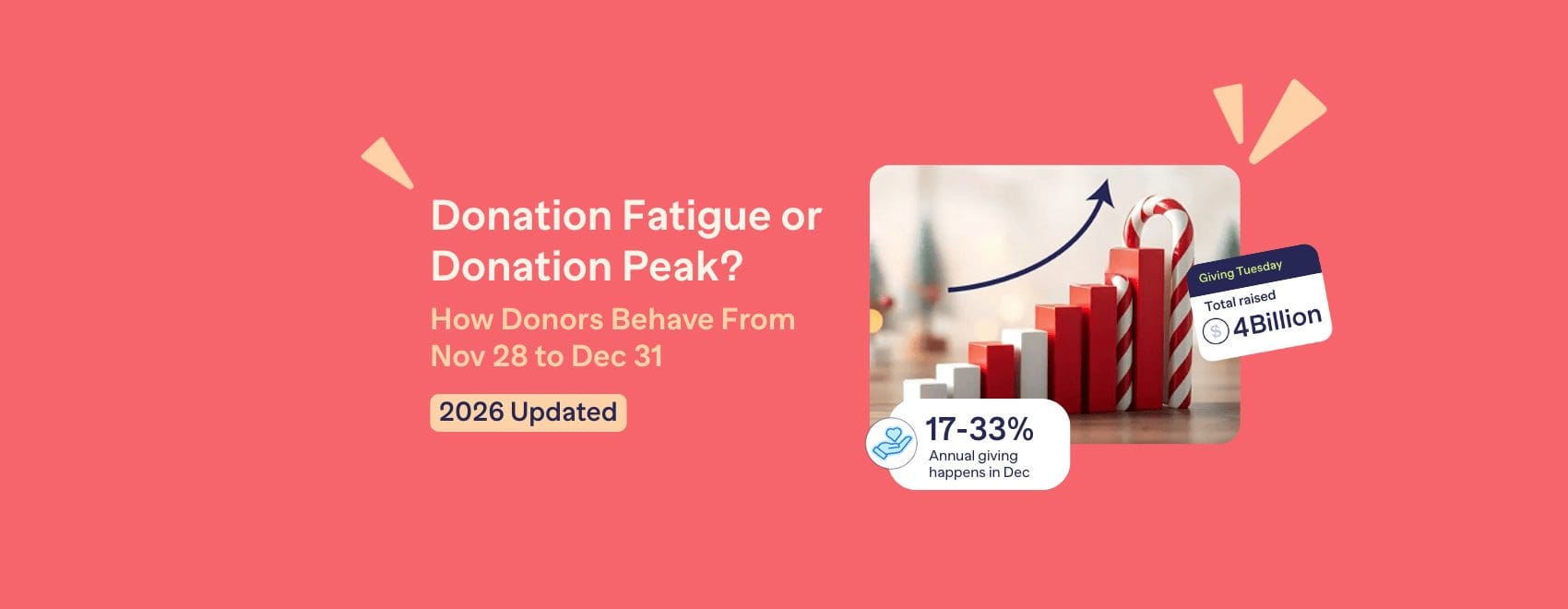
Donation Fatigue or Donation Peak? Look at How Donors Behave From Nov 28 to Dec 31 (2026 Updated)
Year-End Giving: Peak vs. Fatigue
The year-end period from November to December brings both peak giving and donor burnout:
- Giving Tuesday raised $4 billion in 2025
- December accounts for 17–33% of annual donations
- 80% of Giving Tuesday donors give again before December 31
But generic appeals during this crowded season can push supporters away. Learn the difference between donation fatigue and donation peak—and how RallyUp, an end-to-end fundraising platform, helps nonprofits engage donors more effectively during the year-end rush.
December isn’t just busy for nonprofits – it’s when nearly a fifth of all annual donations happen. Between Thanksgiving and New Year’s Eve, donors open their wallets in ways they don’t the rest of the year. Most organizations find the final three days of December bring in the most donations.
With that much funding going around, it’s almost natural to ask: Are donors actually the most generous during this time? Do they get tired of all the asks? How many donations can one raise during this time?
When you have the answer to these questions, you know exactly how you should fundraise during these critical weeks.
In this guide, we examine what’s really happening with donor behavior from November 28 through December 31. Find what donation fatigue actually means, and how to handle it effectively when the stakes are highest.
In this article
What do donation fatigue and donation peak really mean?
Donation fatigue occurs when donors tune out fundraising appeals because they’ve seen too many asks in a short period. It’s not about donors being tired of giving, but it’s about them being tired of hearing the same message over and over.
Some signs that point to donation fatigue are:
- Email open rates drop below your normal baseline, even though you’re sending at optimal times
- Unsubscribe numbers climb higher than your typical monthly average
- Click-through rates on donation links fall compared to earlier campaigns
- Social media engagement decreases despite posting similar content that worked before
- Donors who usually respond to appeals stop opening emails or ignore your calls to action
Donation peak is the opposite reality. It’s the period when donors are most ready and willing to give, which happens to fall during the exact same weeks when everyone else is also asking.
Some signs that point to the donation peak are:
- Average gift sizes increase compared to other months throughout the year
- First-time donors appear in higher numbers than your typical acquisition rate
- Donors who gave earlier in the year return to make second or third gifts
- People respond faster to appeals, often giving within hours instead of days
- Donation volume spikes even when email open rates stay the same or dip slightly
Why can both happen at the same time
Here’s the tricky part: donation fatigue and donation peak aren’t opposites that cancel each other out. They exist together during the year-end giving.
Donors have more money to give and stronger intentions to support causes in December. But they’re also getting hit with more appeals than any other time of year, which makes them selective about who gets their attention.
When your messaging blends into the noise, fatigue wins. When your campaign stands out with clarity and purpose, the peak works in your favor. So, the difference comes down to how you show up during these critical weeks.
The calendar of key giving moments in the US
The stretch between Thanksgiving and New Year’s packs more fundraising moments into a shorter period than any other time of year. Each date comes with its own donor behavior, fundraising reach, and level of competition.
Giving Tuesday: The official start of the year-end giving season

Giving Tuesday sits right at the start of the year‑end rush and is when donors actively seek out causes to support and are primed up with collective generosity.
The numbers clearly back this up. In 2025, Giving Tuesday raised $4.0 billion in the US alone, a 13% increase over 2024.
- Total participation reached 38.1 million people, a 6% increase from the year before
- Financial donations were around 19.1 million, up 3% from 2024
- Volunteering surged by 20%, reaching 11.1 million people who donated their time
- People speaking out about causes climbed 26% to 20.9 million participants
- Around 13.5 million people donated goods, up from 4% in 2024
These show clear engagement and not exhaustion. Even better, the giving doesn’t stop after Giving Tuesday ends.
- About 80% of people who donate on Giving Tuesday give again before December 31. The day pulls in new supporters without draining your year-end pipeline.
- Giving Tuesday is one of the top days for acquiring first-time donors in recent years. In fact, research shows that many organizations raised 5.6 times as much as those that skipped this day.
- Younger donors respond particularly well, with adults aged 18-34 saying Giving Tuesday inspired them to give, making it an ideal entry point for building long-term donor relationships.
Key things to note when planning your appeal:
- Social proof speeds decision-making, with donors responding well to visible goals and donation counters.
- Donors who give on this day show 65% repeat gift rates compared to the 52% average.
- Real value comes from consistent follow-up over the next 7-14 days, not just a single-day total.
- People want multiple ways to participate beyond financial methods, including volunteering and donating goods.
The post-Giving Tuesday lull (roughly December 4-17): The mid-month dip
The period between Giving Tuesday and mid-December is when donation activity usually slows. Donors have already given at the start of the month and might not be willing to give again too soon.
Here are some metrics that you can watch closely to catch these fatigue signs before the problem gets worse.
- The nonprofit average sits at 28.59%, so anything significantly lower signals people are ignoring your messages.
- If fewer than 3.29% of recipients are clicking through, your content isn’t connecting.
- Unsubscribe rates above 0.18% mean donors are actively opting out at a faster rate than typical for nonprofits.
- Since nonprofits in 2024 raised around $58 per 1,000 fundraising emails, anything less means your appeals aren’t performing.
- Donor retention below 44% indicates you’re losing supporters faster than the sector average.
- If fewer than 23% of new donors give again, your welcome and follow-up process needs work.
Key things to note when planning your appeal:
- Sending generic appeals using the same urgent language as every other nonprofit makes donors tune out completely.
- Asking for more money without thanking supporters for recent gifts makes them feel unappreciated and ignored.
- Receiving dozens of year-end appeals from multiple causes overwhelms donors and triggers decision paralysis.
- Holiday shopping and family obligations leave donors with less time and mental energy for charitable decisions.
Pro Tips: Keeping donors engaged without making an appeal
- Send holiday cards thanking supporters for being part of your community this year
- Share a short impact video showing what you accomplished together
- Post photos of volunteers (with permission) in action with personalized thank-you messages
- Feature stories of beneficiaries whose lives changed because of donor support
- Create a digital advent calendar with daily gratitude messages or program updates
Mid-December (18th to 25th): The emotional giving window

The period when holiday cheer and charitable intentions remain strong.
In the week before Christmas, donors are in full holiday mode, thinking about tradition, gratitude, and what it means to give back before the year ends.
Here are several specific days that stand out as peak opportunities during this window.
- December 21 consistently brings the highest donation values of the season especially in UK, even if volume is lower
- December 23 and 24 see strong activity when they fall on weekdays rather than weekends.
- The last Friday before Christmas typically sees increased giving, as many people receive their final salary payment of the year.
- The final workday before Christmas weekend often performs well for donations.
- The Monday before Christmas tends to be another busy day for salary-related donations.
- The last pre-Christmas pension payment date (typically December 23) creates a prime opportunity to reach donors.
- December 24 (Christmas Eve) sees strong donations when it falls on a weekday, with donors in the festive spirit.
Read our holiday fundraisers guide + ideas to maximize the giving season
Key things to note when planning your appeal:
- Weekdays leading up to Christmas see more donation activity than the actual holiday itself.
- Tradition, religious values, and the desire to share blessings drive both spontaneous and planned gifts.
- Christmas-themed storytelling and gratitude messaging work better than generic urgency.
- Messaging should shift from “help us reach our goal” to “help us finish the year strong.”
The last week of December: The final sprint

The final week of December is when the biggest wave of donations happens. Donors usually respond to the December 31 tax deadline, turning last-minute intentions into actual contributions.
- Online giving peaks between 12 PM and 7 PM on December 31.
- December consistently accounts for 17-33% of all annual giving for nonprofits.
- Around 25% of online year-end revenue arrives in the final week of December, and December 29, 30, and 31 together account for roughly 10%.
- Website visitors are 60% more likely to give on December 31 compared to other days.
- On December 31st, donation sizes are 92% higher than those on Giving Tuesday.
Key things to note when planning your appeal:
- Donors respond to clear, direct asks with one specific goal, one dollar amount, and explicit “closes tonight” language.
- Plan for activity across all three days rather than banking everything on December 31 itself.
- Good time to offer monthly giving as a way to continue impact after the calendar flips.
- The end of the year creates natural urgency as donors want to finish their charitable giving before the calendar resets.
9 effective strategies to fight donor fatigue this giving season
Donation fatigue is real, but it is not because your donors don’t care about your cause. It means they’re overwhelmed by repetitive asks and generic messaging during a season when everyone is competing for attention.
Here are some tips that can help you engage with your donors and raise funds without burning them out:
1. Segment your donors based on giving patterns
Not every donor should receive every appeal. Major gift donors who give annually might appreciate a personal call or handwritten note, while first-time donors require nurturing before you make another ask.
Segment your supporters by giving history, frequency, and engagement level to send targeted asks.
For instance, create separate email tracks for donors who gave during Giving Tuesday versus those who haven’t given yet this year. The first group gets gratitude and impact updates, while the second group gets invitation-style appeals.
2. Vary your messaging across channels
Don’t send the same appeal through email, social media, and direct mail. Each channel serves a different purpose and reaches donors in different contexts.
Your email might focus on personal impact stories. Social media can highlight community involvement, and direct mail can provide detailed program updates with financial transparency.
This approach helps donors see your mission from multiple angles rather than feeling bombarded by identical asks from all channels.
3. Time your appeals around the donor
Most nonprofits plan campaigns around internal deadlines or arbitrary dates. Track when your specific donors actually give and reach out just before those patterns occur.
If your data shows a donor gave last year on December 15, send a personalized reminder around December 10-12 this year. You’re meeting them when they’re already thinking about giving, not interrupting their holiday time.
4. Show progress, not just problems
Donors already know that a need exists, but what they want to know towards the end is whether their gifts actually changed anything.

Instead of just focusing on urgent appeals, also offer progress updates that demonstrate tangible results. Instead of saying “We still need to feed 500 families,” try “Your October donation fed 200 families, and we’re on track to reach 500 by year-end with one more push.”
This way, you can position donors as part of the winning effort while creating urgency around what’s left to accomplish.
5. Make sure the giving process is smooth
Every extra form field, page load, or required account creation increases the chance a donor will abandon their gift. In your form, focus only on essentials and add one-click options like Apple Pay, Google Pay, and PayPal.
If your current form requires eight fields and account creation, test a streamlined version with just name, email, amount, and digital wallet options.
Donors are already short on time during the holidays, so your giving process shouldn’t take more than a minute from click to confirmation.
6. Offer alternatives to financial gifts
Some donors might be interested in giving but might not be able to financially support you.
Make sure your campaign includes non-monetary ways to stay involved. You can invite them to volunteer for a holiday event, ask them to share your campaign on social media or accept donations of goods.

With multiple participation options, you can expand your reach and keep donors engaged with your mission without adding to their holiday spending stress. Plus, you can get resources you’d otherwise have to purchase.
7. Space out your asks strategically
Donors notice when you only reach out to ask for money. Before you launch into fundraising appeals, take time to build genuine connections with your supporters.
Start with impact updates or stories that remind supporters why your work matters. Follow with a gratitude message thanking them for their past support. Then, when you do send your fundraising appeal, it feels like a natural next step rather than a cold ask.
A good rhythm looks like this: impact story, gratitude message, fundraising appeal, then back to progress updates. This keeps your organization on people’s minds without making every interaction feel like a transaction during an already busy season.
8. Use surveys to identify fatigue before it’s too late
Don’t wait for unsubscribes and declining donations to tell you there’s a problem. Ask donors directly how they’re feeling about your communication frequency.
Send a quick two-question survey before the year-end season kicks off. Ask how often they want to hear from you and which types of updates they find most valuable.
With that, you can reach out in the way they prefer, preventing fatigue and showing donors you respect their time and interests.
9. Update your donor list
Once someone gives during your year-end campaign, move them to the bottom of your list and focus on donors who haven’t contributed yet this season. Send your strongest appeals and most urgent messaging to people who haven’t made a gift.
Update your lists after each wave of donations so you’re not bombarding people who just gave with urgent asks. This doesn’t mean you stop communicating with recent donors entirely. They might give again since it’s the holiday season and people are extra generous.
But recent donors should receive thank-you messages first, followed by progress reports, impact videos, or small tokens of appreciation if they’re first-time supporters. After a few of these updates, you can send a softer appeal if they’ve engaged with your message.
Next steps: Turn year-end pressure into performance with RallyUp
The final weeks of the year offer nonprofits their best chance to raise funds. Holiday cheer, tax benefits, and donors in a giving mindset create an opportunity too valuable to miss.
So, it’s important to follow a strategic approach. Pick your key moments, create campaigns around them, and launch on time. Segment your audience and write appeals that feel personal and tied to their interests. Pay attention to your key metrics and adjust your approach as you go.
RallyUp – an end-to-end fundraising platform helps you manage year-end campaigns without the chaos. You can combine multiple campaigns – events with peer-to-peer, auctions with raffles, and more to extend your year-end reach.
Get pre-designed templates and done-for-you campaign service so you can focus on strategy instead of execution.
Ready to make this December your strongest fundraising month?
FAQs on donation peak and fatigue
December tends to be a high-volume giving period due to year-end appeals, holidays, and tax-related timing. But for your nonprofit to tap into this giving period, it needs personalized, relevant and timely messaging.
Avoid donor fatigue by segmenting your audience and varying your message. Don’t send the same appeal to everyone. Start by sharing your year-round impact, thank your supporters, then make your ask and explain how it helps you to achieve your goal.
Watch your email open rates and unsubscribe numbers throughout December. If opens stay consistent and unsubscribes remain normal, your donors are engaged rather than annoyed.
Many organizations see spikes around key moments, such as Giving Tuesday, around Christmas, and the final 48 hours of the year.
Now that you’ve seen it in action, are you ready to start fundraising?
Get Started