
How to Increase Donor Engagement for Nonprofits (+ Free Checklist)
In this article
- What is donor engagement?
- Donor engagement statistics: Facts you can trust
- Donor research: The first step in a donor engagement plan
- How the donor engagement cycle actually works
- 5 effective donor engagement strategies for nonprofits
- 5 best practices to strengthen donor relationships
- Download our donor engagement plan + checklist
- Bringing it all together with RallyUp
Increase Donor Engagement
Donor engagement turns one-time givers into lifelong supporters through personalized communication, clear impact reporting, and consistent stewardship. It helps raise retention rates and create predictable revenue streams for your nonprofit.
Fundraising totals might look strong on paper, but the support base behind those dollars is thinning out. In Q1 2025, the number of individual donors slipped 1.3% year over year, and retention slid from 18.3% in 2024 to 18.1%.
The biggest decline came from small donors, who gave $1-$100 and made up 57% of the donor base, dropping by 11.1%.
That just shows how important it is to appeal to the smallest donors and build their trust.
The surest way to stop this slide is to invest in donor engagement – the idea of building relationships that turn one-time givers into long-term advocates.
In this guide, you’ll learn how the donor engagement cycle works, see strategies for keeping supporters involved, and pick up best practices that strengthen loyalty and make future fundraising far more predictable.
What is donor engagement?
Donor engagement is the intentional, ongoing relationship-building that moves supporters from awareness to advocacy. It blends identification, tailored cultivation, well-timed solicitation, and consistent stewardship.
Great engagement makes donors feel seen, proves impact with specifics, and invites two-way feedback. Donor engagement measures retention, average gift, and recurring giving. In short: treat donors like partners, not transactions.
Donor engagement statistics: Facts you can trust
- Retention is slipping, particularly with first-time donors.
By Q3 2024, only 13.8% of new donors were retained; repeat donor retention was 50.3% (overall retention trending downward).
What to do: Build a 3-email/2-touch welcome + second-gift series for first-time donors in the first 45 days.
- Email drives action, but few clicks become gifts.
The fundraising email CTR is 0.48%, and only 12% of those clicks result in a donation. However, the email still generates 11% of online revenue and $58 per 1,000 fundraising emails.
What to do: Send fewer, more targeted appeals; shorten donation pages and test load speed & copy to lift completion.
- Mobile visitors dominate, but desktop donors give most.
53% of traffic is mobile, yet desktop generates 55% of donations and 70% of revenue; average gift $145 desktop vs. $76 mobile.
What to do: Prioritize mobile UX – trim fields, compress images, and surface smart defaults, while preserving easy upgrade paths on desktop.
- Fast checkout options matter.
On main donation pages, nonprofits commonly offer PayPal (76%), Apple Pay (47%), Google Pay (40%) – all reduce friction, especially on phones.
What to do: Add at least one digital wallet (ideally all three) to cut form abandonment on mobile.
- Texting reaches engaged supporters.
Nonprofits saw +8% growth in SMS lists; fundraising texts get 2.82% CTR with 0.14% reply rate; orgs have 224 SMS subscribers per 1,000 email.
What to do: Collect SMS opt-ins on forms and use text for deadlines, event reminders, and quick impact updates.
- Monthly donors stick around.
In FY24 studies, recurring donors retained ~81–82%, vs. ~44–53% for single-gift donors.
What to do: Promote “Give monthly” on every form, add a default monthly tab, and pitch specific, bite-sized impact levels.
Donor research: The first step in a donor engagement plan
Let’s set the scene: A mid-sized arts and culture nonprofit sends the same generic appeal to every name on its mailing list. A few gifts come in, but most emails land in spam.
Then a board member suggests digging deeper, checking past giving patterns, public records, and social media to find people who genuinely share their passion for the arts.
Donor research, sometimes called prospect research, turns blind asks into a data-backed strategy for deeper, long-term relationships.
Now, long-time art collectors get a personal invite to a gallery preview; parents who’ve attended family programs receive an update on the new children’s series.
Here you have a step-by-step process of conducting donor research before you start building relationships:
Step 1: Identify prospective donors who believe in your mission
Start by identifying people who are already inclined to care about your cause.
- Analyze your own donor database for past supporters who gave generously or repeatedly.
- Scan public sources, like foundation websites, social media profiles, and professional associations, to spot individuals or organizations with missions or interests that overlap with yours.
Step 2: Gauge giving capacity
Once you have a list, estimate how much each prospect is likely to give.
- Review publicly available indicators, such as professional titles, real estate ownership, business holdings, or net worth estimates.
- Look for patterns: someone whose career or investments are tied to your sector often has both the means and the motivation to give.
Step 3: Map connections and influence
Strong donor relationships often flow through networks. Use tools like wealth-screening databases (in case of foundations and organizations) or LinkedIn to find connections to your board members, existing donors, or key community figures.
Warm introductions from shared contacts dramatically increase response rates.
Step 4: Prove impact and credibility
Finally, show why their gift matters. Share clear evidence with photos, statistics, and case studies, demonstrating how contributions translate into real outcomes.
Donors who see measurable impact are far more likely to become long-term advocates.
How the donor engagement cycle actually works
Whether you’re reaching out to new prospects or nourishing old relationships, engaging donors is like growing a tree. You don’t rush it, you nurture it step by step. It takes time, patience, and steady attention before you see growth.
4 core stages of donor engagement
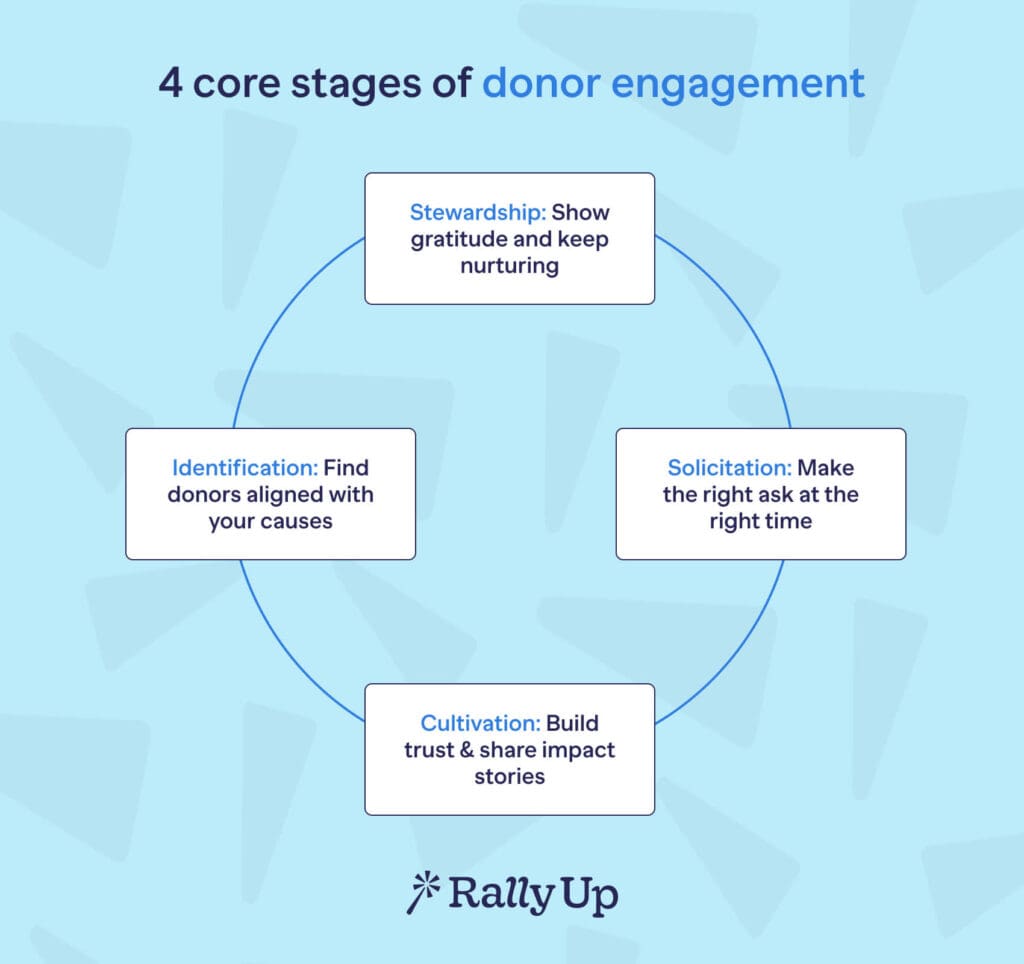
- Identification: First, you choose the right seed. Just as certain trees thrive in certain soils, the best donors are those whose interests already align with your mission.
- Cultivation: Next comes watering and sunlight. Through stories, updates, and personal touches, you nurture the relationship so roots can take hold.
- Solicitation: When the tree is strong enough, you harvest its fruit. A well-timed, thoughtful ask feels natural – like picking ripe fruit instead of forcing it too soon.
- Stewardship: Finally, you keep tending the tree. Regular care – thank-yous, updates, and ongoing communication – ensures it keeps bearing fruit season after season, turning a single harvest into years of abundance.
Donor engagement cycle: Quick action table
.fundraising-table { width: 100%; border-collapse: collapse; table-layout: fixed; /* Prevents broken words */ font-size: inherit; /* Inherit blog font */ } .fundraising-table th, .fundraising-table td { border: 1px solid #ddd; padding: 16px; vertical-align: top; text-align: left; word-break: normal; /* ✅ Prevents mid-word splits */ overflow-wrap: break-word; /* ✅ Wraps only at word boundaries */ } .fundraising-table th { background-color: #f8f8f8; font-weight: 600; color: #272756; } /* Optional scroll for mobile */ .table-wrapper { overflow-x: auto; }| Stage | Key goals | What to watch | Next steps | KPIs |
|---|---|---|---|---|
| Identification | Spot people aligned with your mission. |
|
|
|
| Cultivation | Build trust and relevance. |
|
|
|
| Solicitation | Make a timely, relevant ask. |
|
|
|
| Stewardship | Retain and deepen donor ties. |
|
|
|
Why does a donor engagement strategy matter?
Trust, transparency, and clear impact reporting aren’t optional; they’re the answer to keeping donors engaged long-term. This can be backed by the fact that nearly one in four donors (24%) say they stop giving because they don’t see transparency about how contributions are used.
Each stage feeds the next; neglecting one weakens overall retention. By caring for every stage and backing them with honesty and accountability, you turn one-time donors into lifelong supporters.
How to measure donor engagement?
Tracking the donor engagement cycle means looking beyond single gifts and focusing on long-term signals of loyalty and connection. The metrics you track show how your supporters are feeling about your organization after their first contribution:
Donor retention rate: Shows how many donors gave again this year compared to last. Even a 10% lift in retention can make a difference in revenue without finding new donors.
Donor lifetime value (DLV): Measures the total amount a donor is likely to give over their relationship with your nonprofit. Higher LTV = stronger cultivation and stewardship.
Event engagement: Track registrations, attendance, and follow-up actions for fundraisers like golf tournaments. Events are prime touchpoints for strengthening donor ties.
Response to appeals: Monitor open rates, click-throughs, and actual gifts from email or mail campaigns to see if your messaging resonates.

5 effective donor engagement strategies for nonprofits
Measuring the cycle is just diagnostics. If you say “We retained 10 donors last month”, unless you keep nourishing them, those numbers won’t mean much next month.
Let’s find out how to create a strong donor engagement strategy that keeps them engaged at all times:
- Personalize with purpose
Segmentation could become the backbone of collecting donor data. A corporate sponsor considering a five-figure partnership shouldn’t get the same email as a first-time donor.
How to apply: Use data from giving history, event attendance, and volunteer activity to design communication tracks that match their level of engagement. When supporters feel like partners (not means to an end), retention improves and lifetime value grows.
- Add impact to the message
Donors don’t fund numbers; they fund your cause. When impact is clearly framed, retention rates increase, and so does their trust in your organization.
How to apply: Personalize thank-you templates by replacing “We raised $50,000” with donor-specific impact like “Your support covered one year of treatment for 12 children”.
- Recognition over receipts
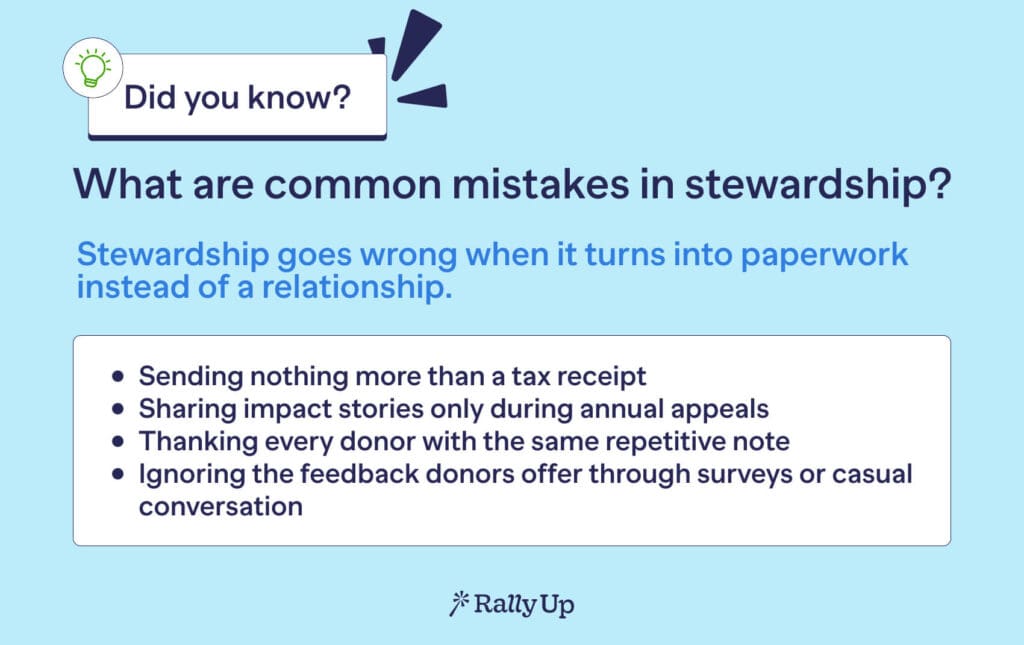
Too many nonprofits stop at sending a tax letter. Recognition builds loyalty. A handwritten note or a feature in your annual report all reinforce that their gift mattered. When donors feel seen, they’re far more likely to give again.
How to apply: Publicly thank donors in newsletters, on social media, or at events, while keeping major donor recognition more personal and discreet.
Note: Research shows public recognition can backfire for donors who value privacy. A quick checkbox for “public acknowledgment” or “private thanks” lets supporters choose and prevents missteps.
- Promoting recurring giving
One-time gifts make an impact, but regular giving creates lasting change. Invite supporters to become monthly or annual donors by showing them how steady support sustains your work.
How to apply: Make the option easy to find on your donation form, with suggested amounts and a reminder that even small, regular gifts add up to something big.
- Leverage technology and social media
Most supporters today receive their updates through email and social media; that’s where you need to be visible.
Email platforms help you send timely thank-yous, reminders, and invitations, while social media keeps your cause in front of donors through impact stories, quick updates, and live event highlights.
How to apply: RallyUp brings these tools together – managing online donations, livestreaming events, and even deep CRM integrations – so you can stay virtually connected with supporters.

5 best practices to strengthen donor relationships
Once you’ve established a donor engagement plan and are starting to build relationships, the challenge shifts to retaining them. The average rate of retaining constant supporters or recurring givers is 83%, compared to 45% for new or one-time donors.
When retention rates flatten or the small-donor pool starts shrinking, it’s time to double down on the relationships you’ve already built.
The following steps help stabilize support and rekindle enthusiasm:
1. Move from personalization to partnership
You already know their giving history; now involve them in shaping the future. Invite veteran donors to small advisory sessions, ask for input on upcoming campaigns, or co-create community projects.
This signals they’re more than a funding source; they’re part of the organization’s decision-making fabric.

2. Offer deeper, face-to-face connections
Instead of the usual annual report, share detailed progress briefings or project walk-throughs. Host site visits, private webinars with program leads, or behind-the-scenes tours so donors can see their contributions in action.
This type of involvement will help with:
- Mission familiarity: Generic updates won’t keep seasoned donors engaged.
- Deeper impact: Firsthand experiences strengthen loyalty and commitment.
- Advocacy boost: Stories from visits turn donors into advocates.
- Differentiation: Exclusive access sets your nonprofit apart.
3. Strengthen peer connections
Consider this the natural next step after peer-to-peer fundraising. Instead of donors simply raising money within their own networks, give them opportunities to connect, such as at appreciation dinners, private roundtables, or a dedicated online group.
These interactions foster a sense of community, where supporters exchange ideas, share experiences, and form lasting friendships. When donors feel part of a tight-knit community, your cause becomes their cause.

4. Email donors without causing fatigue
Nonprofits must limit emails to a general rhythm of one update every two to four weeks to stay on a donor’s radar without wearing them out. If donors have opted to receive emails about a fundraiser, keep it limited to compelling experience updates.
If you’re in the middle of a big campaign or hosting an event, weekly notes are fine as long as each message delivers clear value, like impact updates or a behind-the-scenes peek.
Pro tip: Watch your open and unsubscribe rates; a sudden spike in opt-outs is your cue to slow the pace.
5. Use data to anticipate the next giving
Dig deeper than surface-level KPIs. Track donor-level metrics, including gift frequency trends, average gift growth, cost-per-dollar raised, lapse intervals, event attendance rates, and email click-through patterns.
Layer these with demographic or behavioral donor segments to identify early signs of churn or readiness for a more significant commitment.
For example, donors whose average gift size rises steadily or whose engagement spikes after impact updates can be offered leadership-level briefings or invited to exclusive projects.
Download our donor engagement plan + checklist
Follow these phases sequentially and treat each checklist as a living project plan. Document outcomes at every stage so you can show board members and senior leadership exactly how each action is moving the organization toward higher retention and sustainable revenue.

Bringing it all together with RallyUp
Donor engagement isn’t a one-off campaign you apply during low retention days. It must be an ongoing cycle of research, personalization, relationship-building, and continuous fine-tuning.
With donor retention still stuck in the early stages and small-gift supporters falling by double digits, nonprofits that fail to nurture their base risk watching funding drop.
RallyUp can make a difference here. From creating detailed donor profiles and segmenting communications to running recurring giving programs, the easy-to-use fundraising platform gives you the infrastructure to put this engagement plan into action.
FAQs on increasing nonprofit donor engagement
onor relations usually rest on stewardship, acknowledgment, recognition, and engagement. These pillars ensure gifts are properly managed, donors feel appreciated, communications stay personal, and relationships deepen.
Track engagement with a mix of quantitative and qualitative signals: gift frequency, event attendance, email opens/clicks, and social interactions. CRM like Salesforce, with RallyUp’s integrations, automates these metrics.
A specialist designs and executes effective donor engagement strategies to keep supporters connected. They create donor segments based on patterns, plan appreciation events, craft targeted communications, and analyze engagement data.
Start by charting every touchpoint from first awareness to recurring giving – ads, events, newsletters, and personal outreach. Use analytics and donor feedback to visualize movement through these stages.
Now that you’ve seen it in action, are you ready to start fundraising?
Get Started