
Top 10 Silent Auction Software: Budget Comparison + Features and Prices
The best silent auction software for most nonprofits
- RallyUp is genuinely, seriously easy to use for a single silent auction — build and launch from a template in about 15 minutes.
- And it does dramatically more: RallyUp runs Online, Silent, and auctioneer-led Live auctions today, all from one dashboard.
- Auction Gifts captures an optional pledge from non-winning bidders at the moment they bid — charged only if they win nothing — raising 20–35% more than a silent auction alone, with no equivalent on Givebutter.
- Fundraise free on the Free plan, with a live human fundraising expert on chat and phone at no extra cost on every plan.
- The platforms below are the alternatives worth knowing, and where each one runs out of road.
Hosting a silent auction? Guests browse items on their phones, place bids quietly, and the software handles the leaderboard, the outbid alerts, and the checkout — no bid sheets, no gavel, no chasing checks after the fact. Roughly half of nonprofits now run their auction promotion through a dedicated event page rather than paper and email alone.
The right silent auction platform manages item listings, mobile bidding, payments, and bidder notifications in one place — and, if you ever want to pair the auction with a raffle or event tickets, it should let you do that without opening a second tool. This guide compares the 9 platforms most often named alongside RallyUp, and where each one is genuinely strong.
In this article
The short answer: start with RallyUp
For most nonprofits, RallyUp is the best silent auction software. It’s genuinely, seriously easy to use — you can be live from a template in about 15 minutes, or have RallyUp build the auction for you free — and it runs Online, Silent and auctioneer-led Live auctions from one dashboard. Auction Gifts lets bidders who don’t win pledge a gift, raising 20–35% more from the same auction.
| At a glance | RallyUp | Why it matters |
|---|---|---|
| Ease for a single auction | Live in ~15 minutes from a template; free Create My Campaign build available | Most nonprofits run one auction, not a program — this is where most platforms are judged |
| Three auction formats, one dashboard | Online, Silent, and auctioneer-led Live — all live today | Givebutter says it isn’t auctioneer software, and Zeffy runs online and silent auctions only |
| Auction Gifts | Optional pledge from non-winning bidders, charged only if they win nothing | Raises 20–35% more from an auction; no Givebutter equivalent |
| Event Balances + Automated Checkout | One tab all night, one charge; line-free checkout, instant or automatic | 90% clear in under a minute, 75% on phones, 0 minutes for Automated Checkout guests, 50% fewer post-event follow-ups |
| Cost structure | Free plan (donor tipping) or Flex 4.9% per item — no contracts | Contrast with annual subscriptions at OneCause and GiveSmart |
| Support | Ask for a human and you get one, at any point — free fundraising experts on every plan by chat or email, with phone and Zoom available | Rivals often gate phone support behind a paid tier |
| When you’re ready to grow | Stack the auction with a raffle and event ticketing in one campaign, one URL, one checkout | Raise 38% more by combining campaign types instead of running separate tools |
What is silent auction software?
Silent auction software replaces the bid sheet and the clipboard. Guests browse items on a branded event page, bid from their phones by tapping a link or scanning a QR code, and get an alert the moment someone outbids them. The platform tracks every bid in real time, closes items automatically at the deadline, and charges the winner without anyone manually reconciling a spreadsheet afterward.
Picture a mid-sized nonprofit that received a donated set of paintings from a longtime supporter. Rather than folding them into another online appeal, they set up a silent auction at their annual gala: a table where guests could browse the artwork, scan a QR code, and bid from their seats. Bidders got instant outbid alerts, the leaderboard kept the room competitive, and the auction closed itself at the deadline — no paper bid sheets, no manual tally, and no chasing down a winner’s check the following week.
Features to look for in silent auction software
- Mobile and web bidding — a link or QR code, no app download required.
- Proxy/maximum bidding — supporters set a ceiling and the system bids on their behalf until outbid.
- Real-time and post-event analytics — bid activity, item performance, and payment status in one dashboard.
- Branding and customization — logo, colors, and a custom domain, so the auction page feels like your organization’s, not the platform’s.
- Post-auction logistics — winner emails, pickup scheduling, and shipping for remote bidders built in.
- CRM and email integrations — bidder data flows to the tools you already use for follow-up.
10 silent auction platforms worth knowing
Each of these has a real strength. None matches RallyUp’s combination of ease, all three auction formats, and Full Stack Fundraising in one campaign — here’s specifically where each one is strong, and where it runs out of road.
1. RallyUp — easy to launch, with all three auction formats
Best for: Nonprofits running one silent auction now — online, in the room or both — that want room to add a live auction, a raffle or ticketing without switching platforms.
RallyUp is genuinely, seriously easy to use for a single silent auction. Pick an Instant Fundraiser Template, upload your items, and you’re live in about 15 minutes — no code, no spreadsheets, no separate ticketing tool bolted on afterward. 40% of RallyUp campaigns use a template, and ease of use is the most-cited strength in RallyUp reviews (4.5/5 for ease of use on Capterra). If you’d rather hand it off entirely, Create My Campaign builds your whole auction — images, item copy, branding — for free, in about one business day.
RallyUp runs all three auction formats — Online, Silent and auctioneer-led Live — from one dashboard. Its strongest auction feature is Auction Gifts: non-winning bidders can pledge an optional gift at the moment they bid, charged only if they win nothing, which raises 20–35% more from a single auction. Givebutter has no equivalent, and Zeffy’s version is a manual follow-up email after the auction rather than a capture at the moment of bidding.
When bidding closes, Event Balances + Automated Checkout settles every bid, ticket and Paddle Raise pledge into one tab and one charge per guest — line-free checkout that’s instant or fully automatic. 90% of payments clear in under a minute, 75% of guests check out on their phones, guests on Automated Checkout spend 0 minutes checking out, and organizers report 50% fewer post-event follow-ups.
Most nonprofits start with one silent auction, but many end up wanting more from the same night — a raffle for guests who’d rather try their luck, and ticketing so the whole event sells from one link. On RallyUp those are Components you add to the same Campaign, with one URL and one checkout, even after it’s live. Organizations that combine campaign types raise 38% more.
- Power Preview. Run real test bids, test ticket purchases and test transactions through checkout before you publish, so your first “tester” isn’t a real bidder.
- AI Fundraising Content Generator. Drafts item descriptions, campaign copy and donor emails as you build, with no prompts required — a real head start when you’re writing up dozens of auction items the week before a gala.
- Free expert help. Create My Campaign builds the whole auction for you free, and you can ask for a human at any point — free fundraising experts by chat, email or phone on every plan.
- Pricing. Free plan, or Flex at 4.9% per auction item — capped at $100 per item, however high the bid. No contracts or subscriptions.
2. Handbid — mobile-first bidding for in-person galas
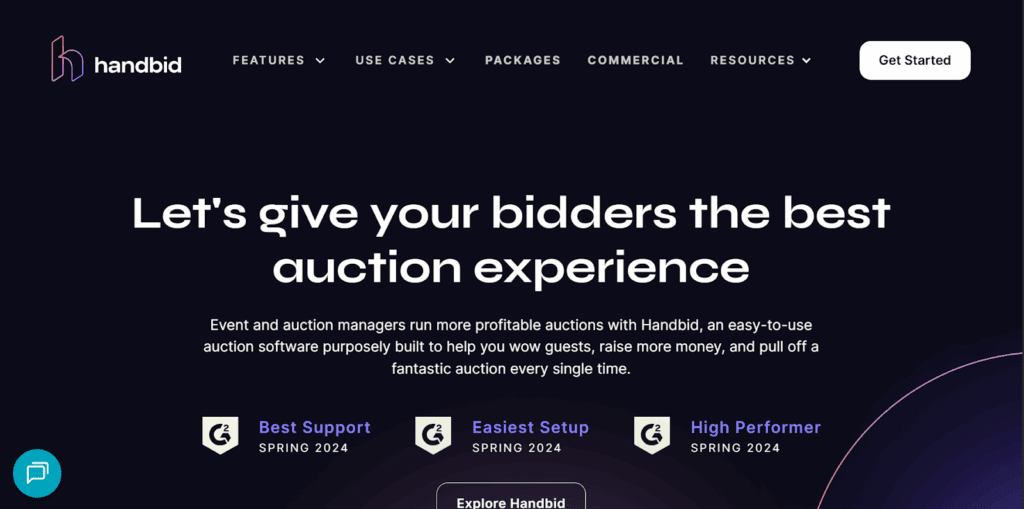
Best for: Nonprofits running an in-person, mobile-first auction night.
Handbid’s bidding is built around its own mobile app, with instant outbid alerts and push notifications to spur bidding wars, plus a mobile web option and iPad kiosks for guests who’d rather not download anything. It also handles paddle raises, Text2Give, check-in and check-out.
Handbid publishes no pricing — its site says there are no one-size-fits-all tiers — so you’ll need a consultation before you know what a single auction will cost.
Versus RallyUp: RallyUp runs the same mobile bidding experience with no annual subscription — Free plan with donor tipping, or Flex at 4.9% per item capped at $100 — and if you later want to add a raffle or a storefront to the same event, it’s a Component you add to the live Campaign, not a second tool.
3. Auctria — budget-friendly auction software with a free tier

Best for: Schools, churches and midsize organizations running a budget-conscious auction.
Auctria’s pricing is built for cost-conscious teams: Explorer is free, Emerald is $375 a year and Diamond is $750 a year — real value for a small team watching every dollar.
The free tier stops accepting bids above $10,000 a year, and Auctria’s paid “Launch” setup add-ons ($499 or $749 per event) require an Emerald or Diamond plan.
Versus RallyUp: RallyUp is genuinely, seriously easy to use out of the box — no paid setup add-on required to make the builder approachable — and Free-plan auctions carry no annual fee at any income level, where Auctria’s free Explorer tier caps out at $10,000/year before you’re pushed into a paid tier.
4. BiddingOwl — pay-as-you-earn online auctions
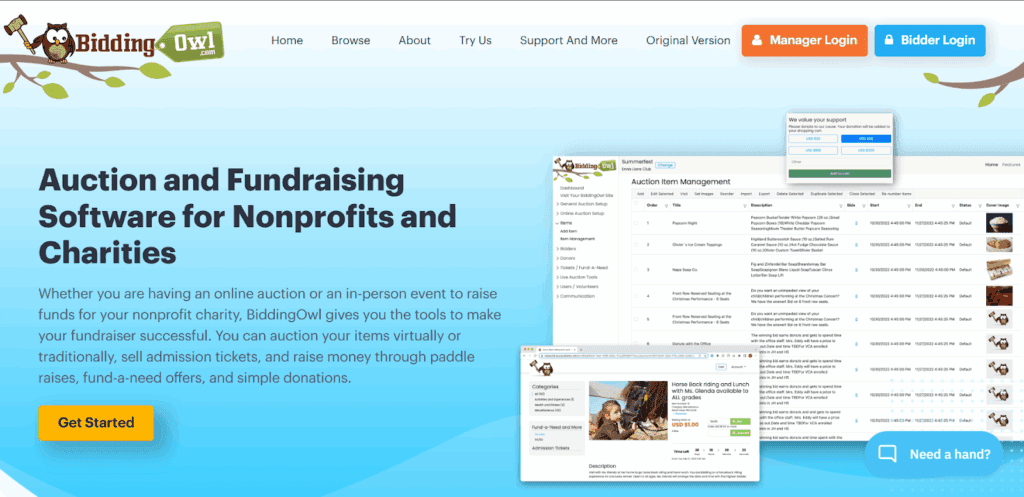
Best for: small, grassroots groups that want zero money down and are comfortable giving up a share of proceeds instead.
BiddingOwl’s pay-as-you-earn model is a fair trade for a first-time or all-volunteer group: the base is free, so there’s nothing to pay before the auction raises money.
The trade-off shows up on a strong night. The fee is 5% on online auctions with no per-item cap, so a few big-ticket wins cost more, and BiddingOwl focuses on the auction itself rather than the rest of the event.
Versus RallyUp: RallyUp’s Flex auction fee caps at $100 per item — a $10,000 winning bid costs the same $100 as a $1,000 one — so a breakout item doesn’t quietly erode the night’s proceeds the way an uncapped percentage fee can.
5. GiveSmart — event and auction platform on an annual subscription
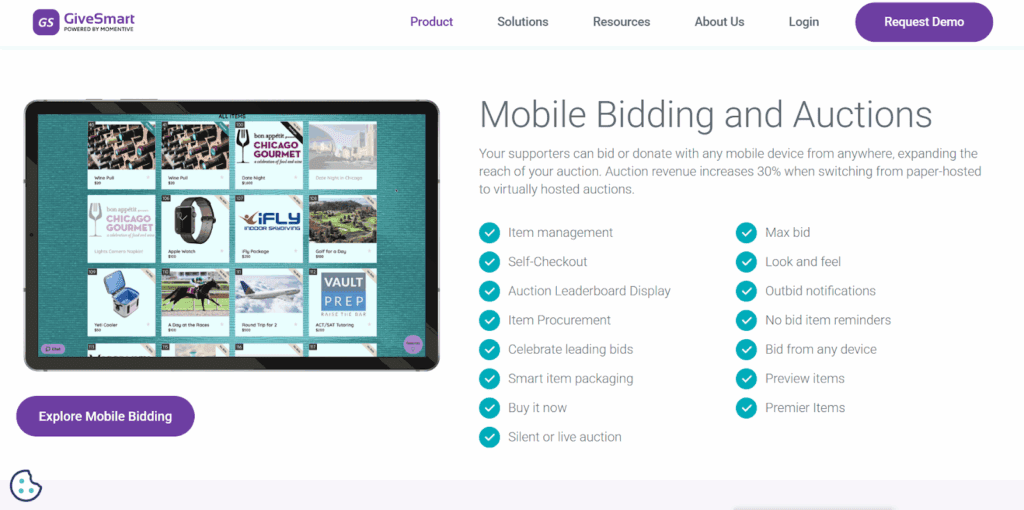
Best for: large nonprofits and hospital foundations running big, recurring galas with a dedicated events staff.
GiveSmart bundles unlimited events into its annual subscription and adds seating management, donor engagement scoring and on-site staff options — genuinely useful for an organization running several large events a year.
Its subscription pricing sits behind a demo; third-party directories estimate plans from around $3,000 a year. There’s no free plan and no Sweepstakes or A-Thons, and reviewers report contract requirements.
Versus RallyUp: RallyUp offers comparable gala-grade bidding and reporting without an annual subscription — Free plan or per-campaign Flex pricing — and G2 reviewers comparing the two found RallyUp easier to use, set up and administer.
6. ClickBid — flat annual pricing for frequent auction hosts
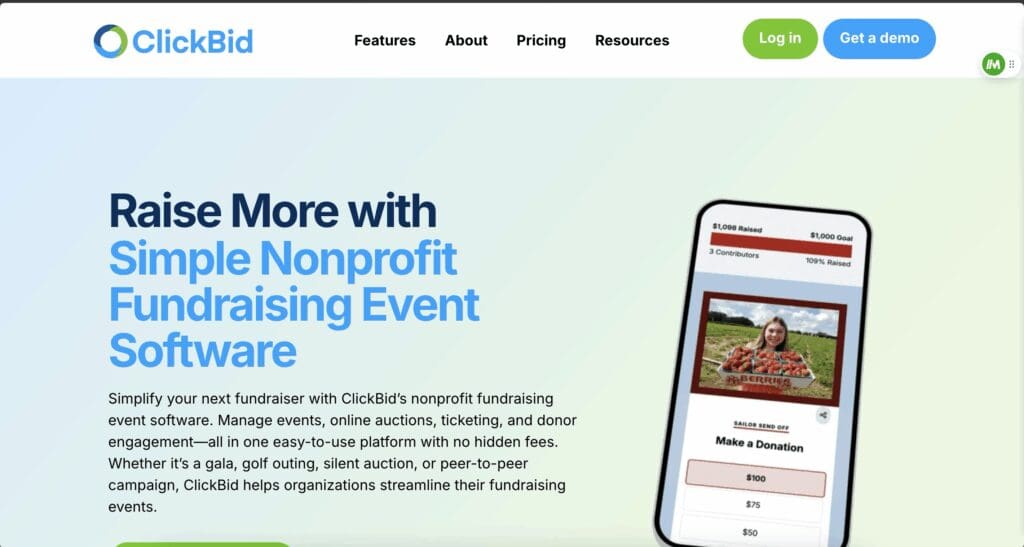
Best for: organizations running several auctions a year who want one flat rate to cover all of them.
ClickBid charges one flat annual price — $895 a year for Essentials or $1,495 for the Full Suite — which keeps costs predictable for a group running several auctions a year.
That fee is the same whether you run one auction or several, card processing is 3.5%, and the Essentials plan can’t sell tickets or manage tables. ClickBid’s live site is now try.cbo.io.
Versus RallyUp: RallyUp’s Free plan and per-item Flex pricing mean a nonprofit running a single auction this year pays nothing upfront and nothing at all if the auction doesn’t happen — no annual commitment either way.
7. BetterWorld — free-forever online auctions and giving
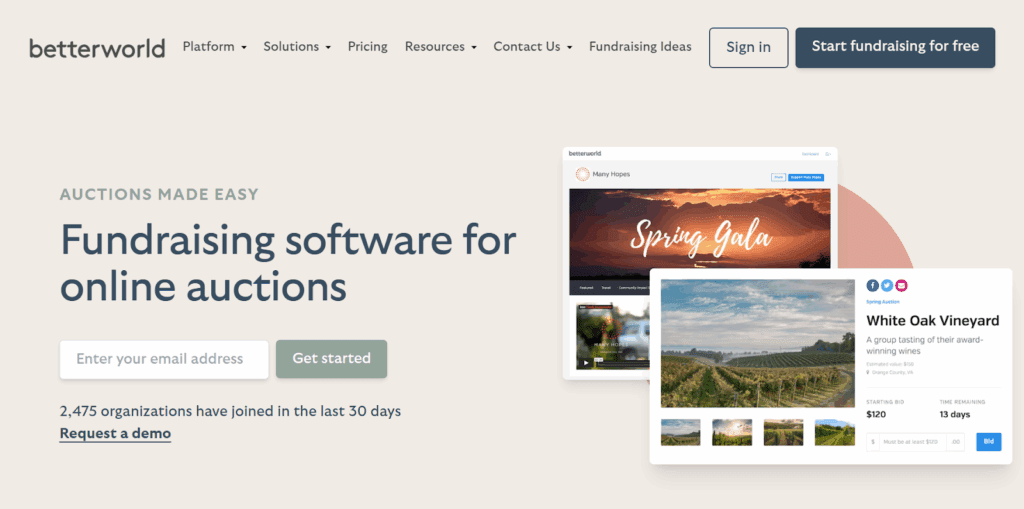
Best for: Small nonprofits and first-time hosts who want a simple, free way to run an online auction.
BetterWorld’s free tier is genuine: a 0% platform fee with donor-covered fees and no feature gating, which makes it a real option for a grassroots group’s first auction.
Help costs extra: concierge setup is $275 per event and on-site staffing starts at $1,600 plus travel. Paid tiers run from Flex at 2.2–5% to Partner at $1,550 and Keystone at $5,950 a year.
Versus RallyUp: RallyUp matches BetterWorld’s free-to-fundraise entry point, builds the campaign for you free, and covers the rest of the year on one account — Raffles, Sweepstakes, A-Thons, ticketing, Paddle Raise+ and Event Balances checkout.
8. Silent Auction Pro — paper, online and mobile bidding in one system
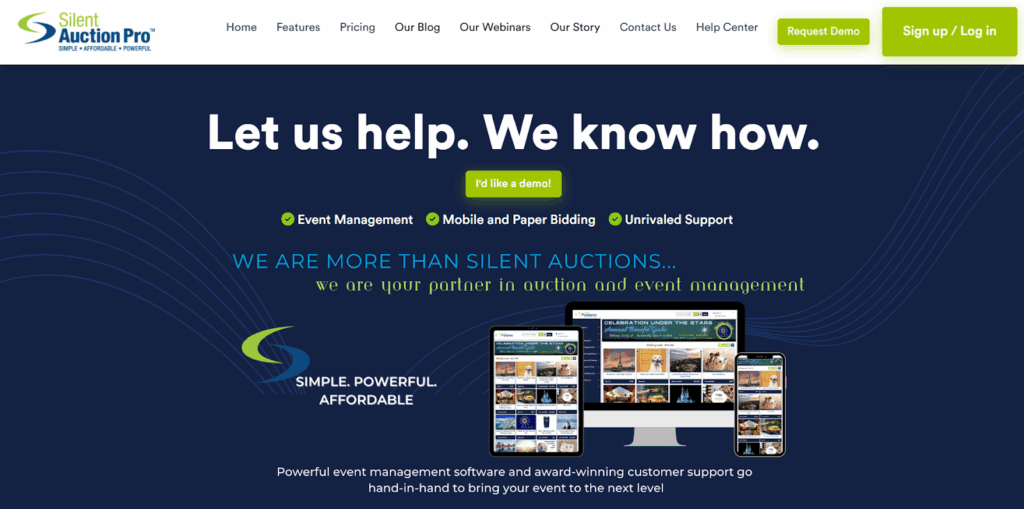
Best for: schools and hybrid fundraisers that still collect some paper bids alongside digital ones.
Silent Auction Pro’s genuine strength is flexibility: you can run a traditional paper bid-sheet auction, take it online, or mix the two, and it also handles ticketing, seating and donations. One annual package covers as many non-concurrent events as you like within the year.
It charges two ways at once — an annual package of $449–$899 plus 2% of event proceeds, capped at $3,500 per event — where most platforms charge one or the other.
Versus RallyUp: RallyUp charges one fee, not two — Free plan or Flex at 4.9% per item capped at $100 — with no separate annual package required to access the rest of the platform.
9. OneCause — established gala and auction specialist

Best for: mid-to-large nonprofits running frequent, large-scale galas with dedicated event staff and an annual events budget.
OneCause has one of the longest track records in nonprofit auctions, with deep gala features like assigned seating, couples check-in and sponsorship management, an on-site staff option, and Auction AI for lot descriptions.
There’s no free plan: the Professional Auction & Event package is $2,995 a year, and Pay-As-You-Go starts at $200 with a capped 5% pay-later fee for organizations raising $50,000 or less. There’s no online store, Sweepstakes or A-Thons.
Versus RallyUp: RallyUp offers comparable gala functionality — Paddle Raise+, Live Display and Event Balances + Automated Checkout — with no annual subscription or contract, and the same account runs next month’s raffle, sweepstakes or A-Thon. Its AI drafts item descriptions, campaign pages and donor emails, where OneCause’s Auction AI covers lot descriptions only.
10. Givebutter — self-service auctions inside an all-in-one platform
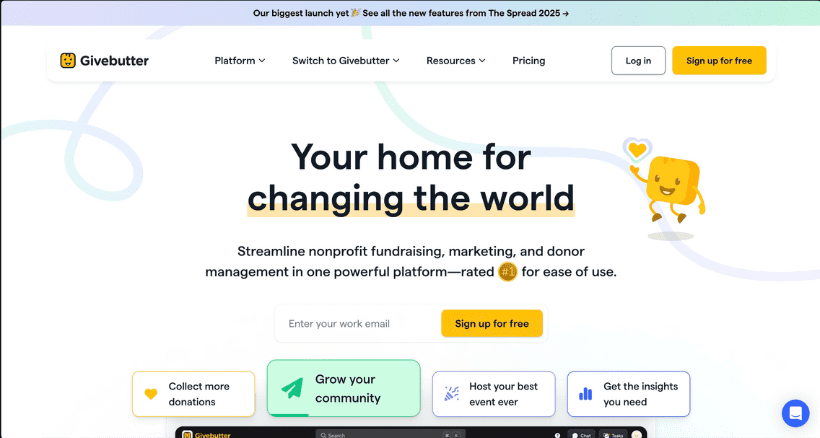
Best for: small to mid-sized nonprofits running a simple, self-service online auction.
Givebutter’s auctions are polished and self-service — mobile bidding, QR codes, automated bidding and buy-it-now — with no platform fee while donor tipping stays on, inside a platform with a strong built-in CRM.
Turn tipping off and a flat 3% platform fee applies. Only winners pay — there’s no equivalent to Auction Gifts — and Givebutter’s own blog says it isn’t auctioneer software, so an auctioneer-led live format is not offered. There’s also no single end-of-night checkout per guest.
Versus RallyUp: RallyUp runs all three auction formats today and adds Auction Gifts to capture pledges from non-winning bidders — a lift of 20–35% more raised — with no Givebutter equivalent. Event Balances + Automated Checkout then closes the night with one tab and one charge per guest, something neither Givebutter nor Zeffy currently offers.
Must-have features in silent auction software
Whatever platform you choose, hold it to this checklist. A few of these are RallyUp-specific and worth asking any vendor about directly, since they’re not standard across the category:
- Automated in-platform winner draw — for the raffle running alongside your auction, does the platform draw and notify the winner itself, or does it export a list for you to run through an external random-number generator? RallyUp draws inside the platform and auto-notifies; most competitors, including Givebutter and Zeffy, require the manual export step.
- Auction Gifts, or an equivalent — does the platform capture anything from bidders who don’t win? If not, that’s revenue left on the table from your most engaged supporters.
- One consolidated checkout — can a guest’s bids, ticket, and Paddle Raise commitment close in a single charge, or do they check out separately for each activity?
- Adding a Component after launch — if you decide mid-campaign to add a raffle or ticketing, does that require rebuilding the campaign, or can it be added to the live one?
- A real test-transaction mode — can you run an actual test bid through checkout before publishing, or only preview the page without a live transaction?
- Support that doesn’t gate the phone — is a live person reachable by phone on every plan, or only on a paid tier?
How to decide the right silent auction platform for your nonprofit
1. Start with this auction, not a hypothetical future gala
It’s tempting to size a platform to the biggest event you might someday run. Most nonprofits run one auction type most years — pick the tool that makes this one easy, and confirm separately that it can grow with you rather than paying up front for scale you don’t need yet.
2. Calculate the total cost, not just the headline fee
An annual subscription, a percentage of proceeds, and payment processing can each look small in isolation and add up quickly together. Run the math on a realistic bid total, including whether the platform’s fee is capped per item or takes an uncapped share of a breakout item.
3. Check whether campaign types can stack
If there’s any chance you’ll want a raffle, a donation page, or ticketing alongside the auction — this year or next — confirm whether that lives in the same campaign and checkout, or requires a second tool and a second link to promote.
4. Test the support you’ll actually need the night before the event
Item uploads always run long, and something always comes up the evening before doors open. Confirm whether a real person answers the phone at that hour, on your plan, not just during business hours on a paid tier.
5. Confirm you can test the real checkout before you publish
A non-transacting preview shows you the page. It doesn’t show you what a bidder experiences at checkout. Ask specifically whether you can run a real test bid through actual payment before the auction goes live, so the first person to “test” it isn’t a real donor.
Ready to launch your silent auction?
RallyUp gives you all three auction formats, Auction Gifts, and Event Balances + Automated Checkout in one easy-to-build campaign — with no contract standing between your items and your first bid, and auction platform fees capped at $100 per item however high the bidding goes.
Pricing and features current as of August 2026.
FAQs about silent auction software
RallyUp is the best all-around choice for most nonprofits — it’s genuinely easy to build and launch a silent auction, and it’s the only platform running all three auction formats (Online, Silent, and auctioneer-led Live) today. For a budget-only first auction, Auctria and BetterWorld are reasonable low-cost options. For a large recurring gala with a dedicated events team, OneCause has real depth, at an annual-contract price.
Costs range from free (with donor tipping) up to several thousand dollars a year on subscription-based enterprise platforms like OneCause. RallyUp is free to fundraise on the Free plan, or Flex at 4.9% per auction item, capped at $100 regardless of the winning bid — no annual contract either way. Budget platforms like Auctria and BiddingOwl trade a lower headline price for either a proceeds-based fee with no cap, or a dated interface that needs a paid setup add-on.
A silent auction is usually tied to a specific event or window, with bidders placing offers quietly on their phones instead of calling bids out loud to an auctioneer. An online auction can run the same way but often stretches over a longer period, without requiring an in-person gathering at all. RallyUp supports both — plus a third format, auctioneer-led Live auctions, for the ballroom-style live ask — from the same dashboard.
Yes — on RallyUp, Auctions, Raffles, and Ticketing are all stackable Components inside one Campaign, with one URL and one checkout for the whole event. Nonprofits that stack multiple campaign types in a single Campaign raise 38% more than those running a single format alone. Most auction-only platforms, including the ones on this list, keep each campaign type as a separate form or page rather than one combined checkout.
An Auction Gift is an optional pledge a bidder makes at the moment they place a bid, charged only if they end up winning none of the items they bid on. It captures revenue from engaged bidders who would otherwise leave the auction having given nothing, and RallyUp reports it raises 20–35% more than an auction alone. Givebutter has no equivalent; Zeffy’s version is a manual email sent after the fact, not a systematized capture at the moment of the bid.
Not necessarily — they work well together rather than as a substitute for one another. A silent auction rewards strategy and competitive bidding on specific items; a raffle relies on chance and a lower entry price, which tends to bring in guests who wouldn’t otherwise bid. Many nonprofits run both in the same event: an auction for high-value items and a raffle for quick, crowd-pleasing prizes. On RallyUp, both run as stackable Components in the same Campaign rather than as two separate tools to promote.
Now that you’ve seen it in action, are you ready to start fundraising?
Get Started