GoFundMe Alternatives (2026): 5 Better Options for Nonprofit Organizations
The best all-in-one fundraising platform for most nonprofits
- RallyUp is genuinely, seriously easy to use. You can build and launch a single campaign — a donation drive, a raffle, an online auction — in as little as 15–20 minutes from an Instant Fundraiser Template, and the average time to a first launch is about three hours.
- And it does dramatically more. GoFundMe is built for one-time personal crowdfunding; RallyUp runs crowdfunding alongside raffles, auctions, Peer-to-Peer, ticketed events, and a storefront, all in one account built for 501(c)(3) nonprofits.
- Donation Pages are free with no donor tipping required, and there are no contracts, subscriptions, or setup fees.
- Real people answer the phone. Ask for a human and you get one — on any plan, at any point. Free human fundraising experts are available by chat or email, with phone and Zoom available.
- The six platforms below — GoFundMe itself, plus five alternatives — are the ones worth knowing, and where each one runs out of road.
GoFundMe has helped raise over $40 billion since 2010 and is the name most donors recognize first, which is exactly why so many nonprofits search for GoFundMe alternatives once they outgrow a single campaign. A platform built for one person’s medical bill or a family’s emergency is a different tool than what a registered nonprofit needs to run a fundraising program year over year.
Your organization isn’t running a single crowdfunding push — it’s fundraising for a sustainable mission. That means multi-campaign support that scales with growth, a donor list you actually own, and event tools that don’t require a second platform.
In this article
- The short answer: start with RallyUp
- What is GoFundMe, and why do nonprofits look elsewhere?
- GoFundMe and 5 alternatives worth knowing
- Other fundraising software worth a quick look
- Must-have features in a GoFundMe alternative
- How to decide the right GoFundMe alternative for your nonprofit
- Ready to move beyond GoFundMe?
- FAQs on GoFundMe alternatives
The short answer: start with RallyUp
For most nonprofits, RallyUp is the best GoFundMe alternative. It’s genuinely, seriously easy to use — launch a campaign in as little as 15–20 minutes from a template, or have RallyUp build it for you free — and it’s built for a nonprofit’s whole fundraising calendar, with Donation Pages that are free with no donor tipping required.
| What matters most | RallyUp | Typical alternative |
|---|---|---|
| Launching one campaign | Build and launch in as little as 15–20 minutes from an Instant Fundraiser Template; 40% of campaigns use one | A blank form, or a personal-page template built for an individual, not a nonprofit program |
| Free expert build | Done-for-You campaign build at no cost | Not offered, or bundled into paid onboarding |
| Campaign types in one account | Crowdfunding, raffles, three auction formats, sweepstakes, Peer-to-Peer, A-Thons, a storefront, and events | Usually one format — typically donation-based crowdfunding only |
| Testing before you publish | Power Preview runs real test card transactions through checkout | Non-transacting previews or no test mode at all |
| Fundraise free | Free plan with a $0 platform fee; Donation Pages free with no donor tipping required | Free only while donor tipping is on, or a flat platform fee once it’s off |
| Getting help | Ask for a human and you get one, at any point — free human fundraising experts by chat or email on every plan, with phone and Zoom available | Help-center articles and email, with phone support rare or paid |
| When you’re ready to grow | 12+ stackable Components in one Campaign — one URL, one checkout — and you can add Components to a live Campaign without rebuilding | A separate campaign, or a separate platform, for every new activity |
What is GoFundMe, and why do nonprofits look elsewhere?
GoFundMe is a crowdfunding platform where individuals raise money for causes ranging from medical bills to memorial funds and community needs. You write your story, add photos, set a goal, and share the link; donors give any amount and funds deposit to a bank account. It’s a genuinely strong tool for what it was built for — personal and emergency fundraising — and its brand recognition and consumer donor pool are real: GoFundMe puts its combined ecosystem (with GoFundMe Pro) at more than 200 million people and $40 billion raised.
What GoFundMe wasn’t built for is running an ongoing nonprofit fundraising program. Nonprofits that outgrow a single campaign consistently run into the same limits:
- Thin nonprofit-specific tooling. On gofundme.com there’s no donor CRM and no native event, auction, or raffle tools — you view donors in a dashboard but can’t run the rest of a fundraising calendar on the same account. GoFundMe Pro is a separate, custom-priced product for larger organizations — see the note below.
- No custom domain on gofundme.com itself. Custom domains are a GoFundMe Pro feature, and even there domain masking covers campaign pages but not Live Events — so on the consumer product, basic templates make it hard to present a campaign as a clear extension of your brand.
- No native raffles, auctions, or sweepstakes. A nonprofit that wants to run those formats needs a second platform, which raises the real cost of “free.”
Worth noting for anyone comparing GoFundMe to its nonprofit-focused sibling: Classy is now branded GoFundMe Pro, combining Classy’s campaign infrastructure with GoFundMe’s donor network for larger organizations running enterprise fundraising programs. That’s a different product, a different price point, and a different comparison than the consumer GoFundMe platform covered here — see our dedicated GoFundMe Pro alternatives comparison if that’s the product you’re evaluating.
None of this makes GoFundMe a bad platform — it makes it a different one. A nonprofit deciding between GoFundMe and a purpose-built alternative should weigh the value of that consumer reach and brand trust against the cost of running the rest of a fundraising calendar somewhere else.
GoFundMe and 5 alternatives worth knowing
Every platform here does something genuinely well. The useful question isn’t whether a platform is good — it’s where it stops. Each entry below names the real strength first, then the point at which you’d need something else.
1. RallyUp — built for a nonprofit’s whole fundraising calendar
Best for: Registered nonprofits that want one campaign live today — a crowdfunding page, a donation drive or a raffle — and the rest of their fundraising calendar on the same account.
RallyUp is genuinely, seriously easy to use. If you’re running one campaign, you can build it and launch it in as little as 15–20 minutes. About 40% of RallyUp campaigns use an Instant Fundraiser Template, a complete, pre-built campaign instead of a blank form. On average, organizations launch their first campaign in about three hours. Ease is the most-cited strength in RallyUp reviews. RallyUp is rated 4.8/5 on G2, and 55,000+ organizations have raised $1B+ with it. If you’d rather not build at all, Create My Campaign hands the setup to RallyUp’s team at no cost.
And it does dramatically more than a personal crowdfunding page. Where GoFundMe is built around a single individual campaign, RallyUp is built for a nonprofit’s whole fundraising calendar: crowdfunding, raffles, three auction formats, sweepstakes, donation pages, a storefront, Peer-to-Peer (P2P), A-Thons, and in-person events, all under one account. Peer-to-Peer on RallyUp isn’t a standalone campaign type — it’s a layer you can add to almost anything you run, with Instant Personal Pages, Team Momentum, Leaderboards, Badges & Prizes, open sign-ups or roster invites, and a Simple Mode that credits a supporter’s fundraising without asking them to build a page at all. Layering Peer-to-Peer onto another campaign type raises 40–60% more than running Peer-to-Peer alone.
That nonprofit focus matters here, because some of the best-known crowdfunding names aren’t an option for a nonprofit at all. Kickstarter’s rules require every project to create something new, and only up to 10% of funds may go to charity; Indiegogo’s content policy lists charities as prohibited; and Patreon has no nonprofit product.
Most nonprofits start with one campaign type, and about nine in ten RallyUp campaigns stay that way. When you’re ready, add a raffle, an auction or a storefront to the same Campaign, even after it’s live — one URL, one checkout — and organizations that combine campaign types raise 38% more.
- Power Preview. Run real test card transactions through checkout before you publish, so the first person to test your page isn’t a donor.
- AI Fundraising Content Generator. Drafts campaign copy, item descriptions and donor emails inside the builder, with no prompts to write. You stay editor-in-chief.
- Support that answers. Ask for a human and you get one, at any point — free fundraising experts by chat or email on every plan, with phone and Zoom available.
- Pricing you can predict. The Free plan has a $0 platform fee, and Donation Pages need no donor tipping at all. Flex charges only on the Components you use, with auction fees capped at $100 per item. No contracts, subscriptions or setup fees.
Across 55,000+ organizations, RallyUp has helped raise more than $1 billion.
2. GoFundMe — the biggest name in personal crowdfunding
Best for: Individuals and one-time personal or emergency campaigns, not an ongoing 501(c)(3) fundraising program.
GoFundMe’s real strength is scale and trust: a brand donors recognize instantly, which lowers the friction of asking a stranger to give. GoFundMe puts its combined ecosystem, with GoFundMe Pro, at more than 200 million people and $40 billion raised.

For a registered 501(c)(3), it narrows fast. The platform fee is 0%, but processing is 2.2% + $0.30 for certified charities, a 5% recurring-donation fee is added to each recurring gift, paid by the donor at checkout, and charity funds route through PayPal Giving Fund — monthly, or three to five months if your charity isn’t enrolled. Donor contact details require claiming the page plus donor opt-in. And in October 2025, GoFundMe generated public donation pages for roughly 1.4 million 501(c)(3)s from IRS data without notifying them; GoFundMe has since acknowledged that creating the pages without consent was wrong, and a bipartisan coalition of state attorneys general has demanded proof the pages were removed.
Versus RallyUp: RallyUp is purpose-built for 501(c)(3) organizations, with org-wide donor profiles, automatic tax-exempt receipts, and native raffles, auctions, Peer-to-Peer, and events on the same account — all launchable in the same 15–20 minutes it takes to start a template-based campaign.
3. Donorbox — recurring-giving specialist with simple donation forms
Best for: Organizations focused on recurring donation management and donor retention.
Donorbox is genuinely strong at recurring giving — its QuickDonate tools are built for monthly donors — and its donation-form setup is fast and simple. It also offers crowdfunding, event ticketing, Peer-to-Peer and memberships.
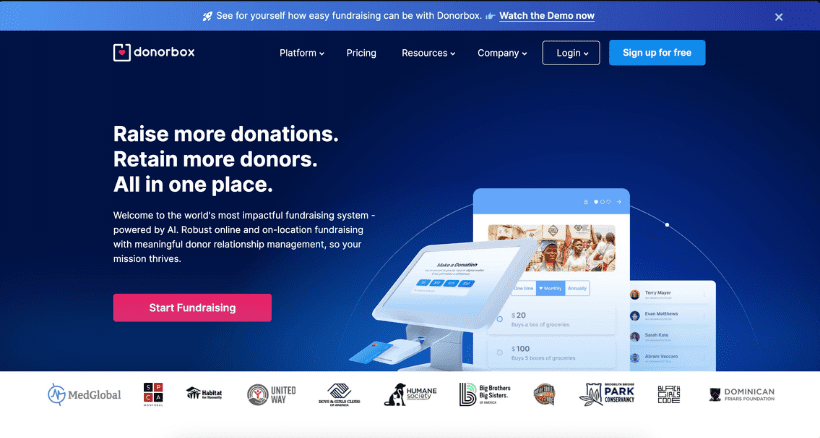
It charges a platform fee on every plan, including the free one — 2.95–3.95%, dropping to about 1.75–2% only on the $150/month Pro plan — and its Acceptable Usage Policy rules out raffles and sweepstakes. There are no auctions of any kind.
Versus RallyUp: RallyUp’s Free plan carries a $0 platform fee with Donation Pages free and no donor tipping required, and raffles and auctions run on the same account rather than requiring a second tool.
4. SignUpGenius Fundraisers (formerly Fundly) — simple donations and ticketed events
Best for: Community groups, schools and clubs that want simple online donations and ticketed events.
Fundly is now SignUpGenius Fundraisers — fundly.com redirects there. It keeps the essentials simple: online donations, recurring giving and ticketed events.
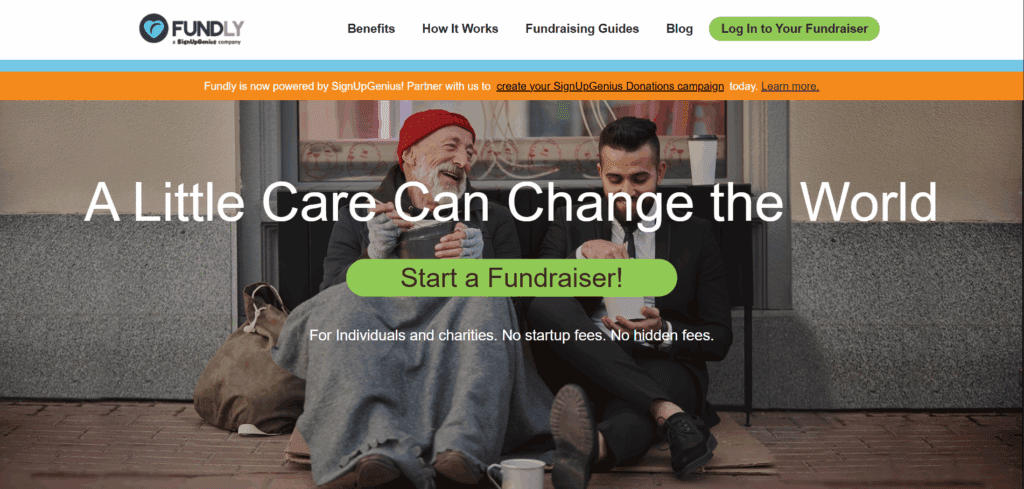
That’s where it stops. There’s no auction, raffle or sweepstakes format, no gala management and no donor CRM, and Fundly never published pricing before the transition.
Versus RallyUp: a RallyUp crowdfunding Campaign covers the same simple giving, and you can add a raffle, an auction or Peer-to-Peer to the same Campaign later — without starting over on a different platform.
5. Givebutter — all-in-one platform with a built-in CRM
Best for: Small to mid-sized nonprofits that want a clean, modern platform and are comfortable with tip-supported pricing.
Givebutter has earned its reputation. Since September 2025, the Givebutter Guarantee means nonprofits keep 100% on tipped campaigns even when donors decline to tip. Its built-in CRM has unlimited contacts, and email, outbound SMS, a Canva integration and the Givebutter Wallet round out a broad package.
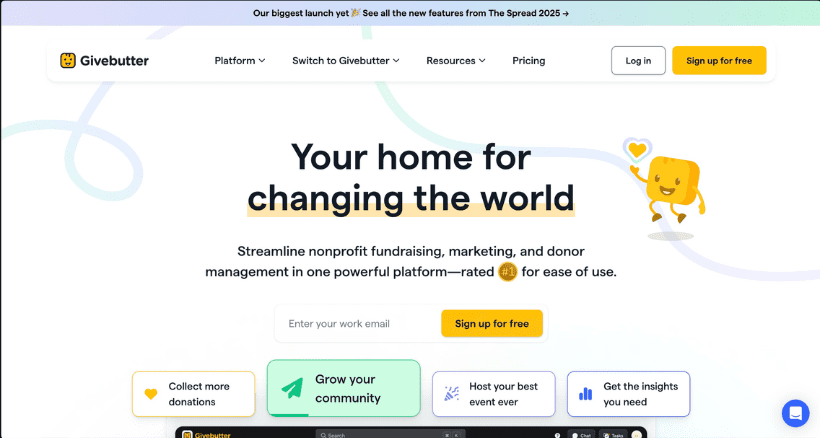
The narrowing is structural. Givebutter documents exactly three campaign types — Form, Page and Event — and has no Sweepstakes, A-Thons or storefront; by its own description, it “isn’t auctioneer software.” Free depends on tips staying on; turn them off and a flat 3% platform fee applies. Givebutter Plus starts at $29/month and rises with contact count, gating automations, outbound SMS and phone support. It offers a non-transacting preview for some campaign types but doesn’t support running test transactions through checkout.
Versus RallyUp: one account stacks 12+ Components inside a single campaign instead of three separate campaign types, Power Preview runs real test card transactions through checkout before you publish, Donation Pages stay free with no donor tipping required, and a human fundraising expert answers the phone free on every plan — no Plus tier required.
6. OneCause — established gala and auction specialist
Best for: Established organizations running large signature galas with a dedicated events team.
OneCause has genuine, long-standing depth in nonprofit auctions and galas — 14,000+ organizations, $8B+ raised, and gala-specific tooling RallyUp doesn’t try to match feature for feature, including assigned seating, couples check-in, sponsorship management, and optional on-site event staff.
That depth comes with a bigger commitment. There’s no free plan, and OneCause doesn’t publish prices: Professional is pay-as-you-go with pricing on request, and Enterprise and Nationals are custom quotes. Reviewers report a steeper learning curve, and there’s no online store, Sweepstakes or A-Thons.
Versus RallyUp: RallyUp runs raffles, online and silent auctions, A-Thons, a storefront, and Peer-to-Peer on a Free plan with published pricing and no annual contract, and if the setup still feels like a lift, Done-for-You builds the campaign for you at no cost.
Other fundraising software worth a quick look
A handful of other platforms show up in GoFundMe-alternative searches but serve a narrower job than a full comparison deserves — custom merchandise, one-off event ticketing, or general crowdfunding without nonprofit tools. Here’s where each one fits, and where it runs out of road.
- Bonfire. Merchandise campaigns — genuinely useful for a branded T-shirt fundraiser. Donations are an add-on at 8%, reduced to 3.5% for verified 501(c)(3)s, campaigns typically run about 21 days, and funds route through the Change Foundation. RallyUp’s storefront Component sits alongside raffles, auctions and donation pages in the same account.
- JustGiving. A long-established platform for charity challenges and events. For US nonprofits the default route is a 0% platform fee through the Blackbaud Giving Fund, but donor data and CRM tools are gated to its paid Grow plan.
- Kickstarter. Not built for nonprofit fundraising: its rules require every project to create something new to share, and only up to 10% of campaign funds may be donated to charity. It charges 5% plus processing on an all-or-nothing model built for creative projects and products.
- FundRazr. Flexible crowdfunding where funds go directly to your own Stripe or PayPal account — the same bring-your-own-processor model RallyUp uses. It runs on optional tips by default, with 1% or 5% fee-recovery options. RallyUp adds raffles, auctions and events to the same Campaign without a second platform.
- Indiegogo. Also not an option for a nonprofit: its content policy lists charities as prohibited. It’s built for product launches and creative projects, with a 5% platform fee.
- Patreon. Built for creators, with creator plans only and no nonprofit product.
Must-have features in a GoFundMe alternative
Whatever platform you land on, hold it to this checklist before you commit:
- A real launch path, not just a blank form — templates or a free expert build, so you’re not starting from zero.
- A way to test before you publish — ideally a full pre-publish preview with real test transactions, not just a static one.
- More than one campaign type in the same account — donation pages plus raffles, auctions, or Peer-to-Peer, without a second platform.
- An in-platform, automated winner draw for any raffle or sweepstakes format, with automatic notification and retained records — not an export-and-spin workaround.
- Donor ownership — org-wide supporter profiles and a downloadable donor list, not just a dashboard view.
- Transparent, published pricing — not a quote-only sales process for a first campaign.
- Support that includes a phone number — free, not gated behind a paid tier.
How to decide the right GoFundMe alternative for your nonprofit
Picking a platform isn’t about finding the one with the most features. It’s about finding the one that fits how your organization actually fundraises, how your donors prefer to give, and how much staff time you have to manage it. Here’s what to focus on:
1. Define your fundraising scope
List every kind of campaign you actually run in a year. If that includes events, a raffle, an auction, or recurring donors alongside crowdfunding, you need a platform built to hold all of it in one account rather than one built for a single campaign type.
2. Calculate the total cost, not just the sticker price
A platform with no monthly fee can still take a meaningful percentage of every donation, and a “free” platform funded entirely by donor tips is a different cost model than a $0 platform fee. Do the math on what you’d actually keep from every $100 raised, including payment processing, before deciding.
3. Check whether nonprofit tools are built in or bolted on
Donor profiles, automatic tax-exempt receipts, and event or raffle tooling should exist natively, not require a second subscription. A platform built for individual campaigns rarely has these as a first-class feature.
4. Prioritize must-haves over nice-to-haves
Start with the essentials: a real launch path, a way to test before publishing, and support you can actually reach. Advanced analytics dashboards and automation are worth having, but they don’t matter if the basics aren’t covered.
5. Plan two years out, not just for this campaign
Starting with a platform that can hold your next three campaign types — not just this one — saves you the cost of migrating donor data and rebuilding brand presence later.
Ready to move beyond GoFundMe?
GoFundMe earned its reputation on individual and emergency fundraising, and it’s genuinely good at that job. Running a nonprofit’s fundraising program is a different job.
RallyUp is built so the first campaign is easy and the tenth one is still easy. Launch from an Instant Fundraiser Template in as little as 15–20 minutes, or let Create My Campaign build it for you. Test the whole thing in Power Preview before a donor ever sees it. Then, when you’re ready, add a raffle, an auction, or Peer-to-Peer to the same campaign without rebuilding a thing.
Pricing and features current as of October 2026.
FAQs on GoFundMe alternatives
For a registered 501(c)(3), RallyUp is a strong default because it’s genuinely easy to launch a single campaign and also covers raffles, auctions, Peer-to-Peer, a storefront, and events on the same account — something GoFundMe doesn’t offer natively.
GoFundMe was built for individual and personal campaigns, and it’s genuinely strong there thanks to its large donor pool and brand recognition. It works for a nonprofit’s one-off crowdfunding push, but it lacks a full donor CRM, native events, auctions, or raffle tools, and custom branding — the things an ongoing 501(c)(3) fundraising program typically needs.
GoFundMe is the consumer platform for individual and personal campaigns. GoFundMe Pro is the rebranded name for Classy, a separate nonprofit fundraising platform that now combines Classy’s campaign infrastructure with GoFundMe’s donor network, aimed at mid-sized and large nonprofits running enterprise fundraising programs on a custom annual contract.
Yes, but read the fine print, because “free” is funded differently on each platform. RallyUp’s Free plan has a $0 platform fee, and Donation Pages are free with no donor tipping required — you only pay payment processing to Stripe or PayPal. Givebutter is free while tipping is on and charges a flat 3% platform fee when it’s off. There are no contracts, subscriptions, or setup fees on RallyUp.
On RallyUp, yes: Peer-to-Peer (P2P) layers onto raffles, auctions, A-Thons, a storefront, crowdfunding, and ticketed events rather than standing alone, with Instant Personal Pages, Team Momentum, Leaderboards, and Badges & Prizes. Layering Peer-to-Peer onto another campaign type raises 40–60% more than running Peer-to-Peer on its own. GoFundMe doesn’t offer a dedicated Peer-to-Peer layer at all.
Now that you’ve seen it in action, are you ready to start fundraising?
Get Started