
Best peer-to-peer fundraising platforms for nonprofits (2026)
The best peer-to-peer fundraising platform for most nonprofits
- RallyUp is genuinely, seriously easy to use. Most teams build and launch a Peer-to-Peer (P2P) campaign in 15–20 minutes from an Instant Fundraiser Template, and the average time to a first campaign launch is about three hours.
- And it does dramatically more. Peer-to-Peer runs across every RallyUp campaign type — raffles, auctions, A-Thons, storefronts, crowdfunding, ticketed events — not just donation drives.
- Donation Pages are free with no donor tipping required, and there are no contracts, subscriptions, or setup fees.
- A person whenever you ask. Every plan gives you full and free access to real fundraising experts by chat or email, with phone and Zoom available.
- The eight platforms below are the alternatives worth knowing, and where each one runs out of road.
People trust those they know, and that trust often leads to action. Approximately 28% of donors in the US report giving because someone personally asked them to.
That’s the heart of peer-to-peer fundraising. Your supporters become your strongest advocates, reaching out to their friends, family, and coworkers on your behalf. You’re no longer one organization asking for donations. You’re 20, 50, or 200 people carrying your message into rooms you’d never reach alone.
The numbers back it up. The top 30 peer-to-peer fundraising programs in the United States collectively raised $1.14 billion last year. The platform you choose decides how much of that momentum you can actually capture — and how much of your week you spend fighting software instead of fundraising.
In this article
- The short answer: start with RallyUp
- What is a peer-to-peer fundraising platform?
- What changes when you're ready to grow
- 8 other peer-to-peer fundraising platforms worth knowing
- Must-have features in a peer-to-peer platform
- How to decide the right peer-to-peer platform for your nonprofit?
- Ready to launch your peer-to-peer campaign?
- FAQs on peer-to-peer fundraising platforms
The short answer: start with RallyUp
RallyUp is genuinely, seriously easy to use. If you’re running one campaign — a peer-to-peer walk, a donation drive, an online auction — you can build it and launch it the same afternoon. About 40% of new RallyUp campaigns use an Instant Fundraiser Template, which drops a complete, pre-built campaign in front of you instead of a blank form; a typical build-and-launch takes 15–20 minutes, and the average across all new organizations is roughly three hours from first login to a live campaign. Ease is the single most-cited strength in RallyUp reviews, with a 4.5/5 score for ease of use on Capterra and a 4.8/5 overall rating on G2. If you’d rather not build at all, Create My Campaign hands the setup to RallyUp’s team.
And it does dramatically more with your peer-to-peer program than a donation-page tool can. On RallyUp, peer-to-peer isn’t a single campaign type — it’s a layer you can add to almost anything you run. Your supporters can fundraise on behalf of a raffle, an A-Thon, an online auction, a storefront, a crowdfunding push, or a ticketed event, all from Instant Personal Pages they can personalize in a couple of minutes. Team Momentum, Leaderboards, and Badges & Prizes keep participants moving, you can run open sign-ups or roster-based invites, and Simple Mode credits donations to a participant without asking them to build a page at all.
Three things separate it from the alternatives below. Easier: templates and a free expert build mean the campaign exists before you’ve finished your coffee. Faster: Power Preview — RallyUp’s interactive draft mode — lets you run real test card transactions all the way through checkout before you publish, so you’re not debugging a live campaign in front of your donors. Cheaper: Donation Pages are free with no donor tipping required, the Free plan carries a $0 platform fee, and there are no contracts, subscriptions, or setup fees to sign before you find out whether the thing works.
| What matters most | RallyUp | Typical alternative |
|---|---|---|
| Launching one campaign | Build and launch in 15–20 minutes from an Instant Fundraiser Template; 40% of new campaigns use one | Cosmetic themes, planning worksheets, and a blank form |
| Free expert build | Done-for-You campaign build at no cost | Not offered, or bundled into paid onboarding |
| How far peer-to-peer reaches | Layers onto raffles, auctions, A-Thons, storefronts, crowdfunding, and ticketed events | Usually limited to donation pages and event campaigns |
| Testing before you publish | Power Preview runs real test card transactions through checkout | Non-transacting previews or campaign-level test receipts |
| Free to fundraise | Free plan with a $0 platform fee; Donation Pages free with no donor tipping required | Free only while donor tipping is on, or a flat platform fee once it’s off |
| Getting help | Ask for a human and you get one, at any point — free fundraising experts on every plan by chat or email, with phone and Zoom available | Chat and email free; phone support behind a paid tier |
| When you’re ready to grow | 12+ stackable Components in one Campaign — one URL, one checkout — and you can add Components to a live Campaign without rebuilding | A separate campaign or form for every new activity |
What is a peer-to-peer fundraising platform?
Peer-to-peer is one format among many, and this guide stays on it deliberately. If the bigger question is which platform to run your whole program on, our comparison of the best online fundraising platforms for nonprofits covers raffles, auctions, galas, and recurring giving alongside peer-to-peer.
A peer-to-peer fundraising platform empowers your supporters to create fundraising pages and raise funds on your behalf with built-in competition to boost results. From one place, it handles campaign creation, social sharing, payment processing, donation tracking, leaderboards, and prize tiers that motivate participants.
Here’s exactly how it works:
- Your animal shelter needs funds to upgrade its medical wing. You launch a campaign with your goal, branding, messaging, leaderboard, and clear prize levels (e.g., T-shirt at $250, VIP kennel tour at $500). You can also preload participants (like volunteers or team members) so donations are automatically credited to the right person.
- Let’s take an example of Jamie, who adopted a dog from your shelter and signed up as a fundraiser. The platform helps her create a personal page where she adds her story about how your veterinary team saved her dog’s life.
- Then, she shares that link with her personal network through email and social media.
- When people click through, they see Jamie’s page and donate directly. The money goes straight to your nonprofit, but Jamie gets credit for bringing in those donors.
- On her dashboard, she sees real-time progress toward the next prize tier, plus who donated and how much. On the public campaign page, a live leaderboard shows top fundraisers competing for prizes, sparking friendly rivalry and more sharing.
- Meanwhile, you monitor total funds raised, celebrate winners, and spotlight milestones to keep the competition and donations growing.
Peer-to-peer tools track everything.
What changes when you’re ready to grow
Most nonprofits start with one campaign type, and about nine out of ten RallyUp campaigns stay that way. But peer-to-peer rewards organizations that combine formats, and that’s where the platform choice starts to compound.
RallyUp calls this Full Stack Fundraising: 12+ stackable Components that live inside a single Campaign, behind one URL and one checkout. A supporter can buy a raffle entry, bid on an auction item, and sponsor a walker in a single transaction instead of three. Organizations that combine multiple campaign types raise 38% more than those running a single format, and layering peer-to-peer onto another campaign type raises 40–60% more than running peer-to-peer on its own. You can also add a Component to a Campaign that’s already live — no rebuild, no second URL, no asking your donors to bookmark something new.
A few things that make the growing part less painful:
- Power Preview. RallyUp’s interactive draft mode lets you test drive a campaign end to end — real test card transactions through the actual checkout, test bids, test receipts, test reports — before a single donor sees it. In-product it’s called Draft Mode.
- The AI Fundraising Content Generator. It drafts your campaign description, participant-facing copy, item and prize descriptions, and donor emails from inside the builder — no prompt writing. Treat it as a co-pilot: you’re still editor-in-chief.
- Done-for-You. If you’d rather hand the whole build over, RallyUp’s Done-for-You team builds the campaign for you at no cost — more than 1,000 campaigns built so far.
- Support that answers — ask for a human and you get one, on any plan, at any point. Every plan gives you full and free access to real fundraising experts by chat or email, with phone and Zoom available — including the free plan.
- Pricing you can predict. The Free plan has a $0 platform fee and optional donor tipping on Core Components; Donation Pages are free with no donor tipping required. The Flex plan charges a percentage only on the Components you actually use — 2.9% for ticketing and storefront, 4.9% for auctions, crowdfunding, Fund-a-Need, Paddle Raise+, and A-Thons, 6.9% for raffles and sweepstakes, and 0% for livestreaming, Donation Pages, and Done-for-You services — with auction platform fees capped at $100 per item. Payment processing goes to Stripe or PayPal at 1.9–2.9% + $0.30. No contracts, no subscription, no setup fee.
Across 55,000+ organizations, RallyUp has helped raise more than $1 billion, at a 4.8/5 average rating.
8 other peer-to-peer fundraising platforms worth knowing
Every platform here does something genuinely well. The useful question isn’t whether a platform is good — it’s where it stops. Each entry below names the real strength first, then the point at which you’d need something else.
1. GoFundMe Pro — enterprise reach, heavy for a single campaign
Best for: Large, multi-chapter organizations running signature peer-to-peer events.
GoFundMe Pro (formerly Classy) is the real thing at enterprise scale: Classy’s fundraising infrastructure plus GoFundMe’s donor network, which the combined ecosystem puts at more than 200 million people and $40 billion raised. Salesforce integration is strong, and supporter coaching helps first-time fundraisers find their footing.

Where it runs out of road is the entry point. Pricing is a custom annual contract with processing on top — there’s no free plan to test with, and reviewers consistently describe onboarding and setup as a project rather than an afternoon. For a single walk or a first peer-to-peer campaign, you’re buying an enterprise implementation to do something small.
Versus RallyUp: you can launch a peer-to-peer campaign on RallyUp’s Free plan in 15–20 minutes from an Instant Fundraiser Template, with no contract to sign and no annual subscription — and scale into 12+ stackable Components later without renegotiating anything.
2. Qgiv (now Bloomerang Fundraising) — strong gamification, priced around a CRM you already own
Best for: Bloomerang CRM customers running competitive, event-tied peer-to-peer campaigns.
Qgiv’s gamification is genuinely good. Supporters build personalized pages, climb leaderboards, earn milestone badges, and join team challenges, and organizations already on Bloomerang CRM get automatic syncing between fundraising and donor management — a real advantage if that’s your stack.
The cost is the catch. Peer-to-Peer plans start at $259/month plus 3.95% + $0.30 per card transaction (and another 1% for AmEx), phone support is a paid monthly add-on, and reviewers describe the interface as less approachable than newer tools. That’s a subscription running whether you have a campaign live or not.
Versus RallyUp: leaderboards, Badges & Prizes, and Team Momentum are standard on RallyUp with no subscription at all, and phone support with a human fundraising expert is free on every plan rather than a monthly add-on.
3. CauseVox — storytelling-first pages, thin once the campaign gets complex
Best for: Grassroots and community-driven nonprofits whose campaign lives or dies on narrative.
CauseVox puts storytelling at the center. The drag-and-drop builder, pre-built templates, and multimedia modules make it easy for a peer community to tell a personal story well, and the matching-gift experience is a nice touch for teams with a corporate sponsor.
Past storytelling, the road narrows. Reviewers report the interface can feel unintuitive for first-time users and that navigation gets awkward as campaigns grow, and event ticketing, team pages, integrations, and onboarding support sit behind a Professional plan starting at $250/month.
Versus RallyUp: team pages, ticketing, and onboarding aren’t behind a $250/month gate — and RallyUp’s AI Fundraising Content Generator drafts the campaign story, participant copy, and donor emails from inside the builder, so the narrative work starts from a draft rather than a blank page.
4. OneCause — deep gala machinery, overbuilt for everyday peer-to-peer
Best for: Established organizations running large signature events with a dedicated events team.
OneCause has the longest track record in nonprofit auctions and galas of anyone on this list — 14,000+ organizations, $8B+ raised, and gala-specific depth that RallyUp doesn’t try to match feature for feature, including assigned seating, couples check-in, sponsorship management, and optional on-site event staff. Its peer-to-peer styles cover event, DIY, and giving-day formats well.
That depth is also the problem for everyday fundraising. There’s no free plan, and the published entry tiers are priced for events rather than everyday fundraising: OneCause lists a Professional Auction & Event package at $2,995 a year and a Pay-As-You-Go option from $200 (OneCause), with Enterprise and Nationals tiers quote-only. Reviewers also repeatedly flag a steep learning curve. There’s no online store, no A-Thons, and no free campaign-build service.
Versus RallyUp: RallyUp runs A-Thons, storefronts, and peer-to-peer on a Free plan with published pricing, and if the setup still feels like a lift, Done-for-You builds the campaign for you at no cost.
5. Zeffy — true zero fees for your nonprofit, funded by a pre-selected donor tip
Best for: Small, volunteer-run nonprofits whose top priority is keeping 100% of every donation.
Zeffy’s zero-fee model is real and best in class on fee purity: it covers both platform and payment processing fees, so the nonprofit keeps 100% whether or not a donor tips. That’s not marketing — no other major platform matches it for a nonprofit’s bottom line. Zeffy serves 100,000+ organizations with $2B+ raised, its peer-to-peer includes individual and team pages, and it offers capable auctions with auto-bidding, anti-sniping, auto-charge, and outbid emails and texts, plus memberships, which RallyUp does not offer.
Two things are worth knowing before you commit. First, the funding math sits with your donors: the checkout contribution is pre-selected and, according to competitor Donorbox‘s reporting, defaults to 17% on donations up to $99.49 and 15% above that; Zeffy itself publishes no percentage and says only that the rate falls as the donation grows. A modelled estimate from 4aGoodCause, a competing provider, puts the effective donor-borne cost of tip-funded platforms near 12.75%, assuming 20% and 13% suggested tips and two-thirds of donors tipping. Zeffy’s own G2 profile carries a strong ~4.8/5 rating alongside recurring reviewer frustrations about the tip percentage and limited features (G2). Second, breadth: no sweepstakes, no A-Thons, no auctioneer-led live auction, no consolidated per-guest event checkout, no native livestreaming, and campaign types run as separate forms rather than stacking into one campaign. Payments run through a Stripe Connected Account that Zeffy creates and administers rather than your own Stripe account, so ask Zeffy how stored cards would transfer before you plan to migrate recurring donors.
Versus RallyUp: RallyUp’s Donation Pages are free with no donor tipping required, your organization connects its own Stripe or PayPal account and owns its donor data outright, and peer-to-peer layers onto 12+ stackable Components in a single campaign with one checkout instead of a set of separate forms.
6. Donately — clean embedded pages, few engagement tools
Best for: Small to mid-sized organizations that want peer-to-peer without a learning curve.
Donately is refreshingly uncomplicated. Setup takes minutes, donation forms embed cleanly into an existing website, fundraisers get their own dashboard to watch donations arrive, and reviewers consistently praise the support team’s response times.
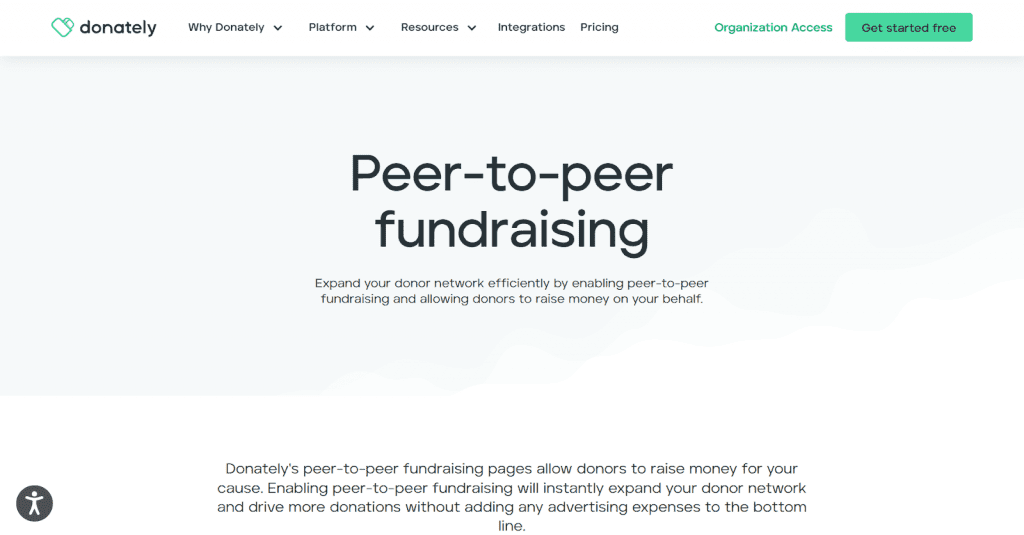
Simplicity is also the ceiling. There are fewer advanced engagement tools and less campaign design flexibility than larger platforms offer, and the pricing ladder is steep: the free plan carries a 4% platform fee, dropping to 2% costs $99/month, and reaching 0% costs a $5,000 one-time payment (up to $1M raised), all before Stripe or PayPal processing of 2.2–2.9% + $0.30.
Versus RallyUp: RallyUp is easy in the same way but doesn’t charge for the engagement layer — Leaderboards, Team Momentum, and Badges & Prizes come standard, and the Free plan’s platform fee is $0 rather than 4%.
7. Donorbox — easy peer-to-peer add-on for an existing site, capped past the basics
Best for: Organizations that want to bolt peer-to-peer onto campaigns they’re already running.
Donorbox makes the add-on motion genuinely painless: flip a switch on an existing campaign, invite supporters from inside the platform, and they get guided emails walking them through building a personal page. Free webpage hosting, a built-in donor CRM, and free text-to-give round it out nicely for organizations without much of a website.
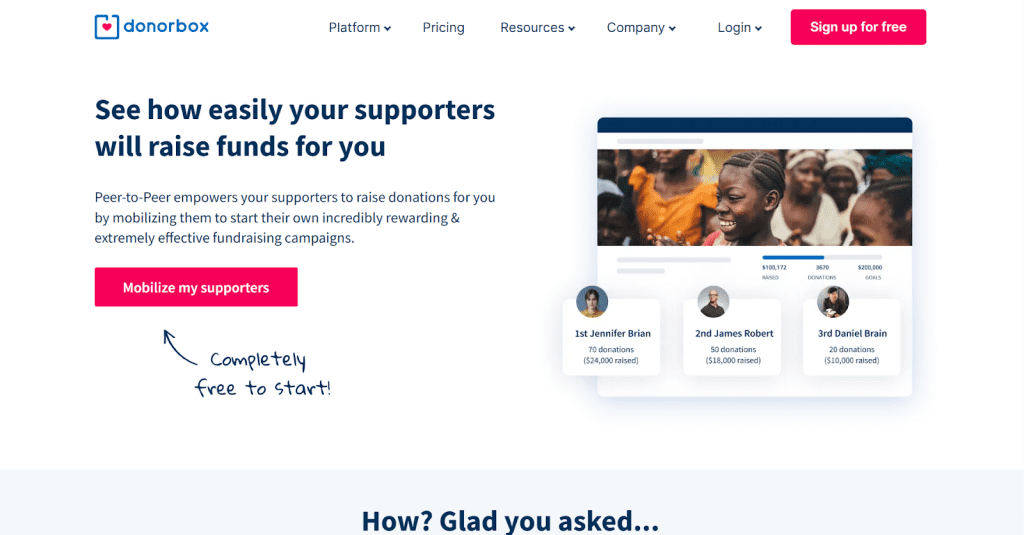
The ceiling arrives at customization and cost. Advanced branding and automation sit in paid tiers, and the standard plan charges a 2.95% platform fee on peer-to-peer campaigns (3.95% for supporter-created pages); the Pro plan is $150/month to bring peer-to-peer down to 1.75%, with Premium quoted individually. Processing of 2.2% + $0.30 (Stripe) or 1.99% + $0.49 (PayPal) applies on every plan.
Versus RallyUp: peer-to-peer on RallyUp isn’t a toggle on a donation form — it extends across raffles, auctions, A-Thons, storefronts, and ticketed events, with custom branding included rather than tiered.
8. Givebutter — polished all-in-one with a strong free model, only three campaign types
Best for: Small to mid-sized nonprofits that want a clean, modern platform and are comfortable with tip-supported pricing.
Givebutter has earned its reputation. The Givebutter Guarantee means nonprofits keep 100% even when donors decline to tip, the built-in CRM has unlimited contacts, and email, SMS, a Canva integration, and the Givebutter Wallet (2.5% APY, Visa commercial cards, QuickBooks sync) make it a legitimately broad package. It was named G2’s #1 Nonprofit Software for 2026 and rates 4.7/5 there.

The narrowing is structural. Givebutter documents exactly three campaign types — Form, Page, and Event — with auctions and paddle raise attached as tabs rather than standalone campaigns, and peer-to-peer only extends across Page and Event campaigns. There are no sweepstakes, no A-Thons, and no online storefront. RallyUp runs all three auction formats today — Online, Silent and auctioneer-led Live. Givebutter’s own blog says it isn’t auctioneer software and has no live bid-calling tools (Givebutter). Its “templates” are theme colors, cover photos, and planning worksheets rather than launchable campaigns, and there’s no free campaign-build service. On pricing, free depends on tips being on: Givebutter charges a 0% platform fee while optional donor tips are on, and turning tips off triggers a flat 3% platform fee across all campaign types plus processing. Auctions are free only when winners pay via the emailed payment request; using Auto-Charge or charging winners from the dashboard incurs 3% regardless of tips, uncapped. Givebutter Plus starts at $29/month for under 250 contacts and rises with contact count, gating automations, outbound SMS, custom reports, and phone support. Givebutter also supports campaign-level test receipts and shipped a non-transacting auction preview in February 2026, but doesn’t let you run test transactions end to end through checkout.
Versus RallyUp: RallyUp rates 4.8/5, stacks 12+ Components inside one campaign instead of three separate types, keeps Donation Pages free with no donor tipping required, caps auction platform fees at $100 per item, and puts a human fundraising expert on the phone with you for free on every plan — no Plus tier required.
Must-have features in a peer-to-peer platform
Now, let’s take a look at the essential features your platform needs to have for effective peer-to-peer fundraising.
- Personal and team fundraising pages:
Your supporters should be able to create individual pages or join teams to fundraise together. This flexibility lets you run different campaigns and appeals to both solo fundraisers and those who thrive in groups. - Customized branding:
Most fundraisers will like to personalize their pages with photos, videos, and their own story about why they’re supporting your cause. It helps to build personal connections and inspire more donations. - Social sharing tools:
One-click sharing to Facebook, Instagram, email, and text messages is non-negotiable. If fundraisers have to manually copy links or jump through hoops to share, they simply won’t do it. - Real-time donation tracking:
Both you and your fundraisers should see donations as they come in. Live progress bars and goal trackers keep momentum going and motivate fundraisers to push harder. - Leaderboards and gamification:
Some friendly competition does no harm. Leaderboards showing top fundraisers, milestone badges, and progress updates turn fundraising into an engaging challenge. - Mobile-optimized pages:
Most people will view and share fundraising pages on their phones. If pages don’t look good or work smoothly on mobile, you’re going to lose donations. - Donation receipt automation:
Tax receipts should go out automatically to every donor. Manual receipt generation wastes time and frustrates donors who need documentation for their records. - Campaign analytics and reporting:
You need to see which fundraisers are performing well, where donations are coming from, and how your overall campaign is tracking. - Secure payment processing:
Donors need to trust that their credit card information is safe. Look for platforms with PCI compliance and trusted payment processors like Stripe or PayPal.
How to decide the right peer-to-peer platform for your nonprofit?
Picking a platform isn’t about finding the one with the most features. It’s about finding the one that actually works for your nonprofit and your supporters. Here’s what to focus on:
1. Consider your fundraiser’s experience
Your tech-savvy staff might navigate anything, but what about your supporters? The platform needs to be simple enough that anyone can create a fundraising page and start raising money without calling you for help.
Even better would be platforms that offer step-by-step guidance or built-in tips to help first-time fundraisers get started confidently.
2. Calculate the total cost of the platform
Your platform fees are just the starting point. You need to factor in credit card processing charges, monthly or annual subscriptions, and whether the platform relies on donor tips to stay “free.:
Some platforms advertise zero fees but automatically add a significant amount of tips at checkout, which can frustrate donors. So, do the math on what you’ll actually keep from every $100 raised before making your decision.
Note: The cost of fundraising tools is subject to change at any time. You should also confirm nonprofit-specific discounts from partners like Stripe and PayPal.
3. Look for multi-campaign flexibility
You shouldn’t need separate tools for different fundraising needs. The best platforms let you run peer-to-peer alongside other campaign types like crowdfunding, raffles, or events – all connected on one platform.
If you invest in a tool that only does peer-to-peer, you’ll end up juggling multiple platforms and donor data across different systems.
4. Prioritize must-haves over nice-to-haves
Start with the essentials your peer campaign can’t work without: team or personal fundraising page, social sharing tools, donation tracking, customization options, and leaderboards.
While features like AI-powered insights, advanced analytics dashboards, or sophisticated automation are fantastic additions, they won’t matter if you don’t have the basics covered. Don’t get distracted by flashy perks, focus on what actually matters for peer fundraisers.
5. Check your integration needs
Ask whether the platform works with your CRM or if it will sync with your email tool. A platform that integrates with your existing systems saves you hours of manual work.
Without proper integrations, you’ll end up manually exporting donor lists, copying fundraiser data between platforms, and risking errors along the way.
Ready to launch your peer-to-peer campaign?
Every nonprofit works differently. Think about your fundraising goals, your team’s capacity, and what your supporters will actually be comfortable doing — then pick the platform that gets out of the way.
RallyUp’s peer-to-peer fundraising is built so the first campaign is easy and the tenth one is still easy. Use an Instant Fundraiser Template and be live in 15–20 minutes, or let Create My Campaign build it for you. Test drive the whole thing in Power Preview before a donor ever sees it. Then, when you’re ready, add a raffle, an auction, or an A-Thon to the same campaign without rebuilding a thing.
Your supporters do the asking. RallyUp handles everything behind the curtain.
Pricing and features current as of August 2026.
FAQs on peer-to-peer fundraising platforms
Crowdfunding is when one organization asks the public for donations directly. P2P fundraising is when your supporters create their own pages and ask their personal networks to give on your behalf.
In peer fundraisers, you launch a campaign with your fundraising goal and story, then your supporters sign up to create their own fundraising pages. They personalize these pages with their connection to your cause and share them with friends and family.
Yes, absolutely, because it expands your reach without expanding your budget or staff. Your supporters do the outreach work, bringing in donors from their networks that you’d never reach on your own, which levels the playing field against bigger organizations.
There’s no single fundraiser that raises the most, as what works best depends on your donor interest and fundraising goals. However, events like walkathons, peer-to-peer campaigns, and auctions are often considered the most popular fundraisers.
RallyUp is genuinely, seriously easy to use: about 40% of new campaigns use an Instant Fundraiser Template, a typical build-and-launch takes 15–20 minutes, and the average across new organizations is roughly three hours to a live campaign. Ease of use is the most-cited strength in RallyUp reviews, with a 4.5/5 score for ease of use on Capterra. If you’d rather not build it yourself, Create My Campaign and the free Done-for-You service will build it for you.
Yes, but read the fine print, because "free" is funded differently on each platform. RallyUp’s Free plan has a $0 platform fee, and Donation Pages are free with no donor tipping required — you only pay payment processing to Stripe or PayPal. Zeffy covers both platform and processing fees through a pre-selected donor tip. Givebutter is free while tipping is on and charges a flat 3% platform fee when it’s off. There are no contracts, subscriptions, or setup fees on RallyUp.
RallyUp does. Full Stack Fundraising lets you stack 12+ Components — peer-to-peer, raffles, auctions, A-Thons, ticketing, a storefront, crowdfunding, and more — inside a single Campaign behind one URL and one checkout, and you can add a Component to a Campaign that’s already live without rebuilding it. Organizations that combine campaign types raise 38% more than those running a single format.
On RallyUp, yes. Peer-to-Peer (P2P) layers onto almost any campaign type rather than standing alone, so supporters can fundraise on behalf of a raffle, an auction, an A-Thon, a storefront, or a ticketed event. Combining peer-to-peer with another campaign type raises 40–60% more than running peer-to-peer on its own. Most other platforms limit peer-to-peer to donation pages and event campaigns.
Now that you’ve seen it in action, are you ready to start fundraising?
Get Started