6 Steps to Creating a Fundraising Plan: Sample and Strategy
Fundraising Plan Overview
A fundraising plan turns scattered campaigns into a scalable revenue system.
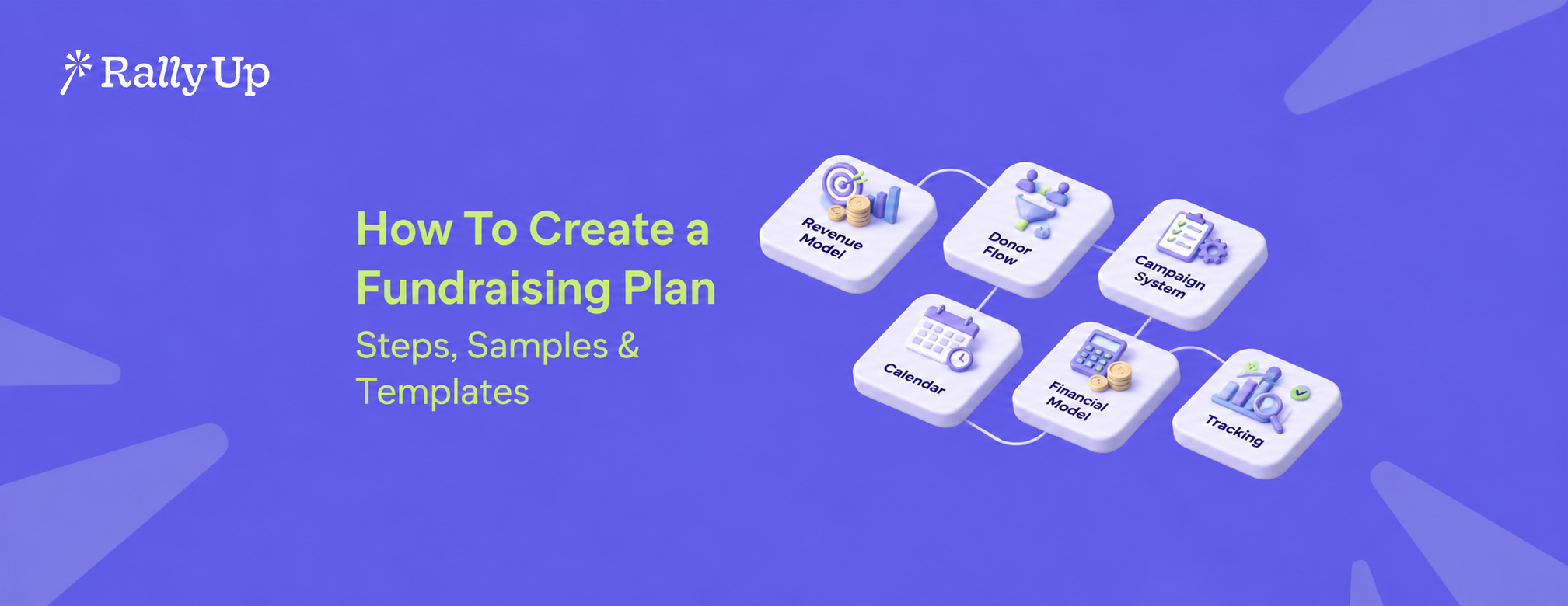
Build yours in six steps:
1. Revenue model
2. Donor flow
3. Campaign system
4. Calendar
5. Financial model
6. Tracking
RallyUp, an end-to-end fundraising platform, keeps most steps in one place.
Think of a nonprofit that runs three solid events every year. Their campaigns launch, perform for a short window, then disappear. The next one starts from zero again.
No carry-over donors, no momentum, just rebuilding the same audience they already earned. Now that’s a planning problem. A fundraising plan connects your campaigns, donors, timing, and revenue into one system where each piece feeds the next.
In this guide, you’ll learn exactly how to write a fundraising plan that’s practical enough to execute and structured enough to scale: six steps, a complete sample, and templates you can use immediately.
In this article
- What is a fundraising plan and how does it work
- Check the compliance and legal considerations of fundraising
- The core elements of a fundraising plan
- Step 1: Define your revenue model
- Step 2: Design your donor flow
- Step 3: Build campaign systems over one-off campaigns
- Step 4: Build your fundraising planning calendar
- Step 5: Build a financial model for each campaign
- Step 6: Set up your tracking and execution system
- Sample fundraising plan and complete template
- Final thoughts: Turning your fundraising plan into execution
- FAQs about fundraising plan
What is a fundraising plan and how does it work
A charity fundraising plan is not a document you file after a strategy meeting. It’s a revenue system, one that connects.
- Where your money comes from
- How donors move through your organization
- What campaigns do you run
- When you run them
Think of it like plumbing. Each pipe connects to the next. When it works, resources flow consistently. When one section is missing or disconnected, everything slows down or stops.
The four things a strong fundraising plan connects are your revenue sources, your donor behavior, your campaign structure, and your timing. Pull any one of those out, and the rest loses its shape.
What are the reasons most fundraising plans fail?
Here’s what makes creating a fundraising plan harder than it looks: in 2025, only 14% of first-time donors returned to give again. Which means most nonprofits are spending the majority of their energy re-acquiring the same type of donor, year after year, without a system to retain them.
That’s a symptom of four specific planning failures:
- Disconnected campaigns: Each campaign is built in isolation. There’s no handoff, no follow-through, no path from one action to the next.
- No donor progression: Donors are treated as transactions, not relationships. Someone gives at your gala and never hears from you in a way that connects back to that experience.
- No financial clarity: Campaigns get approved based on enthusiasm, not expected return. Nobody tracks what it actually costs to raise a dollar.
- Weak tracking: Many organizations measure every possible statistic, but few have enough data to actually guide planning, analyze their systems, or redirect underperforming programs. Measurement without structure doesn’t help.
What does a strong fundraising plan for a nonprofit look like?
A plan that works has six things in place:
- A clear revenue model: You know exactly which streams are funding your annual goal and in what proportion.
- A defined donor movement: Every campaign has a next step attached to it.
- A layered campaign system: Your campaigns build on each other rather than compete.
- A structured calendar: Timing is intentional, not reactive.
- A financial model for every campaign: You know what each campaign costs to run and what it actually returns.
- And measurable outcomes: You’re tracking what matters, not just what’s easy to count.
That’s the system. The next six steps show you how to build it.
Check the compliance and legal considerations of fundraising
Before any campaign goes live, make sure your organization is legally cleared to fundraise. A few things to have in order before your plan kicks off:
Charitable solicitation registration
Around 40 states require nonprofits to register before soliciting donations from their residents. Exemptions exist based on organization size, revenue thresholds, and cause type, so requirements vary significantly.
What’s more to note is that online fundraising has its own terms:
- Simply having a website doesn’t automatically trigger registration in every state
- Actively soliciting residents through targeted emails, ads, or campaigns can create multi-state obligations
- Some states require registration renewal annually, with fees and reporting attached
Check Labyrinth’s 50-state fundraising compliance guide for state-by-state requirements before any campaign goes live.
Raffle and sweepstakes laws
Raffles require payment to enter and are regulated by state charity or gaming laws. Some states prohibit paid-entry raffles entirely, while others require permits.
Sweepstakes need to offer a free way to enter. Charging people to participate turns a sweepstakes into an illegal lottery in most states.
Check your state’s rules for each of these separately before building either into your campaign calendar.
IRS Form 990
Most tax-exempt nonprofits must file Form 990 annually with the IRS to maintain their tax-exempt status. The version you file depends on your organization’s size and assets:
- 990-N: For nonprofits with gross receipts under $50,000
- 990-EZ: For nonprofits with gross receipts under $200,000 and total assets under $500,000 at year-end. Both thresholds must be met.
- 990 (full): Required if your organization exceeds either of the 990-EZ thresholds
Missing this filing three years in a row results in automatic loss of tax-exempt status.
Donor acknowledgment and disclosures
Any single donation of $250 or more requires a written acknowledgment from your organization. Smaller gifts don’t carry that requirement, but sending one regardless is good practice for retention.
If a donor receives something of value in exchange for their gift, like an auction item or a gala ticket, only the portion above fair market value is tax-deductible. That distinction needs to be communicated clearly at the time of the gift.
Permits and event approvals
Most in-person fundraising events require permits from your local city or county, and the timeline to get them is longer than most organizations expect. Auctions involving alcohol need separate liquor licensing. Outdoor events often require parks or public space permits.
Build permit timelines into your calendar before you lock in event dates.
The core elements of a fundraising plan
Before getting into the steps, it helps to see the full picture in one place. Every strong fundraising plan is built on six elements. Together, they form the system. Separately, they’re just tasks.
Here’s how they fit together:
| Element | What it covers | Output |
|---|---|---|
| Revenue model | Where money comes from | Revenue split |
| Donor flow | How donors move | Conversion paths |
| Campaign system | What you run | Campaign stack |
| Calendar | When you run it | Timeline |
| Financial model | What it returns | Net revenue |
| Tracking | How you measure | Reports |
Each element answers a specific question your fundraising operation needs to function: what you’re building toward, who you’re building it for, how you’ll get there, when, whether it’s worth it, and whether it worked.
Most nonprofits have pieces of this. What’s missing is the connection between them.
Step 1: Define your revenue model
Advice on the internet will ask nonprofits to set an annual goal and work backwards from a number. That’s not a revenue model, that’s a wish with a deadline.
A revenue model starts one step earlier. Before you decide how much you want to raise, you decide where it’s coming from. That distinction matters more than most organizations realize, because a goal without a source is just pressure.
Break revenue into streams
Your plan should identify every stream contributing to your annual target. That means some combination of:
- Events: Galas, walks, tournaments
- Peer-to-peer campaigns: Community-driven, network-powered
- Auctions and raffles: High-engagement, time-bound
- Direct donations and recurring giving: Your most stable, compounding revenue
Depending on your organization, your plan may also include these additional streams:
- Grants: Funding from foundations or government sources
- Major gifts: Large individual donations requiring personal cultivation
- Corporate sponsorships: Company funding tied to visibility or mission alignment
- Donor-advised funds (DAFs): Donor-directed giving through a sponsoring organization
- Board giving: Contributions from your own board members
- Planned giving: Bequests and estate-based gifts made over time
Assign realistic contribution percentages
Once you’ve identified your streams, assign each one a realistic share of your total goal. Here’s a simple example:
Total goal: $250,000
| Stream | Target | % of Goal |
|---|---|---|
| Events | $100,000 | 40% |
| Peer-to-peer | $60,000 | 24% |
| Auctions | $50,000 | 20% |
| Recurring giving | $40,000 | 16% |
This split is important because it shows you immediately where your risk is concentrated.
Revenue model template
Use this to map your own numbers before moving to the next step:
| Stream | Last year’s revenue | This year’s target | % of total goal | Risk level |
|---|---|---|---|---|
| Events | $ | $ | % | Low / Med / High |
| Peer-to-peer | $ | $ | % | Low / Med / High |
| Auctions/raffles | $ | $ | % | Low / Med / High |
| Recurring giving | $ | $ | % | Low / Med / High |
| Grants | $ | $ | % | Low / Med / High |
| Major gifts | $ | $ | % | Low / Med / High |
| DAFs | $ | $ | % | Low / Med / High |
| Board giving | $ | $ | % | Low / Med / High |
| Planned giving | $ | $ | % | Low / Med / High |
| Other (corporate sponsorships) | $ | $ | % | Low / Med / High |
| Total | $ | $ | 100% | – |
Two things to flag as you fill this in:
First, if any single stream exceeds 50% of your total, mark it as a concentration risk.
Second, if you don’t have a “last year” number for a stream, that stream needs a conservative target until you have data to support something higher.
Gift range chart
Your revenue model tells you what each stream needs to produce. A gift range chart tells you how many donors it actually takes to get there.
The idea is simple. Your total goal doesn’t come from one big gift or a thousand small ones equally. It comes from a predictable mix of giving levels, each requiring a specific number of donors to fill it.
Here’s an example based on a $150,000 goal:
| Gift amount | Gift needed | Prospects needed | Cumulative total |
|---|---|---|---|
| $10,000 | 1 | 2–3 | $10,000 |
| $5,000 | 4 | 8–10 | $30,000 |
| $2,500 | 8 | 16–20 | $50,000 |
| $1,000 | 20 | 40–50 | $70,000 |
| $500 | 40 | 80–100 | $90,000 |
| $250 | 60 | 120–150 | $105,000 |
| Under $100 | Many | Open | $150,000 |
The “donors needed” column runs higher than gifts needed because not every prospect converts. You need more people in the pipeline than gifts you’re counting on.
Identify risk in your revenue model
Three risk patterns to watch for:
High dependency on one stream: If a single campaign carries more than half your goal, that’s a planning vulnerability.
Seasonal concentration: Many nonprofits generate the bulk of their revenue in a six-week window around year-end.
Unpredictable sources: Grants, one-time major gifts, and corporate sponsorships are valuable, but they shouldn’t anchor your base revenue until they’re consistent and renewable.
A strong revenue model spreads risk without spreading effort thin. The goal is a mix that’s both realistic and resilient.
Step 2: Design your donor flow
Donor retention remains one of the hardest problems in fundraising. The 2025 benchmarks show overall retention at 43.3%, but new-donor retention is just 18.9%. More than 8 in 10 first-time donors never give again.
Fewer return donors, smaller pipelines, same cycle repeating
Donors aren’t disappearing because they stopped caring. They’re leaving because nobody gave them a clear reason to stay. Before you can fix that, you need to know where you actually stand; your donor retention rate is the place to start.
Those donors gave because they cared. What they didn’t get was a clear path forward. The second gift is where a donor relationship actually begins.
So what is donor flow?
Donor flow is the system that defines what happens after someone gives. It maps how a person enters your world, what they do next, and how they eventually become a long-term supporter. Without it, every campaign you run is essentially starting from scratch.
Segment your donors before mapping their journeys
The most common donor flow mistake is treating everyone who gives the same way. A first-time $25 raffle donor and a returning $1,000 event attendee are at very different points in their relationship with your organization.
So, know which segment a donor belongs to. Five dimensions tell you that:
- Source: How they found you: raffle, event, P2P referral, social, or direct
- Gift size: First-time small donor, mid-level, or major donor prospect
- Recency/frequency: New, repeat, or lapsed
- Channel: Email, SMS, direct mail, in-person, or social
- Campaign type: Which campaign brought them in, because that signals their motivation
Once you know where a donor sits across these dimensions, you can build a path that actually fits them.
Build simple donor journeys
Every donor enters through some action: a raffle ticket, an event registration, or a peer-to-peer donation. That entry point is your first data point. What you do with it determines whether they come back.
Here’s how three common entry points can lead to long-term relationships:
| Entry point | Segment | Next step | Long-term path |
|---|---|---|---|
| Raffle | New, small gift | Email welcome + mission story | Repeat donor |
| Event attendee | New attendee | Post-event follow-up with impact story + recurring giving invite | Major donor |
| P2P donor | First-time, referred | Impact update + invite to follow your work | Recurring giver |
Connect campaigns through donor movement
Each campaign in your plan should answer one question: where does this donor go next?
A raffle campaign that ends with no follow-up is a closed loop. A raffle campaign that ends with an email sequence, a mission update, and an invitation to your P2P campaign is a pipeline.
This is the shift from running campaigns to building a system. You’re not just filling a room or hitting a ticket quota anymore; you’re moving people from one level of engagement to the next, intentionally and repeatedly.
Donor flow worksheet
Use this to map the journey for each campaign before you launch it:
| Progression | Campaign 1 | Campaign 2 | Campaign 3 |
|---|---|---|---|
| Campaign name | |||
| Segment | |||
| Entry point | |||
| Immediate next step | |||
| Follow-up within 48 hours | |||
| Upgrade path | |||
| Long-term destination |
A note on the upgrade path: Getting someone to give is step one. Getting them to give more, give again, or bring others in, that’s where your donor flow earns its place in the plan.
The most common gap
Most nonprofits plan campaigns. Very few plan donor progression. The campaign gets a budget, a timeline, and a goal. The donor experience after the campaign gets a thank-you email and silence.
Instead, use personalized thank-you templates.
Step 3: Build campaign systems over one-off campaigns
Think about the last time your organization ran a raffle. It opened, it closed, people bought tickets, someone won. Then what?
If the answer is “we sent a thank-you email and moved on,” that raffle was a closed loop. It raised money, but it built nothing. The energy from that campaign didn’t carry forward into the next one.
That’s the difference between a campaign and a campaign system.
The three-layer campaign system
A campaign system stacks your fundraisers intentionally, so each one feeds the next. Think of it as three layers working together:
- Entry layer: Low friction, high reach
This is where new donors find you. Raffles, sweepstakes, and peer-to-peer campaigns work well here because they’re easy to participate in and easy to share. 47% of donors support nonprofits through online raffles or sweepstakes, making them one of the most accessible entry points.
- Growth layer: Sharing and engagement
Once someone is in, this layer deepens their involvement. Peer-to-peer campaigns are particularly effective here because they turn donors into advocates. When a donor shares your campaign with their network, that referral carries more weight than any ad you could run.
- Revenue layer: Higher-value actions
This is where your most engaged donors take bigger steps. Auctions, major gift asks, and recurring giving programs belong here. The donors arriving at this layer have already given once, shared your mission, and demonstrated they care. They’re ready for a deeper commitment.
Sample campaign system
Here’s what this looks like in practice over a single quarter:
| Month | Campaign | Layer | Purpose |
|---|---|---|---|
| April | Online raffle | Entry | Acquire new donors, build email list |
| May | Peer-to-peer | Growth | Activate existing donors, expand reach |
| June | Auction | Revenue | Convert engaged donors to higher-value gifts |
Each campaign hands off to the next. Your raffle participants get invited into the peer-to-peer campaign. Your peer-to-peer donors get a front-row seat at the auction. Nobody falls out of the system because the system has a next step built in.
Why sequencing beats isolation
When campaigns are planned in isolation, you start from zero every time. No carry-over energy, no built audience, no context for the next ask.
Whereas, when they’re sequenced, each campaign does double duty: it raises money, and it sets up the next one.
This also gives you a buffer against underperformance. A campaign system doesn’t live or die on a single event. If one layer comes in soft, the others hold. That’s a structural advantage you simply don’t get from running campaigns one at a time.
Make it easier, use AI to plan your next fundraising events!
Campaign system planning template
Before you build your next campaign calendar, map each campaign to this framework:
| Plan | Campaign 1 | Campaign 2 | Campaign 3 |
|---|---|---|---|
| Campaign name | |||
| Layer (Entry / Growth / Revenue) | |||
| Target audience | |||
| What it asks of the donor | |||
| How it connects to the next campaign | |||
| Handoff action (what happens after) |
Step 4: Build your fundraising planning calendar
You might have a campaign calendar. What you’re probably missing is a strategy behind it.
Dates get picked based on habit (“we always do the gala in March”), availability (“the venue was open”), or urgency (“we need money this month”).
The result is a schedule that looks busy but performs unevenly. A strong month followed by a dead one, campaigns that step on each other, and a team that never quite feels ahead of the work.
Structure your year around timing, not habit
Before placing campaigns on the calendar, answer two questions for each one:
- When is your audience most receptive?
- How much recovery time does your team need between campaigns?
Receptivity varies by season, cause, and community. A school-based nonprofit peaks in fall and spring. A health-focused org may see surges around awareness months. A community nonprofit often excels at year-end giving. Know your windows and plan into them; don’t schedule against them.
On the team side, every campaign has a tail. Fulfillment, donor follow-up, reporting, and setup for the next campaign all happen after the campaign closes. If your calendar doesn’t account for that, you’ll always feel behind.
Avoid campaign fatigue
Don’t confuse overlap with campaign stacking. There’s an important distinction here.
Avoid: Running two completely separate campaigns at the same time, each with its own page, its own ask, its own audience management, does split attention and dilute results.
Try: Stacking a raffle, an auction, a peer-to-peer component, and a storefront running together on a single campaign page isn’t an overlap; it’s strategy. Each activity gives a different type of donor a way in.Bonus: Watch for calendar concentration. If the majority of your revenue target sits in a six-week year-end window, you don’t have a calendar – you have a single bet. Spread meaningful campaigns across Q1 through Q3 so year-end becomes an amplifier.
Fundraising calendar template
Use this to map your own year before committing to dates:
| Month | Campaign | Revenue goal | Layer | Primary audience | Handoff to next campaign |
|---|---|---|---|---|---|
| January | $ | ||||
| February | $ | ||||
| March | $ | ||||
| April | $ | ||||
| May | $ | ||||
| June | $ | ||||
| July | $ | ||||
| August | $ | ||||
| September | $ | ||||
| October | $ | ||||
| November | $ | ||||
| December | $ |
Two things to do once the grid is filled in:
First, add up the revenue goals by quarter and check whether they’re realistic given your team’s capacity.
Second, look at the handoff column. If any row is blank, that campaign is an isolated event, not part of a system.
Step 5: Build a financial model for each campaign
A campaign without a financial model is just an activity. You might raise money, but you won’t know if the effort was worth it, and you won’t know what to repeat, what to cut, or where you’re leaving revenue on the table.
This step is about giving every campaign a number before it launches, in a safe way.
What to include in your campaign financial model
Every campaign should be able to answer four questions before it goes live:
- What’s the expected revenue?
- Based on past performance, audience size, and campaign type, what’s a realistic target?
- What are the actual costs?
- Platform fees, prizes, event costs, design, promotion, and staff time. All of it. Costs that get ignored in planning make your net look worse than expected.
- What’s the net return = revenue – costs
- A campaign that raises $25,000 but costs $12,000 to run is a very different proposition from one that raises $15,000 at a cost of $1,500.
- What’s the effort level?
- Some campaigns are high-touch: galas, live auctions, peer-to-peer with active participant management. Others are relatively low-lift once they’re set up. Effort matters because your team’s time is a real cost, even when it doesn’t show up on an invoice.
Campaign financial model template
Use this before approving any campaign in your plan:
| Campaign 1 | Campaign 2 | Campaign 3 | |
|---|---|---|---|
| Campaign name | |||
| Expected gross revenue | $ | $ | $ |
| Platform/transaction fees | $ | $ | $ |
| Prize/item costs | $ | $ | $ |
| Promotion costs | $ | $ | $ |
| Event/logistics costs | $ | $ | $ |
| Staff time estimate | hrs | hrs | hrs |
| Total costs | $ | $ | $ |
| Net revenue | $ | $ | $ |
| Effort level | Low / Med / High | Low / Med / High | Low / Med / High |
Here’s a worked example:
Campaign: Spring auction
- Expected gross revenue: $25,000
- Platform fees: $1,200
- Item procurement costs: $2,000
- Promotion: $800
- Event logistics: $1,000
- Total costs: $5,000
- Net revenue: $20,000
- Effort level: Medium
That net figure, $20,000, is what you’re actually raising. Plan from that number, not the gross.
Assign and delegate
A plan without named owners is just a document. Every campaign in your system needs a person responsible for it, not a department, an actual person with their name next to a task.
Before campaigns launch, map ownership across three areas:
| Task | Owner | Completion criteria |
|---|---|---|
| Campaign setup and page build | Campaign manager | Page live and tested |
| Donor communications | Development coordinator | Sequences scheduled |
| Financial tracking | Operations lead | Actuals logged weekly |
| Post-campaign report | Development director | Report shared within 2 weeks of close |
Keep this simple. The point isn’t a project management system, it’s clarity. When something slips, everyone should immediately know whose responsibility it was and what the handoff looks like.
How to evaluate campaigns
Once you’ve run your financial model across all planned campaigns, you’ll see one of three patterns:
High revenue, high cost
These campaigns are worth running if the net is strong and the donor relationships they generate have long-term value. Use your fundraising efficiency ratio to understand how much of every dollar raised is actually going to your mission versus covering campaign costs.
Low revenue, low effort
These are often undervalued. A well-designed campaign that takes two days to set up and generates $10,000 in net revenue is one of the most efficient things on your calendar.
Track your fundraising ROI; the return on low-effort campaigns often outperforms bigger productions when you run the numbers honestly.
Repeat vs. remove decisions
If a campaign has run two or three times and the financial model never looks good, that’s data. Before you cut it, check your gifts secured metric. A campaign that looks weak on revenue may still be pulling in new donors worth keeping in your pipeline. Remove it only when both numbers are telling you the same thing.
Step 6: Set up your tracking and execution system
More often than not, execution breaks down not because the team isn’t trying, but because there’s no clear system for tracking what’s working, what isn’t, and what to do next.
This is the step most nonprofits skip entirely or set up too late. They build the plan, run the campaigns, and then try to piece together what happened at year-end. By that point, the decisions that tracking was supposed to inform have already been made.
What to track
Not everything is worth measuring, but for your planning purposes, two numbers do most of the work:
Donor retention by campaign. Which campaigns are bringing in donors who come back? A campaign with modest revenue but strong retention is building long-term pipeline value that doesn’t show up in gross numbers.
Conversion rates. Of everyone who visited your campaign page, how many gave? Of everyone who gave, how many took the next step? These numbers tell you whether your campaign mechanics are working, or just your audience size.
We’ve covered 42 metrics that improve your plan year over year in depthSimple reporting template
Run this after every campaign closes:
| Metric | Campaign 1 | Campaign 2 | Campaign 3 |
|---|---|---|---|
| New donors acquired | |||
| Donors retained from last campaign | |||
| Retention rate | % | % | % |
| Conversion rate | % | % | % |
| Effort level (actual) | Low / Med / High | Low / Med / High | Low / Med / High |
| Repeat next year? | Yes / No / Modify | Yes / No / Modify | Yes / No / Modify |
Build a feedback loop
Tracking only has value if it feeds back into planning. After each campaign (and again at year-end) run through three questions:
What worked? Which campaigns hit or exceeded their net targets, brought in quality donors, and didn’t exhaust the team? These get repeated and, where possible, scaled.
What do we repeat? Not everything that worked at $10,000 will work at $25,000. Identify what’s repeatable at its current scale versus what has room to grow.
What do we stop? This is the hardest question for most organizations. Campaigns develop internal loyalty; someone championed it, and it’s been running for years. But if the financial model and retention data don’t support it, the decision isn’t personal. It’s just the plan doing its job.
Sample fundraising plan and complete template
Before you fill in your own plan, here’s what a finished one looks like.
Fundraising plan example
Organization: Greenfield Community Foundation
Goal: $150,000
Team: Development director, part-time coordinator, volunteer committee
Revenue model: Raffle ($20K) · Peer-to-peer ($30K) · Spring auction ($50K) · Year-end appeal ($30K) · Corporate sponsorship ($10K) · Board giving ($10K) · Major gifts ($10K)
Donor flow: Raffle participants get invited into the peer-to-peer campaign. Peer-to-peer donors get invited to the auction. Auction attendees become year-end appeal donors. Year-end donors re-enter the raffle cycle in February.
Campaign sequence: February raffle → April peer-to-peer → June auction → November year-end appeal
Financials: Total gross $164,000 · Total costs $14,000 · Net $150,000″
Fundraising plan template
Now use the template below to fill your own plan from top to bottom and share with your team, your board, or just yourself.
Get your complete fundraising plan hereFinal thoughts: Turning your fundraising plan into execution
Building the plan is the easy part, keeping it connected as your team, your campaigns, and your donor base grow is harder.
Most execution breaks down not from lack of effort, but from fragmentation: campaigns running on different tools, donor data sitting in spreadsheets, reporting that happens too late to change anything.
RallyUp, an end-to-end fundraising platform, keeps your campaigns, donors, and reporting in one place, so nothing you build gets left behind. Start with a clear revenue model, build connected campaigns, and track what works. The rest follows.
Make RallyUp part of your fundraising planFAQs about fundraising plan
Start with your revenue model, then map donor flow, build your campaign system, structure your calendar, model the finances for each campaign, and set up tracking.
Every strong fundraising plan has six elements: a revenue model, donor flow, a campaign system, a calendar, a financial model, and a tracking system.
At minimum: an annual revenue target broken into streams, a donor progression map, a sequenced campaign system, a 12-month calendar, a financial model for each campaign, and a post-campaign reporting process.
A campaign plan covers one fundraiser: its goal, audience, timeline, and budget. A fundraising plan covers the entire year: how campaigns connect, how donors move between them, and how the revenue adds up to your annual goal.
Now that you’ve seen it in action, are you ready to start fundraising?
Get Started