
15 Best Online Auction Sites for Nonprofit Fundraising (Updated 2026)
The best online auction site for most nonprofits
- RallyUp is genuinely, seriously easy to use. Most teams build and launch an online or silent auction in 15–20 minutes from an Instant Fundraiser Template, with no app download for bidders.
- And it does dramatically more. RallyUp runs all three auction formats — Online, Silent, and auctioneer-led Live — plus Auction Gifts, which captures a pledge from non-winning bidders and raises auctions 20–35% more.
- Auction platform fees are capped at $100 per item on the Flex plan, and Donation Pages are free with no donor tipping required.
- Event Balances + Automated Checkout settles a guest’s whole night — bids, donations, purchases — into one tab and one charge, with line-free checkout that’s instant or automatic.
- The auction platforms below are the alternatives worth knowing, and where each one runs out of road.
A well-run online auction can carry an entire year’s fundraising goal in a single night. But the platform underneath it decides how much of that night’s energy actually turns into dollars — and how much leaks out through clunky checkout, missed bids, or a guest who gives up on a slow mobile page.
That’s what online auction software is for: item catalogs, mobile bidding, outbid alerts, and checkout, so your team runs the event instead of chasing spreadsheets. The right platform can also turn non-winning bidders into donors — a gap most auction tools never close (see Auction Gifts below).
In this article
- The short answer: start with RallyUp
- What is online auction software, and why nonprofits use it
- Three auction formats, Auction Gifts, and the $100 fee cap
- 9 nonprofit online auction platforms worth knowing
- Other nonprofit auction platforms worth a quick look
- When you're ready to grow: stacking auctions, raffles, and ticketing
- What to ask before you commit to an auction platform
- Ready to run your online auction?
- FAQs on online auction sites for nonprofits
The short answer: start with RallyUp
RallyUp is genuinely, seriously easy to use. Whether you’re running a silent auction at a school gala or a fully online auction with no in-person event at all, you can build the item catalog, set bidding rules, and publish from an Instant Fundraiser Template in about 15–20 minutes — no app download required for bidders, who join by scanning a QR code. Ease of use is the most-cited strength in RallyUp reviews (4.5/5 ease-of-use score on G2, 4.8/5 overall), and if you’d rather not build it yourself, Create My Campaign hands the setup to RallyUp’s team for free.
And it does dramatically more than a single-format auction tool. RallyUp runs all three auction formats — Online (no event required), Silent (mobile bidding in-person), and auctioneer-led Live (paddle or QR-code bid entry, real-time Live Display) — on one platform. Non-winning bidders can be offered Auction Gifts, a pledge charged only if they don’t win anything, lifting total auction revenue 20–35% on average. And when your event runs more than an auction, Event Balances + Automated Checkout settles every guest’s night into one tab and one charge — line-free, instant or fully automatic.
Three things separate it from the alternatives below. Easier: templates and a free expert build mean your item catalog exists before you’ve finished your coffee. Faster: Power Preview lets you run real test bids all the way through checkout before you publish. Cheaper: auction platform fees are capped at $100 per item no matter the winning bid, and Donation Pages are free with no donor tipping required.
| What matters most | RallyUp | Typical alternative |
|---|---|---|
| Launching one auction | Build and launch in 15–20 minutes from an Instant Fundraiser Template; no app download for bidders | Manual item setup, or an app bidders must install |
| Auction formats available | Online, Silent, and auctioneer-led Live — all three, today | Usually one or two formats; auctioneer-led live often unavailable or still in beta |
| Capturing non-winning bidders | Auction Gifts — a systematized pledge charged only if they win nothing, raising 20–35% more | No mechanism, or a manual thank-you-email ask after the fact |
| End-of-night checkout | Event Balances + Automated Checkout — one tab all night, one charge, line-free | Per-item or per-activity checkout with a line at the end of the night |
| Testing before you publish | Power Preview runs real test bids through actual checkout | Non-transacting previews or campaign-level test receipts |
| Auction fees | Capped at $100 per item on Flex, regardless of the winning bid | Uncapped percentage fees, or an annual subscription |
| When you’re ready to grow | Stack a raffle and event ticketing onto the same auction Campaign — one URL, one checkout — and raise 38% more | A separate campaign or form for every new activity |
What is online auction software, and why nonprofits use it
Online auction software runs a nonprofit’s auction from item catalog through checkout, without a paper bid sheet in sight. Bidders browse items on their phone, place bids, get outbid alerts, and pay — all inside one link, whether that link points to a fully virtual auction or a live gala with an auctioneer on stage.
Here’s what a platform should be doing for you:
- Mobile bidding without an app. A QR code on each item should take a bidder straight to the bid screen — no download, no account creation friction.
- Outbid alerts. Email at minimum, SMS ideally, so bidders come back and keep bidding instead of losing an item they never knew they’d lost.
- Automatic checkout. Winners should be charged without a manual invoice step, and the nonprofit should get a clean report of who owes what.
- A path for non-winning bidders. Most platforms let a bidder walk away with nothing to show for an evening of engagement. The better ones give that person an easy way to still give.
That last point is where most auction tools stop short, and it’s worth understanding before you pick a platform.
Three auction formats, Auction Gifts, and the $100 fee cap
Most nonprofits picture one kind of auction, but there are three distinct formats, and the platform you choose should run all of them without forcing a switch as your event evolves.
- Online auctions run entirely on the web — no physical event required. Bidders browse and bid from anywhere, which works well for a giving-day push or a nonprofit without the staff to run an in-person gala.
- Silent auctions pair mobile bidding with an in-person event. Guests scan a QR code at each item, bid from their phone, and get outbid notifications while they mingle — no bid sheets, no runners collecting paper.
- Auctioneer-led live auctions spotlight high-value items one at a time with a professional auctioneer driving the room, while paddle or QR-code scanning captures bids instantly and a Live Display shows real-time updates. Mobile bidding lifts average live-auction revenue by 30%.
RallyUp runs all three today. A silent auction can add a live-auction component the following year without switching platforms.
The bigger revenue lever, though, is what happens to the people who don’t win. On any given item, most bidders leave with nothing — and most auction platforms just let that engagement evaporate. Auction Gifts changes that: a non-winning bidder can pledge an optional gift that’s charged only if they end up winning nothing at all, capturing generosity at the exact moment it’s highest — while the bidding is still live — instead of hoping a thank-you email works after the fact. On average, Auction Gifts raises total auction revenue 20–35%.
For in-person events, Event Balances + Automated Checkout is the other half of the story: every bid, donation, and purchase a guest makes all night rolls into one balance, settled with one charge. Guests on Automated Checkout leave without doing a thing. In practice, 90% of payments process in under a minute, 75% of guests check out on their phones, and nonprofits see 50% fewer post-event follow-ups. Neither Givebutter nor Zeffy offers an equivalent.
Only after formats and revenue mechanics does price belong in the conversation: RallyUp’s auction platform fee on the Flex plan is capped at $100 per item — whether the winning bid is $500 or $50,000. That cap is a detail worth knowing once you’re comparing costs, not the reason to choose a platform.
9 nonprofit online auction platforms worth knowing
Every platform here does something genuinely well. The useful question isn’t whether a platform is good — it’s where it stops. Each entry names the real strength first, then the point where you’d need something else.
1. OneCause — deep gala machinery, an annual contract to get it
Best for: Established organizations running large signature galas with a dedicated events team.
OneCause has the longest track record in nonprofit auctions and galas on this list — 14,000+ organizations, $8B+ raised, and gala-specific depth including assigned seating, couples check-in, sponsorship management, and optional on-site event staff.

That depth comes with a commitment. There’s no free plan — pricing runs pay-as-you-go from around $500 upfront plus a 5% pay-later fee, or an annual subscription starting at $2,995 for the Professional Auction & Event package (OneCause plans page) plus transaction fees — and reviewers repeatedly flag a steep learning curve and days-to-weeks of setup. There’s no online store, no sweepstakes, and no free campaign-build service.
Versus RallyUp: RallyUp runs all three auction formats plus Auction Gifts and Event Balances + Automated Checkout on a Free plan with published, per-campaign Flex pricing and a $100 auction fee cap per item — no annual contract, and setup in 15–20 minutes instead of days or weeks.
2. GoFundMe Pro (formerly Classy) — enterprise reach, heavy for a single auction
Best for: Large, multi-chapter organizations running signature events with dedicated development staff.
GoFundMe Pro combines Classy’s fundraising infrastructure with GoFundMe’s donor network, putting the combined ecosystem at more than 200 million people and $40 billion raised. Salesforce integration is strong for organizations already on that stack.
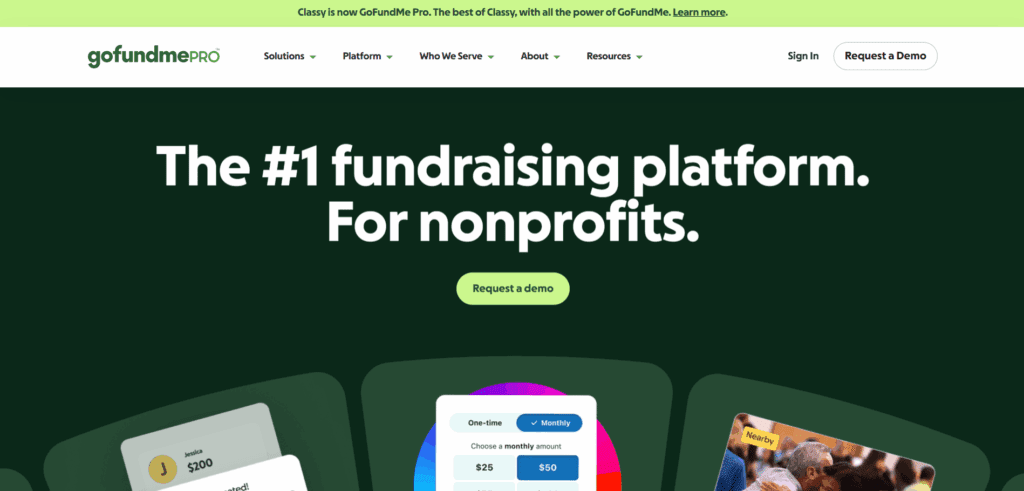
The entry point is the catch. Pricing is a custom annual contract with processing on top; GoFundMe Pro does list a no-subscription Essentials plan for nonprofits under $1M in revenue, but it’s request-access rather than self-serve, and reviewers consistently describe onboarding as a project rather than an afternoon — a heavy lift for a single auction.
Versus RallyUp: you can launch an online or silent auction on RallyUp’s Free plan in 15–20 minutes from an Instant Fundraiser Template, with no contract to sign and no annual subscription.
3. Bloomerang Fundraising (formerly Qgiv) — solid if you’re already on Bloomerang CRM
Best for: Bloomerang CRM customers running event-tied auctions who want automatic donor-record syncing.
Bloomerang Fundraising (formerly Qgiv) offers mobile bidding, outbid alerts, and automatic syncing between fundraising and donor management for organizations already on Bloomerang’s CRM — a real advantage if that’s your stack.
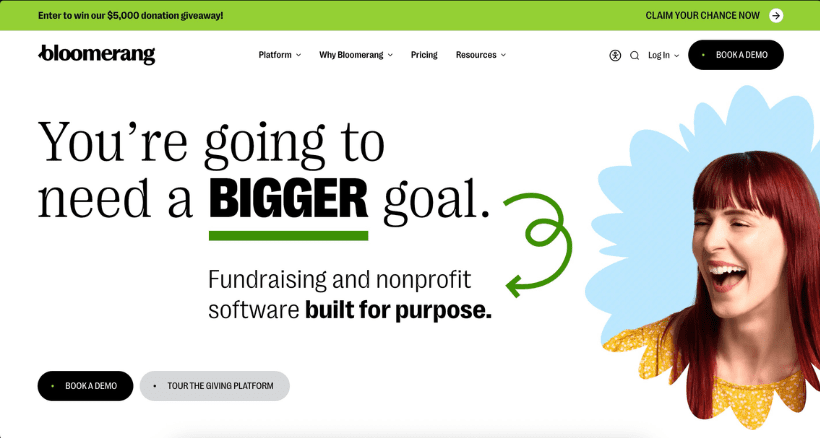
The cost is the catch. Bloomerang lists Bloomerang Fundraising from $40/month billed annually, sold as a bundle with Bloomerang CRM (from $125/month), and its all-in-one Giving Platform from $242/month (Bloomerang pricing). Card processing rates aren’t published, phone support is a paid add-on, and that’s a subscription running whether or not an auction is live. There’s no Auction Gifts-style non-winner capture and no auctioneer-led live-auction format.
Versus RallyUp: mobile bidding and outbid alerts are standard on RallyUp with no monthly subscription, phone support is free on every plan, and Auction Gifts captures non-winning bidders that Bloomerang’s tool has no mechanism for.
4. GalaBid — built for the live gala, priced per event
Best for: Nonprofits running one or two big in-person galas a year that want dedicated event-day support.
GalaBid focuses on the live-event auction experience — mobile bidding, text-to-give, and a dashboard built around a single gala night, with event-day support reviewers rate highly.
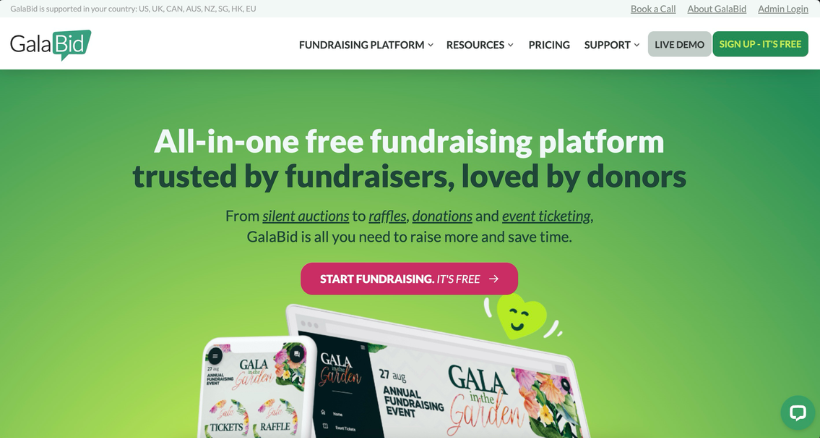
The pricing model charges per event rather than offering a free plan, which adds up for a nonprofit running more than one auction a year, and GalaBid doesn’t extend into raffles or ticketing.
Versus RallyUp: RallyUp runs unlimited auctions on the Free plan with no per-event charge, and the same Campaign can stack a raffle and event ticketing alongside the auction instead of running each as a separate paid setup.
5. GiveSmart — capable event software, subscription pricing
Best for: Organizations with an established annual gala budget that want an all-in-one event tool.
GiveSmart bundles auction, ticketing, and donation tools with real event-management depth, including guest check-in and table management, aimed at nonprofits running a signature annual event.

GiveSmart doesn’t publish subscription pricing — plans are quote-based — though third-party software directories list a starting point near $3,000/year; its published card rate is 3.5%, or 3.95% for American Express — a fixed cost whether or not an auction is running that quarter, and a steeper commitment than most single-campaign nonprofits want to make up front.
Versus RallyUp: RallyUp’s Free plan carries no annual subscription, and Flex pricing charges only for the Components actually used, with the auction fee capped at $100 per item regardless of the winning bid.
6. Handbid — auction-first specialist, thin outside the auction
Best for: Nonprofits that want a dedicated auction app and nothing else.
Handbid built its name on auctions specifically, with a mobile bidding app, text-to-bid, and buy-it-now pricing — a focused tool for organizers who only need the auction piece.

That focus is also the limit: no raffles, no Peer-to-Peer (P2P), no ticketing, and no built-in path to add a campaign type without a separate tool. Bidders on some plans still need an app rather than a browser.
Versus RallyUp: RallyUp’s auctions need no app download for bidders, and the same auction Campaign can add a raffle or event ticketing later without switching platforms.
7. Auctria — budget-friendly for volunteer-run auctions, dated interface
Best for: Small, volunteer-run nonprofits watching every dollar of software spend.
Auctria is a lower-cost option built specifically for auctions, with item cataloging and check-in tools a volunteer committee can run without much training.

Reviewers describe the interface as dated next to newer mobile-first tools, and Auctria doesn’t extend into raffles or peer-to-peer — it’s an auction tool, not a fundraising platform.
Versus RallyUp: RallyUp’s Free plan costs the same $0 upfront, with a modern mobile bidding experience and room to add a raffle or storefront to the same campaign later.
8. Zeffy — capable auctions, funded by a pre-selected donor tip
Best for: Small, volunteer-run nonprofits whose top priority is keeping 100% of every dollar raised.
Zeffy’s auctions are genuinely capable — auto-bidding, anti-sniping that extends bidding when a last-second bid comes in, auto-charge at close, and outbid notifications by email are all real, and Zeffy’s zero-fee model covers both platform and payment processing, so a nonprofit keeps 100% of what’s raised whether or not a donor tips. Zeffy also offers memberships, which RallyUp does not.

Two things are worth knowing. First, the funding math sits with donors: the checkout tip is pre-selected, reportedly defaulting to around 17% (Donorbox), and an independent analysis by 4aGoodCause estimates donors effectively pay around 12.75% through tips, though Zeffy’s own materials say the contribution is never defaulted; Zeffy’s G2 profile carries a strong rating alongside recurring reviewer notes about the tip percentage (G2). Second, format: Zeffy runs online and silent/mobile-bid auctions but has no auctioneer-led live-auction format, no Auction Gifts-style systematized non-winner capture (Zeffy’s is a manual after-the-fact thank-you email, not something built into the bid flow), and no consolidated per-guest end-of-night checkout.
Versus RallyUp: RallyUp runs the room, not just the auction form — auctioneer-led live auctions, Auction Gifts capturing non-winning bidders at 20–35% more revenue, and Event Balances + Automated Checkout settling the whole night into one tab and one charge, none of which Zeffy offers.
9. DoJiggy — long-standing golf-and-auction combo, dated bidder experience
Best for: Nonprofits pairing a golf tournament with a silent auction.
DoJiggy has served nonprofit events for years, with a golf-tournament registration tool that pairs naturally with an add-on silent auction for the same event.
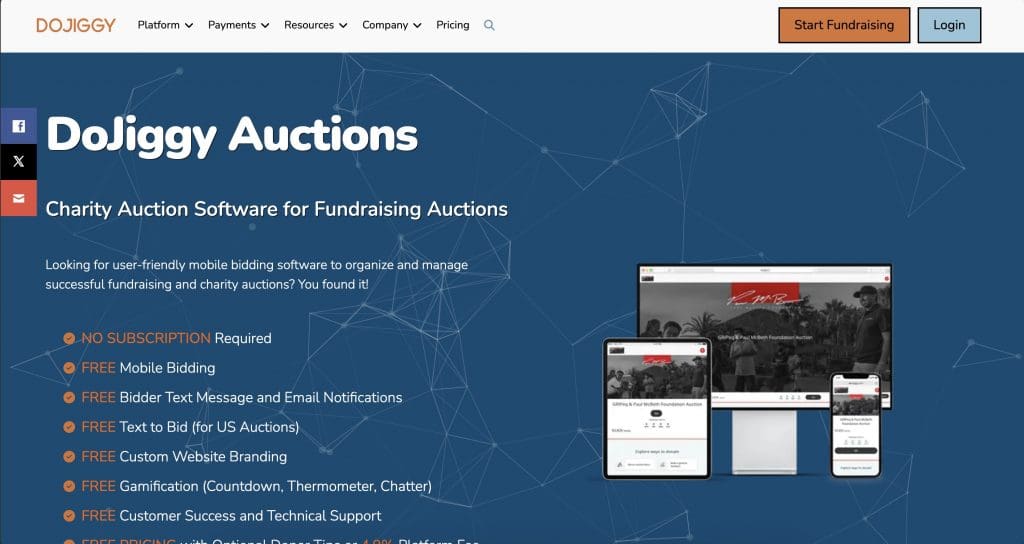
Reviewers note the bidding interface feels dated next to mobile-first tools, and DoJiggy’s auction module works best as an add-on to its golf product rather than a standalone platform.
Versus RallyUp: RallyUp’s auction bidding is mobile-first with no app download, and the same platform runs the auction as a standalone campaign or stacked with ticketing and a raffle — no golf tournament required.
Other nonprofit auction platforms worth a quick look
A handful of other charity auction sites turn up in nonprofit searches but serve a narrower slice of the job than a full comparison deserves — a pay-only-if-it-sells tool, a large-event specialist, a template-first builder. Here’s where each one fits, and where it runs out of road.
- BiddingOwl. A lean auction site with a pay-only-if-an-item-sells model, direct customer support, and no upfront or monthly charges — but integrations are limited and reporting stays basic. RallyUp pairs that same no-upfront-cost approach with fuller reporting and a broader fundraising toolkit in one account.
- 32auctions. A minimalist platform with a free tier and multi-currency support for straightforward auctions — but the free plan caps out at 20 items with one image each, and reviewers call the design basic. RallyUp doesn’t cap item counts or images on its free plan.
- ClickBid. A 20-year-old platform built for in-person events, with SMS text bidding that needs no app download — but full features run $895 a year for Essentials or $1,495 for the Full Suite plus a 3.5% credit card fee (ClickBid pricing), and customization is limited. RallyUp’s mobile bidding is also app-free, with no separate feature tiers to climb.
- Greater Giving. A long-running platform, in operation since 2002, offering comprehensive training and on-site support for large nonprofit galas — but the cost structure runs higher and setup can overwhelm smaller organizations. RallyUp brings auction setup within reach of a lean team, no on-site support contract required.
- Charity Auctions Today. A design-focused builder with polished templates for a fast, professional-looking setup — but event-management features stay limited, and it now operates as CharityAuctions, with event-based rather than monthly pricing: $0 upfront and 8% of funds raised, or $499 setup plus 3% (CharityAuctions pricing). RallyUp’s auctions launch in minutes, with room to add event management as a Campaign grows.
When you’re ready to grow: stacking auctions, raffles, and ticketing
Most nonprofits start with a single auction, and about nine out of ten RallyUp campaigns stay that way. But an auction rarely happens in isolation for long — a gala usually needs ticket sales to get people in the room, and a raffle is a natural add-on that raises money from guests who don’t want to bid on items.
That’s what RallyUp calls Full Stack Fundraising: 12+ stackable Components living inside a single Campaign, behind one URL and one checkout. Instead of building a separate auction tool, a separate ticketing form, and a separate raffle page, one Campaign can combine an auction with event ticketing and a raffle — a guest buys their ticket, bids on an item, and picks up a few raffle entries in a single transaction. You can add a Component to a Campaign that’s already live, too — if a silent auction is taking off, a raffle can be added the same day, with no rebuild and no second URL. Organizations that combine multiple campaign types raise 38% more than those running a single format.
A few things that make the growing part less painful:
- Power Preview. RallyUp’s interactive pre-publish preview lets you test drive the whole auction end to end — real test bids through the actual checkout, test receipts, test reports — before a single guest sees it.
- The AI Fundraising Content Generator. It drafts auction item descriptions, campaign copy, and donor emails from inside the builder — no prompt writing. Treat it as a co-pilot: you’re still editor-in-chief.
- Done-for-You. If you’d rather hand the whole build over, RallyUp’s Done-for-You team builds the campaign for you at no cost.
- Support that answers. Ask for a human and you get one, at any point — real human fundraising experts, free on every plan by chat or email, with phone and Zoom available.
- Pricing you can predict. The Free plan has a $0 platform fee with optional donor tipping on Core Components; Donation Pages are free with no donor tipping required. On Flex, auctions run at 4.9% (capped at $100/item), ticketing and storefront at 2.9%, and raffles at 6.9% — each Component charged its own rate within the same Campaign. No contracts, no subscriptions, no setup fees.
Across 55,000+ organizations, RallyUp has helped raise more than $1 billion, at a 4.8/5 average rating.
What to ask before you commit to an auction platform
Picking a platform isn’t about finding the one with the most features listed. Here’s what actually determines whether auction night runs smoothly:
1. Which auction formats does it actually run?
Confirm the platform supports the format you need today — online, silent, or auctioneer-led live — and ask directly whether a format you might want next year (like adding a live auction to a silent one) is fully supported or still in beta.
2. What happens to bidders who don’t win?
Most bidders on any given item walk away with nothing. Ask whether the platform has a systematized way to capture a gift from them at the moment of bidding — not a manual follow-up email days later.
3. What’s the total cost, including the fine print?
Add up the platform fee, payment processing, and any annual subscription or per-event charge. Ask specifically whether the auction fee is capped per item or charged as an uncapped percentage of the winning bid — on a $10,000 item, that difference is significant.
Note: Pricing for fundraising tools changes often. Confirm current rates directly and ask about nonprofit-specific discounts from payment processors like Stripe and PayPal.
4. How does checkout work at the end of the night?
For in-person events, ask whether guests check out per item or per activity, or whether the platform consolidates a guest’s whole night into one balance and one charge. A line at the coat check is a bad last impression.
5. Can it grow with you?
If there’s any chance next year’s event adds a raffle, ticket sales, or a peer-to-peer component, ask whether that lives inside the same campaign and checkout — or whether it means standing up a second tool.
Ready to run your online auction?
Every nonprofit’s auction night looks a little different. Think about the format you need, how much staff time you have on the night itself, and what happens to the bidders who don’t win — then pick the platform that gets out of the way.
RallyUp’s auction tools run Online, Silent, and auctioneer-led Live from one platform, with Auction Gifts turning non-winning bidders into donors and Event Balances + Automated Checkout closing out the night without a line. Start from an Instant Fundraiser Template and be live in 15–20 minutes, or let Create My Campaign build it for you. Test drive the whole thing in Power Preview before a single bidder sees it.
Your bidders do the giving. RallyUp handles everything behind the curtain.
Pricing and features current as of August 2026.
FAQs on online auction sites for nonprofits
Yes. RallyUp’s Free plan has a $0 platform fee with optional donor tipping, and Donation Pages are free with no donor tipping required at all. You only pay standard payment processing (1.9–2.9% + $0.30) through Stripe or PayPal. On the Flex plan, RallyUp’s auction fee is capped at $100 per item no matter the winning bid.
It depends on what you need. RallyUp is a strong fit for most nonprofits because it runs all three auction formats — online, silent, and auctioneer-led live — on one Free-plan-eligible platform, plus Auction Gifts and Event Balances + Automated Checkout. OneCause and GiveSmart offer deep gala infrastructure at an annual-contract price point; Zeffy is a strong fit if true zero fees matter more than live-auction or non-winner-capture features.
Bidders scan a QR code or open a link to see an item’s photos, description, and current bid, then submit a bid straight from their phone — no app download required on RallyUp. If someone outbids them, they get an email (and optionally SMS) alert so they can bid again before the item closes. When the auction ends, winners are charged automatically through checkout.
On most platforms, nothing — a non-winning bidder simply walks away. RallyUp’s Auction Gifts feature offers non-winning bidders the chance to pledge an optional gift, charged only if they end up winning nothing at all, capturing that generosity while the bidding is still live. On average, it raises total auction revenue 20–35%.
Yes. RallyUp’s Full Stack Fundraising lets you combine an auction, a raffle, and event ticketing in a single Campaign — one URL, one checkout — instead of running three separate tools. You can even add a raffle or ticketing to an auction Campaign that’s already live, with no rebuild. Organizations that stack multiple campaign types raise 38% more than those running a single format.
Yes, on a reputable platform. Look for PCI-compliant payment processing through a trusted processor like Stripe or PayPal, automatic tax receipts, and a platform that lets you test the full bidding and checkout flow with real test transactions before it goes live — RallyUp’s Power Preview does exactly that, so the first “test” bidder isn’t an actual donor.
Now that you’ve seen it in action, are you ready to start fundraising?
Get Started