Crowdfunding vs Peer-to-Peer Fundraising: Key Differences, Examples, and Strategies
In this article
- Crowdfunding vs peer-to-peer fundraising: What do they mean?
- How do crowdfunding and peer-to-peer fundraising campaigns work
- Can you run crowdfunding and peer-to-peer campaigns at the same time?
- Crowdfunding vs peer-to-peer side-by-side comparison
- Pros and cons of crowdfunding vs peer-to-peer fundraising
- How to choose between crowdfunding and peer-to-peer fundraising
- Best fundraising strategies: Crowdfunding vs peer-to-peer
- Which one is better for your NPO: Crowdfunding vs peer-to-peer?
- FAQs about crowdfunding vs peer-to-peer
Crowdfunding vs. Peer-to-Peer Fundraising
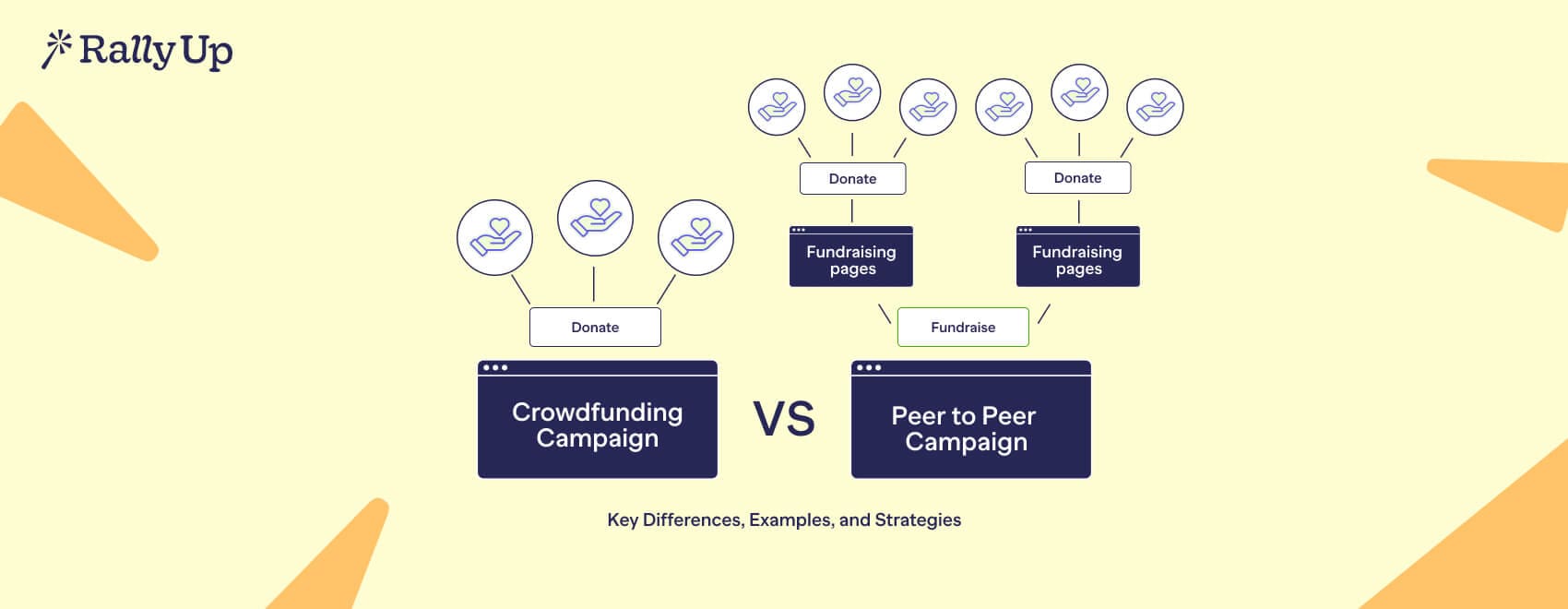
Crowdfunding and peer-to-peer fundraising raise money in very different ways. Crowdfunding relies on your team and urgency; peer-to-peer spreads the work across supporters. RallyUp – an end-to-end fundraising platform help you run both crowdfunding and P2P campaigns.
On the surface, crowdfunding vs peer-to-peer fundraisers look similar. Both happen online. Both involve donation pages. Both are described as “easy ways to raise funds.” But in practice, they are run very differently.
Crowdfunding usually means your team does the asking, the reminding, and the momentum-building. Peer-to-peer fundraising shifts some of that work to supporters who raise funds through their own networks.
Let’s take you through both campaign types to understand the distinction better, especially for nonprofit teams juggling limited time, energy, and reach. Understanding how each model works helps you choose the one that best fits your goals and capacity, rather than burning out halfway through a campaign.
Crowdfunding vs peer-to-peer fundraising: What do they mean?
Before delving into workflows and comparisons, here’s the simplest way to distinguish between crowdfunding and peer-to-peer fundraising, using situations that most nonprofit teams recognize.
What is crowdfunding in fundraising?
Crowdfunding is when your organization runs one main donation page and sends everyone to it.Take this scenario for example: After heavy flooding, a nonprofit launches one donation page with a clear goal and deadline: “Help the locals today, their homes are drowning”. Every email, post, and message shares the same link.
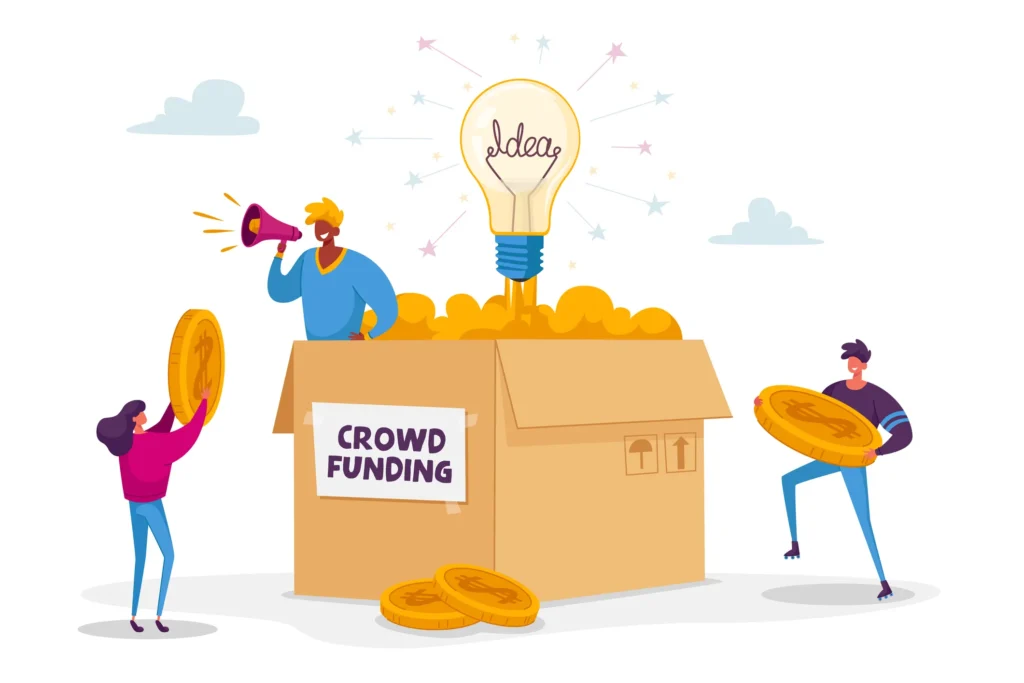
The team tracks the total, pushes urgency, and closes the campaign when time runs out. One page. One message. One team carrying the load.
What is peer-to-peer fundraising?
Peer-to-peer fundraising is when supporters raise money for you using their custom donation pages born from the main campaign page.
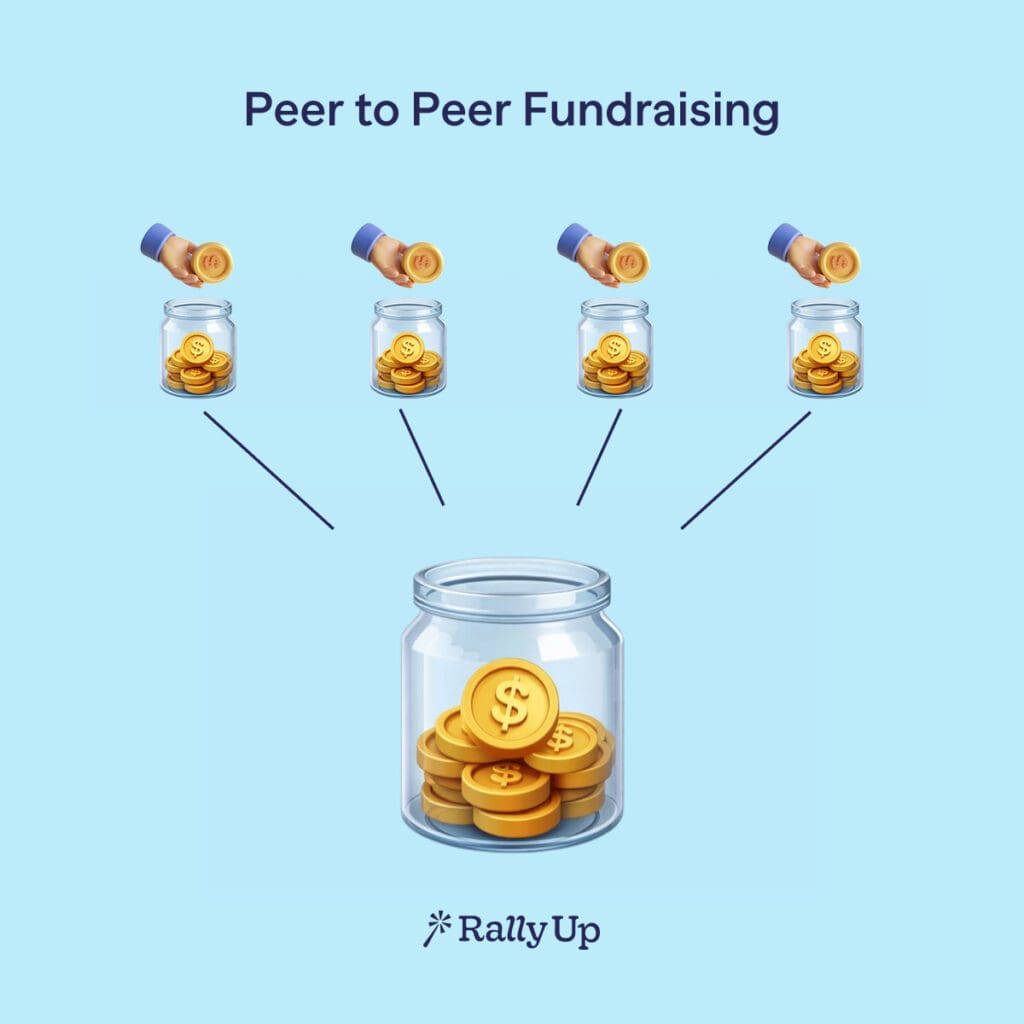
So, for example: For her birthday, Viola signed up for her favorite nonprofit’s upcoming peer-to-peer campaign supporting clean water access – a cause she deeply believed in.
Once the campaign launched, she received a personal fundraising page, customized it with her story, and shared it with friends. Their donations through her page contributed to the nonprofit’s overall campaign goal.
One cause. Many personal pages. Run by supporters.
What is the difference between crowdfunding and peer-to-peer fundraising?
Crowdfunding is a fundraising method where a nonprofit drives donations to a single, centralized donation page.
Peer-to-peer fundraising, on the other hand, involves supporters creating their own donation pages to raise money on behalf of the organization.
The main difference lies in who does the asking: the nonprofit vs. the supporter.
How do crowdfunding and peer-to-peer fundraising campaigns work
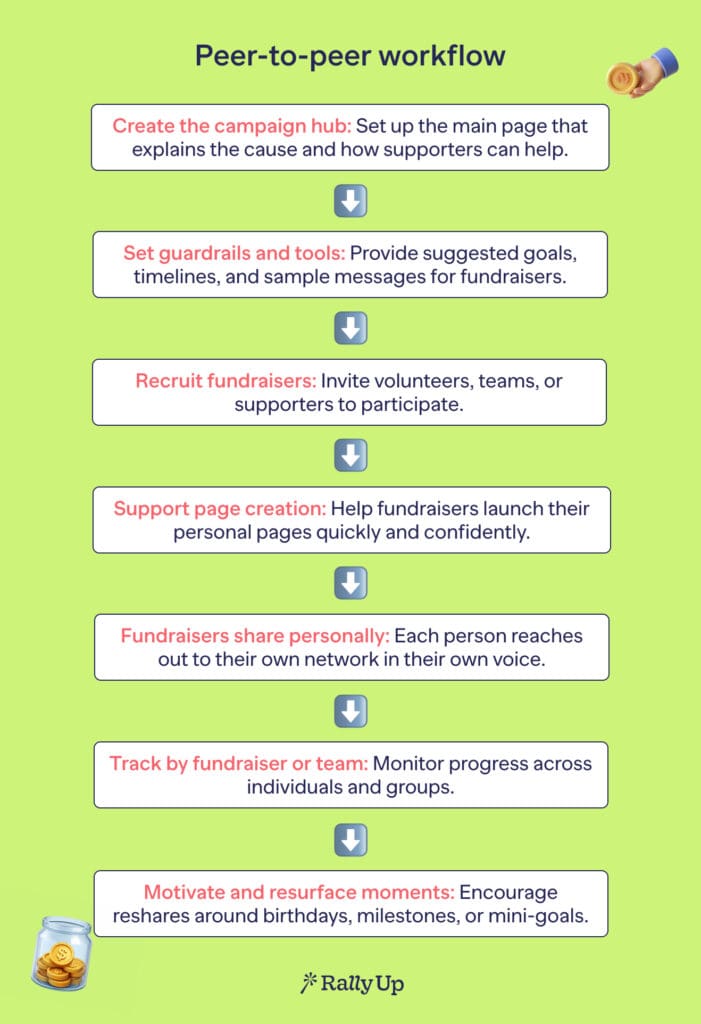
At a glance, the difference between crowdfunding and P2P shows up in where the work flows. One model keeps it with your team. The other passes it outward to your supporters.
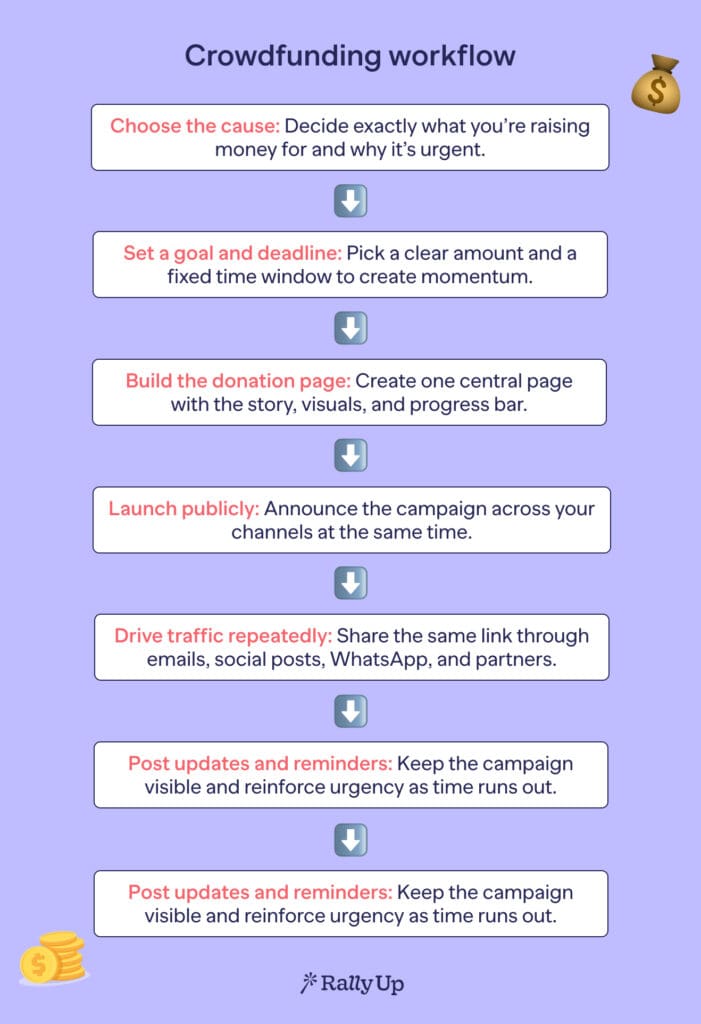
Crowdfunding workflow
Peer-to-peer workflow
Can you run crowdfunding and peer-to-peer campaigns at the same time?
Yes, but only if they’re clearly separated by purpose. Crowdfunding works best for a single urgent goal, while peer-to-peer runs alongside it to let supporters raise in their own way.
Tips to make both work together:
- Use crowdfunding as the anchor: Set one clear, time-bound goal that everyone understands.
- Layer peer-to-peer on top: Let supporters fundraise around personal moments without competing with the main ask.
- Keep links and messaging distinct: One link for the main campaign, separate pages for individual fundraisers.
- Use a platform built for both: Tools like RallyUp let you run centralized campaigns and peer-to-peer fundraisers side by side without confusing donors or your team.
Crowdfunding vs peer-to-peer side-by-side comparison
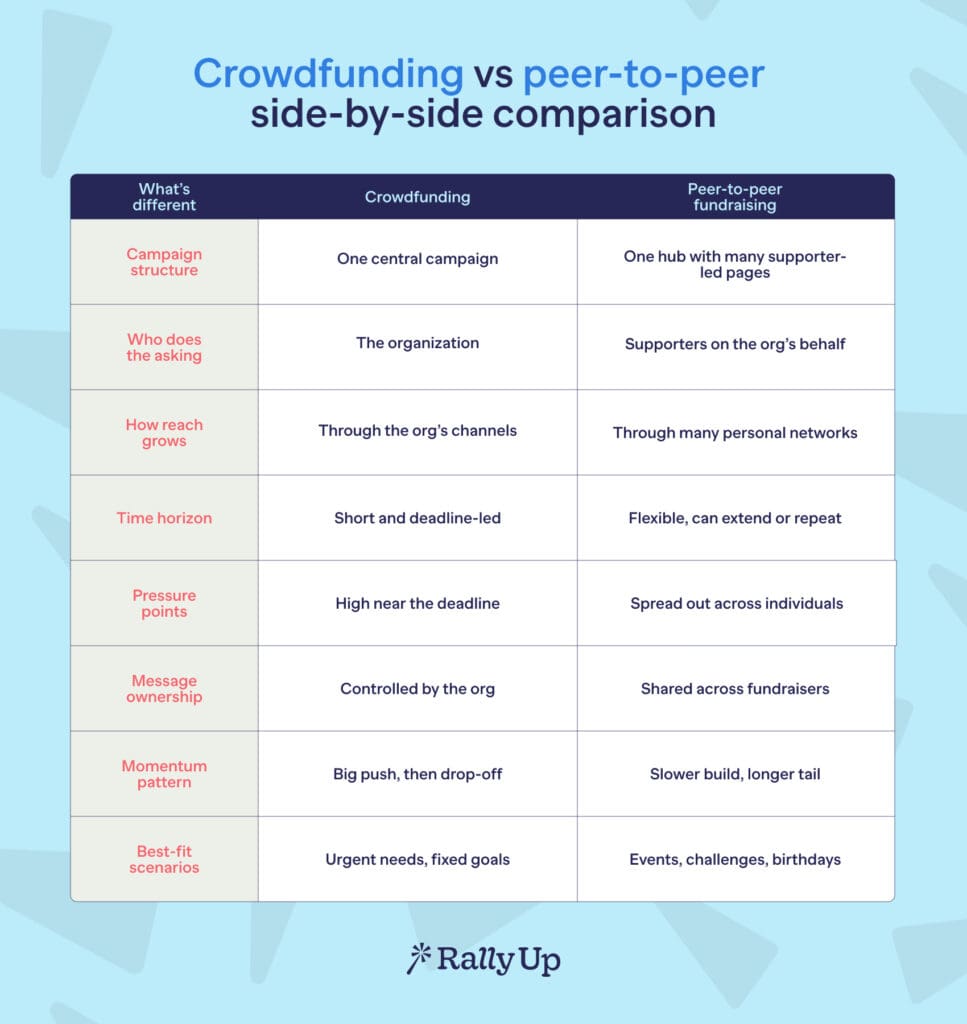
To make the differences clearer, let’s take one real fundraising goal and see how it plays out under crowdfunding versus peer-to-peer, step by step, through the same campaign.
Campaign: A local nonprofit needs to raise $50,000 to keep its after-school program running for the year.
1. Centralized vs distributed donation pages
In a crowdfunding setup: The team launches one donation page. Every email, Facebook post, and text message points to that single link. Donors see one total climbing toward $50,000.In a P2P setup: The nonprofit creates a main campaign domain, then supporters spin up their own pages: $500 here, $1,000 there. A parent’s page looks different from a volunteer’s page, even though they support the same program
The twist with peer-to-peer is that it doesn’t have to feel like fundraising at all. It can turn into a friendly competition. Teams racing to the top of a leaderboard, coworkers trying to out-raise each other, or supporters unlocking small milestones together.
2. Who does the heavy lifting
In a crowdfunding setup: The nonprofit staff does most of the work. They write the emails, schedule the posts, monitor progress, and jump in when donations slow.
In a P2P setup: The nonprofit shifts into a support role. Staff help fundraisers get started, answer questions, and keep people motivated, but supporters handle the asking inside their own circles.
3. Timeline and campaign shape
In a crowdfunding setup: The $50,000 goal is tied to a fixed deadline, say, 30 days. Activity spikes early, dips in the middle, and ramps up hard near the end.
In a P2P setup: The campaign stretches out. One supporter raises money for their birthday in March. Another runs a mini drive during a school event in April. The total grows in waves instead of one big push.
4. Risk and pressure
In a crowdfunding setup: If the campaign stalls at $32,000 with a week left, the pressure lands squarely on the team. Everyone feels the clock ticking.
In a P2P setup: No single page determines success. One fundraiser slowing down doesn’t stall the entire effort, which lowers stress and keeps the campaign from feeling make-or-break.
5. Best-fit use cases
In a crowdfunding setup: For this nonprofit, crowdfunding makes sense if the funding gap is urgent and time-sensitive: rent, payroll, or a program about to shut down.
In a P2P setup: It fits better if the goal is community involvement: parents, volunteers, and partners helping keep the program alive throughout the campaign.
Pros and cons of crowdfunding vs peer-to-peer fundraising
On paper, both crowdfunding vs peer-to-peer look “manageable”. In reality, the effort shows up in different places and that’s where most teams get caught off guard. Let’s see what they are so you can plan your fundraising ahead of time:
The hidden workload in crowdfunding
- Constant content creation: Updates, reshares, rewrites, and performance tracking don’t stop once the page is live.
- Manual momentum management: When donations slow, the team has to step in and push harder.
- Creative fatigue: With the organization as the only voice, ideas dry up fast and visibility drops when posting slows.
The hidden workload in peer-to-peer
- Fundraiser onboarding: Supporters need help getting started before they feel confident asking others.
- Ongoing encouragement: Check-ins, shoutouts, and small nudges keep fundraisers active.
- Messaging alignment: Without clear guidance, supporters may struggle to explain the cause clearly or consistently.
How to choose between crowdfunding and peer-to-peer fundraising
Ask yourself two simple questions:
Do we need money fast for one clear need?
Go with crowdfunding. It’s focused, time-bound, and works best when urgency is real.
Do we want supporters involved beyond one donation?
Choose peer-to-peer. It builds participation, momentum, and repeat engagement over time.
Many nonprofits end up using both, just not at the same moment or for the same purpose. A strong setup matters more than the model itself. The right choice isn’t about trends. It’s about capacity, timing, and how much help you want from your community.
Best fundraising strategies: Crowdfunding vs peer-to-peer
| Strategy Area | Crowdfunding | Peer-to-Peer Fundraising |
|---|---|---|
| Primary focus | Focus on one specific, urgent fundraising goal | Empower supporters to fundraise on your behalf |
| Timeline structure | Set a clear deadline to drive urgency and fast action | Allow flexible timelines and repeat participation |
| Campaign preparation | Plan all campaign content before launch | Provide templates and starter messages for supporters |
| Promotion style | Rely mainly on organization-led promotion | Encourage supporter-led sharing and outreach |
| Donor engagement | Use regular updates to maintain urgency | Use friendly competition and team goals to build momentum |
| Personal connection | Campaign messaging centers on the cause or need | Tie fundraising to personal moments like birthdays or events |
Real-world example of a crowdfunding campaign
Lifting Little Hands runs a classic crowdfunding campaign powered by RallyUp, with one central donation page and a single, visible goal.
Supporters are directed to one donate button, and progress toward the $500,000 target is tracked publicly, with $155,845 raised so far.
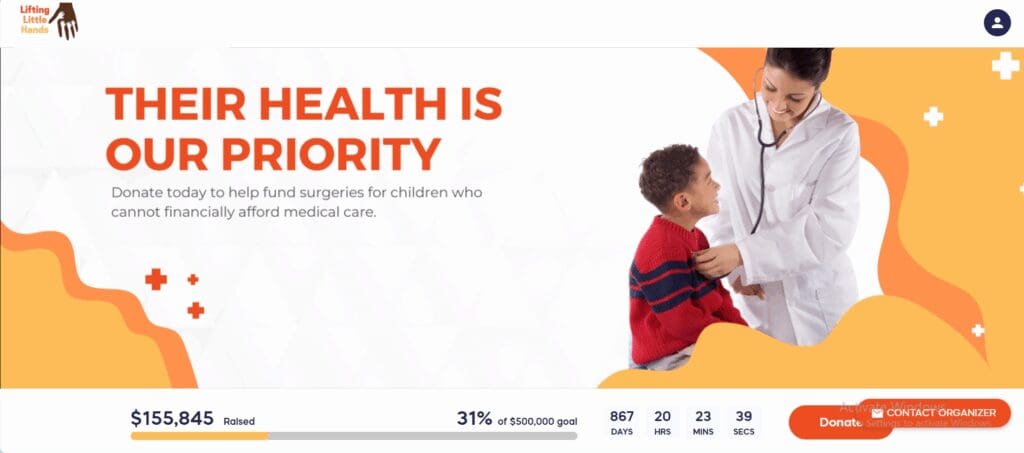
The focus stays on urgency and impact, helping families manage the unexpected medical costs of caring for a child in need.
Real-world example of a P2P campaign
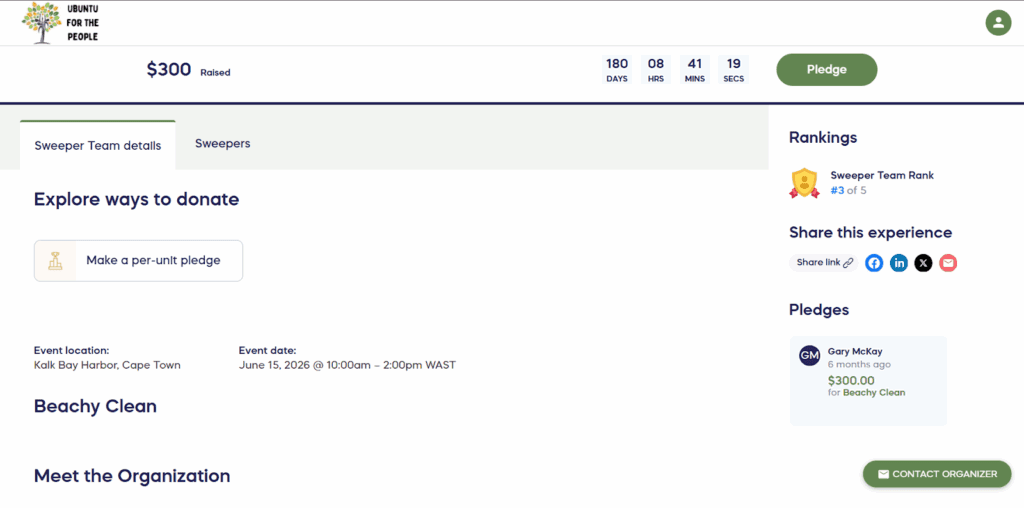
Powered by RallyUp, Ubuntu for the People’s beach sweep uses a peer-to-peer model where individual “sweepers” and sweeper teams raise funds through their own pages.
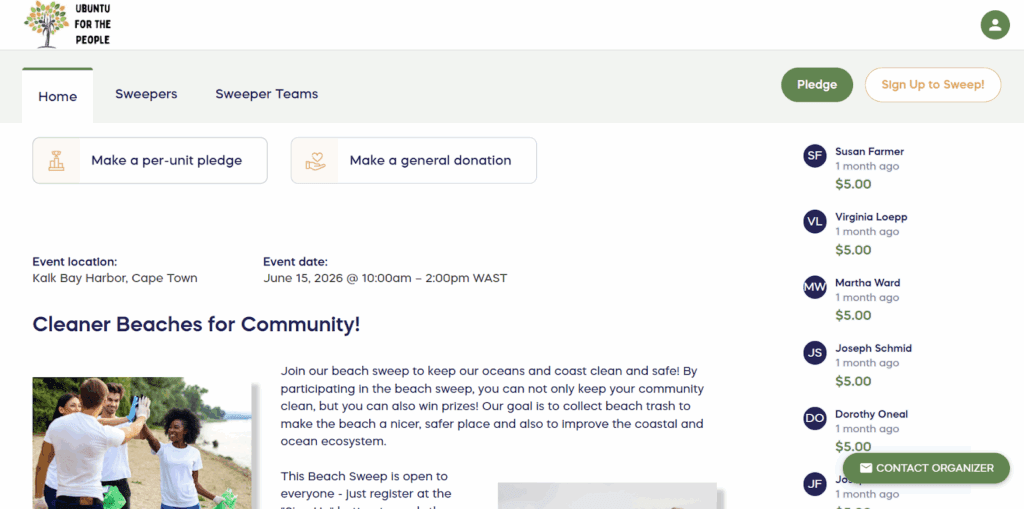
Each participant invites friends, family, or coworkers to donate in support of their effort, turning the campaign into a friendly team-based competition.
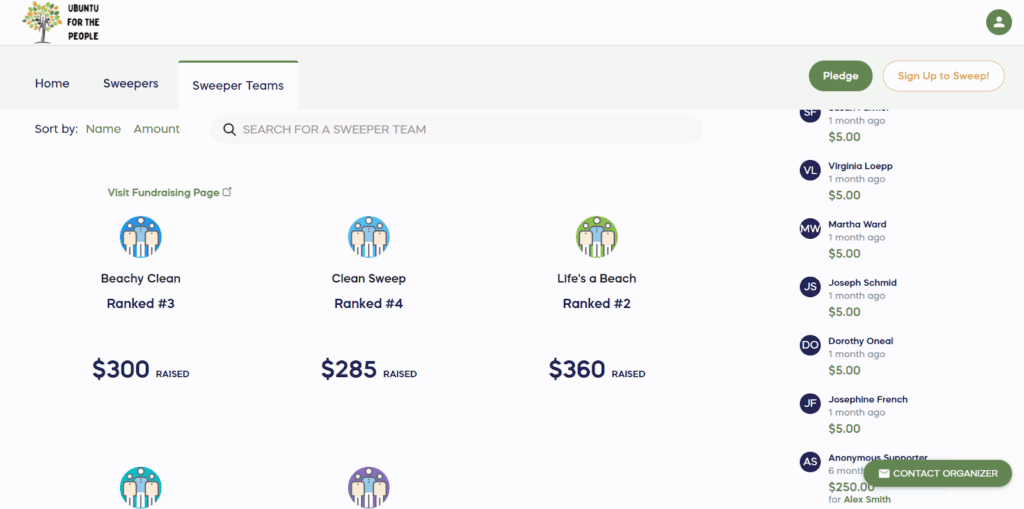
The organization provides the cause and structure, while supporters bring in donations through their personal networks.
Real-world example of crowdfunding + P2P fundraiser campaign
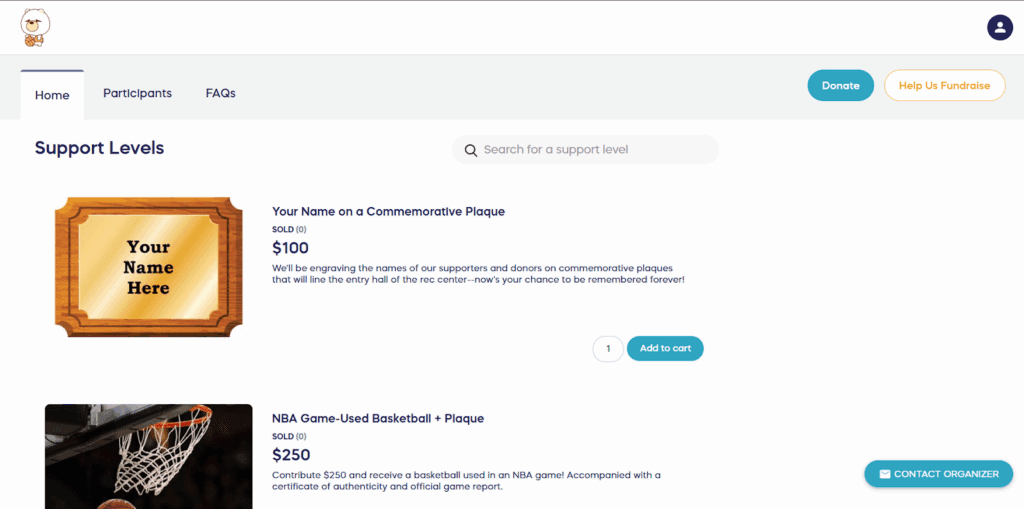
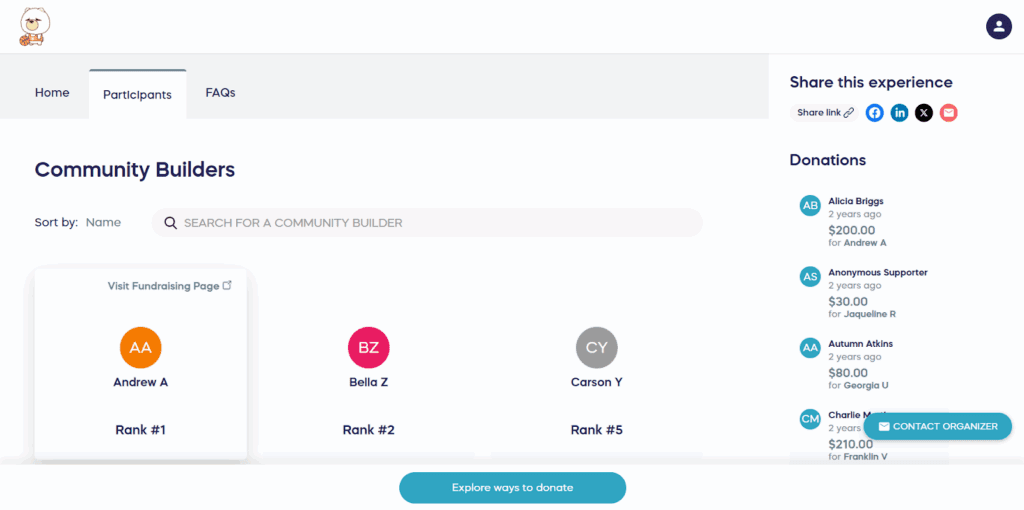
Little League of Layups uses RallyUp to run a hybrid campaign that combines crowdfunding and peer-to-peer fundraising.
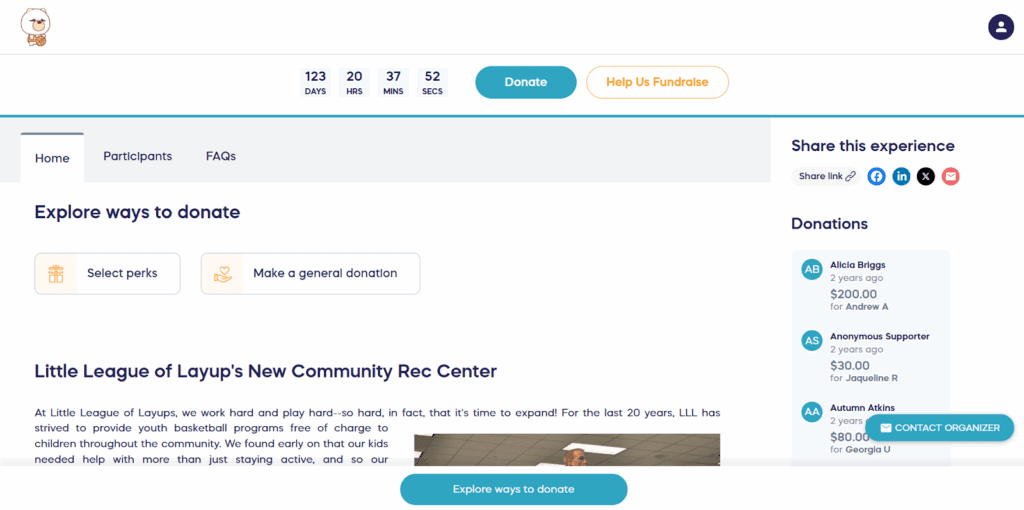
The main donation page uses crowdfunding-style support levels and perks to drive larger gifts toward the $400,000 goal for a new community rec center.
At the same time, supporters can become “Community Builders,” create their own fundraising pages, and raise money through their personal networks, blending a centralized goal with supporter-led outreach.
Which one is better for your NPO: Crowdfunding vs peer-to-peer?
Crowdfunding vs peer-to-peer fundraising aren’t competing ideas, they’re tools built for different moments. The former helps you rally support fast around a single need. The latter helps you turn supporters into active partners who keep momentum going.
The mistake most teams make isn’t choosing the “wrong” model. It’s using the right one at the wrong time, or trying to force one campaign to do everything.
When you align the right fundraising model with your goals, team capacity, and community, campaigns become more effective and far less overwhelming.
With a powerful end-to-end fundraising platform like RallyUp, nonprofits can seamlessly launch, manage, and track both crowdfunding and peer-to-peer campaigns from one place, making it easier to raise more with less effort.
FAQs about crowdfunding vs peer-to-peer
Crowdfunding demands constant promotion from the organization, which can drain time and energy. If momentum slows, results drop fast, especially near deadlines.
Yes, GoFundMe is a classic example of crowdfunding, where donations flow to one central campaign page.
Yes, peer-to-peer fundraising can be used year-round for birthdays, awareness months, or community events, not just during major campaigns.
Peer-to-peer requires more coordination and support for fundraisers. Messaging can vary if supporters aren’t given clear guidance.
Now that you’ve seen it in action, are you ready to start fundraising?
Get Started