Learn how to add Fair Market Value (FMV) to Auction item receipts so winners can claim tax deductions. Step-by-step guide for creating IRS-compliant charity Auction receipts.
Fair Market Value (FMV) on Auction receipts allows winning bidders to claim tax deductions for the amount they paid above an item’s actual worth. By adding FMV to your Auction items before or during your fundraiser, RallyUp automatically generates IRS-compliant tax receipts that winners receive immediately after the Auction ends, eliminating the need to manually issue documentation later. This guide explains what Fair Market Value means, why it matters for charity Auctions, and how to add it to your Auction items.
What Is Fair Market Value for Charity Auctions?
Short answer: Fair Market Value (FMV) is the price an Auction item would sell for in the open market between a willing buyer and seller, used to determine the tax-deductible portion of a winning bid.
Detailed explanation: When supporters bid on charity Auction items, they typically pay more than the item’s actual value because they want to support your cause. The IRS only allows donors to deduct the amount paid above the item’s Fair Market Value. For example, if someone bids $500 on a restaurant gift certificate with a $200 FMV, only $300 is tax-deductible. By including FMV on receipts, you provide winners with the documentation they need to claim their charitable deduction.
Before You Begin
Before adding Fair Market Value to Auction items:
- Determine the actual market value for each Auction item (retail price, appraised value, or comparable market rates)
- Understand that FMV must reflect what the item would sell for in a regular commercial transaction
- Consider consulting a tax professional for high-value items or complex valuation scenarios
- Remember that only 501(c)(3) organizations can provide tax-deductible receipts
Time to complete: 1-2 minutes per Auction item
Important: RallyUp is not a tax advisor. Always consult with your organization’s tax professional to verify specific tax implications and proper FMV calculations for your Auction items.
Adding Fair Market Value to Auction Items
- Go to Account Navigation in the left menu and select Campaigns.
- If you have chosen a list view, click on the Campaign title. If you have chosen a grid view, click on the Campaign image.
- Select Campaign Setup.
- Go to Auction in the timeline at the top.
- Scroll down to Add auction items and select Create an item or select the pencil icon on an existing item.
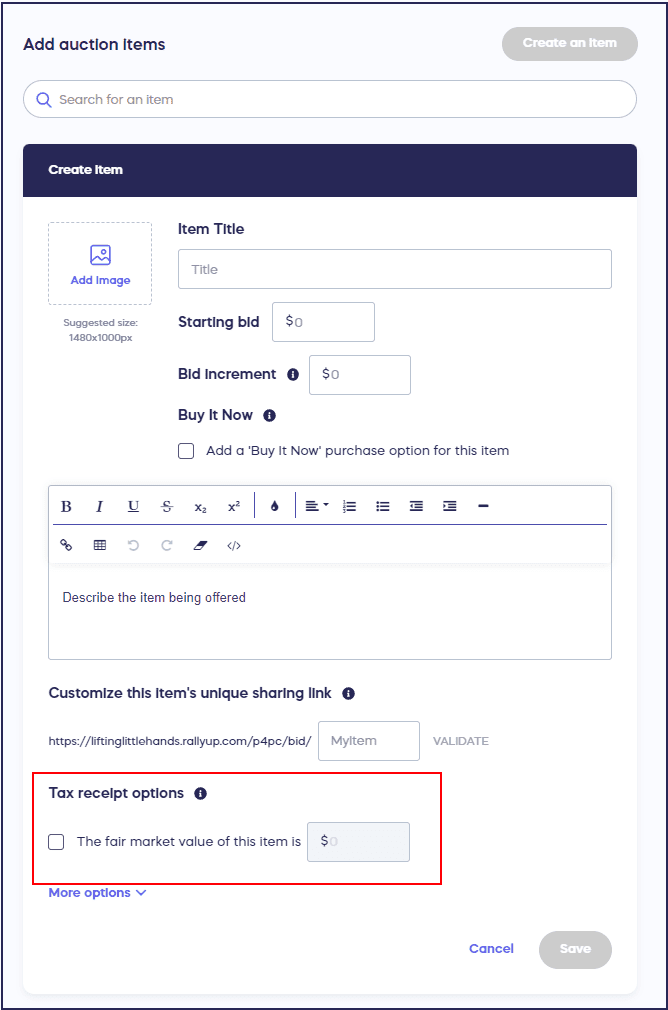
- Scroll down to Tax receipt options, check the box next to The fair market value of this item is, and enter the FMV amount:
- Select SAVE.
What happens next: When the Auction ends, RallyUp automatically charges winning bidders and sends email receipts that include the Fair Market Value and winning bid amount.
Why Add Fair Market Value to Auction Receipts?
Automatic Tax Documentation
When you add FMV to Auction items, RallyUp automatically includes this information in winners’ email receipts. These receipts serve as IRS-compliant tax documentation without requiring additional administrative work.
Save Time After Your Auction
Winners receive complete tax receipts immediately when the Auction ends, eliminating follow-up requests for tax documentation and reducing your post-event workload.
Support Donor Tax Planning
Providing FMV information helps donors maximize their charitable deductions by clearly showing the deductible portion of their winning bids.
Demonstrate Transparency
Including FMV shows bidders exactly how much of their contribution qualifies as a charitable donation, building trust and encouraging higher bids.
IRS Compliance
Proper FMV documentation helps your organization meet IRS requirements for charitable contribution substantiation, protecting both your nonprofit and your donors.
How Fair Market Value Affects Tax Deductions
Calculating the Deductible Amount
The tax-deductible portion equals the winning bid minus the Fair Market Value:
Deductible Amount = Winning Bid – Fair Market Value
Examples
Example 1: Restaurant Gift Certificate
- Fair Market Value: $100
- Winning Bid: $200
- Tax-Deductible Amount: $100
Example 2: Vacation Package
- Fair Market Value: $1,500
- Winning Bid: $2,000
- Tax-Deductible Amount: $500
Example 3: Handmade Item
- Fair Market Value: $50
- Winning Bid: $75
- Tax-Deductible Amount: $25
Example 4: Bid Below FMV
- Fair Market Value: $300
- Winning Bid: $250
- Tax-Deductible Amount: $0 (no deduction when bid is below FMV)
IRS Guidelines for Charity Auctions
The IRS requires organizations to provide written disclosure statements when donors receive goods or services in exchange for contributions exceeding $75. Including FMV on Auction receipts satisfies this requirement.
IRS Guidelines on Charity Auctions
Determining Fair Market Value for Different Item Types
Purchased Items and Gift Cards
Use the retail purchase price or face value. For example:
- Restaurant gift certificate: Face value ($50, $100, etc.)
- Retail merchandise: Manufacturer’s suggested retail price (MSRP)
- Store gift cards: Card amount
Donated Services
Determine what clients typically pay for similar services:
- Photography session: Standard session rate
- Legal consultation: Hourly billing rate
- Spa services: Menu price for identical services
Experience Packages
Calculate the total value of all included components:
- Weekend getaway: Hotel room rate + included meals + activities
- Event tickets: Box office price per ticket
- Tour packages: Sum of all individual components at regular prices
Handmade or Unique Items
Research comparable items:
- Check online marketplaces for similar handmade items
- Compare with retail stores selling comparable products
- Consider materials cost plus reasonable labor for custom items
- For artwork, consider the artist’s typical selling prices
Items with No Clear Market Value
For truly unique items with no comparable market value:
- Use the cost of materials and creation
- Consider appraisal for high-value unique items
- Document your valuation methodology
- Be conservative in your estimate
Important: When in doubt, use a conservative (lower) FMV estimate. Overvaluing items reduces the deductible amount and may raise IRS concerns.
Items That May Not Have Tax-Deductible Value
Some auction items may not provide tax-deductible benefits:
Services from Professionals Who Donated Their Time
While valuable, professional services donated by individuals (like legal or medical services) typically don’t have FMV for tax purposes if the professional can’t normally deduct their own time.
Items with FMV Equal to or Greater Than Winning Bid
If someone wins an item at or below its FMV, they received fair market value for their money, leaving no charitable contribution.
Attendance at Charity Events
When Auction items include event attendance, only the amount above the cost of attendance may be deductible.
Best Practices for Fair Market Value
Be Conservative
When estimating FMV, err on the side of lower values rather than higher. Conservative estimates protect your organization from IRS scrutiny and ensure donors aren’t disappointed if they’re audited.
Document Your Sources
Keep records of how you determined each item’s FMV:
- Purchase receipts for bought items
- Retail website screenshots for gift cards
- Comparable item listings for unique items
- Appraisals for high-value pieces
Update Values for Dated Items
If you’re reusing Auction items from previous years, verify that FMV estimates still reflect current market prices.
Consider Professional Appraisal
For items worth more than $5,000, consider professional appraisal. The IRS requires formal appraisals for high-value donations, and having this documentation protects both your organization and the winning bidder.
Review IRS Guidelines Annually
Tax laws change periodically. Review current IRS guidelines for charitable auctions before each fundraising event.
Resending Receipts to Auction Winners
If a winning bidder loses their receipt or needs additional copies:
- Access your Campaign Management Dashboard.
- Find the winning bidder’s donation record.
- Resend the receipt through RallyUp.
How to View and Resend Receipts
Frequently Asked Questions
Do I need to add Fair Market Value for all Auction items?
No, Fair Market Value is optional. However, including it provides better documentation for donors and reduces your administrative burden after the Auction. For items with minimal or no market value, you can choose not to include FMV.
What if I don’t know the exact Fair Market Value?
Research comparable items online, check retail prices, or consult with the item donor about original purchase price. Use a reasonable, conservative estimate. For valuable or unique items, consider professional appraisal.
Can winners claim a deduction if I don’t include Fair Market Value?
Winners can still claim deductions, but they’re responsible for determining the FMV themselves. Providing FMV on receipts makes the process easier for donors and reduces questions after your Auction.
What if someone bids less than the Fair Market Value?
If a winning bid is below the FMV, there’s no tax-deductible amount. The winner received goods or services equal to or greater than what they paid, so no charitable contribution occurred beyond the item’s value.
Should I include Fair Market Value for donated items?
Yes, even for donated items. FMV represents what the item would sell for in the open market, regardless of whether you purchased it or received it as a donation. The donor of the item may claim a deduction when donating, separate from the Auction winner’s deduction.
Can I add or change Fair Market Value after the Auction starts?
Yes, you can edit Auction items and add or modify Fair Market Value during your Auction. Changes apply to items that haven’t yet been won. For items already won, contact RallyUp support for assistance updating receipts.
Does Fair Market Value affect how much money my organization receives?
No, your organization receives the full winning bid amount regardless of FMV. Fair Market Value only affects the donor’s tax deduction, not your proceeds.
Why would I include Fair Market Value if it reduces the deductible amount?
Including FMV provides transparency and IRS compliance. While it may reduce the deductible portion, accurate reporting protects both your organization and your donors. Bidders appreciate knowing exactly what they can claim as a charitable deduction.
What’s the difference between Fair Market Value and starting bid?
Fair Market Value is the actual worth of an item in the regular market. Starting bid is the minimum amount you’ll accept for an item. You might set a starting bid below, at, or above FMV depending on your fundraising strategy.
How does Fair Market Value affect bidding behavior?
When donors know the FMV, they understand how much of their bid qualifies as a tax-deductible donation. This transparency often encourages higher bids because supporters can see the charitable benefit clearly.
Tax Considerations for Winners
Winner Responsibilities
Auction winners should:
- Keep their receipt for tax records
- Consult their tax advisor about deduction eligibility
- Report charitable contributions on Schedule A of their tax return
- Maintain receipts for contributions over $250 (IRS requirement)
Non-Cash Contributions
Auction purchases are considered non-cash charitable contributions for the deductible portion. Winners must complete Form 8283 for non-cash contributions over $500.
Record Keeping Requirements
The IRS requires written acknowledgment (receipt) for any single contribution of $250 or more. RallyUp’s automatic receipts satisfy this requirement when FMV is included.
Related Auction Articles
Understand: Auction Bidding Styles
Important Reminder: RallyUp provides fundraising tools but cannot offer tax or legal advice. Always consult qualified professionals regarding tax implications and Fair Market Value determinations for your specific situation.