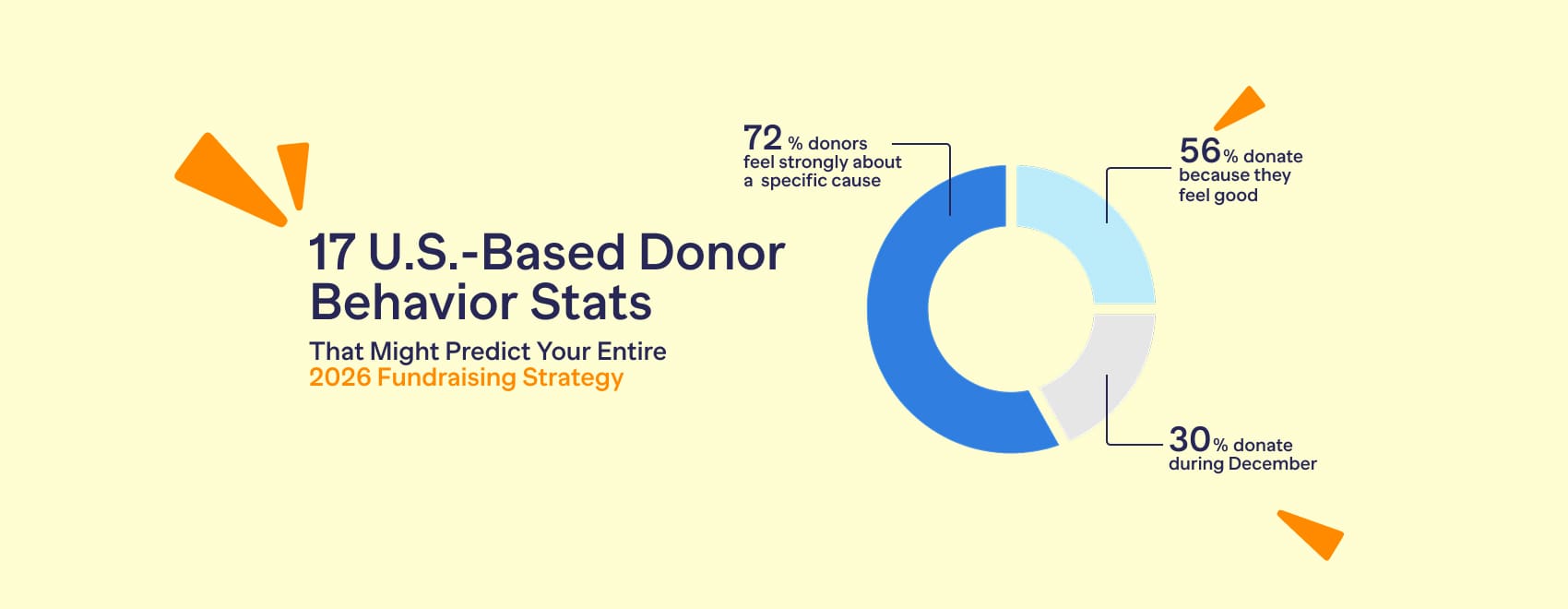
17 U.S.-Based Donor Behavior Stats That Might Predict Your Entire 2026 Fundraising Strategy
Donor Behavior Insights That Drive More Giving
Nearly 30% of donations occur in December, 46% of donors give when personally asked, and 72% donate to support one specific cause. By using RallyUp as an end-to-end fundraising platform, nonprofits can act on these insights to create timely asks, cause-driven campaigns, and higher-converting donor experiences.
Every fundraising team likes to believe its strategy is unique. In reality, most donor behavior stats show patterns.
As 2026 approaches, the nonprofits aren’t raising funds by simply guessing what donors might do. They’re watching how donors already behave – what motivates them, what makes them stay, and what makes them disappear.
These aren’t abstract insights or psychological theories. They’re behavioral signals. And if you read them right, they can dictate your entire fundraising strategy before 2026 even begins. This blog breaks those studied behaviors down, one by one.
In this article
- About the data in this post
- 1. Holiday giving peaks at year-end, but decisions start earlier
- 2. Many American holiday donors give only once a year
- 3. Clear impact trumps financial scarcity
- 4. Donors give to causes they recognize, not missions they’re told to support
- 5. Direct asks drive action more than seasonal urgency
- 6. Giving is emotional first; “feeling good” beats social signaling
- 7. Younger donors are more likely to give only at year-end
- 8. Familiarity and trust matter more than discovery
- 9. Personal connection outperforms abstract awareness
- 10. Donors are more likely to give when nonprofits show how they solve the problem
- 11. Trust and data-driven decision-making increase donor engagement
- 12. Simplifying donation choices increases the number of donors
- 13. Social media engagement shows donor potential before a gift is made
- 14. Digital behavioral data can reliably identify likely first-time donors
- 15. Millennials respond to social and mobile touchpoints
- 16. School fundraising still runs on peer networks and product sales
- 17. Women influence a majority of household donation decisions
- 2026 fundraising action planner based on donor behavior stats
- Conclusion: Unveil donor behavior patterns with RallyUp
- FAQs about donor behavior stats
About the data in this post
This article combines findings from a small set of widely-cited U.S. fundraising and donor-behavior sources. To keep the post readable, we use short source tags instead of long citations after every stat.
Sources used throughout the post:
- Nonprofits Source (online giving statistics roundup). A compiled page of U.S. online giving stats.
- Yale SOM donor behavior study (nationwide panel) with a sample size of a nationwide (U.S.) panel of 2,900+ individuals.
- CAF America surveys (U.S. adults, late October sampling)
- Holiday giving drivers survey. Sample: 1,000+ U.S. adults.
- 2024 “Spirit of Giving” survey of 1,028 U.S. adults.
- 2025 holiday giving trends.
- The National Philanthropic Trust’s Annual DAF 2024 report.
- Philanthropy.org report and analysis on giving pullback.
- Choice overload experiment by Amanda M Lindkvist and Timothy J Luke in charitable giving. Pre-registered online experiment with a sample of N = 501.
- Decision Support Systems paper by Lisa Schetgen, Matthias Bogaert, Dirk Van den Poel, using Facebook data.
- Donor Database Experts analysis on What is a Good Donor Retention Rate.
1. Holiday giving peaks at year-end, but decisions start earlier
Every year, donors don’t suddenly become kinder in December. They become more reflective. What the data shows is something more precise: giving clusters heavily at year-end, but the decision-making starts much earlier.

What the data says
- 30% of annual charitable donations in the U.S. are made in December, with the highest concentration in the final two weeks of the year.
- Yale’s YCCI research suggests donation intent rises when nonprofits show they are advancing solutions, not just describing problems.
- The same study also found that community framing and giving tied to special occasions can increase intent.
2. Many American holiday donors give only once a year
CAF America’s 2024 data shows that while 62% of Americans plan to donate during the holiday season, 15% say they will only give during this time of year.
Holiday giving makes for a meaningful slice of exclusive donors. For them, generosity isn’t a year-round habit; it becomes a seasonal ritual. This matters because nonprofits often treat holiday donors as “bonus” revenue instead of a distinct behavioral segment.
These donors aren’t disengaged the rest of the year; they’re intentional. They associate giving with reflection, closure, and tradition.
3. Clear impact trumps financial scarcity
Total U.S. charitable giving reached over $592 billion in 2024, but it did not outpace inflation. In inflation-adjusted terms, giving declined, and the sector has been navigating uncertainty.
Many donors, especially business-built wealth donors, are unsure whether nonprofits still align with their values or long-term direction.
As a result, money isn’t disappearing; it’s being parked in donor-advised funds, with an estimate of $250 billion in 2024. Until nonprofits clearly show how they’re solving problems in ways donors trust, that hesitation remains.
4. Donors give to causes they recognize, not missions they’re told to support
72% of donors feel strongly about a specific cause, while 61% donate because they feel fortunate and want to help others.
This means donors would rather give to problems they emotionally recognize over large organizations telling them what to do. Once again proving that intent is a lot stronger than the ask.
When nonprofits stay vague to appeal to everyone, they end up resonating with no one. The data shows that specificity wins, especially when paired with personal relevance.

5. Direct asks drive action more than seasonal urgency
CAF America reports that donors are 46% more likely to say they’re motivated to give when they receive a direct ask, compared to donors who only give at year-end.
Direct doesn’t mean aggressive; it means personal, timely, and familiar.
This also explains why year-round donors behave differently. They don’t wait for December because they’re already in an active relationship with the organization.
6. Giving is emotional first; “feeling good” beats social signaling
56% of donors say they give simply because it makes them feel good. Only 35% cite setting an example for others as a minor motivator.
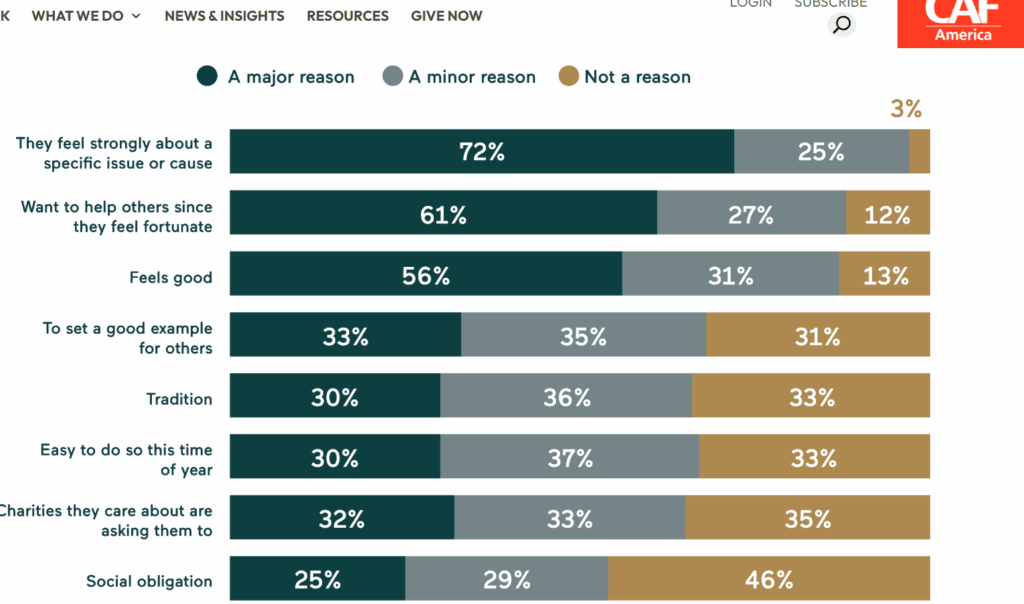
Despite how nonprofits talk about visibility and peer pressure, internal emotional reward matters more than external optics.

This is confirmed by Yale’s findings: witnessing a problem firsthand, like seeing environmental damage, can trigger a strong sense of duty to give.
7. Younger donors are more likely to give only at year-end
While adults aged 65+ remain the most likely to donate overall (60%), donors under 50 are twice as likely to give exclusively during the holidays (27% vs. 13%).
There’s also a growing shift among ages 30-49 toward prioritizing year-end giving. This says more about donor bandwidth than a lack of generosity. Younger donors combine decisions, including giving, into fewer moments.
8. Familiarity and trust matter more than discovery
More than half of American donors decide where to give because they’ve given to that organization before.
This outweighs influence from friends and family (36%), independent research (34%), or social media (23%). In simple terms: familiarity beats novelty.
This stat exposes a common fundraising blind spot. Many nonprofits pour time and money into acquiring new donors while under-investing in the people who already trust them. But donor behavior stats show retention rate as 60% for repeat donors, setting the industry repeat donors retention benchmark at 69.2%.
9. Personal connection outperforms abstract awareness
American donors decide where to give because they’ve had a direct or personal connection to the issue.
This CAF finding aligns closely with the above Yale study that personally witnessing a problem, such as environmental damage, can sharply increase a sense of responsibility to give.
Abstract missions don’t trigger action. Recognition does. When donors see their own lives reflected in a cause, giving feels less like charity and more like responsibility.
10. Donors are more likely to give when nonprofits show how they solve the problem
Researchers found that donation intent increased significantly when a nonprofit was framed as actively contributing to solutions, rather than simply highlighting the existence of a problem.
This matters because many appeals stop at awareness. The reason donors are giving is that they’re now aware and want to fund progress. Especially in uncertain economic conditions, donors want proof that their money moves something forward.

11. Trust and data-driven decision-making increase donor engagement
Donors are more drawn to organizations that share research-backed insights and demonstrate data-driven decision-making.
Emotion gets attention. Credibility secures commitment. Donors want to believe not just in the cause, but in the organization’s ability to execute.
12. Simplifying donation choices increases the number of donors
In controlled experiments, researchers found that reducing preset donation options from five to three increased the number of people who donated.
Too many choices create friction at the moment of action. This one’s more about design than messaging. The donation experience itself shapes donor behavior more than most nonprofits realize.
13. Social media engagement shows donor potential before a gift is made
Research published in Decision Support Systems shows that actions like liking a nonprofit’s social media page publicly signal interest and can identify potential donors before they ever donate.
These signals are often ignored or treated as vanity metrics. But behaviorally, they’re early indicators of intent.

14. Digital behavioral data can reliably identify likely first-time donors
In practice, the highest-ranked 10% of prospects are 3.33x more likely to donate than a random audience, showing clear predictive lift rather than vague “accuracy.”
This is why behavior-based targeting beats broad outreach. It concentrates spend where intent already exists, lowering acquisition costs and improving campaign efficiency.
CRM-connected tools, like RallyUp’s integrations, turn existing data into clearer fundraising decisions without adding complexity.
15. Millennials respond to social and mobile touchpoints
Millennials are consistently more responsive to text messages and social media than to personal email or phone calls.
They’re more likely to donate via mobile-first experiences and work-sponsored initiatives. They also tend to watch online videos before making a giving decision, signaling a preference for visual, on-the-go engagement.
Notably, 47% of Millennials donate through an organization’s website, reinforcing that digital touchpoints are conversion channels.
16. School fundraising still runs on peer networks and product sales
School fundraising behaves differently from most nonprofit models because it’s driven by parent participation and peer-to-peer selling.

What the data says
- 71% of parents have sold fundraising products to friends, family, or co-workers.
- School groups raise over $1.5 billion every year through product-based fundraisers.
- Traditional product fundraising accounts for roughly 80% of the funds schools use to pay for “extras” like trips, equipment, and programs.
School communities rely on trust-based networks, social obligation, and simple asks that parents can execute quickly within their existing circles.
The strongest school fundraising campaigns don’t fight tradition; they modernize it with better tools, smoother checkout, and clearer tracking for parents and organizers alike.
17. Women influence a majority of household donation decisions
Women influence 64% of household charitable giving decisions in the U.S., particularly for ongoing and cause-driven donations., making them the single most influential group in giving decisions.
This reflects consistent behavioral patterns: women are more likely to initiate giving, sustain long-term support, and engage actively with community and nonprofit causes.
This does not mean men do not give. It means women more often decide whether, where, and how consistently households give. Campaigns that ignore this reality risk missing the primary decision-makers.
2026 fundraising action planner based on donor behavior stats
Step 1: Donor segmentation by when, not who
Giving behavior clusters around timing. Some donors show up once a year. Others give whenever asked. Treating them the same weakens both groups.
Action:
- Create segments for:
- Holiday-only donors
- Year-round donors
- Lapsed donors
- First-time donors
- Design at least one campaign specifically for donors who only engage during year-end.
Step 2: Pick one issue per campaign
Donors don’t respond to organizational complexity. They respond to problems they recognize.
Action:
For every major appeal, write one sentence:
“This donation solves this specific problem right now.”
If you need more than one sentence, the issue is too broad; narrow it down.
Step 3: Design the emotional payoff first
Giving is driven more by how donors feel after donating than by how visible the act is.
Action:
- Use donor-centered language (“you made this possible”)
- Show results immediately after the gift
- Close the loop quickly with updates that confirm impact
If donors don’t feel the outcome, they won’t repeat the behavior.
Step 4: Make trust visible, not implied
Donors hesitate when they can’t see how decisions are made.
Action:
- Share why you chose a specific program or solution
- Use simple data to show progress
- Be open about what changed based on the results
Competence builds confidence faster than emotional appeals alone.
Step 5: Reduce friction in the last 30 seconds
Most donation drop-off happens right before completion.
Action:
- Limit preset donation amounts
- Remove unnecessary form fields
- Guide donors toward confident choices
The donation experience is a strategy, not an afterthought. This is where behavior-led, easy-to-use platforms like RallyUp outperform patchwork setups.
Step 6: Treat engagement as early intent
Likes, follows, clicks, and repeat visits are signals, not noise.
Action:
- Track social engagement, repeat visits, and content interaction
- Nurture interested supporters with stories and proof
- Ask only after trust and familiarity are established
Engagement first. Conversion later.
Step 7: Use past behavior to predict the next gift
Your best forecasting data already exists.
Action:
- Segment by giving history, frequency, and recurring vs. one-time behavior
- Identify high-intent supporters for monthly or subscription-style giving
- Personalize asks based on past actions and giving cadence
- Prioritize re-engagement and retention before acquisition
Recurring donors stabilize revenue, lower fundraising costs, and turn unpredictable giving into a dependable growth engine.
Step 8: Design for women as primary decision-makers
Most giving decisions are initiated and sustained by women.
Action:
- Use empathetic, outcome-driven storytelling
- Emphasize community impact and continuity
- Create campaigns that feel shareable, not transactional
Note: It’s not just about women here; designing with these principles in mind will naturally add story and emotion to your campaign.
Step 9: Match channels to donor bandwidth (especially millennials)
Some donors won’t respond to long emails or repeated asks.
Action:
- Prioritize mobile-friendly donation flows
- Use social, text, and short-form content strategically
- Keep campaigns concise and time-bound
Respecting attention spans increases follow-through.
Step 10: Modernize school fundraising without breaking tradition
School fundraising works because of peer networks and simplicity.
Action:
- Make fundraisers easy to explain and easy to share
- Support parents with digital checkout and tracking
- Preserve familiar formats while removing friction
Modern tools should support tradition, not replace it.
Step 11: Lock in a clear year-end strategy by October
December is execution, not experimentation.
Action:
By October, you should already know:
- Who you’re targeting
- What issue you’re leading with
- What experience donors will have when they give
If you’re still deciding in December, donors have already decided without you.
Conclusion: Unveil donor behavior patterns with RallyUp
By now, one thing should be clear: donor behavior in 2026 won’t be unpredictable. It will be patterned. The data shows that people give at specific moments, for specific reasons, and in response to cues like timing, relevance, trust, and ease.
Most of the time, it’s misalignment that holds nonprofits back. Asking too late. Asking too broadly. Making the act of giving harder than it needs to be. When your strategy mirrors how donors already behave, fundraising stops feeling reactive and starts feeling intentional.
The right tools, like RallyUp, an end-to-end fundraising platform, are built around donor behavior. From donor-engaging fundraisers to CRM integrations that help you act on real engagement signals.
When your tech supports how donors give, execution becomes simpler, faster, and far more predictable going into 2026.
FAQs about donor behavior stats
Trends change. Behavior repeats. When you understand why, when, and how donors give, you can design campaigns that align with real decision-making instead of reacting to surface-level tactics.
Existing donors are more likely to give again because trust is already established. Retention and re-engagement usually deliver better results than constant acquisition.
Friction kills intent. Too many choices, steps, or unclear options can stop donors at the final moment, even if they want to give.
Now that you’ve seen it in action, are you ready to start fundraising?
Get Started